 The board that governs the flow of power for more than 26 million people in Texas has been blamed for the widespread outages, prompting the governor, lawmakers and federal officials to begin inquiries into the system’s failures, particularly in preparation for cold weather.
The five board members, who intend to resign at the conclusion of a meeting scheduled for Wednesday morning, were all from outside of Texas, a point of contention for critics who questioned the wisdom of outsiders playing such an influential role in the state’s infrastructure.
The board became the target of blame and scrutiny after the winter storm last week brought the state’s electric grid precariously close to a complete blackout that could have taken months to recover from. In a last-minute effort to avert that, the council, known as ERCOT, ordered rolling outages that plunged much of the state into darkness and caused electricity prices to skyrocket. Some customers had bills well over $10,000.
One of the striking things about the crisis was not just that Texas was hit worse than neighboring states, but that some parts of the state did much better than others. On Tuesday, at the height of the power disruptions, only .04% of households tracked in El Paso County were without power, while the comparable number was 29% in Dallas County, 44% in Travis County (Austin), 41% in Tarrant County (Fort Worth), and 18% in Harris County (Houston).
Texas is the only state that has its own grid, which it maintains in order to avoid federal regulation. The rest of the US is on either the Western power grid (like El Paso) or the Eastern Power grid, like the panhandle and a few counties on the state’s eastern border. (In Bowie County, home of Texarkana, 10% of households lost power.) So when Texas’ supply/demand situation went bad, the rest of the country couldn’t bail them out.
The result was a laissez-faire market design that rewards those who can sell power inexpensively and still recover their capital costs. That keeps prices low when demand is steady. When demand spikes, however, so do prices, which can climb as high as $9,000 per megawatt-hour to incentivize power plants of all kinds to fire up.
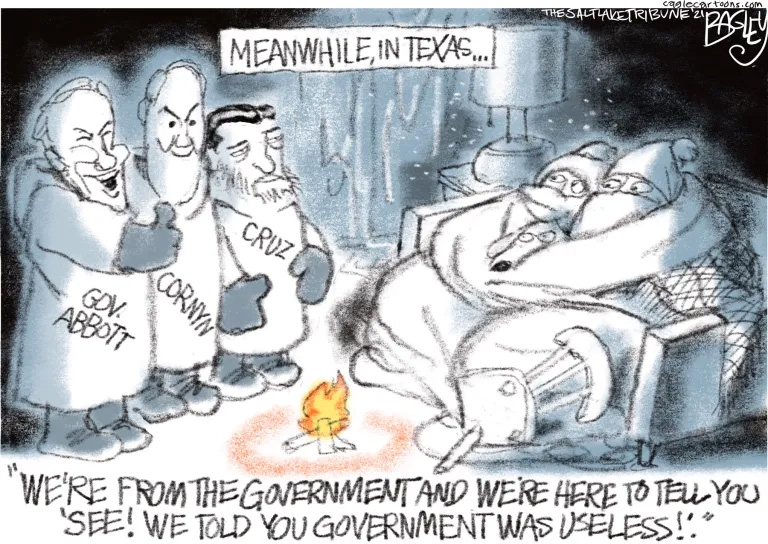
Texas lawmakers are trying to find someone to blame. Republicans are trying to blame Democrats but that will be hard to do in a state that is run by the GOP. More likely those five board members from outside Texas will be the fall guys for mismanagement.
 Coast Contact