An Independent view of law, politics and social issues confronting Angelinos, Californians, and Americans
Author: coastcontact
I am a somewhat cranky but mostly optimistic 65 plus who refuses to give up on this maddening world. The purpose of this BLOG is to express my feelings, thoughts.
HOLLYWOOD has produced plenty of films about underdogs rising to claim the limelight. Now Los Angeles is experiencing its own real-life Cinderella story, as the area’s technology scene has been transformed from backwater to boomtown in just a few years. Hordes of venture capitalists from northern California, once long dismissive of their southern neighbour, now regularly commute in search of deals in a less heavily hunted spot than the Bay Area. In 2016 the city’s startups received around $3bn in funding, around six times more than in 2012, according to CB Insights, a research firm.
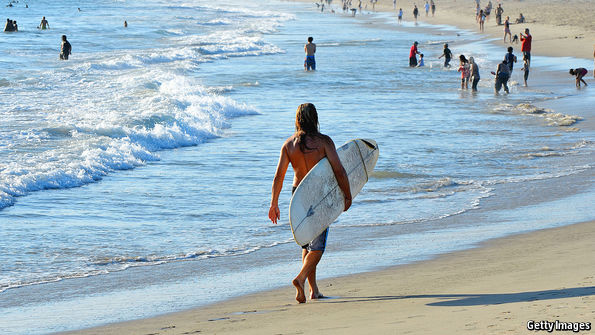
Evan Spiegel went to Stanford University in the heart of Silicon Valley, but he wanted to live and work close to the sea. So he based his new company one block from the Pacific in Venice Beach, which is better known in Los Angeles for its silicone-enhanced bodies than the silicon chips that gave the Valley its name. Mr Spiegel’s firm, Snap, is best known for its ephemeral Snapchat social-media messages and is now valued at a whopping $18bn. Other successful technology firms are thriving nearby, including Dollar Shave Club, an e-commerce firm recently sold to Unilever for $1bn; Ring, a “smart” doorbell company, and Riot Games, maker of “League of Legends”, a popular online multiplayer contest.
Los Angeles is now the third-most-prominent outpost for startups in America, after San Francisco and New York. It has several advantages, including good universities, warm weather, a relaxed culture, proximity to San Francisco and much lower costs. Michael Schneider, the boss of Service, a customer-relations startup, reckons he would need to have raised at least 40% more money if based in San Francisco, “just to pay for the same space and people”.
Although Los Angeles has fewer experienced engineers, those that are there tend to be more loyal, not least because there are fewer firms out to poach them. Startups can convince people to move. Ophir Tanz of GumGum, an advertising startup, says he has recruited several employees looking for a more balanced life away from cities like New York and San Francisco.
Los Angeles may at last be getting the attention it deserves. “The original monetisation of the internet was created here, not Silicon Valley,” says Mark Suster, a venture capitalist with Upfront Ventures, referring to pioneers such as Applied Semantics, bought by Google. But for Los Angeles to establish itself as an enduring place for startups, it needs Snapchat to continue to thrive and go public, which could happen as soon as next year.
Would you buy this car? General Motors hopes you will ignore their reliability track record.
I have owned a Buick, Chevrolet, and Oldsmobile. The Buick was the best of the bunch but the interior finish was sloppy. The Oldsmobile engine turned off as I was driving down a freeway at 65 mph (that was frightening).
Motor Trend magazine has announced it choice for Car of the Year Award for 2017. Chevrolet Bolt EV.
This is not GM’s first all electric car. The General Motors EV1 was an electric car produced and leased by General Motors from 1996 to 1999. You could not buy that car. GM believed that electric cars occupied an unprofitable niche of the automobile market, and ended up crushing most of the cars, regardless of protesting customers.
The issue is should you buy a new car, even “Car of the Year”, in its first year of production?
Consumer Reports has a list of cautions in buying a new car including this. “Wait a Year or Two Before Buying a New or Redesigned Model. It’s true that a few brands, like Lexus and Toyota, have lines that are consistently reliable, but even they can launch a few clunkers. The redesigned Tacoma pickup was unreliable in its first year, and it took three years after being redesigned for the Ford Escape to improve to average reliability. It can take years for an automaker to work out the kinks. When a car model is brand new or “completely redesigned,” that can mean new parts, new systems—and new problems.”
Another thing to do is look at the history of Car of the Year selections.
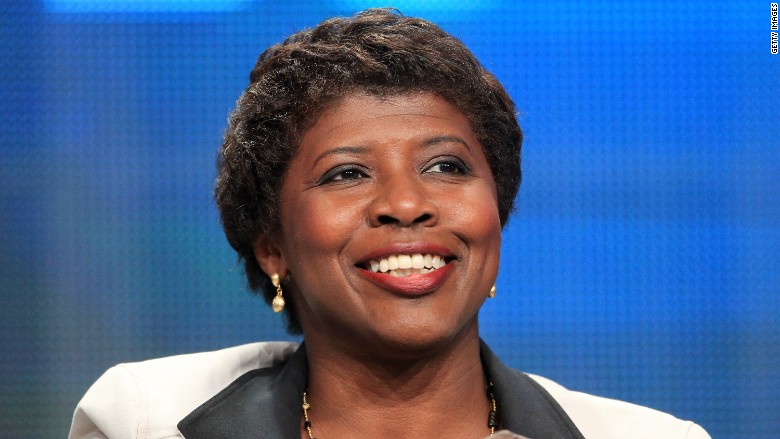
Gwen Ifill, the veteran journalist and newscaster who co-anchored “PBS NewsHour,” has died, PBS said Monday.
Ifill, 61, broke gender and racial barriers and became a role model for journalists across the country. She had been battling endometrial cancer while covering this year’s presidential election.
PBS said in a statement that she died Monday “surrounded by family and friends.”
“Gwen was one of America’s leading lights in journalism and a fundamental reason public media is considered a trusted window on the world by audiences across the nation,” Paula Kerger, the PBS president and CEO, said.
“She often said that her job was to bring light rather than heat to issues of importance to our society,” Kerger said.
During a press conference on Monday, President Obama described Ifill as “an extraordinary journalist” who “always kept faith with the fundamental responsibilities of her profession, asking tough questions, holding people in power accountable, and defending a strong and free press that makes our democracy work.”
Ifill, who worked at The Washington Post, The New York Times and NBC News, became moderator of PBS’s “Washington Week in Review” in 1999. She was tapped to be the co-anchor of the “NewsHour” in 2013. Ifill and co-anchor Judy Woodruff were the first women to jointly lead a national nightly news broadcast.
Ifill also moderated the 2004 and 2008 vice-presidential debates, as well as a 2016 Democratic primary debate.
“Whether she reported from the convention floor or from the field, whether she sat at the debate moderator’s table or the anchor’s desk, she not only informed today’s citizens, she also inspired tomorrow’s journalists,” Obama said. “She was an especially powerful role model for young women and girls who admired her integrity, her tenacity and her intellect, and for whom she blazed a trail as one half of the first all-female network anchor team on network news.”
“I think we’re all diminished without Gwen,” CNN’s Gloria Borger, a longtime friend of Ifill’s, said after the news of Ifill’s passing was announced.
Borger recalled that Ifill’s “preparation for those debates was stunning.”
“She was such a role model for me, and for so many people,” CNN’s Nia-Malika Henderson said.
“We all loved her,” CNN’s Jamie Gangel said, remembering Ifill as smart, funny and fearless.
Ifill was a pioneer for women and for African Americans in journalism, becoming the first African American woman to host a major political talk show when she took the helm at “Washington Week in Review.”
Her path to prominence was hard-fought: While in college in the late 1970s, Ifill secured an internship at The Boston Herald.
“They didn’t know what a college-educated black woman was and they didn’t know how to treat me,” she once told The Washington Post. One day, she told the Post, a staffer left her a note in the photo lab that said “Nigger go home.” The editors were so apologetic about the issue that they hired Ifill after her 1977 graduation, she recalled.
I am not happy as I did support Hillary Clinton. However I did not support her because she had anything worthwhile to offer. She was “the lesser of two evils” in my opinion. Trump won because he promised change. That was the Obama promise too. We all know how that turned out. Millions of people believed that Mrs. Clinton was just a continuation of the same gridlock that has kept the same bunch of elected people in office (and that includes Republicans and Democrats). It’s unlikely Trump will be successful but the public keeps hoping.
Charles Krauthammer in his November 11, 2016 column mostly wrote about how a Republican congress can now cancel Obamacare, end Dodd Frank consumer protection, and impose their solutions for illegal immigration. One point he made does make sense: “Trump spoke to and for a working class squeezed and ruined by rapid technological and economic transformation.” While Krauthammer was correct in that analysis his solutions make no sense.
The greater question for me is what will Donald Trump actually do as president? His history of remarks and promises is full of contradictions. Many of those contradictory statements have been played on CNN and elsewhere. A good example is in 1999, when Trump forcefully argued for universal health care, telling CNN’s Larry King, “If you can’t take care of your sick in the country, forget it, it’s all over. I mean, it’s no good. So I’m very liberal when it comes to health care. I believe in universal health care. I believe in whatever it takes to make people well and better.”
The world has changed dramatically over the last two decades. Donald Trump cannot roll back the impact of globalization. Our congress is filled with people with an average age of Members of the House at the beginning of the 114th Congress of 57.0 years; of Senators, 61.0 years. These are a bunch of older people many of whom do not understand the changing world. This is not the group likely to lead this nation in a rapidly changing technology world.
Sadly, we are likely to see an America in decline. Tell me I am wrong and why.
The above map shows the national results of the November 8 2016 election by county. It is obvious that the most populace parts of California voted for Hillary Clinton. 54% of the voters chose Mrs. Clinton. 30% Chose Donald Trump.
California holds significantly different views of the world from most of the United States. Immigration and the environment are the two really big differences. Donald Trump by his own words does not believe there is any climate change and he intends to deport millions of “illegal aliens.” He says immigrants will be subject to ‘extreme vetting.‘ Trump intends to end Obama Care. All of these views are diametrically opposite of those held by most Californians.
“If Trump wins,” venture capitalist Shervin Pishevar wrote, “I am announcing and funding a legitimate campaign for California to become its own nation.” That was reported in the Los Angeles Daily News.
California is approximately 38% Latino and 38% White. The rest of the state is a mix of Black, Asian, and other groups. Clearly this is not a White state.
California has more millionaires with over $1million to invest than any other state.
Compared to countries California’s economy ranks 6th in the world.
40% of America’s imports arrive through the ports of Los Angeles/Long Beach.
http://www.yescalifornia.org/ In the Spring of 2019, Californians will go to the polls in a historic vote to decide by referendum if California should exit the Union, a #Calexit vote.
You will have this historic opportunity because the Yes California Independence Campaign will qualify a citizen’s initiative for the 2018 ballot that if passed would call for a special election for Californians to vote for or against the independence of California from the United States.
Yes California is the nonviolent campaign to establish the country of California using any and all legal and constitutional means to do so. We advocate for peaceful secession from the United States by use of an independence referendum to establish a mandate, followed by a nationwide campaign to advocate in support of a constitutional exit from the Union.
This would be a VERY BIG step. It is worth thinking about.
The United States democratically elects its president and the majority has spoken through the ballot box. The losers must accept the will of the majority.
I am deeply disappointed with the results. Donald Trump is the poster child for hate, misogyny, and discrimination. His election tells me more about America than about him.
I fear for the fate of minorities and the handicapped in this nation under a Trump presidency. I have personally experienced discrimination and sympathize with all who have had to live in a world of hate.
I see Adolph Hitler in the words of Donald Trump. Asians, Jews, Latinos and Muslims are the likely targets of a President Trump.
A rebellion is unlikely. A massive emigration of minorities from the United States is a possible outcome. Certainly the entry of minority peoples to America will be significantly smaller than in previous years.
My likely new home will be Canada – if they will take me.
Donald Trump’s closing argument in tomorrow’selection: “The U.S. is ‘the laughingstock of the world.’ Trump is absolutely wrong.
The United States is the envy of the World.
The United States has a more millionaires (over 8 million) than any other country in the world. Second place is China with 2 million.
The United States has the universities that are the most desired schools to obtain a higher education.
Latin American nations have all tried to emulate the United States form of government. Most Europeans learn English in the hope that they will have a better opportunity to visit a stay in the United States. Most country leaders, including dictators, call themselves “president” in the hope of convincing their populace that they were selected by them and that they are legitimate leaders.
The rest of the world looks to the United States to help with their challenges caused by floods, earthquakes, tornados, and other natural disasters. The United States is known as the country that tries to help in every way.
United States government always do the right thing? No! But this country tries to help the least fortunate.
Inside this country there is a large gap between the very rich and the very poor. The middle class is struggling. Education and health care are issues that are in need of major attention. Infrastructure has deteriorated substantially. We do have free and fair elections that provide the representatives to address those problems.
Wherever you travel in this world you see McDonald’s, Starbucks, and Kentucky Fried Chicken stores. American music and movies are emulated throughout the world. Do you suppose the people of other countries laugh at what has been built here or do they have some envy?
Finally consider that the U.S. immigrant population stood at more than 42.4 million, or 13.3 percent, of the total U.S. population of 318.9 million in 2014, according to ACS data. Between 2013 and 2014, the foreign-born population increased by 1 million, or 2.5 percent.
Does this sound like a country that is “the laughingstock of the world?”
Many have theorized that Christopher Columbus was a Jew. The basis for that is the fact that the Spanish Inquisition was in process in 1492. The theory goes that Columbus and his crew were Jews escaping the Inquisition. There is no proof to support that idea. The following article may be factual or not. My daughter does have a Jewish friend whose family did emigrate from Jamaica to the United States.
Some Jews turned to piracy as a way to fight against Spain and Portugal, the hosts of the brutal Inquisition.
Jewish pirates? It’s not a joke. Turns out, some of the most well-known and respected buccaneers in previous centuries were Jews. These captains were not the dreaded pirates of popular imagination; many worked in the employ of Britain, the Netherlands, and other maritime powers, protecting those nations’ coasts and seas.
While many of the details of these captains’ lives are mysterious, historians have pieced together some details of their lives, giving us a glimpse into the little-known world of Jewish pirates. Here are eight interesting facts about Jews and piracy.
Abraham Henriques Cohen and the World’s Biggest Heist
Abraham Henriques Cohen started life as a secret Jew living under the Inquisition in his native Portugal. One of the most prominent merchants in Lisbon, he was discovered to be a practicing Jew in 1605 and publicly tortured, along with 150 other hidden Jews. This experience apparently led Cohen to decide to work against Spain and Portugal, the hosts of the brutal Inquisition.
After escaping to Amsterdam, Cohen seemingly became a secret agent for the Dutch navy, and made his way to the New World, settling in Jamaica, which was then a haven for Jews. He worked on behalf of the Netherlands to attack Spanish ships and frustrate Spain’s colonial designs in the New World.
Cohen teamed up with one of the most feared pirates of the time, Sir Henry Morgan, with the tacit backing of both the Dutch and British governments. In 1628, along with Dutch folk hero Admiral Piet Pieterszoon Hein, Cohen captured a Spanish treasure fleet off the coast of Cuba. The ships were carrying gold and silver worth 11,509,524 guilders, around $1 billion today. It was the largest theft in the history of the Spanish fleet.
Cohen gave up piracy in old age when Sir Henry Morgan became Lieutenant Governor of Jamaica, and pardoned his longtime friend. The two lived out their days in Jamaica, their pirate ways behind them for good.
Jean Laffite, War Hero and Pirate
One of the most fabled and swashbuckling pirates of all time, Jean Laffite, was born in France in about 1780. He later wrote that his grandparents were Jews who were tortured by the Inquisition. This sparked a lifelong disdain for Spain in young Jean, and inspired him to turn to piracy to attack Spanish holdings in the New World where the Inquisition held sway.
Moving to the French colony of New Orleans, Jean Laffite and his brother Pierre founded a blacksmith shop, but they had a second secret profession as well: they held commissions from the Republic of Cartagena (in modern day Colombia) to intercept Spanish boats. They carried on this secret activity from a secluded colony in Barataria Bay, off the coast of New Orleans.
During the War of 1812, Laffite warned American troops of British invasion plans. He offered the help of his pirate gang to Gen. Andrew Jackson in the defense of New Orleans in exchange for a pardon for their pirate activities. Gen. Jackson agreed and Laffite’s gang fought with distinction. Jackson later called Laffite “one of the ablest men” of the Battle of New Orleans.
A few years later, in 1817, Laffite once again turned to piracy, taking nearly a thousand followers with him to the site of present-day Galveston, Texas. Until his death in about 1825, Jean Laffite remained one of the most feared pirates of the “Spanish Main,” the eastern coast of Spain’s holdings in the New World.
“Brotherhood of the Black Flag” and Buried Treasure
Sudel Deul, a 16th Century Jewish physician, was an early explorer of the Americas and is credited with introducing the potato to Europeans. His son Subatol found fame in a very different route: becoming one of the most feared pirates in the world.
Subatol formed an alliance with another son of a famous explorer who’d also turned to piracy: Henry Drake, son of the great British explorer Sir Francis Drake. Together the two buccaneers formed the “Brotherhood of the Black Flag”, leading a band of pirates in attacking Spanish ships off the coast of present-day Chile. It is said that the duo buried 6,000 pounds of Spanish gold and an even greater amount of silver near the Guayacan harbor in present-day Chile. No one has found the buried treasure yet, though seekers have discovered documents written partly in Hebrew, possibly written by Subatol.
Pirate Gravestones in a Jewish Cemetery
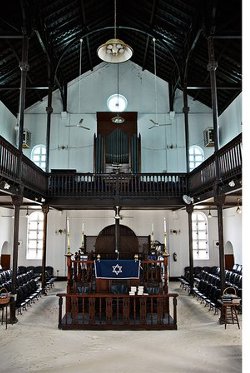
jamaicas-sole-synagogue
The island nation of Jamaica was once crawling with pirates; it seems that some of these were Jews. Seven gravestones in the old Hunt’s Bay Cemetery in Kingston bear unusual markings above Hebrew writing can be seen the familiar skull and crossbones of the pirate insignia. Similarly marked graves have also been found in Bridgeport, in the Bahamas, and in the old Jewish cemetery of Curacao.
Those buried in Hunts Bay were carried across the Cagway Bay from Port Royal, once called the Wickedest City in the World. These seven Jewish denizens might have helped contribute to that fearsome reputation with their pirate activities.
The Pirate Rabbi
Although Samuel Pallache trained as a rabbi in the late 1500s in Fez, Morocco, he preferred the seafaring life, eventually working as a privateer for both the Dutch government and for the Sultan of Barbary, in Morocco. Pallache negotiated one of the very first treaties between European and Middle Eastern nations: the 1610 agreement guaranteeing peace between the Netherlands and Morocco.
In 1614, Morocco and Spain were at war, and Pallache led a small Moroccan fleet that captured Spanish ships. Arrested by the Spanish ambassador, Pallache was tried for piracy. A letter to Dudley Carleton, British ambassador to Venice at the time, described the dashing Jewish buccaneer: “Here is a Jew Pirate arrested that brought three prizes of Spaniards into Plymouth . . . he shall likely pass out of here well enough for he has league and license under the King’s hand for his free egress and regress which was not believed until he made proof of it.”
Indeed, Pallache was eventually acquitted of piracy and set free. When he died in 1616, he was given a hero’s funeral. Every member of Amsterdam’s Jewish community marched in his funeral procession and they were joined by city elders and Prince Maurice of Nassau.
The “Great Jew”
Sinan Reis and his family fled the Spanish Inquisition in the early 1500s, settling in the city of Smyrna, in what is today Izmir, Turkey. There, Sinan became the right-hand man of one of the most famed pirates of all time, Hayreddin Barbarossa, who eventually became a sultan and commander in the Ottoman navy. The two sailed under a flag bearing a six-sided star, much like the Jewish Star of David.
The pair’s greatest victory came in 1538, in the Battle of Preveza, off the coast of Greece, when Ottoman forces led by Reis and Barbarossa defeated a flotilla of armed ships from Christian countries assembled by Pope Paul III, ensuring Ottoman dominance on the Mediterranean for generations to come. Sinan’s great bravery in that battle earned him the sobriquet “The Great Jew” from his Spanish enemies. The Ottoman Empire rewarded him by appointing him Supreme Naval Commander.
At the end of his life, Barbarossa dictated his memoirs to Sinan Reis, who created five hand-written volumes that are exhibited today in the Topkapi Palace in Istanbul and in the Istanbul University Library.
Israel Connections in the Caribbean
The Jewish homeland was never far from the thoughts of some Jewish seafarers. Yaakov Koriel worked as a buccaneer in the Caribbean in the early 1600s, until he changed his ways, moved to Israel, and studied Torah and Kabbalah in the Israeli city of Safed. He’d buried in that city, near the grave of his the famous Rabbi Isaac Luria, whose works he studied.
Another Jewish seafarer in the Caribbean, David Abrabanel, shared his name with a famous rabbi, Isaac Abrabanel. After his family was murdered in South America in the early 1700s, David adopted the nickname “Captain Davis” and sailed with British privateers. He eventually commanded his own ship, which he named The Jerusalem.
Israelis Fighting Pirates Today
The days of Jewish pirates on the high seas is over. Today instead, Israeli security teams are world leaders in opposing piracy and protecting cargo and passenger ships from modern-day pirates.
One such Israeli anti-piracy company, Mano International Security, gained international attention in 2009, when its Israeli guards fought off a daring attempt by Somali pirates to take over the Italian cruise ship Melody, which was sailing within a few hundred miles of the pirate-infested coast of Somalia with 1,500 passengers and crew on board. According to ship captain Ciro Pinto, Israeli guards fired shots over the heads of the bandits, eventually scaring them off.
“It was the first time we have encountered resistance” one of the Somali pirates was quoted as saying after the attack. “The guys acted exactly according to the regulations and I’m proud of them” Mano Nik, the company owner said.
The following letter appeared in today’s Los Angeles Daily News. It reflects my opinion.
Media are just reporting the truth about Trump
Of all the irrational attacks by Donald Trump supporters on the Daily News Opinion page, the most ridiculous is that the media supports Hillary Clinton.
From the beginning, Trump has treated the selection of president of the United States as a reality show in which he makes the rules. He has mocked the people and the processes of democracy with name-calling, unproven allegations (“birther” slurs against the only black president, among others), threats that he’ll use the office for payback against his opponent and anyone else who has stood up to him, and the accusation that the voting process is a fraud if he doesn’t win.
He has created a new uncivil war in a country that has aspired to be “one nation, indivisible.” He has truly made America hate again. If the media reports on his activities truthfully, he calls foul and threatens them.
The only media that could possibly report him as he is are the National Enquirer, the Star and the Globe. The rest are constrained to reporting factually the nearly $1 billion income claimed loss to avoid taxes, the sexist and racist comments and charges, the bankruptcies, the fraudulent “university.”
Reporting the truth is also an American way, Mr. Trump.
The Chicago Cubs are World Series champions at long last, winning their first Fall Classic in 108 years, defeating the Cleveland Indians in 10 innings 8-7 in Game 7 at Progressive Field in Cleveland.
What added to the anticipation was a rain delay before the 10th inning could start.
That last inning was just as dramatic as the rest of the game. The Cubs made two runs thanks to the Indians fatal decision to walk two batters. The top of the inning ended with the bases were loaded. The pitcher collapses allowing one run and two men on base. Another pitcher comes in and the batter hits a grounder to the short stop, and the throw to first base gives the Cubs the last out and a wonderful and well deserved World Series win.






 Coast Contact