An Independent view of law, politics and social issues confronting Angelinos, Californians, and Americans
Author: coastcontact
I am a somewhat cranky but mostly optimistic 65 plus who refuses to give up on this maddening world. The purpose of this BLOG is to express my feelings, thoughts.
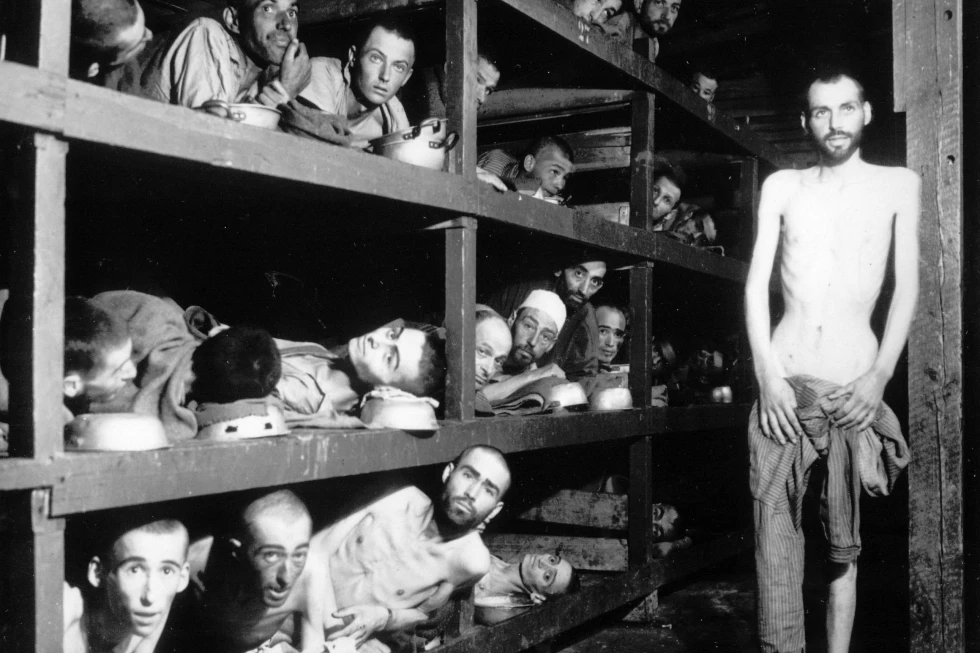
On April 11, 1945, during World War II, U.S. Army troops liberated the Nazi concentration camp Buchenwald near Weimar, Germany.
This April 16, 1945 photo shows inmates of the German KZ Buchenwald inside their barrack, a few days after U.S troops liberated this concentration camp near Weimar. The young man seventh from left in the middle row bunk is Elie Wiesel, who would later become an author and Nobel Peace Prize laureate. (AP Photo)
“Trump’s ‘will he, won’t he’ tariff chaos is just one more con on working people.”
That’s what Melinda St. Louis, Global Trade Watch director at the watchdog group Public Citizen, said in a Wednesday statement after U.S. President Donald Trumpannounced a 90-pause for what he has called “reciprocal” tariffs, excluding China.
It seems Donald Trump wants a recession. Why? A recession will drive down the price of real estate, companies, and shares of stock. Trump and his fellow billionaires want o buy everything on the cheap and then enjoy the ride upward-no matter the cost to working people.
“OUR PLAN IS WORKING PERFECTLY AND IS JUST A NEGOTIATING TACTIC BUT IT IS ALSO GOING TO BE PERMANENT AND WE WILL BE THE WORLD LEADER IN TEXTILES AND NOW THERE IS A PAUSE AND EVERYONE NEEDS TO CHILL BUT ALSO WE WILL NEVER BACK DOWN AAAAAAHHHHHH.”
• Trade negotiations: Trump just defended his tariff policy in a Cabinet meeting, saying his administration is “working on deals” with multiple countries. Earlier today, the EU announced it would pause its retaliatory US tariffs for negotiations. Even after Trump’s U-turn, economists say the damage is done.
DOW down 1,835.94, S&P 500 down 281.5 5.5% mid-day April 10,2025
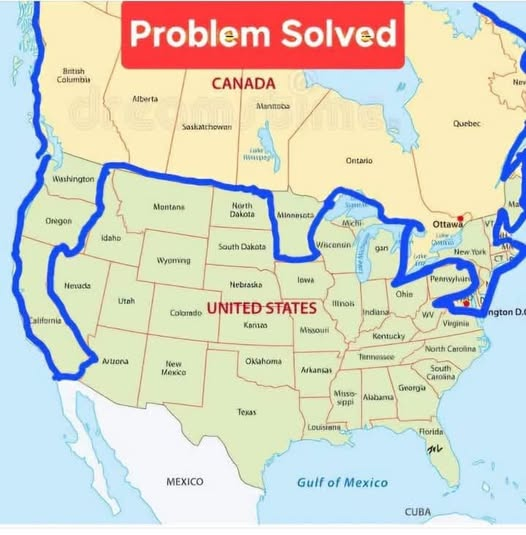
Since his reelection in November, Trump has upended the typically friendly relationship between the U.S. and its northern neighbor. He has mocked Canada by calling it America’s “51st state” and repeatedly referred to former Prime Minister Justin Trudeau as “governor.” And he has threatened to use “economic force” to annex the country, whose population of 40 million is about the same as California’s.
Trump in February invoked emergency powers to justify stiff new tariffs on Canadian imports, arguing in an executive order that the trafficking of illegal drugs — namely, fentanyl — across the northern border constituted a dire threat to American security.
After Trump’s separate 25% tariff on imported automobiles went into effect last week, Canadian Prime Minister Mark Carney, who called the levies a “direct attack” on his country, slapped a 25% retaliatory levy on vehicles imported from the United States.
In Palm Springs, the snowbirds who were already here before Trump took office are leaving for the season. The question is: Will they return?
Two Canadian airlines this spring ended their seasonal service to and from Palm Springs International Airport earlier than initially planned, airport spokesman Jake Ingrassia said in a statement to The Times.
“Flair Airlines and WestJet have slightly shortened their seasonal service to Vancouver and Winnipeg, respectively,” Ingrassia said. “The airlines have advised the airport that these adjustments are in response to the current operating environment and shifts in demand.”
Kenny Cassady, director of business development for Acme House Co., which manages vacation rental properties in Palm Springs, said Canadians often book stays of one to three months a full year in advance, returning to the same properties annually.
“But when it comes to rebooking for next year? They’re just declining,” said Cassady, who also is a board member for Visit Greater Palm Springs, a tourism marketing agency for the Coachella Valley.
US stocks opened on a grim note in New York, with the Morningstar US Market Index down as much as 3.6% in early trading. Stocks were briefly more than 2% in the green, seemingly on rumors of a pause in the implementation of tariffs, but they quickly fell lower again.
The Nasdaq 100 was 1.8% lower in midmorning trading, while the S&P 500 was down 2.0%. The “Magnificent Seven” stocks continued their declines from the previous week, with Nvidia NVDA down 1.9%, Tesla TSLA down 6%, and Apple AAPL down 4.5%.
CNN‘s black sheep and resident MAGA supporter, Scott Jennings, had a hilarious reaction to President Trump’s recent tariffs that sunk the stock market.
Jennings, a frequent conservative contributor on the network, joined anchor John Berman on Friday’s broadcast of CNN News Central with Meghan Hays, a Democratic strategist, to sound off on the impact of Trump’s tariffs.
At the end of the segment, the stock market ticker was displayed on the screen near Jennings, who hid under the table in an effort to escape it.
Berman jokingly apologized to Jennings for having the stock market ticker in front of him on screen.
‘Why didn’t you put it by Meghan? Can we just shove it to the other side of the screen? I don’t understand. I feel like you did this on purpose,’ Jennings joked.
One thing we do know is that people thinking about buying a car or large appliances are shopping now before the prices go up.
Berman coyly responded that moving the ticker to the other side of the screen won’t change the problem for Republicans.
When the camera panned out, the ticker was still positioned near Jennings and Berman joked that it was ‘following’ him.
‘Literally! Let me just get down here,’ Jennings responded as he hid under the table to escape the plummeting stock market.
—
One thing we do know is that people contemplating a car purchase or a large appliance purchase are shopping to complete that purchase this weekend.
Financial markets around the world are reeling Thursday following President Donald Trump’s latest and most severe set of tariffs, and the U.S. stock market is taking the worst of it so far.
The S&P 500 was down 4% in midday trading, more than other major stock markets, and at its bottom in the morning was on track for its worst day since COVID struck in 2020. The Dow Jones Industrial Average was down 1,412 points, or 3.3%, as of 11:50 a.m. Eastern time, and the Nasdaq composite was 5.1% lower.
In President Donald Trump’s first term, apparel and footwear makers shifted manufacturing out of China to avoid tariffs. Now they’re being pummeled as Trump targets the same nations they moved to.
A tariff of 46% on goods from Vietnam is particularly painful for companies such as Nike Inc., Adidas AG and Lululemon Athletica Inc., which produce significant amounts of merchandise in the country. Levies of 49% on Cambodia and more than 30% on Indonesia and Thailand are also problematic. Trump says the tariffs will push companies to relocate manufacturing to the US.
America’s biggest trading partners promised retaliation for President Donald Trump’s massive tariff announcement. The first major response has come in — from Canada.
Canadian Prime Minister Mark Carney said that Canada will levy a 25% counter-tariff on vehicles imported from the United States that are not compliant with the United States-Mexico-Canada Agreement (USMCA) in response to US tariffs on Canadian vehicles and auto parts that went into effect today.
“As I told President Trump during our call last week, Canada will respond to the US auto tariffs, and today, I’m announcing that the Government of Canada will be responding by matching the US approach with 25% tariffs on all vehicles imported from the United States that are not compliant with CUSMA, our North American Free Trade Agreement,” Carney told reporters in Ottawa, using the Canadian acronym for the USMCA.
The prime minister said there were no talks scheduled between him and Trump, but he would talk to the US president again “if appropriate.” Carney also said Canada’s counter-tariffs would not affect auto parts.
Though Carney said Canada still considers the US an ally in defense and security, his country “must be looking elsewhere to expand our trade, to build our economy and to protect our sovereignty.”
Where will all this end? Look for a World Wide RECESSION.
“NPR and PBS, two horrible and completely biased platforms (Networks!), should be DEFUNDED by Congress, IMMEDIATELY,” Trump wrote late Wednesday on Truth Social. “Republicans, don’t miss this opportunity to rid our Country of this giant SCAM, both being arms of the Radical Left Democrat Party. JUST SAY NO AND, MAKE AMERICA GREAT AGAIN!!!”
Example Two:
Students at public colleges and universities are protected by the First Amendment freedoms of religion, speech, press, assembly and petition. Private schools do not have that protection.
Columbia University, officially Columbia University in the City of New York, is a private Ivy League research university in New York City.
On 8 March, Immigration and Customs Enforcement (Ice) agents arrestedMahmoud Khalil, a graduate student at Columbia University, as he was returning from dinner with his wife in New York. The agents said the state department had revoked his student visa and green card, though he had never been accused of, let alone convicted for, a crime. He was held in detention in New Jersey, then transferred to Louisiana. He has still not been accused a crime.
Nevertheless, Donald Trump’s state department, headed by Marco Rubio, seeks to deport him under a provision of federallaw that gives him the power to deport someone if their presence in the country is deemed to “have potentially serious adverse foreign policy consequences for the United States”. Khalil’s crime? He was a lead organizer of Columbia’s protests for Palestinian rights.
“Who has the right to have rights? It is certainly not the humans crowded into the cells here,” Khalil, a Palestinian raised in exile in a Syrian refugee camp, wrote in a letter proclaiming his status as a “political prisoner”. He is the one of the most prominent targets of a chilling federal crackdown over pro-Palestinian advocacy in the US, particularly on college campuses. And he is one of the most forceful voices in The Encampments, a new documentary on the campus movement for Palestine that has drawn ire from across the US political spectrum, in particular the right.
Example Three:
The nation’s legal profession is being split between those that want to fight back against President Trump’s attacks on the industry and those that prefer to engage in the art of the deal.
Two big firms sued the Trump administration on Friday, seeking to stop executive orders that could impair their ability to represent clients. The lawsuits filed by Jenner & Block and WilmerHale highlight how some elite firms are willing to fight Mr. Trump’s campaign targeting those he doesn’t like, while others, like Paul Weiss and Skadden, have cut deals to appease the president.
In recent weeks, Mr. Trump has issued similarly styled executive orders against firms that he perceives as enemies and threats to national security. The orders could create an existential crisis for firms because they would strip lawyers of security clearances, bar them from entering federal buildings and discourage federal officials from interacting with the firms.
Here Are the Attack Plans That Trump’s Advisers Shared on Signal
The administration has downplayed the importance of the text messages inadvertently sent to The Atlantic’s editor in chief. By Jeffrey Goldberg and Shane Harris
So, about that Signal chat.
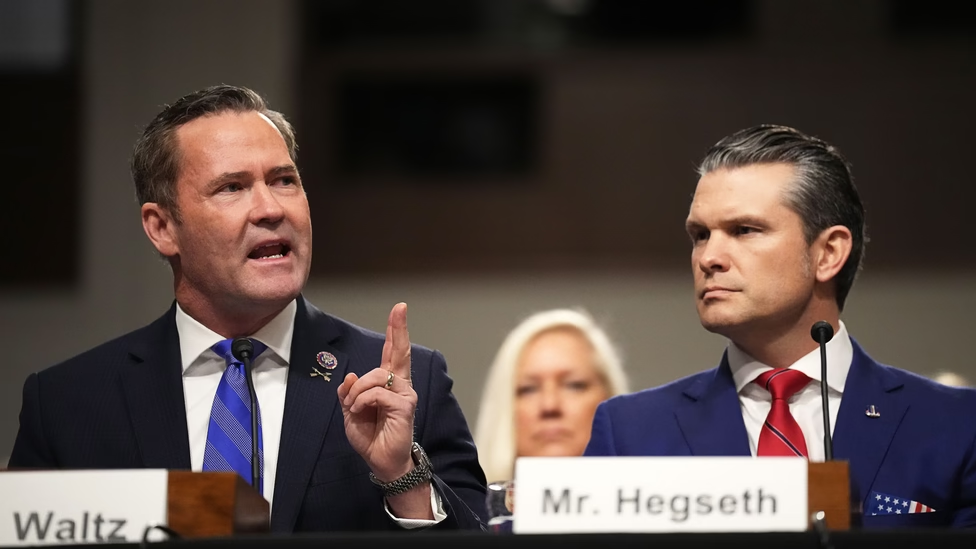
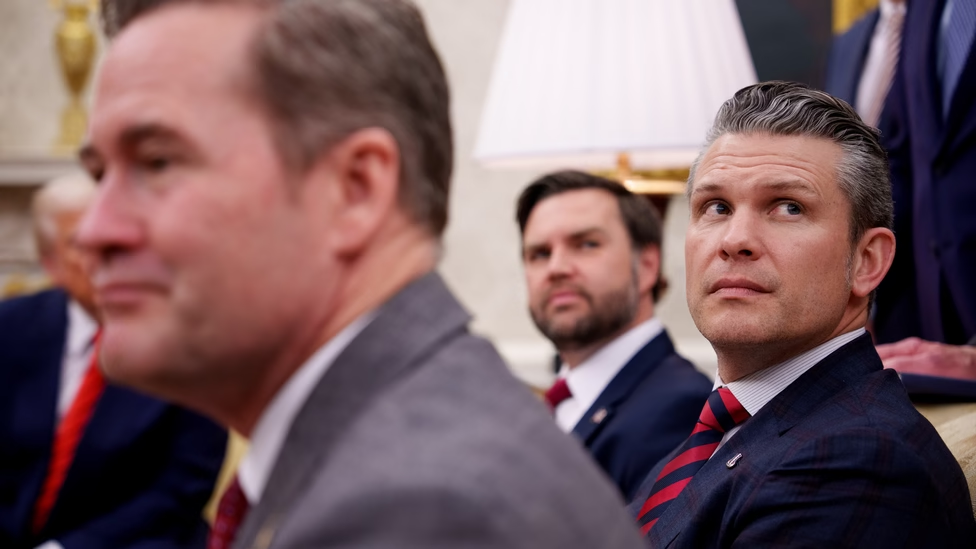
On Monday, shortly after we published a story about a massive Trump-administration security breach, a reporter asked the secretary of defense, Pete Hegseth, why he had shared plans about a forthcoming attack on Yemen on the Signal messaging app. He answered, “Nobody was texting war plans. And that’s all I have to say about that.”
At a Senate hearing yesterday, the director of national intelligence, Tulsi Gabbard, and the director of the Central Intelligence Agency, John Ratcliffe, were both asked about the Signal chat, to which Jeffrey Goldberg, the editor in chief of The Atlantic, was inadvertently invited by National Security Adviser Michael Waltz. “There was no classified material that was shared in that Signal group,” Gabbard told members of the Senate Intelligence Committee.
Ratcliffe said much the same: “My communications, to be clear, in the Signal message group were entirely permissible and lawful and did not include classified information.”
President Donald Trump, asked yesterday afternoon about the same matter, said, “It wasn’t classified information.”
These statements presented us with a dilemma. In The Atlantic’s initial story about the Signal chat—the “Houthi PC small group,” as it was named by Waltz—we withheld specific information related to weapons and to the timing of attacks that we found in certain texts. As a general rule, we do not publish information about military operations if that information could possibly jeopardize the lives of U.S. personnel. That is why we chose to characterize the nature of the information being shared, not specific details about the attacks.
The statements by Hegseth, Gabbard, Ratcliffe, and Trump—combined with the assertions made by numerous administration officials that we are lying about the content of the Signal texts—have led us to believe that people should see the texts in order to reach their own conclusions. There is a clear public interest in disclosing the sort of information that Trump advisers included in nonsecure communications channels, especially because senior administration figures are attempting to downplay the significance of the messages that were shared.
Experts have repeatedly told us that use of a Signal chat for such sensitive discussions poses a threat to national security. As a case in point, Goldberg received information on the attacks two hours before the scheduled start of the bombing of Houthi positions. If this information—particularly the exact times American aircraft were taking off for Yemen—had fallen into the wrong hands in that crucial two-hour period, American pilots and other American personnel could have been exposed to even greater danger than they ordinarily would face. The Trump administration is arguing that the military information contained in these texts was not classified—as it typically would be—although the president has not explained how he reached this conclusion.
Yesterday, we asked officials across the Trump administration if they objected to us publishing the full texts. In emails to the Central Intelligence Agency, the Office of the Director of National Intelligence, the National Security Council, the Department of Defense, and the White House, we wrote, in part: “In light of statements today from multiple administration officials, including before the Senate Intelligence Committee, that the information in the Signal chain about the Houthi strike is not classified, and that it does not contain ‘war plans,’ The Atlantic is considering publishing the entirety of the Signal chain.”
We sent our first request for comment and feedback to national-security officials shortly after noon, and followed up in the evening after most failed to answer.
Late yesterday, White House Press Secretary Karoline Leavitt emailed a response: “As we have repeatedly stated, there was no classified information transmitted in the group chat. However, as the CIA Director and National Security Advisor have both expressed today, that does not mean we encourage the release of the conversation. This was intended to be a an [sic] internal and private deliberation amongst high-level senior staff and sensitive information was discussed. So for those reason [sic] — yes, we object to the release.” (The Leavitt statement did not address which elements of the texts the White House considered sensitive, or how, more than a week after the initial air strikes, their publication could have bearing on national security.)
A CIA spokesperson asked us to withhold the name of John Ratcliffe’s chief of staff, which Ratcliffe had shared in the Signal chain, because CIA intelligence officers are traditionally not publicly identified. Ratcliffe had testified earlier yesterday that the officer is not undercover and said it was “completely appropriate” to share their name in the Signal conversation. We will continue to withhold the name of the officer. Otherwise, the messages are unredacted.
As we wrote on Monday, much of the conversation in the “Houthi PC small group” concerned the timing and rationale of attacks on the Houthis, and contained remarks by Trump-administration officials about the alleged shortcomings of America’s European allies. But on the day of the attack—Saturday, March 15—the discussion veered toward the operational.
Top officials in the Trump administration discussed highly sensitive military planning using an unclassified chat application.
Pete Hegseth, the Secretary Of Defense who according to the Atlantic’s report disclosed to the group how the Yemen strike would take shape before it occurred, forcefully denied any wrongdoing and attacked Goldberg in personal terms — calling him a “deceitful” journalist who “peddles in garbage.”
“Nobody was texting war plans,” Hegseth told reporters after landing in Hawaii late Monday, “and that’s all I have about that.”
The distraction was obvious. Hegseth, according to the Atlantic’s report, responded a short time later that he understood Vance’s concerns and fully supported the vice president raising them with Trump. The defense secretary then added that the “messaging is going to be tough no matter what” because “nobody knows who the Houthis are,” and so those who will announce the operation should aim to convince the American public that “1) Biden failed & 2) Iran funded.” Those were apparent references to the Biden administration not being able to stop Houthi attacks, which the militant group began in response to Israel’s war in the Gaza Strip, and Tehran’s long-standing backing of the group.
The effort was trying to divert your attention after a major screwup. The Keystone Cops are alive and well.



 Coast Contact