Donald Trump Calls George Clooney a ‘Second Rate Movie Star’ After Clooney Calls Out the Government for Trying to ‘Make Journalists Smaller’: ‘They Don’t Like the Press’
Author: coastcontact
I am a somewhat cranky but mostly optimistic 65 plus who refuses to give up on this maddening world. The purpose of this BLOG is to express my feelings, thoughts.
Tyrants
Tyrants view educated citizens as their greatest enemy. Slaveholders stopped the enslaved from learning to read. Nazis burned books. Dictators censor media. That’s why Trump is attacking education, science, museums, and the arts. Ignorance is the handmaiden of tyranny.
Trump consistently frames policy around ‘fairness,’ trading on American frustration
A long article worth reading.
By Kevin Rector, Staff Writer for the Los Angeles Times
In a sit-down interview with Fox News last month, President Trump and his billionaire “efficiency” advisor Elon Musk framed new tariffs on foreign trading partners as a simple matter of fairness.
“I said, ‘Here’s what we’re going to do: reciprocal. Whatever you charge, I’m charging,’” Trump said of a conversation he’d had with Indian Prime Minister Narendra Modi. “I’m doing that with every country.”
“It seems fair,” Musk said.
Trump laughed. “It does,” he said.
“It’s like, fair is fair,” said Musk, the world’s richest person.
The moment was one of many in recent months in which Trump and his allies have framed his policy agenda around the concept of fairness — which experts say is a potent political message at a time when many Americans feel thwarted by inflation, high housing costs and other systemic barriers to getting ahead.
“Trump has a good sense for what will resonate with folks, and I think we all have a deep sense of morality — and so we all recognize the importance of fairness,” said Kurt Gray, a psychology professor at University of North Carolina at Chapel Hill and author of the book “Outraged: Why We Fight About Morality and Politics and How to Find Common Ground.”
“At the end of the day,” Gray said, “we’re always worried about not getting what we deserve.”
In addition to his “Fair and Reciprocal Plan” for tariffs, Trump has cited fairness in his decisions to pull out of the Paris climate agreement, ban transgender athletes from competing in sports, scale back American aid to embattled Ukraine and pardon his supporters who stormed the U.S. Capitol on Jan. 6, 2021.
Trump has invoked fairness in meetings with a host of world leaders, including Japanese Prime Minister Shigeru Ishiba and British Prime Minister Keir Starmer. He has suggested that his crusade to end “diversity, equity and inclusion” programs is all about fairness, couched foreign aid and assistance to undocumented immigrants as unfair to struggling American taxpayers, and attacked the Justice Department, the media and federal judges who have ruled against his administration as harboring unfair biases against him.
Trump and Musk — through his “Department of Government Efficiency,” which is not a U.S. agency — have orchestrated a sweeping attack on the federal workforce largely by framing it as a liberal “deep state” that either works in unfair ways against the best interests of conservative Americans, or doesn’t work at all thanks to lopsided work-from-home allowances.
“It’s unfair to the millions of people in the United States who are, in fact, working hard from job sites and not from their home,” Trump said.
In a Justice Department speech this month, Trump repeatedly complained about the courts treating him and his allies unfairly, and reiterated baseless claims that recent elections have been unfair to him, too.
“We want fairness in the courts. The courts are a big factor. The elections, which were totally rigged, are a big factor,” Trump said. “We have to have honest elections. We have to have borders and we have to have courts and law that’s fair, or we’re not going to have a country.”
Before a meeting with NATO Secretary-General Mark Rutte this month, Trump complained — not for the first time — about European countries not paying their “fair share” to defend Ukraine against Russian aggression, and the U.S. paying too much.
“We were treated very unfairly, as we always are by every country,” Trump said.
Almost exclusively, Trump’s invocations of fairness cast him, his supporters or the U.S. as victims, and his critics and political opponents as the architects and defenders of a decidedly unfair status quo that has persisted for generations. And he has repeatedly used that framework to justify actions that he says are aimed at tearing down that status quo — even if it means breaching norms or bucking the law.
Trump has suggested that unfavorable media coverage of him is unfair and therefore “illegal,” and that judges who rule against him are unfair liberal activists who should be impeached.
The politics of feeling heard
Of course, grievance politics are not new — nor is the importance of “fairness” in democratic governance. In 2006, the late Harvard scholar of political behavior Sidney Verba wrote of fairness being important in various political regimes but “especially central in a democracy.”
Verba noted that fairness comes in different forms — including equal rights under the law, equal voice in the political sphere, and policies that result in equal outcomes for people. But the perception of fairness in a political system, he wrote, often comes down to whether people feel heard.
“Democracies are sounder when the reason why some lose does not rest on the fact that they are invisible to those who make decisions,” Verba wrote. “Equal treatment may be unattainable, but equal consideration is a goal worth striving for.”
According to several experts, Trump’s appeal is in part based on his ability to make average people feel heard, regardless of whether his policies actually speak to their needs.
Gray said there is “distributive fairness,” which asks, “Are you getting as much as you deserve?” and “procedural fairness,” which asks, “Are things being decided in a fair way? Did you get voice? Did you get input?”
One of Trump’s skills, Gray said, is using people’s inherent sense that there is a lack of distributive fairness in the country to justify policies that have little to do with such inequities, and to undermine processes that are in place to ensure procedural fairness, such as judicial review, but aren’t producing the outcomes he personally desires.
“What Trump does a good job at is blurring the line between rules you can follow or shouldn’t follow,” he said. “When he disobeys the rules and gets called out, he goes, ‘Well those moral rules are unjust.’”
People who voted for Trump and have legitimate feelings that things are unfair then give him the benefit of the doubt, Gray said, because he appears to be speaking their language — and on their behalf.
“He’s not just saying that it’s him. He’s saying it’s on behalf of the people he’s representing, and the people he’s representing do think things are unfair,” Gray said. “They’re not getting enough in their life, and they’re not getting their due.”
Lawrence Rosenthal, chair of the Center for Right-Wing Studies at UC Berkeley and author of “Empire of Resentment: Populism’s Toxic Embrace of Nationalism,” said Trump and his supporters have built him up as a leader “interested in fixing the unfairness to the working class.”
But that idea is premised on another notion, even more central to Trump’s persona, that there are “enemies” out there — Democrats, coastal elites, immigrants — who are the cause of that unfairness, Rosenthal said.
“He names enemies, and he’s very good at that — as all right-wing authoritarians are,” Rosenthal said.
Such politics are based on a concept known as “replacement theory,” which tells people to fear others because there are only so many resources to go around, Rosenthal said. The theory dovetails with the argument Trump often makes, that undocumented immigrants receiving jobs or benefits is an inherent threat to his MAGA base.
“The sense of dispossession is absolutely fundamental and has been for some time,” Rosenthal said.
John T. Woolley, co-director of the American Presidency Project at UC Santa Barbara, said Trump has “a remarkable capacity for constructing the world in a way that favors him” — even if that’s as the victim — and appears to be an “outlier” among presidents in terms of how often he focuses on fairness as a political motif.
“Certainly since his first term with impeachment, ‘the Russia hoax,’ ‘dishonest media,’ ‘fake news’ and then ‘weaponizing’ of justice — he’s constructed a kind of victim persona, in battle with the deep state, that is now really basic to his interaction with his core MAGA constituency,” Woolley said.
An idea for Democrats
In coming to terms with Trump’s win in November, Democrats have increasingly acknowledged his ability to speak to Americans who feel left behind — and started to pick up on fairness as a motif of their own, in part by zeroing in on mega-billionaire Musk.
In an interview with NPR last month, Rep. Alexandria Ocasio-Cortez (D-N.Y.) evoked the idea of unfairness in the system by saying American government is working for rich people like Musk, but not for everyone else. “Everything feels increasingly like a scam,” she said.
She and Sen. Bernie Sanders (I-Vt.) have since embarked on a nationwide “Fighting Oligarchy” tour, where they have blasted Musk’s role in government and questioned how his actions, or those of Trump, have helped average Americans in the slightest.
“At the end of the day, the top 1% may have enormous wealth and power, but they are just 1%,” Sanders wrote Friday on X. “When the 99% stand together, we can transform our country.”
Buy Canadian movement starts to take a sizable bite out of U.S. business
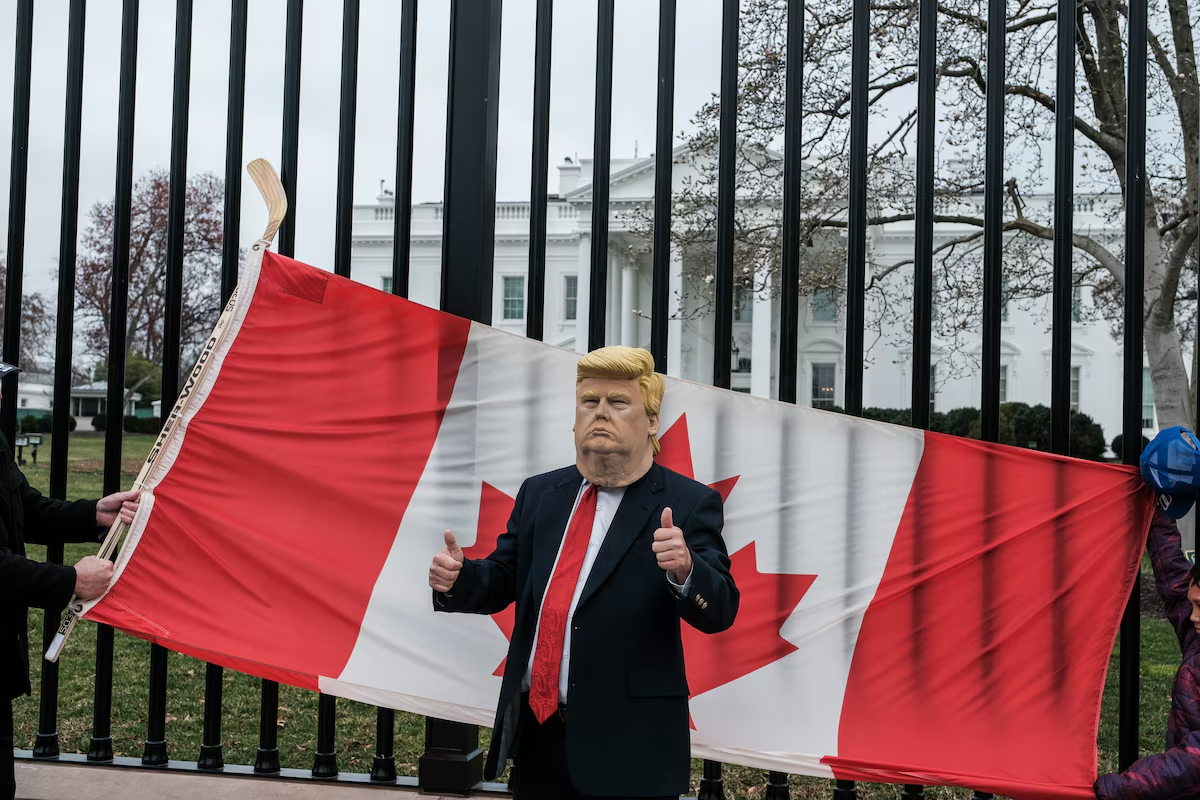
A man dressed as U.S. President Donald Trump poses for a photo near the White House in Washington on March 13. MICHAEL A. MCCOY/The New York Times News Service
The surge in patriotism among Canadian shoppers, fuelled by trade tensions with the United States, is already leaving a sizable mark on American business, early data from a variety of industries suggests.
U.S. tour operators are reporting booking declines of as much as 85 per cent, while American distilleries are losing major deals. Meanwhile, Canadian grocers are posting a bump in domestic product sales of up to 10 per cent.
Donald Trump’s jabs about annexation, along with a 25-per-cent levy on steel and aluminum from Canada and the U.S. President’s threats of a 25-per-cent tariff on most Canadian imports have prompted a rallying cry to “Buy Canadian” across this country.
While consumer boycotts – combined with government policy actions – are causing trouble south of the border, concerns are bubbling up about the toll on Canadian businesses, too.
“To use some of the words I hear from tour company members of the National Tour Association, the drop-off is ‘astronomical’ when speaking about Canadians booking group travel to the United States,” said Catherine Prather, president of the Kentucky-based organization, which specializes in group tours.
The exchange rate and fluctuating trade policies have had a “resounding effect” on Canadians’ travel cancellations, she said. But tour operators shared that the rhetoric about making Canada the 51st state is “perhaps even worse,” and in many cases, has been the “deciding factor” for customers.
Traffic across some major border crossings in tourism states such as New York has dropped by 12 per cent in the first two weeks of February alone, said Corey Fram, director at the Thousand Islands International Tourism Council. He cited data provided to him by the Bridge and Tunnel Operators Association for border crossings on the Thousand Islands Bridge between Alexandria Bay, N.Y., and southeastern Ontario.
Statistics Canada data also show that Canadian automobile trips to the U.S. are plummeting. About 1.2 million return trips were made into Canada by Canadians in February – a 23-per-cent drop from that period a year ago.
The U.S. Travel Association warned in February that even a 10 per cent drop in Canadian visitors would lead to more than $2.1-billion in spending losses and a threat to 14,000 jobs.
The Buy Canadian movement is also hitting the grocery aisles. Per Bank, CEO of Canada’s largest food retailer, Loblaw Cos. Ltd., said in February that the company saw about a 10-per-cent uptick in sales for Canadian products in preceding weeks.
Pierre Cléroux, vice-president of research and chief economist at the Business Development Bank of Canada, told The Globe and Mail that if every Canadian household redirected $25 a week from foreign products to Canadian ones, it would boost GDP by 0.7 per cent and create 60,000 jobs.
According to his modelling, if Canadians also cut international travel by 10 per cent and spent that money domestically, the combined effect would raise GDP by 1 per cent and create 74,000 jobs.
Another U.S. industry reeling from the “Buy Canadian” movement and its manifestation in public policy – including provincial moves to take American booze off the shelves – is American distilling.
Canada is a critical market for U.S. spirits, making up “a little over 31 per cent of all U.S. exports” of distilled spirits in 2024, said Stephen Gould, a Colorado-based alcohol trade consultant at Consulting Alchemist Ltd and former distillery owner.
In addition to bourbon, Canada is a crucial market for U.S. whisky and other spirits as well as wine and beer. Bartenders, waitstaff and retail clerks in the U.S. are among those who will face significant layoffs if trade tensions continue, said Mr. Gould.
“The American industry is suffering,” he said.
Victor Yarbrough, co-founder of Brough Brothers,Kentucky’s first Black-owned distillery, said his company was “deeply disappointed” after losing a lucrative deal to sell its bourbon to New Brunswick Liquor due to trade tensions. The deal was projected to increase company sales by 2.55 per cent in 2025.
“Canada’s a large export market for us,” said Mr. Yarbrough. “Let’s figure out ways to move forward and amicably.”
Abridged article from the Canadian Globe and Mail.
Trump Does Not Have Absolute Power
Did Donald Trump have a face to face meeting with Chief Justice John Roberts or was it a telephone call? Either way Trump was apparently told he does not have absolute power over everything.
The consequence was Trump administration reinstated thousands of probationary federal workers. The Trump administration is making the move after several court orders ruled that the firings were not legal.
The decision reinstates at least 24,500 recently fired probationary workers following a pair of orders from federal judges last week that found the terminations pushed by President Donald Trump were illegal.
The reinstatements, spanning 18 departments, are outlined in a filing Monday by the Department of Justice in federal court in Maryland after a judge asked for a report on efforts to reinstate the employees.
The separate declarations from Trump officials within each of the departments offer the most detailed public account yet of the administration’s firing of recently hired or promoted probationary workers as part of Elon Musk’s Department of Government Efficiency’s push to drastically cut the federal workforce.
Here are the tallies of recently fired probationary workers, by department, the Trump administration says it is working to reinstate:
- Environmental Protection Agency: 419
- Department of Energy: 555
- Department of Commerce: 791
- Department of Homeland Security: 310
- Department of Transportation: 775
- Department of Education: 65
- Department of Housing and Urban Development: 299
- Department of Interior: 1,710
- Department of Labor: 167
- Consumer Financial Protection Bureau: 117
- Small Business Administration: 298
- Federal Deposit Insurance Corp.: 156
- Human Capital and Talen Management: 270
- General Services Administration: 366
- Treasury Department: 7,613 (including 7,315 IRS employees)
- Department of Agriculture: 5,714
- Department of Veterans Affairs: 1,683
- Department of Health and Human Services: 3,248
Conservatives have a 6-3 advantage on the high court and Trump himself nominated three of the current justices. The court has frequently sided with him in major cases, most notably the decision last year to grant former presidents wide immunity from criminal prosecution for their official actions. But in a series of emergency orders since Trump’s return to the White House, the court has preliminarily ruled against him.
At the same time, Trump appeared especially eager to woo Roberts during his joint address to Congress earlier this month.
US green card holders, student visa holders can be deported
Can a green card holder be deported from the United States? The recent arrest of Mahmoud Khalil, a Palestinian activist involved in organising campus protests over the Israel-Hamas conflict at Columbia University in New York City, has raised questions about the protections foreign students and green card holders have against deportation from the US.
A green holder and student visa holders have been given a privilege. They have no rights
A green card holder has lawful permanent resident status, allowing them to live and work in the US indefinitely. However, this status is not absolute, and deportation remains a possibility under certain circumstances.
Rights and responsibilities of green card holders
According to US Citizenship and Immigration Services (USCIS), green card holders have the right to:
< Work in any legal job they qualify for, except some roles restricted to US citizens for security reasons
< Be protected by all US laws, including state and local regulations
They are also subject to specific responsibilities:
< Obey all US and local laws
< File income tax returns and report income to the Internal Revenue Service and state tax authorities
< Support the democratic form of government (without voting in elections)
< Register with the Selective Service if they are male and between 18 and 25 years old
< Work in any legal job they qualify for, except some roles restricted to US citizens for security reasons
< Be protected by all US laws, including state and local regulations
Can green card holders be deported?
Yes, they can.
“Generally, green card holders have the same First Amendment rights as US citizens. Constitutionally protected speech, including peaceful protest, would not normally be grounds for cancelling a green card. Green cards are typically revoked for serious crimes or other obvious violations,” Russell A Stamets, partner at Circle of Counsels told Business Standard.
“While they have strong legal protections, such as the right to a hearing before an immigration judge and the ability to appeal deportation orders, they can still be removed for reasons like aggravated felonies, fraud, national security threats, or abandoning their residency by staying outside the US for too long,” Aurelia Menezes, partner at King Stubb & Kasiva, Advocates and Attorneys, explained to Business Standard.
As protests over the Gaza conflict ignited rancor and division at Columbia University last year, one student stood out for his role as a negotiator representing activists in talks with the school officials who were desperate to achieve peace on campus.
Mahmoud Khalil, 30, emerged as a public face of students opposed to the war, leading demonstrations and granting interviews. He delivered a message that his side viewed as measured and responsible but that has been branded by some, including the Trump administration, as antisemitic.
Mr. Khalil has been involved in demonstrations as recently as January, when four masked demonstrators entered a class on the history of Israel taught by an Israeli professor at Columbia to accuse the school of “normalizing genocide.” Videos of an unmasked Mr. Khalil at a related sit-in were soon circulated on social media among critics of Columbia’s protest movement, with some calling for him to be deported.
Over the weekend, Mr. Khalil was at the center of the news again. He was arrested by federal immigration officials in a drastic escalation of President Trump’s crackdown against what he has called antisemitic campus activity. Mr. Khalil, a permanent resident of the United States, had been living in Columbia’s student housing when he was detained and then transferred to the Central Louisiana ICE Processing Center in Jena, La.
A green card holder and student visa holders have been given a privilege. They have no rights. Deportation for bad behavior by ICE is a consequence of that behavior. Deporting Mr. Khalil and others who are guests in this country is the right thing to do.
Canada and Greenland
Yes, I was born in Canada. My parents moved to the United States when I was 6 months old. As a boy I visited Winnipeg every summer until I was 10 years old to see my grandparents. I have cousins in Winnipeg, Vancouver, and other cities in Canada. I have visited Canada many times as an adult. Toronto and Vancouver are fun places to tour.
That being said, I am concerned about Canada’s future.
It appears Donald Trump is serious about annexing Canada and Greenland. The difference between Donald Trump and Vladimir Putin is that Trump wants to accomplish his goals without a war.
Earlier this month, Canadian Prime Minister Justin Trudeau publicly said of President Donald Trump, “What he wants is to see a total collapse of the Canadian economy because that’ll make it easier to annex us.”
Trudeau’s accusation was extraordinary and unprecedented. Here was the leader of Canada, one of America’s closest and longest-standing allies, accusing the U.S. president of engaging in economic warfare. More and more, however, it seems Trudeau wasn’t making this argument up. The evidence is piling up that Trump has declared economic war on Canada for the express purpose of making our Northern neighbor the 51st state.
Trump first referred to Canada as the 51st state in a December 2024 meeting with Trudeau. At the time, the Canadian Prime Minister assumed Trump was joking. But then, in January, he said it again publicly, this time threatening the use of “economic force” to pursue annexation. In addition, he began referring to Trudeau as “Governor” rather than “Prime Minister.”
By this point, one could easily chalk this up to Trumpian bluster. He couldn’t possibly be serious about annexing Canada? Could he?
But, two weeks after Trump’s inauguration, a private call between him and Trudeau, which was supposed to be about tariffs, took an odd turn. According to The New York Times, Trump told “Trudeau that he did not believe that the treaty that demarcates the border between the two countries was valid and that he wants to revise the boundary.” He also mentioned revisiting long-standing treaties between the U.S. and Canada regarding the sharing of lakes and rivers.
Even the Canadians were taken aback by Trump’s statement — and it slowly began to dawn on them that perhaps the president was serious (or as serious as one can be about an insane notion like the U.S. annexing Canada).
Publicly, Trump wouldn’t let the matter die. In an interview broadcast before the Super Bowl, on February 9, Trump told Fox News’ Bret Baier his plans to annex Canada were a “real thing.” And to magnify Canada’s economic vulnerability, Trump told reporters that Canada was “not viable as a country” without U.S. trade.
The problem for Canada is that Trump isn’t wrong on this front. Canada is so dependent on cross-border trade that if the U.S. were to turn the screws on The Great White North it could crater Canada’s economy.
In the current context of the emerging trade war between the U.S. and Canada, it seems more than reasonable to believe that this is precisely Trump’s intention.
Consider for a moment how this trade war has unfolded. When Trump first declared his intention to slap tariffs on Canada, he used the smuggling of fentanyl across the Canadian border as a justification (never mind that 19 kilograms of fentanyl came across the Canadian border last year, compared to 9,600 kilograms that crossed the U.S.-Mexico border). After Trudeau reminded Trump of Canada’s plan for slowing the smuggling of fentanyl, which was introduced late last year, he backed down.
But then last week, Trump returned to the trade spat with Canada, but this time blamed Canada because of its protectionist trade policies on dairy, lumber and banking. After Ontario’s premier, Doug Ford, announced a 25% surcharge on electricity exports to Michigan, Minnesota and New York, in response, Trump upped the ante announcing a new 25% tariff on Canada’s exports of steel and aluminum (which is in addition to already planned tariffs on steel and aluminum).
In announcing the new tariffs, Trump didn’t mention fentanyl as a justification, but instead wrote on TruthSocial that “the only thing that makes sense is for Canada to become our cherished Fifty First State. This would make all Tariffs, and everything else, totally disappear.” In a follow-up post, he wondered why the U.S. “allow(s) another Country to supply us with electricity, even for a small area?”
Trump’s zigzagging has left markets and the business community flummoxed. For Canadians, the confusion is even worse. How can they end these trade tensions if the reason Trump is slapping tariffs on their country keeps changing?
But perhaps the obvious answer is staring us in the face, and we’re all too dumbfounded to acknowledge it. Trump has been remarkably consistent in stating that Canada should become America’s 51st state — he has said this repeatedly for months now. Moreover, he has openly espoused using U.S. economic power to achieve that goal — and is doing precisely that.
Just so we’re clear, this is not a Trump-only phenomenon. Yesterday, when asked if the U.S. still considers Canada a “close ally,” White House press secretary Katherine Leavitt said that Canada would “benefit greatly” from joining the United States and pointed to its high cost of living as a reason for surrendering sovereignty.
Commerce Secretary Howard Lutnick sounded a similar theme, noting that “Canada is gonna have to work with us to really integrate their economy, and as the president said, they should consider the amazing advantages of being the 51st state.”
In recent days, the Trump administration has further imposed its will on Canada by requiring Canadians who visit the country for more than 30 days to register with the U.S. government.
The first 51 days of Trump’s presidency have been, for lack of a better word, an odyssey. Crazy has been dropped on top of more crazy. But in the year 2025, an American president, with no pushback from his Cabinet or Congress, has declared economic war on our closest neighbor to annex its land (which is larger than America’s) and wants to make its 40 million citizens part of the United States. This is the craziest notion of all.
The first three paragraphs of this posting are my words. The rest of this article was originally published on MSNBC.com
Dr. Seuss and Green Eggs

Trump Versus Canada
Donald Trump wants to annex Canada and Greenland. To accomplish that goal without an invasion he is using tariffs. Trump doesn’t want to use the military to obtain his objectives. Vladimir Putin’s effort to annex Ukraine using his military is a message that Trump should not use military force to reach his objectives.
Mr. Trump followed through on a threat at midnight Wednesday to slap 25-per-cent tariffs on aluminum and steel from all countries including Canada, Mexico, South Korea, Australia and Europe. The 27-nation European block joined Canada with retaliatory tariffs of US$28-billion on American goods.
“These tariffs are completely unjustified, unfair and unreasonable,” Canada Finance Minister Dominic LeBlanc told a news conference on Wednesday, warning U.S. protectionist measures will hurt American and Canadian consumers.
U.S. Commerce Secretary Howard Lutnick said the tariffs put in place Wednesday will stay in effect until there is a strong U.S. aluminum and steel industry. That is not a likely scenario.
Ontario premier Mr. Ford on Monday announced a 25-per-cent surcharge on electricity exports to three U.S. states, but suspended it Tuesday after a call with the Commerce Secretary. The Premier said Mr. Lutnick “extended an olive branch” to start a conversation about the future of the United States-Mexico-Canada Agreement.
Canadian Foreign Affairs Minister Mélanie Joly said she’ll once again told Mr. Rubio that Canadians are fed up with Mr. Trump’s call for the annexation of Canada. “Everything that has to do with the 51st state rhetoric is unacceptable,” she said.
The President also defended his whipsaw approach to tariffs, after weeks of threats followed by retreats – and then new rounds of levies.
“It’s called flexibility,” he said. “It’s not called inconsistency.”
Will the American congress assert itself? The authoritarian has control for now.
Aesop fable Live
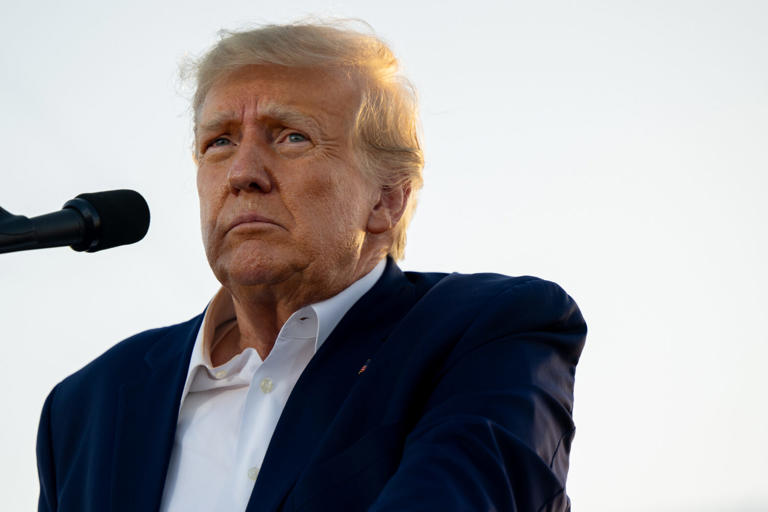
“The Boy Who Cried Wolf” is an Aesop fable about a shepherd boy who tricks villagers into thinking a wolf is attacking his sheep. But there was no wolf. The story teaches that people who lie will not be believed, even when they are telling the truth.
President Donald Trump has threatened new tariffs on Canadian lumber and dairy products, potentially as soon as Friday, just one day after providing Canada a one-month reprieve from 25% tariffs. The tariff on dairy products and lumber Trump threatens is 250%.
Is Trump serious or is it just noise?
Trump’s repeated threats of tariffs applied to Mexico and Canada are getting tiresome because he seems to change his mind daily.
Canada, Mexico, and other countries will soon tire of his threats.
Because of his power as president of the United States we all need to be concerned.
A new report from ABC News concludes that many Americans who voted for Donald Trump do not necessarily support most of his policies. The study, which analyzed 300 poll questions from publicly available surveys conducted since Trump took office on Jan. 20, reveals that while voters largely support his immigration policies, they disapprove of several other aspects of his agenda.
 Coast Contact