An Independent view of law, politics and social issues confronting Angelinos, Californians, and Americans
Author: coastcontact
I am a somewhat cranky but mostly optimistic 65 plus who refuses to give up on this maddening world. The purpose of this BLOG is to express my feelings, thoughts.
Growing up in the United States (I was born in Canada) I learned that this country is a “melting pot” where everyone mixed together to form one great nation. I was taught to believe that it made no difference where you came from. Religion, race, or ethnicity was not consequential. Everyone has the same chance and the same opportunity in America.
Where I was born was different. I was told Canada is not a “melting pot.” It is a mosaic where every group can co-exist. I was shocked by that and happy to be in the United States.
Then I grew up. As I did so I realized that the “melting pot” did not really exist except in the minds of dreamers. Mexicans, Jews, and Blacks all had their own separate cultures and were kept separated by neighborhood.
Even after equal rights and affirmative action proliferated, the Canadian format of mosaic has accelerated. Everyone is identified with his religious, ethnic, and cultural background. Jewish-Americans, Mexican-Americans, Afro-Americans, etc., etc., etc. Every news media emphasizes everyone’s race, religion, and family national origin.
Consider these inexplicable contradictions.
Miss America is not really an American because her family is from India.
Julie Chen, host and moderator of THE TALK, CBS’s daily daytime talk television show had eye lid surgery to look moreAmerican.
Our own president is the child of a White Christian American and a Black Kenyan and has been called an illegal president because he may have been born outside of the United States (despite his birth certificate).
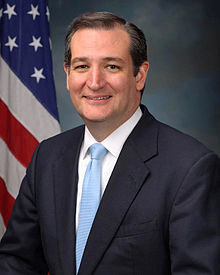
However, Senator Ted Cruz, whose mother is an American and father is a Cuban, was born in Canada but could legally become president of the United States. He looks like a White American.
Meanwhile the rest of the world looks on and laughs.
The 223rd and final C-17 cargo plane was delivered to the Air Force last week. The plane was manufactured at Boeing (the old Douglas Aircraft facility) in Long Beach, California. That’s the last airplane manufacturing facility in Southern California. The plant will be closed by 2015 and will result in the loss of 3,000 jobs.
Here is the problem. While Boeing cited sequestration, the Pentagon has made it clear for several years that it didn’t require more C-17s. However, lawmakers pushed through more orders to preserve jobs.
As reported in Businessweek, October 29, 2009, “Every year since 2006, the Pentagon has said that it has enough C-17s. And every year, Congress overrules the military and authorizes funds for additional planes. In October the Senate approved $2.5 billion in the 2010 budget for 10 more C-17s, which would bring the fleet to 215.”
The United States has created high paying jobs by ordering complex technology and other aerospace/biotech products from American companies. To a great extent the military-industrial complex has been the driver of jobs.
We give $1.3 billion of aid to Egypt in the form of military hardware. We even gave Russia $126 million in aid in 2010.
Top Recipients of U.S. Military Aid, FY2010
Country
$ U.S. millions
Afghanistan
6,800.3
Israel
2,799.5
Egypt
1,301.9
Iraq
1,006.0
Pakistan
913.9
Jordan
303.8
Somalia
204.0
Colombia
185.8
Russia
126.8
Sudan
104.9
Mexico
96.0
Poland
55.6
Is this the only way we can provide our citizens with good jobs?
Our willingness to allow everyone to have a gun is part of what makes the United States an exceptional country. Freedom of press, freedom of religion, democracy is in all of the countries listed below and many more.
Despite the latest killing in Washington D.C., Americans view their right to bear arms as a vital part of their freedom. Thus even the killing in Newtown, Connecticut of 20 small children and their teachers is the price we pay for that freedom.
I disagree with this philosophy but it is the will of the majority.
According to GunPolicy.org, run by Philip Alpers, a firearms analyst at The University of Sydney, the United States is unusual with what Alpers described as the “two pillars” of gun control: licensing gun owners and registering weapons.
“You are basically the only country in the developed world that doesn’t license gun owners across the board and you are almost alone in not registering guns across the board,” Alpers said. “It’s very difficult to compare [the U.S.] with others, because you simply don’t have those things.” New Zealand and Canada are the other developed countries that don’t register guns across the board, Alpers said. The two countries register handguns and military-style semi-automatics, but not rifles and shotguns.
Adjusting for population, the U.S. death rate by firearms — which includes homicides, suicide and accidents — was 10.2 per 100,000 people in 2009, according to the Coalition for Gun Control. The closest developed country was Finland, with a firearms death rate of 4.47 per 100,000 people in 2008, less than half that of the U.S. rate. In Canada, the rate was 2.5 per 100,000 people in 2009. In the United Kingdom, the 2011 rate was 0.25 per 100,000 people.
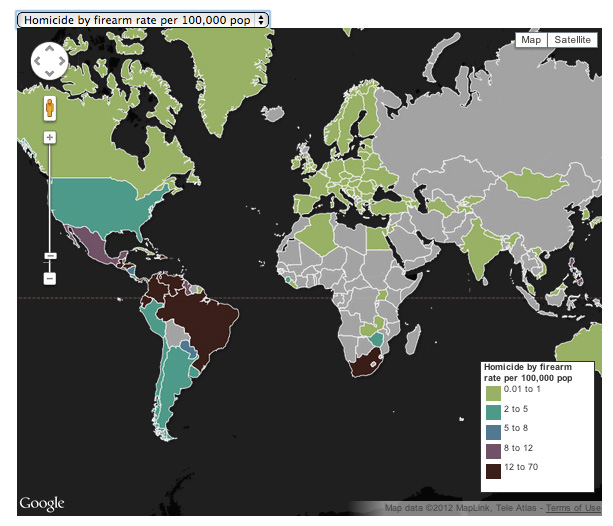
A map showing homicides rates form an article in the Washington Post December 14,2012.
Here’s how several other prosperous nations deal with the issue: The United Kingdom In 2011, the U.K. had 0.07 gun homicides for every 100,000 people; the U.S., by contrast, had 3 gun homicides for every 100,000. In 2009 there were 138 gun deaths in the U.K, where there are 6.7 firearms for every 100 people. One reason contributing to this is the U.K.’s strict gun laws. According to an English rifle and gun club legal center, any person possessing a firearm in the U.K. must posses a Shotgun Certificate or a Firearm Certificate.
Machine guns, pepper spray, semi-automatic, and pump-action rifles, and any firearm that has a barrel less than 30 centimeters in length are prohibited.
The only firearms that can be owned legally are shotguns, black powder weapons, manually-loaded cartridge pistols and manually-loaded center-fire rifles, all termed “Section 1” firearms.
To gain a firearm certificate, applicants must be over age 14, and must demonstrate they have satisfactory security and “good reason” to own a rifle. Applicants must declare all criminal convictions and name two references to support the application. Applications must be renewed every five years.
The requirements are largely the same for a shotgun certificate, although the applicant doesn’t need two references, only one counter-signatory — and there is no minimum age.
Anyone convicted of a criminal offense can’t even handle a gun for five years. If the sentence involved more than three years in prison, there is a lifetime ban. Canada
The U.S.’s neighbor to the north also has outstandingly low gun casualty statistics. In 2009, there were 0.5 deaths per 100,000 from gun homicide — only 173 people. Still, the ownership is comparatively high — there are 23.8 firearms per 100 people in the country. There is no legal right to possess arms in Canada. It takes sixty days to buy a gun there, and there is mandatory licensing for gun owners. Gun owners pursuing a license must have third-party references, take a safety training course and pass a background check with a focus on mental, criminal and addiction histories.
Licensing agents are required to advise an applicant’s spouse or next-of-kin prior to granting a license, and licenses are denied to applicants with any past history of domestic violence. Buyers in private sales of weapons must pass official background checks.
Canadian civilians aren’t allowed to possess automatic weapons, handguns with a barrel shorter than 10.5 cm or any modified handgun, rifle or shotgun. Most semi-automatic assault weapons are also banned. As a result of exemptions, several kinds of assault weapons are still legal in Canada, although this has been the source of some controversy. Japan
Japan’s gun policies are notoriously strict. Civilians cannot possess handguns, automatic assault weapons, semi-automatic assault weapons, military rifles, or machine guns. Japanese civilians aren’t even allowed to own swords. Without a license, a Japanese citizen isn’t even permitted to touch a firearm. Failure to follow this law can result in up to 10 years in prison.
What is legal are hunting rifles and shotguns, but those can only be obtained after an exhaustive application process. An aspiring gun-toucher must first take an all-day class and pass both written and practical exams. Then, applicants are required to go to the hospital for a mental health test, and provide police with a medical certificate attesting their mental health and drug-free status.
The police then investigate the applicants ;background, relatives and group affiliations. Involvement in some political or activist organizations is grounds for categorical denial of license application.
Only after all that can a Japanese citizen buy a gun. Even then, gun-owners are required to store the gun in a locker, store ammunition in a separate locked safe, and provide for the police a map of the location of the locker,
Gun owners must then submit to annual inspections of the rifle or shotguns and retake the shooting range class and written exam every three years. Australia
Australia had 30 gun homicides in 2010, which amounted to 0.13 gun deaths for each 100,000 people. Australians hold 3-3.5 million guns, a rate of 15 guns for every 100 people.
Australia is a rare nation that has had a significant shift toward additional gun control in recent years. Following a 1996 shooting spree that left 35 Australians dead at the Port Arthur tourist location in Tasmania, the government launched a major overhaul of gun laws.
In the decade before Port Arthur, Australia saw 11 mass shootings; since then, there has not been a single mass shooting and the gun murder rate has continued its steady decline.
Here’s what they did: Pro-gun Conservative John Howard pushed through an ambitious gun control program. The laws banned all automatic and semi-automatic weapons and instituted strict licensing rules involving background checks and waiting periods for purchases.
The conservative government also instituted a buyback program, where people were paid for turning in newly illegal automatic and semi-automatic rifles; 650,000 weapons were voluntarily handed in and destroyed at a cost of roughly $359.6 million.
Facts:
On September 11, 2001, 19 men hijack four fuel-loaded commercial airlines bound for west coast destinations. This terrorist attack on the United States is orchestrated by al Qaeda leader Osama bin Laden.A total of 2,977 people are killed in New York City, Washington, DC and outside of Shanksville, Pennsylvania, in the worst terrorist attack in U.S. history.
The Victims:
At the World Trade Center site in Lower Manhattan, 2,753 people are killed when hijacked American Airlines Flight 11 and United Airlines Flight 175 are intentionally crashed in the north and south towers.
Of those who perish during the initial attacks and the subsequent collapses of the towers, 343 are New York City firefighters, another 23 are New York City police officers and 37 others are officers at the Port Authority.
The victims range in age from two to 85 years. Approximately 75-80 percent of the victims were men.
At the Pentagon in Washington, 184 people are killed when hijacked American Airlines Flight 77 crashes into the building.
Near Shanksville, Pennsylvania, 40 passengers and crew members aboard United Airlines Flight 93 die when the plane crashes into a field. It is believed that the hijackers crashed the plane in that location, rather than their unknown target, after the passengers and crew attempted to retake control of the flight deck.
September 11, 2013
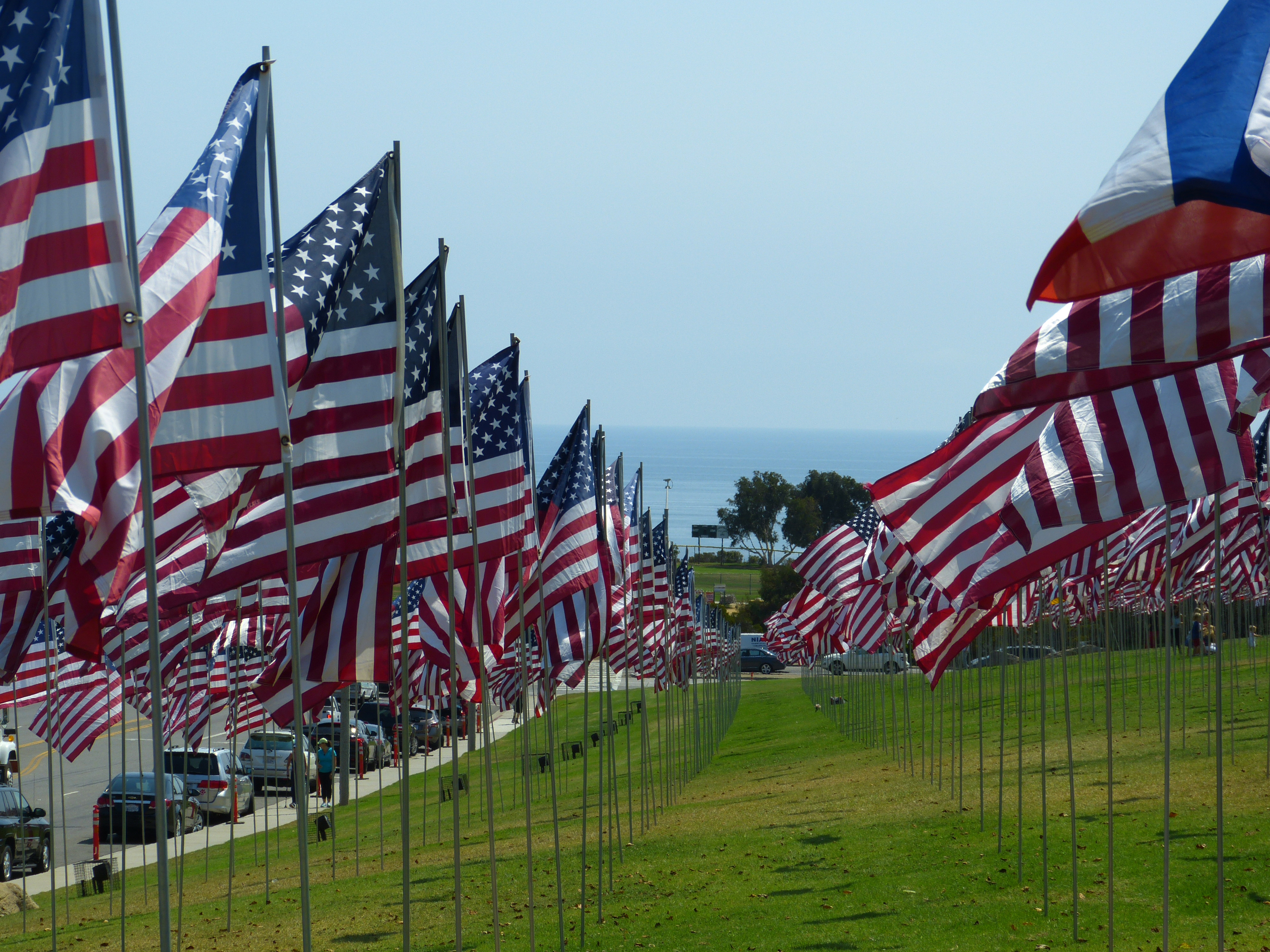
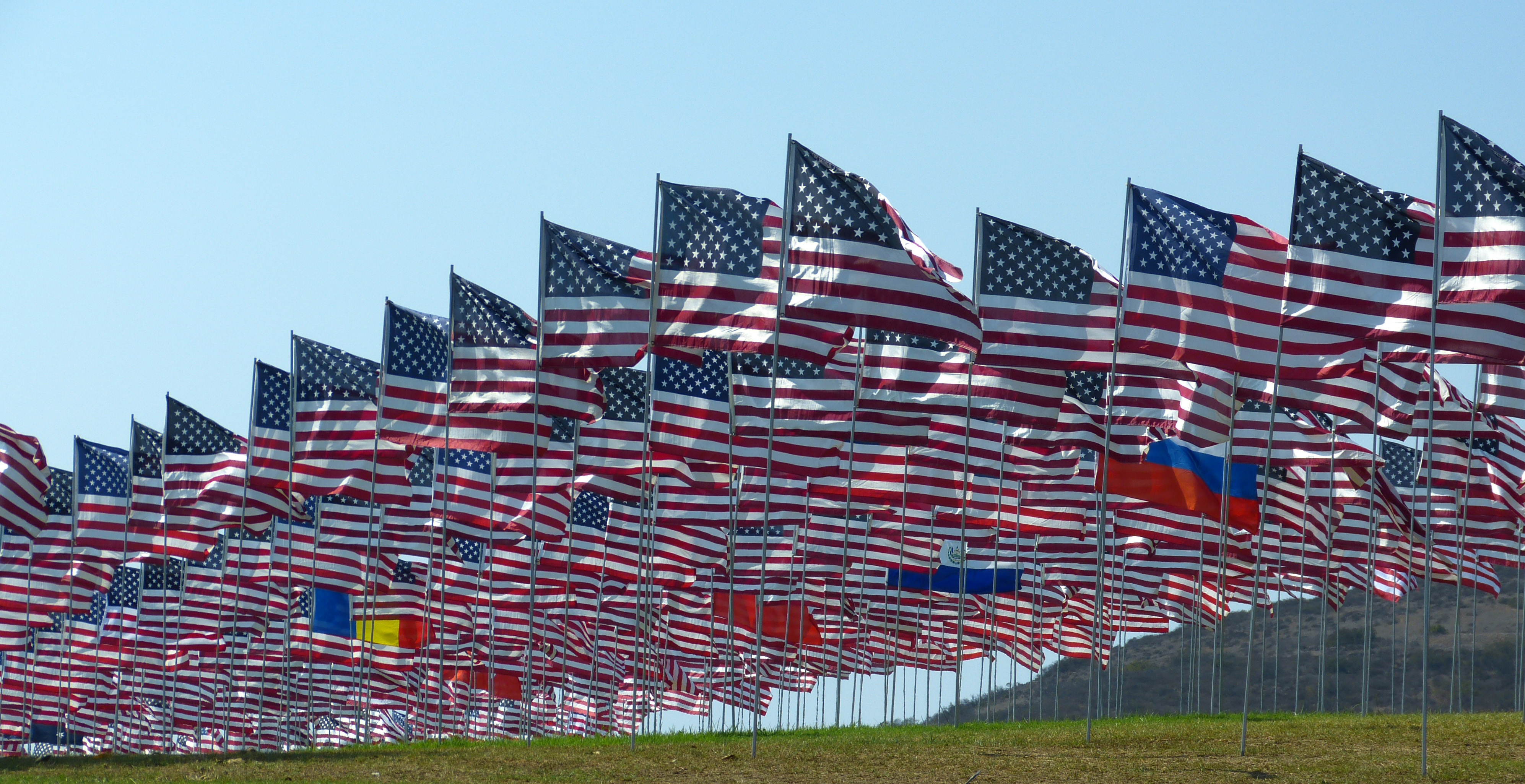
One flag for each lost life.Their home country flag was displayed at Pepperdine University in Malibu, California. The display is presented annually.
We certainly were busy watching the news right after 9/11, but we never saw this… BOAT-LIFT OF 9/11… You know, in the 12 years since this happened, this is the first time I’ve ever seen this… I don’t even remember seeing/hearing about this evacuation on the news! The fact is, it was all done in 9 hours… 500,000 people!
This is a video well worth watching. The guy at the end (same guy who is at the beginning) has some great words to live by for all of us.
Watch till the end. You won’t regret it. We will never forget what happened that day.
The president’s speech dealing with Syria clearly defined our moral outrage and our leadership in enforcing internationally accepted norms. Unfortunately America’s history dealing with Muslim countries has been a failure.
Iraq, Afghanistan, Libya, and Egypt are all realities. Despite America’s efforts to help those nations transition to democracies, all have been a failure.
Even if this proposed attack on Syria will be significant, it is unlikely to change Bashar al-Assad’s behavior.
If the president really does believe that the United States has a moral responsibility to deal a significant blow against Syria, he could have acted without congressional approval. Other presidents have acted in the past without that approval.
He still can act today without that approval. He won’t. Why? He does not have the backbone.
In 1914, Henry Ford started an industrial revolution by more than doubling wages to $5 a day—a move that helped build the U.S. middle class and the modern economy. After World War II the return of the GIs and the benefits they received prompted an educated society that wanted homes and cars. Union jobs with good benefits along with little competition from other nations made the United States into an industrial power house that lasted for decades.
Then big business realized that there was an opportunity to save money by outsourcing the manufacture of the things we buy. The government accommodated those businesses by negotiating free trade agreements with many nations. Communications with the entire world became easier and cheaper.
People in the poorest nations of the world could be trained to operate the machines that made things Americans want to buy. They would work for one fourth the rate of pay or less than American workers.
Today my computer, television, home theater, camera, and my clothes are all made in another country. The people who used to make those things are now either unemployed or working in low paid service jobs (tourism, retail, fast food, and other jobs that pay less than $15 an hour). The middle management jobs are now part of those outsourced functions. Call the help line for Earthlink or Hewlett-Packard and you will be speaking to someone in India or the Philippines.
“A middle-age middle manager who was laid off is not going to be miraculously rehired in that position or anything like it. Same with the factory worker and the receptionist and the copy editor. They’re finished. Many of the people who held those positions have already pulled out of the workforce and others are moving into different jobs (often at lower pay levels)” writes Mark Lacter on LA Observed.
Do not look for Congress or any government agency to solve this problem. They have no solutions.
Those desperate people who have taken jobs that pay half of what they previously earned are no longer part of the middle class. Those that have not obtained any job at this point are living on their accumulated wealth. Neither of those groups will be spending money as they had in the past. Thus the bifurcated economy of the wealthy and the poor. This means the end of the middle class in America. That is the big picture.
Some event in the future could change my mind. However, at this time there is no justification for our entry into the Syrian Civil War. After writing this piece I read in the Los Angeles Daily Newsthat there was a protest march in downtown Los Angeles that was objecting to the possible intervention of the USA in Syria. For a change I am not alone.
On July 25, 2013 The number of dead in Syria‘s civil war had passed 100,000, according to a United Nations report.
200 missiles at $569,000 each is over $11 million. Who said the military-industrial complex isn’t alive and well? 1,000 people have been killed by the use of chemical weapons but at least 40,000 civilians have been killed by conventional weapons. If the United States is concerned about human rights why aren’t we concerned about those deaths?
So the first question is how will bombarding Syria for three days change their behavior? No one that I have heard or read believes there will be any impact.
Is there a moral imperative that we become involved? The United States has taken on the mantle of “the right thing to do.” It remains to be seen if President Obama will have the courage and the will to take steps that many American oppose.
The third question is if there is no impact of a three day missile attack what will the next move be for the United States?
Will we invade? Probably not as most Americans are opposed to any involvement.
Will we resort to more bombardment? Maybe.
Will we create no fly zones? Possibly.
Setting aside the morality issue the other question is what will Syria’s neighbors and Russia do if we involve ourselves in their civil war? Are we prepared to face down those that would oppose our involvement?
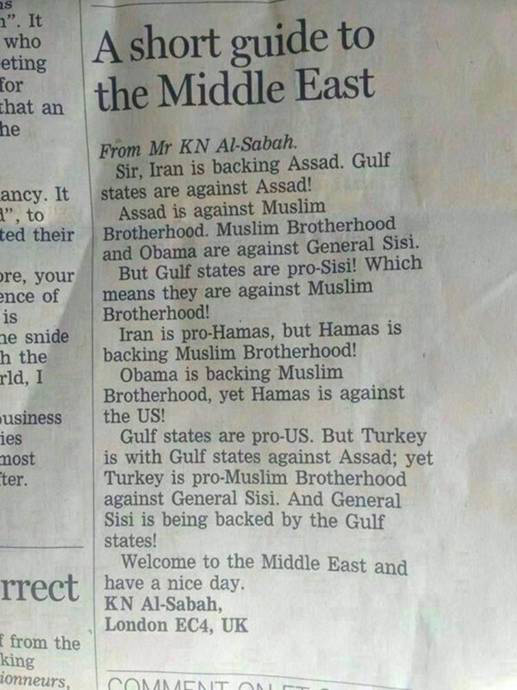
The Assad regime has a faithful army. The truth is that there are large numbers of Syrians who support the regime. The opposition apparently consists of al Qaeda supported groups that are among the rebel’s most successful warriors. If they win, enemies of the United States will be stronger and more emboldened. So just exactly why are we taking any action to protect their insurgency? The children? Among the tens of thousands killed in Syria there have been many children. We only care about those children killed by gas. What kind of logic is this?
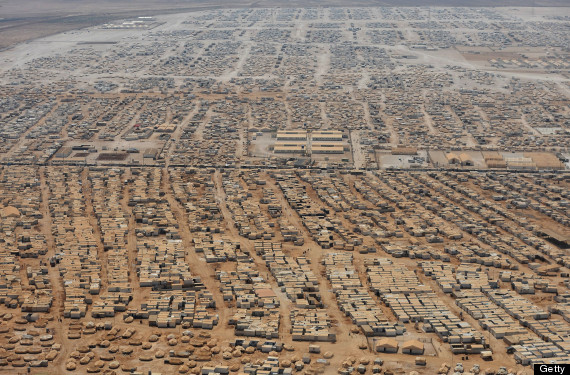
An aerial view shows the Zaatari refugee camp on July 18, 2013 near the Jordanian city of Mafraq, some 8 kilometers from the Jordanian-Syrian border. (MANDEL NGAN/AFP/Getty Images)
I see this civil war as an effort by Assad to drive those opposing him out of Syria. Different reports vary but from 1 million to 2.5 million people have left the country. There was even a televised report of Israeli hospitals treating some victims of the war. Once opposition has been driven out the war will be over.
I do not have a solution. No matter who wins this war, there are no benefits to the United States. Chemical weapons are not a consequential part of this war.


 Coast Contact