When You Retire Will the Money be There?

No one cares more about your savings and investments more than you.  You need to become an expert on the kinds of investments that you are comfortable with holding.  Don’t let a financial adviser take control of your funds.  No matter what he/she says, they do not understand your true wishes and needs.  They will not be the one in pain if those savings are lost.

The unpleasant reality is that most of us do not save enough money for our retirement years.  The reason is obvious.  The cost of living takes our paychecks.  It’s not a new situation.  This has been a fact for all of history.  It is the reason that Social Security was created in the 1930s.  That insurance provides sufficient income in retirement years to prevent starvation.  It is only enough to pay for food, housing, and other basic necessities.

The problem is that Social Security has become the only income resource for many retired Americans.  (401(k) plans have not become the outstanding resource that many believed would occur.  The reason is they are not a mandatory savings plan.  It is a voluntary program.  The average balance in all 50 million (401(k) accounts is just over $60,000 according to the Employee Benefit Institute.  Even people within 10 years of retirement have saved an average of only $78,000, and more than a third have less than $25,000.

I still hear financial gurus saying that you should be receiving 10% or more on your savings.  I know such investments do exist but they are not well known.  Those that do pay that level of return are high risk securities that most people are not prepared to take.  Even Vanguard’s High Yield Corporate Bond Fund pays 6.75%.

Even if you savings are small there are magazines you can view in the library and sites that do not charge anything.  My favorite is Morningstar.  You do not have to subscribe to obtain much of their information.

Start today thinking about where your income will come from when that day comes when you want to say “It’s time for me to retire.”

Obama and Romney: Where they stand on the issues

The Associated Press offered a detailed and lengthy run down of where Obama and Romney stand on the issues that we all to consider in the next election. Following is a summary. You can read the detail at http://my.earthlink.net/article/pol?guid=20120430/fe9b4c4c-15ca-43a7-9a4d-2605576b3e73


ABORTION and BIRTH CONTROL:
  

Obama: Supports abortion rights.

Romney: Opposes abortion rights.
  

DEBT:

Obama: Federal spending is estimated at 23.5 percent of gross domestic product this year, up from about 20 percent in previous administration, and is forecast to decline to 21.8 percent by 2016. Calls for tackling the debt with a mix of spending cuts and revenue increases. Central to Obama’s plan is to let Bush-era tax cuts expire for couples making more than $250,000. Debt reduction is based upon a stepped 10 year plan.

Romney: Would cap federal spending at 20 percent of gross domestic product by end of first term. Proposes broad but largely unspecified cuts in federal spending. Among the few details: 10 percent cut in federal workforce, elimination of $1.6 billion in Amtrak subsidies and cuts of $600 million in support for the arts and broadcasting.

ECONOMY:

Obama: Continued implementation of Wall Street and auto industry bailouts begun under George W. Bush. Proposes tax breaks for U.S. manufacturers producing domestically or repatriating jobs from abroad, and tax penalties for U.S. companies outsourcing jobs. Won approval of South Korea, Panama and Colombia free-trade pacts begun under previous administration, completing the biggest round of trade liberalization since the North American Free Trade Agreement and other pacts of that era.

Romney: Lower taxes, less regulation, balanced budget, more trade deals to spur growth. Replace jobless benefits with unemployment savings accounts. Proposes repeal of the (Dodd-Frank) law toughening financial-industry regulations after the meltdown in that sector. Proposes repeal of the (Sarbanes-Oxley) law tightening accounting regulations in response to corporate scandals, and replacing it with less onerous rules to ease the accountability burden on smaller businesses.

EDUCATION:

Obama: Has approved waivers freeing states from the most onerous requirements of the Bush-era No Child Left Behind law with their agreement to improve how they prepare and evaluate students. “Race to the Top” competition has rewarded winning states with billions of dollars for pursuing education policies Obama supports. Won approval for a college tax credit worth up to $10,000 over four years and more money for Pell grants for low-income college students. Wants Congress to agree to reduce federal aid to colleges that go too far in raising tuition.

Romney: Supported the federal accountability standards of No Child Left Behind law. In 2007, said he was wrong earlier in career when he wanted the Education Department shut because he came to see the value of the federal government in “holding down the interests of the teachers’ unions” and putting kids and parents first. Has said the student testing, charter-school incentives and teacher evaluation standards of Obama’s “Race to the Top” competition “make sense” although the federal government should have less control of education.

ENERGY and ENVIRONMENT

Obama: Proposes Congress give oil market regulators more power to control price manipulation by speculators and stiffer fines for doing so. Failed to persuade a Democratic Congress to pass limits he promised on carbon emissions. Shelved plan to toughen health standards on lung-damaging smog. Rejected Keystone XL oil pipeline from Canada but supports fast-track approval of a segment of it. Proposes ending subsidies to oil industry but has failed to persuade Congress to do so.


Romney: Supports opening the Atlantic and Pacific outer continental shelves to drilling, as well as Western lands, the Arctic National Wildlife Refuge and offshore Alaska; and supports exploitation of shale oil deposits. Wants to reduce obstacles to coal, natural gas and nuclear energy development, and accelerate drilling permits in areas where exploration has already been approved for developers with good safety records.


GAY RIGHTS:

Obama: Once opposed federal recognition of same-sex marriage, later said his views were “evolving” and has not taken a position on that since.

Romney: Favors constitutional amendment to ban gay marriage.

HEALTH CARE:

Obama: Achieved landmark legislation and if the Supreme Court upholds the heath care law and its mandate for almost everyone to obtain insurance.

Romney: Promises to work for the repeal of the federal health care law.

IMMIGRATION:

Obama: Failed to deliver on a promised immigration overhaul. . Says he is still committed to it.

Romney: Favors U.S.-Mexico border fence, opposes education benefits to illegal immigrants. Opposes offering legal status to illegal immigrants who attend college, but would do so for those who serve in the armed forces. Proposes more visas for holders of advanced degrees in math, science and engineering who have U.S. job offers, and would award permanent residency to foreign students who graduate from U.S. schools with a degree in those fields.

SOCIAL SECURITY:

Obama: Has not proposed a comprehensive plan to address Social Security’s long-term financial problems.

Romney: Protect the status quo for people 55 and over but, for the next generations of retirees, raise the retirement age for full benefits by one or two years and reduce inflation increases in benefits for wealthier recipients.

TAXES:

Obama: Wants to raise taxes on the wealthy and ensure they pay 30 percent of their income at minimum. Supports extending Bush-era tax cuts for everyone making under $200,000, or $250,000 for couples.

Romney: Drop all tax rates by 20 percent, bringing the top rate, for example, down to 28 percent from 35 percent and the lowest rate to 8 percent instead of 10 percent. Curtail deductions, credits and exemptions for the wealthiest. End Alternative Minimum Tax for individuals, eliminate capital gains tax for families making below $200,000 and cut corporate tax to 25 percent from 35 percent.

TERRORISM:

Obama: Largely carried forward Bush’s key anti-terrorism policies, including detention of suspects at Guantanamo Bay despite promise to close the prison. Also has continued with military commissions instead of civilian courts for detainees and invocation of state secrets privilege in court. Expanded use of unmanned drone strikes against terrorist targets in Pakistan and Yemen.

Romney: No constitutional rights for foreign terrorism suspects. He does not consider waterboarding to be torture.

WAR:

Obama: Declined to repeat the Libya air power commitment for Syrian opposition. Opposes a near-term military strike on Iran, either by the U.S. or by Israel, to sabotage nuclear facilities that could be misused to produce a nuclear weapon. Says the U.S. will never tolerate a nuclear-armed Iran but negotiation and pressure through sanctions are the right way to prevent that outcome. Reserves the right to one day conclude that only a military strike can stop Iran from getting the bomb.


Romney: Has not specified the troop numbers behind his pledge to ensure the “force level necessary to secure our gains and complete our mission successfully” in Afghanistan. Would increase strength of armed forces, including number of troops andwarships, adding almost $100 billion to the Pentagon budget in 2016.

Economy is Job One!

May 4, 2012 Addendum.  The April jobs report confirmed my worst fears.  The U.S. economy added just 115,000 jobs and yet the unemployment rate is down another tenth of a percent to 8.1%.  In other words more people have given up the search.  This is another great day for Mitt  Romney.  Everything I wrote on April 28 remains valid.  The difference  is it has just been reinforced.    

Is the recession over? Not if you are unemployed. Over 12 million Americans are in that status. Most of those people have families that have been impacted. The impact is more likely on three to four times that number. Worse is that the number is not the real number because many more people are no longer counted as unemployed. Most economists add about 50% to the official numbers to reach that real number.

The Obama administration failed to address the primary issue facing the nation. That is the condition of our economy.

Where is the plan to change our course of outsourced jobs? It does not exist.

The latest pieces of economic data support the feeling that the economy is struggling to recover from the Great Recession. New claims for unemployment benefits dropped to 351,000 in the week ending February 11 of this year but have been increasing every week since then with one exception. Gross Domestic Product (GDP) for the first quarter of 2012 grew 2.2% versus a growth of 3% in the last quarter of 2011. The president can’t be held responsible for everything in our economy but there is little he has done or proposed to improve the situation.

 The problem is that Mitt Romney has not enunciated any actions he would take that would change our desperate employment situation. The number of unemployed reached over 14 million people and has now dropped to under 13 million. However the number of long term unemployed has not been significantly reduced and still remains over 5 million people. Obama’s policies did save the country’s auto manufacturers but too many products and services are now provided in other countries.

Americans are the employer of the president. We have the right to expect results. Barack Obama’s four year contract is almost up. Unfortunately the alternate candidate for the job has not told us what he would do to change our economic situation.

Israel’s Nuclear Deception – A Perfect Hoax

Remember the Trojan Horse and the inflatable tanks on the shores of England at the end of WWII. Israel’s nuclear war heads are in the same anthology.

Do a Google search and you will find that there is the perception that Israel has nuclear weapons. France did provide cooperation for some kind of nuclear development in the 1950s. There is a secret facility in a location called Dimona but United States officials have never actually seen what is located there. Apparently no one outside Israel has seen the inner workings of the site. One Googled site speculates “Israel could have thus produced enough plutonium for at least 100 nuclear weapons, but probably not significantly more than 200 weapons.”

However, the next time you read an article quoting an Israeli official or listen to an interview you will notice that they never claim to have any nuclear weapons. I just saw an interview by Erin Burnett of Benjamin Netanyahu and he avoided responding to her inquiries about Israel’s nuclear capabilities. In the April 2, 2012 issue of Time magazine “10 Questions” column the author asks President Simon Peres Remind me, does Israel have nuclear weapons? ‘Look, Israel doesn’t intend to introduce nuclear weapons, but if people are afraid that we have them, why not? It’s a deterrent. I want to tell you a small story. Amr Moussa was the Foreign Minister of Egypt. One day he came to me and said, ‘Simon, we are such good friends. Take me to Dimona. Let me see what’s going on.’ I said, ‘Amr, are you crazy? I shall take you, and you’ll see there’s nothing there. You’ll stop being frightened, and then I should be out of my job.’ ”

Obviously Israel has perpetuated the perfect hoax. Most Jews even believe it!

The Social Security Time Bomb

Rather than focusing on our broken political system this article is focusing on a solution to the Social Security time bomb. Only yesterday the Social Security Trustees said that the system will not have sufficient funds for the promised payouts in 2033.

Regular ongoing monthly Social Security benefits started in January 1940. Despite what some will claim we are experiencing longer lives. The system was counting on almost everyone dying within ten years of retirement. The problem for the program is that too many are living into their 80s and 90s.

The Democrats have not faced the reality of longer lives. The Republicans have but their solutions are unacceptable to most of us. Interestingly it was George W. Bush who tried to resolve the issue but the two parties seem bent upon disagreement even when they know there is a solution.

We all know that many people are relying on the system as their only source of income. Cutting benefits for the poorest is not a reasonable solution.

There are a few things we can do:
1. Establish a “means test” that would deny benefits to those with higher retirement income.
2. Raise the maximum taxable contributions from the current level.
3. Raise the retirement age.

To do these things will require courage. That is lacking in our representatives.

Point and Shoot Cameras will beat your Cell Phone

Joshua Goldman writing for c/net offers ten reasons that even an inexpensive point and shoot camera will do a better job of capturing the photo you want to remember.  Following are some of the most important reasons.

Optical zoom
For a lot of people, optical zoom is the biggest feature missing from smartphones; with rare exceptions, the only option on mobile devices is image-destroying digital zoom. A good zoom lens, of course, can be used to bring distant subjects closer. But it can also be used for several other things, such as changing the relative size of subjects or compressing the distance between them, or, in the case of this photo, creating an out-of-focus background — no dSLR or software needed.

Macro
Even a sub-$100 point-and-shoot can take better macro photos than a smartphone. Many models can focus at less than half an inch from a subject and, depending on the quality of the camera’s high-resolution photos, you can enlarge them and view sharp fine details. Plus, with a camera’s slightly larger sensors, you’re actually able to create a shallow depth of field.

Shooting performance
Anyone who’s tried to capture a picture of a fast-moving child or pet with a smartphone knows how tricky it can be. Even when you think you’ve gotten the shot, chances are if you look at it larger, it’s blurry, soft, noisy, or all of the above. Camera makers have been improving all aspects of shooting performance, though; startup time, shutter lag, and shot-to-shot times are much better than they were even a couple years ago. Plus, since cameras have a shutter release button, it’s easier to hold the camera and quickly prefocus again and again until you get the shot you want. That’s not exactly easy to do when you’re trying to hold your phone and tap a screen.

Burst shooting
One of my favorite Android camera apps is Fast Burst Camera, which lets you fire off shots at up to 30 frames per second. However, that’s at a significantly reduced resolution, whereas a camera like the Sony Cyber-shot DSC-HX9V can shoot 10fps at its full 16-megapixel resolution. The Panasonic Lumix DMC-ZS20 is even better, shooting at up to 60fps at reduced resolutions, 10fps at full resolution, and up to 5fps with autofocus.

Battery life
Obviously, if you’re only going to take a couple snapshots or a 30-second movie clip, it won’t eat up too much of your smartphone’s battery. But if you’re out shooting at an event, on vacation, or simply while out and about for the day, using your phone’s camera will drain your battery.

Storage
If you’re just taking the occasional snapshot or movie clip, it’s not a big deal. But if your smartphone’s become your only camera, it’s something to consider. With a dedicated camera, you can shoot as much as you want without worrying about running out of space on your phone.

Optical or sensor-shift image stabilization
Smartphones only have digital image stabilization, which, like digital zoom, degrades image quality. Cameras, except really low-end ones, have either optical or sensor-shift image stabilization to help with camera shake, and it has no impact on photo quality and is much more effective. In fact, image stabilization has gotten so good that manufacturers are able to offer longer lenses that are actually usable handheld.

Read the rest of the article at http://news.cnet.com/8301-17938_105-57414697-1/10-ways-a-point-and-shoot-camera-beats-your-phones/

Being Green

Checking out at the store, the young cashier suggested to the older woman, that she should bring her own grocery bags because plastic bags weren’t good for the environment.

The woman apologized and explained, “We didn’t have this green thing back in my earlier days.”

The young clerk responded, “That’s our problem today. Your generation did not care enough to save our environment for future generations.”
She was right — our generation didn’t have the green thing in its day.

Back then, we returned milk bottles, soda bottles and beer bottles to the store. The store sent them back to the plant to be washed and sterilized and refilled, so it could use the same bottles over and over. So they really were recycled.

But we didn’t have the green thing back in our day.

Grocery stores bagged our groceries in brown paper bags, that we reused for numerous things, most memorable besides household garbage bags, was the use of brown paper bags as book covers for our schoolbooks. This was to ensure that public property, (the books provided for our use by the school) was not defaced by our scribblings. Then we were able to personalize our books on the brown paper bags.

But too bad we didn’t do the green thing back then.

We walked up stairs, because we didn’t have an escalator in every store and office building. We walked to the grocery store and didn’t climb into a 300-horsepower machine every time we had to go two blocks.

But she was right. We didn’t have the green thing in our day.

Back then, we washed the baby’s diapers because we didn’t have the throwaway kind. We dried clothes on a line, not in an energy-gobbling machine burning up 220 volts — wind and solar power really did dry our clothes back in our early days. Kids got hand-me-down clothes from their brothers or sisters, not always brand-new clothing.

But that young lady is right; we didn’t have the green thing back in our day.


Back then, we had one TV, or radio, in the house — not a TV in every room. And the TV had a small screen the size of a handkerchief (remember them?), not a screen the size of the state of Montana . In the kitchen, we blended and stirred by hand because we didn’t have electric machines to do everything for us. When we packaged a fragile item to send in the mail, we used wadded up old newspapers to cushion it, not Styrofoam or plastic bubble wrap. Back then, we didn’t fire up an engine and burn gasoline just to cut the lawn. We used a push mower that ran on human power. We exercised by working so we didn’t need to go to a health club to run on treadmills that operate on electricity.

But she’s right; we didn’t have the green thing back then.

We drank from a fountain when we were thirsty instead of using a cup or a plastic bottle every time we had a drink of water. We refilled writing pens with ink instead of buying a new pen, and we replaced the razor blades in a razor instead of throwing away the whole razor just because the blade got dull.

But we didn’t have the green thing back then.

Back then, people took the streetcar or a bus and kids rode their bikes to school or walked instead of turning their moms into a 24-hour taxi service. We had one electrical outlet in a room, not an entire bank of sockets to power a dozen appliances. And we didn’t need a computerized gadget to receive a signal beamed from satellites 23,000 miles out in space in order to find the nearest burger joint.

But isn’t it sad the current generation laments how wasteful we old folks were just because we didn’t have the green thing back then?

The Stockholders Strike Back!

At Citigroup’s annual meeting, owners of the stock voted 55 to 45 against a $50 million executive pay package, including $15 million for CEO Vikram Pandit.

This is all thanks to the Dodd-Frank financial overhaul law.

Buried in its 2,300 pages is a requirement for public companies to hold “say on pay” votes for executive compensation.

Now, the vote is non-binding, but the chairman of Citigroup Dick Parsons said he took it seriously, and promised the board would consider it carefully.

Shareholders have every right to be upset with Vikram.

Over the last decade, Citigroup has had the worst stock price performance of the big banks, but consistently had some of the highest executive compensation.

 Citi shares up slightly today, but they’re down more than 80% since the financial crisis hit.

They’re down 93% from 2006.

Last year, Pandit got a $1.7 million salary, plus a $5.3 million cash bonus, and he got a $40 million retention package that pays out through 2015.

Getting a bonus should be a piece of cake for these execs, too, since the standard for the payout is an earnings track record half of what it was in 2009 and 2010 when the economy was in the tank.

Whoa! Don’t get too ambitious!

Look, to be fair to Pandit, for 2009 and 2010, he accepted just a buck in salary.

 But to be fair to shareholders, Citi’s quarterly dividend is one penny.

 At the start of this week, Citigroup announced its first-quarter profit had fallen two percent from a year earlier on a paltry one percent rise in revenue.

 The Federal Reserve turned the company down on its request for a share buyback or dividend after Citi flunked the central bank’s stress test in March. And don’t forget the bank was one of many bailed out during the financial crisis.

Some people bridle at anyone earning millions of dollars a year, but not me.

If you can grow sales, boost the bottom line, raise the share price, then by all means you’ve earned a fat paycheck.

But what we can’t do is reward mediocrity and failure.

There’s a lot not to like about Dodd-Frank – about 2,299 pages’ worth if you ask me – but shareholder “say on pay”? That’s OK with me.

Last year shareholders voted down just two percent of executive pay plans. Maybe this is the start of a new trend.

Read more: http://www.foxbusiness.com/on-air/willis-report/blog/2012/04/18/shareholders-strike-back?link=mktw#ixzz1sXtwnCTx

Decline of Manufacturing Jobs in America

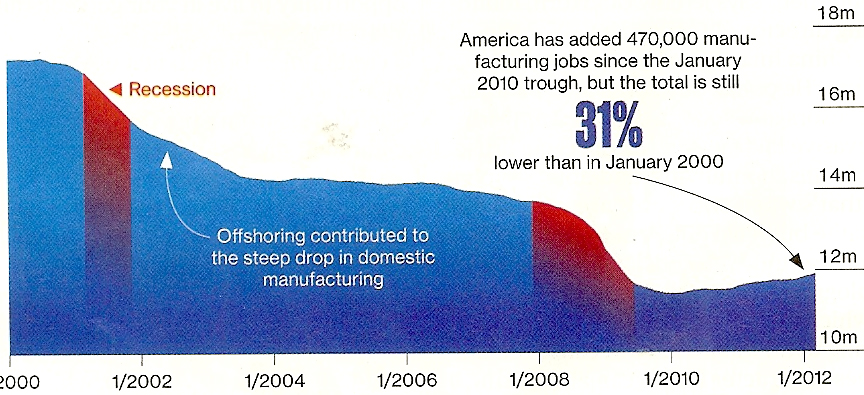
 The Long Goodbye: Number of U.S. Manufacturing Jobs

The graph was in Businessweek April 16-April 22, 2012.  It tells the story of the continuing loss of manufacturing jobs in the United States.  Those that believe that America will become a “service society” are in a dream world.  No nation thrives on services alone.  Actually we are already outsourcing many services to Asian countries.  Dell Computer, Citi Bank, Hewlett Packard, and the Los Angeles Times are just FOUR of the many companies that have out sourced their customer service.

Notice that this graph reflects what many of us already knew.  Decline in manufacturing has been a decades old event.

The Tech impact has Just Begun

When my son had his car stolen, my daughter called to say she learned about it on his Facebook page.

No one doubts that technology has impacted our way of life. Computers, television have morphed into computers, cell phones have become smart phones, tablet computers are replacing lap top computers, and music is now downloaded rather than played on CDs or records (what are records?).

Despite all the new stuff, electronic retail has seen a continuous downward trend over the last few years.  First it was Circuit City that once was the largest chain of electronic stores in the nation and now Best Buy seems to be following with the closing of 50 stores by the end of this year.  Six (revised to 7)in California, six in Illinois, and the balance in Minnesota (revised to 17 states and Puerto Rico).

This really is the impact of technology.  Borders Books is gone and Barnes and Noble is barely hanging on.  All these businesses are impacted by the internet.  It’s the place I made two purchases this month from Amazon.  One was a new camera (tech product) and the other was sugar bowl (that is a blow to all retail).  Banking? On line.

What is the message?  Retail will never be the same.

What about jobs?  Many of us will be working from home.

Betty White may be correct when she said, “Facebook is a big waste of time.”  Just don’t tell the millions of people who use it as a primary means of communication.