Government Nationalizing Business

If your company does business with the government does the government have a say in how it is operated or where you locate operations?

“Living wages,” now adopted by over 50 local governments, require employers that have some financial interaction with the local government to pay covered employees a living wage that is significantly above the federal or state minimum wage.

The National Labor Relations Board (NLRB) filed a complaint recently over Boeing’s plans to open a second plant in South Carolina, a “right-to-work” state, instead of expanding its operations in Puget Sound, Washington, where its workers are unionized. The new South Carolina facility is for the production of the company’s 787 Dreamliner plane.

Boeing’s Washington workers belong to the International Association of Machinists and Aerospace Workers (IAM). The IAM went on strike four times since 1989, costing Boeing at least $1.8 billion in revenue. The new plant in South Carolina would be a non-union facility.

The government agency decided nearly two years after the fact that Boeing’s actions were retaliation for the IAM’s repeated shut downs of commercial aircraft production, including a strike lasting almost 60 days costing billions.

There might be another reason for Boeing’s decision to re-locate to South Carolina. The cost of labor.  In Washington the median hourly pay for Production Operations is $16.56.  In South Carolina the median hourly pay for the same category is $14.49.  When you are employing thousands of people, that $2.07 difference per hour adds up to a significant savings.  These numbers are from the Bureau of Labor Statistics.

According to Boeing’s financial reports, 37% of its “Earnings from Operations” were from Military aircraft.  Like General Motors, Boeing relies on the United States government for support.  Of course they have the right to direct Boeing operations. Or do they?  Is this another case of creeping government control of everything?  Wasn’t that the system used in the U.S.S.R.?  As I recall it failed.

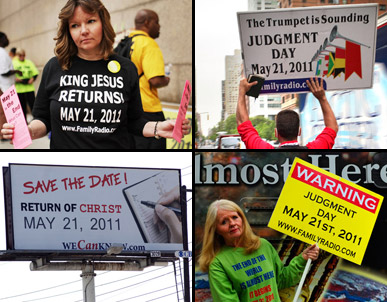
Judgment Day-May 21, 2011

Chatsworth, CA 

Even The Daily Beast has featured this forecast!

Daily Beast posts "World ends Saturday"

These billboards have been appearing around the country.  The church group putting up the money says you must accept Christ before this date.

The wecanknow.com website includes this message:

This web site serves as an introduction and portal to four faithful ministries which are teaching that WE CAN KNOW from the Bible alone that the date of the rapture of believers will take place on May 21, 2011 and that God will destroy this world on October 21, 2011.

May 8. 2010

laurensheil left a comment elsewhere on the blog. Reposted here

Check out my take on this at; www.laurensheil.com

We Want The Best President

The argument over Barack Obama’s birthplace seems to me of little value.  There is no credible evidence he was born elsewhere.  The question ought to be “How well is he doing as president?”  I was born in Canada.  My parents moved to the United States less than six months later.  If only they had contained themselves for those six months I could have been eligible to be president of this country.  For that reason alone, I and many other loyal Americans are denied the opportunity to reach America’s highest office.  I am not certain that Arnold Schwarzenegger would be elected to the presidency but why would we deny someone who is clearly devoted to America the opportunity to run for leading the country?  Some of the brightest and smartest Americans were born elsewhere.

Our former Secretary of State, Madeleine Albright was born in Czechoslovakia.  Joseph Pulitzer was was born in Hungary in 1847.  He made his way to America to join the Union Army during the Civil War.  Supreme Court justice Felix Frankfurter was born in Vienna, Austria in 1882 and moved with his family to the United States in 1894.  Irving Berlin was born in Russia in 1888. He is the composer of “White Christmas,” “Easter Parade” and “God Bless America.”  Dr. Rita M. Rodriguez, a former director of the Export-Import Bank of the United States, was born in Oriente, Cuba in 1942.  Sidney Harman (deceased this year), founder of Harman Kardon Industries (famous for Hi-fi sound systems) was born in Montreal, Quebec, Canada.  Mortimer Benjamin “Mort” Zuckerman (born June 4, 1937) is a Canadian-born American magazine editor, publisher (U.S. News and World Report, etc.), and real estate billionaire. He is a naturalized citizen of the United States. Google co- founder Sergey Brin (born in Russia and moved to the U.S. at age 6). 

A well known host of a quiz show, born in Canada, that asks the contestants to provide the questions.  I am sure you know many more great foreign born Americans.

Gas Price Investigation

Is this business or politics?

Here is the title of an April 25, 2006 posting by Fox News.

Bush Announces Gas Price Investigation

WASHINGTON — With gas prices on the rise, President Bush on Tuesday offered suggestions for reducing oil costs, including increasing refinery capacity and conservation, to diversify away from oil through the use of alternative fuels like ethanol.

Under pressure from lawmakers and the public who have alleged price gouging by oil companies, the president also said he has ordered a probe of price manipulation and market speculation. On Tuesday, he also ordered a temporary halt of deliveries to the Strategic Petroleum Reserve.

Read the rest of this article here.

Today President Obama called for an investigation of price gouging.

Obama orders investigation of gas prices

LOS ANGELES (KABC) — President Barack Obama has ordered the Justice Department to investigate potential price gouging at the pump.

Attorney General Eric Holder will appoint a task force to examine both gasoline sales and potential manipulation in oil markets.

Read the rest here.

It’s politics!  The president does not have the power to control gasoline prices.  Check the price in other free market nations and you will find the cost of gasoline is more there than in the United States.

Apple Crushes Forecasts Again, iPad Backlogged

Looking for a good stock for investing? Consider these facts.

(Reuters) – Apple Inc’s results smashed Wall Street’s expectations after iPhone and Mac sales scaled new heights while iPad supplies could not keep up with roaring global demand.

“We sold every iPad 2 we could make and the demand was stunning,” Apple Chief Financial Officer Peter Oppenheimer told Reuters in an interview.

The company’s stock — which is trading at roughly 18 times forward earnings, versus 19 times for Google and 10 times for Microsoft — is considered a must-have in any technology portfolio.

Apple’s I series of products have not been duplicated by any other company. Morningstar’s listing of competitors are: Hewlett-Packard Company, Sony Corporation ADR, Microsoft Corporation, Dell Inc. All of these companies have worthwhile products. None of these companies offers a similar product line.

iPad Competitors? The Motorola Xoom launched to sales that were okay but not breakthrough, the BlackBerry Playbook has gotten hopeful though mixed reviews. There is also the HP TouchPad, as well as Android Honeycomb tablets by manufacturers such as Toshiba and Motorola that have not yet been well reviewed. The Samsung Galaxy Tab has received an excellent rating by Consumers Reports.

Although I am not a fan of Apple products, Morningstar predicts a “$475 fair value estimate.” Today’s stock price is in the $350 to $352 range.

Ending For-profit Health Care

 Imagine a society where no company earns a profit providing health care. The immediate impact would be a savings of $12.2 billion just by eliminating the “for profit” insurance companies.

It is time we had a discussion about

David Lazarus, Los Angeles Times

providing all Americans with health care at the lowest possible cost. David Lazarus in his April 19, 2011 column in the Los Angeles Times about health insurance choices reflects the problem that many of us face. His ending words “access to safe food, clean water, affordable healthcare — that shouldn’t be first and foremost about profits” is the issue that really faces America. The Los Angles Time editorial “Can Medicare be saved?” ducked that issue. The editorial discussion and the words on every person’s lips ought to be about America’s choice between for-profit health care or non-profit health care.

Profit is the crux of the issue. Why should anyone in the United States be profiting from providing health care? Private insurance companies and “for profit” hospitals and clinics are part of the problem. Neither Democrats nor Republicans will address this issue. In my view the reason for this is that capitalism takes precedence over everything else. Despite what Republicans say about Barack Obama, he is a capitalist.

The Hospital Corporation of America (HCA) is perhaps the largest company of its kind with hospitals in 20 states. 38 of those hospitals are in Florida and no wonder since that is the state with the greatest number of seniors (age 65+) according to Seniorjournal.com. HCA Revenue for the year that ended Dec. 31, 2010, was $30.68 billion, up from $30.05 billion in 2009. Profits rose 14.5 percent to $1.2 billion.

In 2006, Kohlberg Kravis Roberts and Bain Capital, together with Merrill Lynch and the Frist family (which had founded the company) completed a $31.6 billion acquisition of the hospital company, making the company privately-held again 17 years after it was taken private for the first time in a management buyout. Florida Governor Rick Scott is the former CEO of HCA.

Former Senator Bill Frist of Tennessee

Remember Senator Bill Frist of Tennessee? He began his career as an heir and major stockholder of HCA.

What are the chances that “for-profit” health insurance and hospitals will be eliminated? Try the number ZERO.

Who should seek the presidency or challenge President Obama for nomination in 2012?

The question was posed by the Los Angeles Daily News.

Here are some of the answers the newspaper printed.

‘Good’ isn’t good enough

Ten presidents were defeated for re-election including John Adams, Jimmy Carter and George H.W. Bush. Thus we know that even good presidents can be beaten. President Barack Obama did not bring us “change you can believe in.” The problem for the Republicans is that they do not yet have a strong candidate. Look who replaced the three I identified: Thomas Jefferson, Ronald Reagan and Bill Clinton. All three were great leaders. Mediocre or good enough will not bring a win for the GOP.

Continuing support for Obama

There is not one Republican candidate qualified to run for president against President Barack Obama, who seems to be going out of his way to cross the aisle to avoid an assassination threat. President Obama will have my vote and be re-elected in 2012, after cleaning up most of the mess left by the Bush/Cheney administration.

Waiting for sensible contender

I suggest they find a normal, working-class man. A person with brains and common sense, with at least a high school or some college education who can realize that another four years of President Obama will never ever get us out of debt.

.

Other letters supported New Jersey Gov. Chris Christie, Comedy Central’s Stephen Colbert, Herman Cain (he used to be the CEO of Godfather’s Pizza), and former Massachusetts Governor Mitt Romney. 

Although there was no supporters for Donald Trump among the letter writers, he is at least the most well-known and certainly one of the smartest people in the GOP.  Then again California had Arnold Schwarzenegger as governor and that didn’t turn out too well.

6 common photography mistakes (and how to avoid them)

  • Richard I’Anson
  • Lonely Planet Author

Whether you’re on the other side of the world or wandering your own neighbourhood, you’ll soon realise that the sights that have you reaching for your camera are fleeting photo opportunities.

With this in mind, you really need to be prepared to capture such moments. Here are the six most common mistakes that can leave you with an ordinary image – instead of the masterpiece it should have been.

1. Not having a strong point of interest

The very first thing to consider is the subject – what is it and why are you taking a photo of it? Successful images have a point of interest: the key element around which the composition is based. It’s probably the thing that caught your eye in the first place and should be able to draw and holds the viewer’s attention.
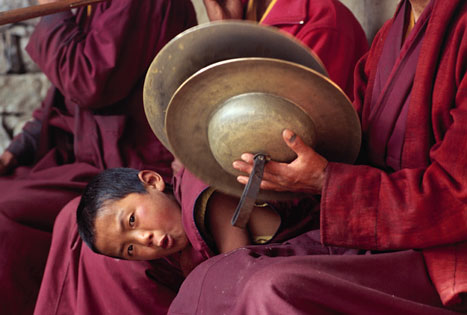
2. Not getting close enough to the subject

Good compositions leave no doubt as to the subject of the photograph. How do you make sure this is clear? A good way to start is to fill the frame with your subject. This helps to eliminate unnecessary or unwanted elements and overcomes the common mistake of making the subject too small and insignificant, which leaves the viewer wondering what the photo is supposed to be of. Often just taking a few steps towards your subject or zooming in slightly will make an enormous difference.
3. Focusing on the wrong part of the composition

The sharpest part of the image should be the point of interest, so take care when focusing. If something other than the main subject is the sharpest part of the composition the viewer’s eye will rest in the wrong place.

Most compact cameras and all SLRs have a focus-lock facility, activated by depressing the shutter release button halfway, which you should be confident using. It allows you to produce more creative and technically better pictures by locking the focus on the main subject then recomposing without the camera automatically refocusing.

4. Placing the subject in the middle of the frame

Centering the subject often contributes to a static composition so you should aim to place the point of interest away from the centre of the frame. As you’re thinking about where to place the point of interest, keep in mind the ‘rule of thirds’ that has traditionally been the starting point for successful composition. As you look through your viewfinder or study the LCD screen, imagine two vertical and two horizontal lines spaced evenly, creating a grid of nine rectangular boxes.

Try placing the point of interest, or other important elements, on or near the points where the lines intersect. For example, if you’re taking a portrait, the subject is the person’s face and the point of interest would be their eyes. In a landscape the point of interest may be a boat floating on a lake; place the boat on one of the intersections and also position the horizon near one of the horizontal lines.

5. Including elements that conflict with the subject

Avoid including other elements that conflict with the main subject. Look at the space around and behind your subject and make sure nothing overpowers it in colour, shape or size. What you leave out of the frame is just as important as what you leave in.

Do you really want power lines running across the facade of the most beautiful building in the city? It’s fine if you do, but not if you didn’t notice them in the first place! Scan the frame before pressing the shutter release, looking for distractions and unnecessary elements.

6. Not thinking about the direction of the light

The direction of the light and how it is illuminating your subject, whether it’s the natural light of the sun, incandescent lighting indoors or at night or flashlight, can make or break a photograph. That’s why it’s vital to observe the light. If you are aware that it’s striking your subject in the wrong place – for example, if the facade of a beautiful monument is in shade, or if someone’s hat is casting a shadow over half their face – then you can take action.

Either move the subject, move yourself or, if the subject isn’t going to disappear, wait a while or return at the appropriate time of day. Once you’re in the habit of considering how the light is falling on your subject you can select a viewpoint and time of day so that the light enhances your subject, rather than detracts from it.

Happy photographing!

Prince William and Kate Middleton Wedding Day: Minute by Minute

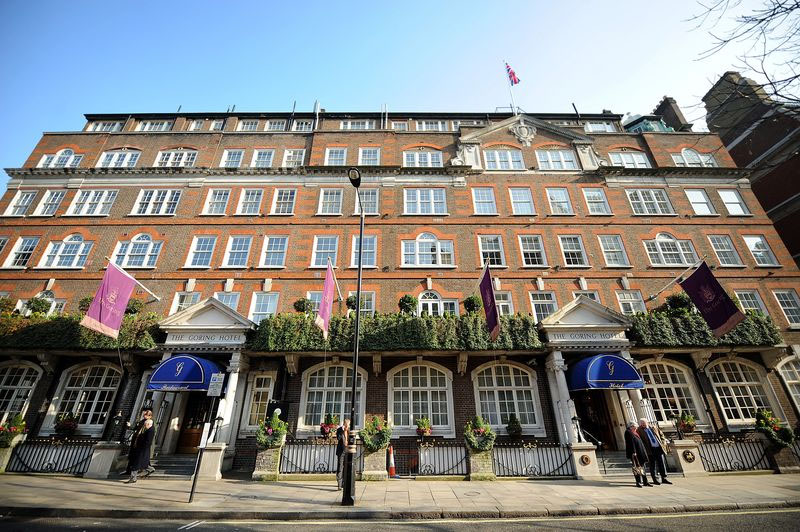
The Goring Hotel, a few blocks from Buckingham Palace, is where Kate Middleton will spend the night before the wedding. Rooms at the posh hotel go for $315-$2,600 (U.S./Canadian) a night. (Ben Stansall/AFP/Getty Images)

More details have emerged about the royal wedding day, right down to the minute.

To start with, it’s revealed that Kate Middleton will be spending her final night of single-dom at the Goring Hotel, nearby Buckingham Palace. (Don’t bother looking … it’s fully booked for April 28). It’s reported that the bride-to-be, her sister Pippa and mom Carole will be staying in a five-room suite, complete with a four-poster bed and a grand piano,

From the moment Kate awakens (if she even gets any sleep), everything is on the clock. Here’s how the day will break down. (These are London times. For Eastern times, subtract five hours: Western times subtract eight hours):

  • Between 8.15 am and 9.45 am (3:15-4:45 Eastern):  The general congregation will arrive at the Great North Door of Westminster Abbey.
  • From 9.50am:  Governors-General and Prime Ministers of realm countries,the diplomatic corps, and other distinguished guests arrive at the Abbey.
  • 10.10am: Prince William and Prince Henry of Wales leave Clarence House for Westminster Abbey.  They arrive at the Abbey at 10.15 am.
  • 10.20 am: Members of Foreign Royal Families arrive at Westminster Abbey from Buckingham Palace.
  • 10.20 am: Carole Middleton, Kate’s mom, and brother James Middleton leave the Goring Hotel for Westminster Abbey.  They arrive at the Abbey at 10.27 am.
  • 10.25 am: Members of the Royal Family (except those listed below) leave Buckingham Palace for Westminster Abbey.  They arrive at the Abbey at 10.30am.
    • 10.35 am: The following Members of the Royal Family leave Buckingham Palace for Westminster Abbey.  They arrive at the Abbey at 10.40am

                 – The Princess Royal and Vice Admiral Timothy Laurence
                 – The Duke of York
                 – Princess Eugenie of York
                 – Princess Beatrice of York
                 – The Earl and Countess of Wessex

  • 10.38 am: The Prince of Wales and The Duchess of Cornwall leave Clarence House for Westminster Abbey.  They arrive at the Abbey at 10.42 am.
  • 10.40 am: The Queen and The Duke of Edinburgh leave Buckingham Palace for Westminster Abbey.  They arrive at the Abbey at 10.45 am.
  •  10.48 am: The bridesmaids and Pages leave the Goring Hotel for Westminster Abbey.  They arrive at the Abbey at 10.55 am.
  • 10.51am The Bride, accompanied by Mr. Michael Middleton, leaves the Goring Hotel for Westminster Abbey.
  •  11.00 am The marriage service begins.  The service will be relayed by audio speakers along the route.
  • 12.15 pm: The carriage procession of the bride and bridegroom with a Captain’s Escort of the Household Cavalry, followed by The Queen’s procession with a Sovereign’s Escort of the Household Cavalry, leaves Westminster Abbey for Buckingham Palace.
  • 12.30 pm: The bride’s carriage procession arrives at Buckingham Palace.
  • 12.40 pm: Members of the royal family and Members of foreign royal families arrive at Buckingham Palace.
  • From 12.40 pm: Other guests for the Reception arrive at Buckingham Palace.
  • 1.25 pm:  The Queen and the bride and bridegroom, together with their families, appear on the balcony.
  • 1.30 pm:  Flypast by the Royal Air Force and Battle of Britain Memorial Flight. 

This report taken from the Toronto Star.