Unintended Consequences

For every action there is a reaction.  This is not news.  The concern ought to be the unknown consequences. 

Former Vice President Dick Cheney and others had predicted that the Iraq invasion would end peacefully in weeks after it was started.  It appears that no one considered there would be a sectarian war between Sunnis, Shias, and Kurds.  Nor did the administration consider many Iraqis would think the United States an enemy.

The State of Israel withdrew from Gaza expecting to see an end to the rocket attacks against their border settlements.  The result was just the opposite.  Palestinians were motivated to increase their attacks believing that they had succeeded in their efforts.

Health care reform has already created one unintended consequence.  A surprising number of companies announced they would be taking charges on future earnings because of tax law changes in the new law.  Heavy-construction equipment manufacturer Caterpillar that said the tax hikes would result in a $100 million drag on their first quarter because the bill Obama signed will cut the tax deduction businesses are given to provide their retirees with health care benefits.  AT&T, Prudential Financial Inc., John Deere Co., Valero Energy, AK Steel Corporation and 3M all announced that they too would take charge against earnings in response to the $1 trillion health care bill’s tax consequences on employers.

Could it be that all the leaders who put these situations into play actually realized there might be these kinds of consequences?  Perhaps they considered the possible results were prices worth paying.  Honestly I do not think they are that smart.  What did Obama mean when he said ‘change we can believe in’ ?

You Can Avoid Execution for Murder

White supremacist gang hit man Billy Joe Johnson got what he asked for from the Orange County California jury that convicted him of first-degree murder in October 2009: a death sentence.

It wasn’t remorse for his crimes or a desire for atonement that drove him to ask for execution; it was the expectation that conditions on death row would be more comfortable than in other maximum-security prisons and that any date with the executioner would be decades away if it came at all.

Huntington Beach, California Police Department detectives are trying to identify women, girls, boys and toddlers who appear in hundreds of photos seized from a storage locker in Seattle, Washington, that was rented by convicted serial killer and Dating Game winner Rodney Alcala.  Alcala, age 66, was sentenced to death on Monday, March 30, 2010 for killing five people. 

The Los Angeles Times reports that since 1977 the actual number of executions in California prisons is 13.  What are the chances that Alcala or Johnson will be executed?  It is unlikely.  California has the nation’s largest death row population, with 685 sentenced to die by lethal injection.  Five times as many death row inmates — 71 — have died over that same period of natural causes, suicide or inside prison violence. 

The reason the death penalty has failed to reduce murder is obvious.  The State of California rarely actually does conduct executions.

Next Year in the White House: A Seder Tradition

REPAIRING A DAMAGED IMAGE

Although this really happened last year it was not an event that came to my attention.  I suspect this re-write on New York Times page A1 is a set up to “make nice” with American Jews.

  Pete Souza/White House

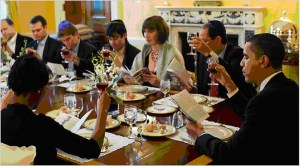
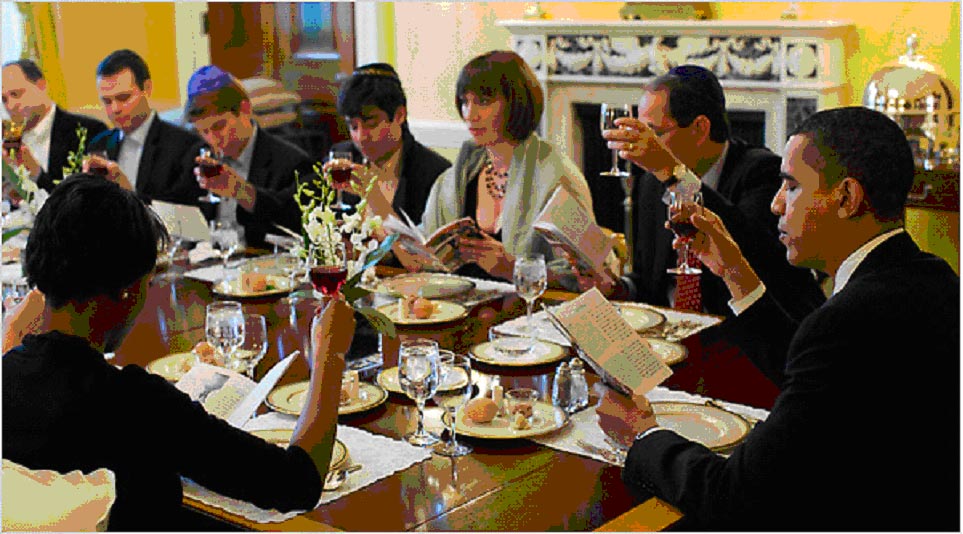
Last year’s Seder, a White House first, saw the Macaroon Security Standoff.
By JODI KANTOR
Published: March 26, 2010 in the NewYork Times
WASHINGTON — One evening in April 2008, three low-level staff members from the Obama presidential campaign — a baggage handler, a videographer and an advance man — gathered in the windowless basement of a Pennsylvania hotel for an improvised Passover Seder.
 
 Pete Souza/White House
Susan Sher, who is now Michelle Obama’s chief of staff, at the White House Seder last year.

The day had been long, the hour was late, and the young men had not been home in months. So they had cadged some matzo and Manischewitz wine, hoping to create some semblance of the holiday.

Suddenly they heard a familiar voice. “Hey, is this the Seder?” Barack Obama asked, entering the room.

So begins the story of the Obama Seder, now one of the newest, most intimate and least likely of White House traditions. When Passover begins at sunset on Monday evening, Mr. Obama and about 20 others will gather for a ritual that neither the rabbinic sages nor the founding fathers would recognize.

In the Old Family Dining Room, under sparkling chandeliers and portraits of former first ladies, the mostly Jewish and African-American guests will recite prayers and retell the biblical story of slavery and liberation, ending with the traditional declaration “Next year in Jerusalem.” (Never mind the current chill in the administration’s relationship with Israel.)

Top aides like David Axelrod and Valerie Jarrett will attend, but so will assistants like 24-year-old Herbie Ziskend. White House chefs will prepare Jewish participants’ family recipes, even rendering chicken fat — better known as schmaltz — for just the right matzo ball flavor.

If last year is any guide, Malia and Sasha Obama will take on the duties of Jewish children, asking four questions about the night’s purpose — along with a few of their own — and scrambling to find matzo hidden in the gleaming antique furniture.

That event was the first presidential Seder, and also probably “the first time in history that gefilte fish had been placed on White House dishware,” said Eric Lesser, the former baggage handler, who organizes each year’s ritual.

As in many Jewish households, the Obama Seder seems to take on new meaning each year, depending on what is happening in the world and in participants’ lives (for this group, the former is often the same as the latter).

The first one took place at the bleakest point of the campaign, the long prelude to the Pennsylvania primary, which was dominated by a furor over Mr. Obama’s former pastor. “We were in the desert, so to speak,” remembered Arun Chaudhary, then and now Mr. Obama’s videographer, who grew up attending Seders with his half-Jewish, half-Indian family.

No one led the proceedings; everyone took turns reading aloud. Mr. Obama had brought Reggie Love, his personal aide, Ms. Jarrett and Eric Whitaker, another close friend, all African-American. Jennifer Psaki, the traveling press secretary, and Samantha Tubman, a press assistant, filtered in. Neither had ever been to a Seder, but they knew the Exodus story, Ms. Psaki from Catholic school and Ms. Tubman from childhood Sundays at black churches.

They peppered the outnumbered Jews at the table with questions, which the young men sometimes struggled to answer. “We’re not exactly crack Hebrew scholars,” said Mr. Lesser, now an assistant to Mr. Axelrod.

Participants remember the evening as a rare moment of calm, an escape from the din of airplanes and rallies. As the tale of the Israelites unfolded, the campaign team half-jokingly identified with their plight — one day, they too would be free. At the close of the Seder, Mr. Obama added his own ending — “Next year in the White House!”

Indeed, the group, with a few additions, has now made the Seder an Executive Mansion tradition. (No one considered inviting prominent rabbis or other Jewish leaders; it is a private event.)

But maintaining the original humble feel has been easier said than done.

Ms. Tubman and Desirée Rogers, then the White House social secretary, tried to plan an informal meal last year, with little or even no wait staff required. White House ushers reacted with what seemed like polite horror. The president and the first lady simply do not serve themselves, they explained. The two sides negotiated a compromise: the gefilte fish would be preplated, the brisket passed family-style.

Then came what is now remembered as the Macaroon Security Standoff. At 6:30, with the Seder about to start, Neil Cohen, the husband of Michelle Obama’s friend and adviser Susan Sher, was stuck at the gate bearing flourless cookies he had brought from Chicago. They were kosher for Passover, but not kosher with the Secret Service, which does not allow food into the building.

Offering to help, the president walked to the North Portico and peered out the door, startling tourists. He volunteered to go all the way to the gates, but advisers stopped him, fearing that would cause a ruckus. Everyone seemed momentarily befuddled. Could the commander in chief not summon a plate of cookies to his table? Finally, Mr. Love ran outside to clear them.

Mr. Obama began the Seder by invoking the universality of the holiday’s themes of struggle and liberation. Malia and Sasha quickly found the hidden matzo and tucked it away again, so cleverly that Mr. Ziskend, the former advance man, needed 45 minutes to locate it. At the Seder’s close, the group opened a door and sang to the prophet Elijah.

In preparation for this year’s gathering, Mr. Lesser and others have again been collecting recipes from the guests, including matzo ball instructions from Patricia Winter, the mother of Melissa Winter, Mrs. Obama’s deputy chief of staff.

“We like soft (not hard) matzo balls,” Mrs. Winter warned in a note to the White House chefs, instructing them to buy mix but doctor it. Use three eggs, not two, she told them; substitute schmaltz for vegetable oil, and refrigerate them for a day before serving (but not in the soup).

The Seder originated with Jewish staff members on the campaign trail who could not go home, but now some celebrate at the White House by choice. Participants say their ties are practically familial now anyway. “Some of the most challenging experiences of our life we’ve shared together,” Ms. Jarrett said.

No one yet knows exactly what themes will emerge this year. Maybe “taking care of people who can’t take care of themselves and health care reform,” suggested Ms. Sher, now Mrs. Obama’s chief of staff.

The evening might also reflect a group that has settled into the White House and a staff more familiar with the new custom. Last week, Ms. Sher was leaving the East Wing when a guard stopped her.

“Hey, are you bringing macaroons again this year?” he asked.
The Pope Should Resign

Misbehavior from larceny to sexual scandal to child abuse is not limited to the Roman Catholic Church.  Wikipedia lists 27 Christian evangelist scandals that do not include Roman Catholic clergy.  Among them are Aimee Semple McPherson, Jim and Tammy Bakker, Jimmy Swaggart, Ted Haggard, and Tony Alamo.  The Baltimore Jewish Times reported on money laundering by Jewish religious organizations this past February 21.

The Associated Press Reported on March 15, 1995: “The Rev. Donn Moomaw, who was Ronald Reagan’s minister for decades, resigned as pastor of Bel Air Presbyterian Church because of “sexual contact” with five women, the church disclosed.”  Initially the reverend stated that he was resigning for “personal reason.”    

Cardinal Joseph Ratzinger, the future Pope Benedict XVI, participated in precisely the sort of secrecy and administrative negligence that has been at the root of the sexual child abuse scandal that has rocked the American Catholic archdiocese.  

The pope in a recent letter to the Irish bishops fails to see his own culpability: “It cannot be denied that some of you and your predecessors failed, at times grievously, to apply the long-established norms of canon law to the crime of child abuse. . . . I recognize how difficult it was to grasp the extent and complexity of the problem, to obtain reliable information and to make the right decisions in the light of conflicting expert advice. Nevertheless, it must be admitted that grave errors of judgment were made and failures of leadership occurred. All this has seriously undermined your credibility and effectiveness.”

The pope should resign for “health reasons.”    

RECONCILIATION

Life is all about reconciliation.

America’s strength is based upon reconciliation.  A synonym for reconciliation is compromise.  That is the basis for our form of government going back to Benjamin Franklin.  The first 10 amendments to the constitution were a gesture of compromise by those believing the basic document was sufficient.

Of course feuding married couples try to find reconciliation of their marital disagreements through some form of compromise.  Just enter the words “marital reconciliation” into Google and the results are significant.  Many web sites offer success stories.

Oh those jobs I accepted to put food on the table and pay the bills.  They were jobs I thought I would never take.  Higher earning Americans cannot survive on unemployment insurance for very long without impacting their savings.   

The Senate just faced a reconciliation bill on health care.  Unfortunately the Republicans want to make some political capital out of this situation.  They are more of a flag waving group than Democrats.  Apparently they do not see that they are destroying a basic tenant of our democracy.

Pareto’s Law

About 30 years ago a mathematician working at my employer told me about Pareto’s Law or principle and how it worked.  I had recalled learning about the theory in college but never had an opportunity to apply its use. 

The theory was devised by Vilfredo Pareto.  In 1906, the Italian economist created a mathematical formula to describe the unequal distribution of wealth in his country, observing that twenty percent of the people owned eighty percent of the wealth. The Pareto law, in its generalized form, states that 80 % of the objectives – or more generally the effects – are achieved with 20 % of the means – or more.  In other words, not always in the exact 80/20 ratio, this phenomenon seems to occur in many venues.

If you apply the principle to the distribution of wealth in the United States you reach the conclusion that about 20% of the population does own 80% of the wealth.  Although it is not precise, G. William Domhoff’s research about America’s wealth distribution seems to hold up fairly well.

Back at the factory I worked in 30 years ago the sales of our 110 unit product line did break down to 80% of the revenue coming from 20% if the items we offered.  It was almost exactly in that ratio.  I was astonished how closely the numbers were aligned.

I am willing to bet that 80% of the revenue in any super market is derived from 20% of the stocked items plus or minus 3%.

Occupations with the Largest Employment Growth

The U.S. Bureau of Labor Statistics lists the top 30 occupations in employment growth through 2018. There is more detail on the BLS web site. This is a sortable listing using Microsoft Excel.  You can copy this listing into Excel. 

 Occupation  Employment Change
         
  2008 2018 Number Percent
      (In thousands)  
Registered nurses 2,619 3,200 582 22.2
         
Home health aides 922 1,383 461 50.0
         
Customer service representatives 2,252 2,652 400 17.7
         
Combined food preparation and 2,702 3,096 394 14.6
serving workers, including fast food        
         
Personal and home care aides 817 1,193 376 46.0
         
Retail salespersons 4,489 4,864 375 8.4
         
Office clerks, general 3,024 3,383 359 11.9
         
Accountants and auditors 1,291 1,570 279 21.7
         
         
Nursing aides, orderlies, and 1,470 1,746 276 18.8
attendants        
         
Postsecondary teachers 1,699 1,956 257 15.1
         
Construction laborers 1,249 1,505 256 20.5
         
Elementary school teachers,     1,550 1,794 244 15.8
except special education             
         
Truck drivers, heavy and  1,798 2,031 233 13.0
tractor-trailer        
         
Landscaping and groundskeeping 1,206 1,423 217 18.0
 workers        
         
Bookkeeping, accounting, 2,064 2,276 212 10.3
and auditing clerks          
         
Executive secretaries and  1,594 1,799 204 12.8
administrative assistants        
         
Management analysts 747 925 178 23.9
         
         
Computer software engineers, 515 690 175 34.0
applications        
         
Receptionists and information clerks 1,139 1,312 173 15.2
         
Carpenters 1,285 1,450 165 12.9
         
Medical assistants 484 648 164 33.9
         
First-line supervisors/managers of  1,457 1,618 160 11.0
office and administrative support         
workers        
         
Network systems and data  292 448 156 53.4
communications analysts        
         
Licensed practical and licensed  754 909 156 20.7
vocational nurses        
         
Security guards 1,077 1,229 153 14.2
         
Waiters and waitresses 2,382 2,533 152 6.4
         
Maintenance and repair workers,  1,361 1,509 148 10.9
general        
         
Physicians and surgeons 661 806 144 21.8
         
Child care workers 1,302 1,444 142 10.9
         
Teacher assistants 1,313 1,448 135 10.3

Health Care We Can’t Afford

While the passing of health care reform may be a major improvement in the availability of care it is coming at a significant cost to this nation.  I do not subscribe to many, perhaps most, of Republican objections.  America will have to find money to cover the cost of health care that many people cannot afford.

As it stands now the cost of this bill will be a major burden on senior citizens.  That is a reduction of Medicare payouts of $500 billion.  Senior citizens will most likely punish the Democratic Party by voting many of their members out of office next November.      

America’s Economic Future

According to Bloomberg BusinessWeek’s Rich Miller there are two economic theories about the future of the United States.

“Mohamed El-Erian and his colleagues at Pacific Investment Management Co. coined the phrase “the new normal” to describe their vision of America’s economic future. The chief executive of the world’s largest bond fund argued that retrenchment by debt-laden consumers and tougher regulation of the financial-services industry would leave the U.S. with tepid annual growth of around 2% for years.”

Miller reports that Joseph Carson, an economist with AllianceBernstein (AB) in New York “posits” his new mix view that the economy will be “powered more by exports and business investment than by the traditional drivers of consumption and housing.”

I want to be the optimist about the future of the United States. It’s hard to be positive when unemployment in California is at 12.5 % and the signs of growth are few and far between.  However, I found one outstanding example of new growth today.  Boeing Company has reported they will speed up production of 747 and 777 models.  The vast majority of the increased business will come from carriers in Latin America and Asia.  This event supports Joseph Carson’s theory.

A Richman’s Roadmap

Republican Congressman Paul Ryan of Wisconsin’s 1st District has an interesting web site titled The Roadmap Plan.  There was a very appealing article in Newsweek about Mr. Ryan and he has appeared on Hardball with Chris Matthews on MSNBC sounding like a very reasonable person.  If ever there was a likely candidate for Republican president it is Congressman Ryan.  The problem is he proposes changes to America that every wealthy person will love.  After you have read The Roadmap Plan you can read my rebuttal below. 

-Health Care

An interesting proposal but there is limited effort to control the actual cost of care.  That was President Obama’s number one priority and it was forgotten shortly after his push for health care reform.  Anthem Blue Cross raising rates as much as 39% in CA is a very loud message.  What is the solution to this issue?

-Medicare

I believe this program was established for those who could not afford private insurance.  If this revised program will leave people penniless when there is a major medical issue, it does not answer the needs of the elderly.  This is a matter of public policy.  Does society tell the elderly when you run out of money you will die because we do not want to pay your bills?

-Social Security

If the government will “guarantee that individuals will not lose a dollar they contribute to their accounts, even after inflation” that will not satisfy the payment rates currently provided to a retiree who lives 20 past his retirement date.

Where will the money come from to support current pay out rates?

-Tax Reforms

There is at least one aspect of this complicated program that I do understand.  “Eliminating taxes on interest, capital gains, and dividends” will be a great benefit to the wealthy.  People with earnings of million of dollars per year in pay will invest their money but won’t pay taxes on the investment income.  How nice for the millionaires of the country.  They will pay no taxes if their income is in the form of stock options and other non salary payments.

The frightening thing is that many Americans might buy Congressman Ryan’s ideas as the best roadmap for America.