Today in History: August 14, FDR signs Social Security Act

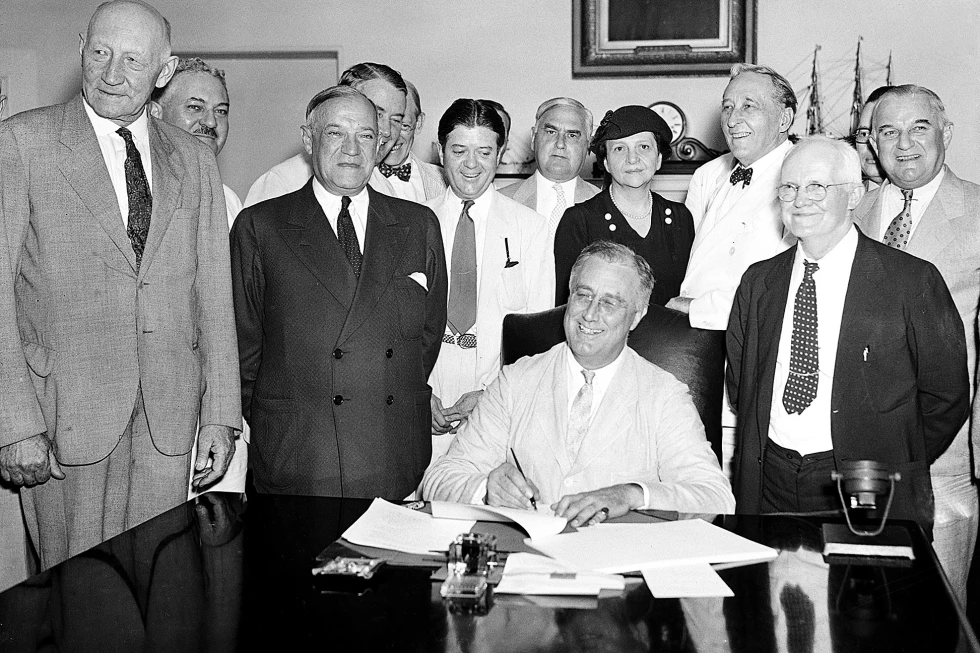
On Aug. 14, 1935, President Franklin D. Roosevelt signed the Social Security Act into law, ensuring income for elderly Americans and creating a federal unemployment insurance program. 

The Social Security Act was the most important domestic legislation signed into law by FDR.

As of February 2024, approximately 67 million people, or about 1 in 5 US residents, received Social Security benefits. This includes retirees and their families, as well as people who receive Social Security Disability Insurance (SSDI) or are young survivors of deceased workers.

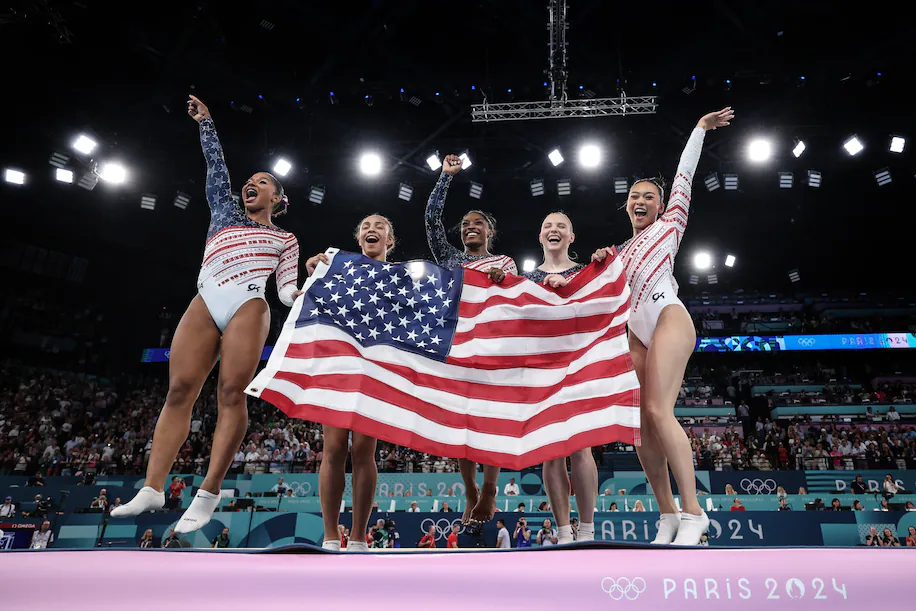
Olympics: Lots of medals. Lots of skin colors. See the connection?

Diversity shows its value in the makeup of Team USA

By Michele Norris, Washington Post

August 10, 2024 at 1:24 p.m. EDT

Right-wing warriors can rail against diversity, equity and inclusion all they want. But the same so-called patriots who aggressively wrap themselves in the flag and claim America as their country cannot be blind to what is on display for all the world to see at the Paris Olympics.

Diversity is now a core part of America’s brand. In gymnastics and swimming. In fencing and rugby. In skateboarding, tennis, boxing, basketball and so much more. In commentary from Snoop Dogg and Flavor Flav. In the massive billboards all over Paris from U.S.-based companies like Nike and Ralph Lauren that feature brown-skinned models. And let’s not forget the music that’s played to pump upthe audience at all the events — whether or not Americans are competing. I was at the Paris Olympics for a few days,and at every venue I visited, American music with a funky beat was the go-to choice to fire upcrowds and athletes from all over the world. As we watch Americans rack up medals, that retrograde Trumpian Make America Great Again message seems silly; America is clearly pretty great right now.

You cannot cheer for the United States in this moment without also cheering on the diversity born of merit. And that is an important point because the ammunition used to instill fears about diversity in a changing America are based on the false notion that Black and Brown people are getting something they don’t deserve.

That is the fib at the heart of the orchestrated effort to dismantle diversity programs. It assumes that the only way to achieve diversity is by bringing on people of color who have lesser skills or qualifications than White candidates. This is what feeds the idea —no, make that the lie — that under credentialed people of color are pushing White candidates out of their rightful place.

Diversity is not about lowering standards. It’s about widening the aperture to make sure an organization can find the best talent available. It’s about reaching beyond one’s comfort zone or personal network to look for talent and potential in areas that might be unfamiliar. So often, access to opportunity is based on something sociologists call “homosociality” – friendship, mentoring, social circles and cliques based on commonality and comfort. It’s the jolt of reassurance or even relief at finding someone who appears to be the right fit because they have the right background and the right skin color, they went to the right school, they engage in the right sports (golf or sport fishing, for instance), or they speak in the right vernacular. People drift to the familiar. It’s human nature.

This is why the world of sports provides a useful antidote. While sports teams and athletic organizations may have limited their scope of recruitment in the past — based on tradition, bias or the belief that certain kinds of people lacked certain innate characteristics — that line of thinking has eroded faster in sport than other sectors. Remember: It wasn’t that long ago that Black men were not considered quarterback material.

Coaches and recruiters will go where the talent is and cast an ever-widening net to find it. Why? Because they know that talent is equally distributed but opportunity is not. They know that the potential for greatness percolates in all kinds of places, and if they spot it early, they can nurture it toward victory without lowering standards. And they know that staying in their personal socio-economic comfort zonescould keep them from winning.

The Olympic Games are about winning — and so much more. I’ve always loved watching the Games on TV with my family in part because of the learning experience it provides: calmness under pressure. Grace in defeat. People from all over the world coming together to chase their dreams. After a year of pugilistic politics and attacks on diversity programs, the Olympics once again deliver an avalanche of life lessons.

At a time when members of one political party will not commit to accepting the outcome of the upcoming election, it is heartening to watch top athletes shake hands with the competitors who beat them and step aside so the victors can bask in their earned glory. And the mosaic of diverse athletes — often in sports that until recently did not include many people of color — is also a reflection of American values and the cultural diversity at the core of this multiethnic country.

You can’t have it both ways. You can’t cheer on Team USA without cheering on the diversity that makes Team USA great.

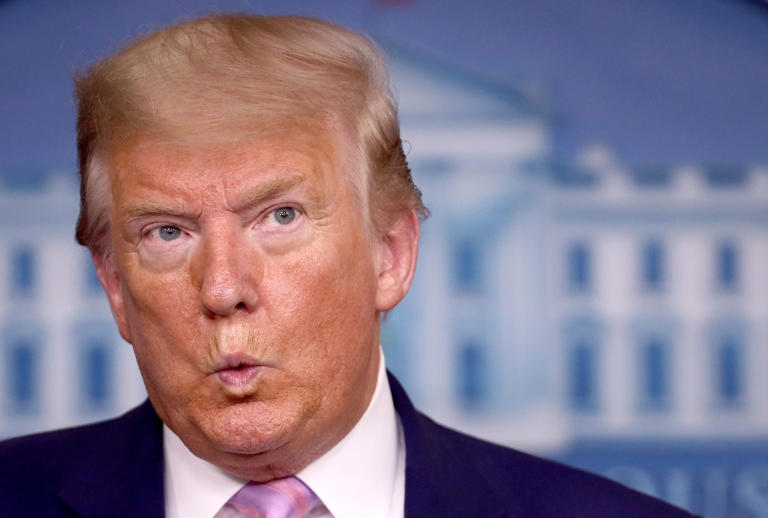
What did Donald Trump accomplish as president?

As identified by The Week magazine these were Donald Trump’s significant accomplishments during his presidency.

The judiciary

Trump’s “most lasting impact on the country” is likely the drastic reshaping of America’s courts, Business Insider said. By installing more than 200 federal judges, including 54 who “reshaped the ideological makeup of federal appeals courts” and three who drove a “generational shift in the highest court in the land,” Trump’s impact on the judicial branch of government overall will “continue shaping the American legal and political landscape for decades,” CNN said. 

The Tax Cuts and Jobs Act

Trump’s 2017 tax bill — colloquially The Tax Cuts and Jobs Act — was arguably his “biggest legislative achievement,” which was intended, per Trump, to “super-charge the economy,” said Politico. It was also the “biggest tax overhaul since the Tax Reform Act of 1986,” the Brookings Institute said, but “skewed toward the rich” and “failed to deliver promised economic benefits,” said the Center on Budget and Policy Priorities. One unambiguous takeaway: “U.S. corporations got to keep more of their money, and the U.S. government got less,” said Bloomberg.

Space Force

It was the stuff of jokes and mockery when Trump announced in 2018 that he planned to back a long dormant plan to create a sixth, space-focused branch of the U.S. Armed Services — the first new branch since the Air Force was founded in the wake of World War II. But just one year after its official founding in 2019, Space Force had “developed from a theoretical concept to an operational service fully engaged in a broad spectrum of activities,” West Point’s Lieber Institute said. While the Space Force’s annual budget grew over the first four years of its existence, that upward trend “will stop in fiscal 2025, for which the service is requesting $29.4 billion, down $0.6 billion from last year,” Defense One said.

Criminal justice reform  

While much of Trump’s experience in the realm of criminal justice has been as a litigant, rather than policy expert, he nevertheless helped champion the historic First Step Act, the “most sweeping set of changes to the federal criminal justice system since the 1990s,” NBC said. The bipartisan-backed law “allows thousands of people to earn an earlier release from prison and could cut many more prison sentences in the future,” said Vox, and represents “modest steps to alter the federal criminal justice system and ease very punitive prison sentences at the federal level.” The law has shown “promising results thus far,” with beneficiaries showing recidivism rates “considerably lower than those who were released from prison without benefit of the law,” The Sentencing Project said. 

Democrats are Living in a Fantasy World

The giddy excitement over the selection of Tim Walz for vice president may make Democrats feel good for the moment but it is unlikely to change the outcome of the November election. No one decided to vote for President Joe Biden based on his decision to select Kamala Harris as his running mate.

John McCain’s selection of Sarah Palin was not the reason he lost his election for president. Barack Obama wasn’t elected president because he chose to run alongside Joe Biden. Mitt Romney didn’t lose his White House bid because Paul D. Ryan was his pick for vice president.

So far Kamala Harris has not offered one thought about what she will do if elected president. We have all heard Donald Trump’s plans to raise tariffs, close the border, and expel illegal aliens among other promises. From Harris we have heard nothing.

Some of you may remember the 1984 US presidential campaign in which Walter Mondale used this slogan, “Where’s the beef?” to ridicule his rival for the Democratic nomination.

I am asking the same question in 2024.

Kamala Harris is now Democratic presidential nominee but was it a mistake?

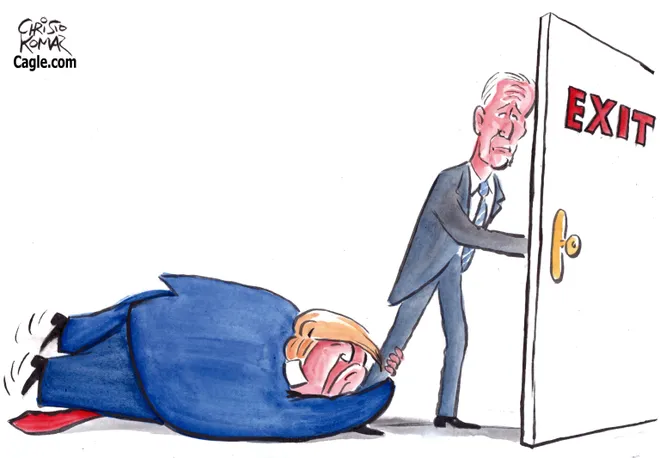
Just as soon as Biden abruptly ended his candidacy, he endorsed Vice Kamala Harris. Her team worked rapidly to secure backing from the 1,976 party delegates needed to clinch the nomination in a formal roll call vote.

When the initial exuberance wears off will Harris be able to lead?

Her first decision was to identify a running mate to be her vice president. The selection offered a list of many extremely qualified candidates. Josh Shapiro, Governor of Pennsylvania, Minnesota Governor Tim Walz, Arizona Sen. Mark Kelly of Arizona, and Secretary of Transportation Pete Buttigieg. All of them more than qualified to be president. None of them with the baggage of the Biden presidency.

No matter what Harris says she will be linked to President Joe Biden and to her past positions. While I agree with most of her positions the Trump campaign will paint her positions as radical and her as a radical left-wing extremist.

None of her potential VP candidates will be burdened with her views.

Democrats rushed to avoid disarray. But crowning Harris was a mistake.

When President Biden courageously ended his reelection bid, he gave Democrats a golden opportunity to win in November. Now, many Democratic leaders and delegates seem intent on squandering that opportunity by rushing to make Vice President Harris the party’s nominee.

Their aim is to coalesce quickly around Ms. Harris as the heir apparent and forestall a nomination fight at the party’s convention next month. But for all her achievements and admirable service, Ms. Harris carries all the baggage of the Biden administration.

She, like Mr. Biden, has been trailing Donald Trump in polling and is unlikely to carry the handful of states — Michigan, Wisconsin, Ohio and Pennsylvania — where this election will be decided. Democrats should take a deep breath and consider their options. If they are guided by data and political instinct, they can choose the candidate most likely to defeat Mr. Trump.

Name calling like saying Trump and Vance and their supporters are “weird” is playground nonsense.

I have yet to hear one thing that a President Harris will do once she is elected.

Joe Biden: My plan to reform the Supreme Court and ensure no president is above the law

By Joe Biden, Published in The Washington Post

July 29, 2024 at 5:00 a.m. EDT

The writer is president of the United States.

This nation was founded on a simple yet profound principle: No one is above the law. Not the president of the United States. Not a justice on the Supreme Court of the United States. No one.

But the Supreme Court’s 6-3 decision on July 1 to grant presidents broad immunity from prosecution for crimes they commit in office means there are virtually no limits on what a president can do. The only limits will be those that are self-imposed by the person occupying the Oval Office.

If a future president incites a violent mob to storm the Capitol and stop the peaceful transfer of power — like we saw on Jan. 6, 2021 — there may be no legal consequences.

And that’s only the beginning.

On top of dangerous and extreme decisions that overturn settled legal precedents — including Roe v. Wade — the court is mired in a crisis of ethics. Scandals involving several justices have caused the public to question the court’s fairness and independence, which are essential to faithfully carrying out its mission of equal justice under the law. For example, undisclosed gifts to justices from individuals with interests in cases before the court, as well as conflicts of interest connected with Jan. 6 insurrectionists, raise legitimate questions about the court’s impartiality.

I served as a U.S. senator for 36 years, including as chairman and ranking member of the Judiciary Committee. I have overseen more Supreme Court nominations as senator, vice president and president than anyone living today. I have great respect for our institutions and the separation of powers.

What is happening now is not normal, and it undermines the public’s confidence in the court’s decisions, including those impacting personal freedoms. We now stand in a breach.

That’s why — in the face of increasing threats to America’s democratic institutions — I am calling for three bold reforms to restore trust and accountability to the court and our democracy.

First, I am calling for a constitutional amendment called the No One Is Above the Law Amendment. It would make clear that there is no immunity for crimes a former president committed while in office. I share our Founders’ belief that the president’s power is limited, not absolute. We are a nation of laws — not of kings or dictators.

Second, we have had term limits for presidents for nearly 75 years. We should have the same for Supreme Court justices. The United States is the only major constitutional democracy that gives lifetime seats to its high court. Term limits would help ensure that the court’s membership changes with some regularity. That would make timing for court nominations more predictable and less arbitrary. It would reduce the chance that any single presidency radically alters the makeup of the court for generations to come. I support a system in which the president would appoint a justice every two years to spend 18 years in active service on the Supreme Court.

Third, I’m calling for a binding code of conduct for the Supreme Court. This is common sense. The court’s current voluntary ethics code is weak and self-enforced. Justices should be required to disclose gifts, refrain from public political activity and recuse themselves from cases in which they or their spouses have financial or other conflicts of interest. Every other federal judge is bound by an enforceable code of conduct, and there is no reason for the Supreme Court to be exempt.

All three of these reforms are supported by a majority of Americans— as well as conservative and liberal constitutional scholars. And I want to thank the bipartisan Presidential Commission on the Supreme Court of the United States for its insightful analysis, which informed some of these proposals.

We can and must prevent the abuse of presidential power. We can and must restore the public’s faith in the Supreme Court. We can and must strengthen the guardrails of democracy.

In America, no one is above the law. In America, the people rule.
Diversity, Equity, and Inclusion

What is DEI and how will it effect the upcoming election? DEI means Diversity, equity, and inclusion. It has become a talking point for businesses and politics.

As the nation prepares for the 2024 election, it is crucial to recognize the role of DEI in shaping political narratives and voter behavior. The ongoing debates and controversies highlight the importance of fostering an inclusive and equitable political landscape where all voices can be heard and respected.

Republicans are warning their colleagues to back off using diversity, equity and inclusion (DEI) politics to attack Vice President Harris as she launches her presidential bid.

The GOP has had to quickly revamp its attacks in the days since President Biden withdrew from the 2024 race and Democrats coalesced around Harris as his replacement — and some members have taken swipes over her race and gender in arguing she is unqualified.

Senator JD Vance (R-OH) and Congressman Michael Cloud (R-TX-27), along with cosponsors Senators Marsha Blackburn (R-TN), Bill Cassidy (R-LA), Kevin Cramer (R-ND), Eric Schmitt (R-MO), Rick Scott (R-FL), and fifteen members of the U.S. House of Representatives, have introduced the Dismantle DEI Act to eliminate all federal DEI programs and funding for federal agencies, contractors which receive federal funding, organizations which receive federal grants, and educational accreditation agencies.

The Washington Post reports that Harris’s campaign will have to contend with DEI, culture war attacks. Despite rising political tensions over DEI programs, a recent Washington Post-Ipsos poll found that about 6 in 10 Americans said diversity programs are a “good thing.”