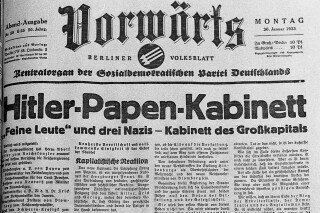
Today in History: January 30, 1933 Hitler becomes German chancellor
In a March 1, 2016 Vanity Fair article it reported that “Trump Kept a Volume of Hitler’s Speeches By His Bedside.”
In a March 1, 2016 Vanity Fair article it reported that “Trump Kept a Volume of Hitler’s Speeches By His Bedside.”
Nobel laureate Paul Krugman on Friday took exception to comments made by Republican presidential primary candidate Nikki Haley.
Haley offered a bleak take on the economy in a campaign speech in her home state of South Carolina on Wednesday. Criticizing her GOP rival Donald Trump for throwing a temper tantrum, Haley said, “He [Trump] didn’t talk about the American people once he talked about revenge. He didn’t talk about the fact that we’ve got an economy in shambles and an inflation that’s run out of control.”
Sharing excerpts of Haley’s comments from OK Magazine on X, Krugman said the economy grew 3% and core inflation was back at 2%. Haley repeated those claims on her Meet the Press interview on the Sunday January 28 program.

Krugman also said the six-month annualized rate of the core price consumption expenditure index should be considered as a more accurate inflation measure than the core annual inflation rate.
“Using annual core CPI puts you way behind the curve, for 2 reasons. First, annual: even core CPI was 4.6 in the first half of 2023, 3.2 in the second half. Second, known lags in official shelter prices lagging far behind market rents,” he said.
“So annual CPI creates a spurious impression of stubborn inflation, with a difficult last mile to cover.”
He observed that shelter receives a lower weight in the calculation of price consumption expenditure.
“The inflation battle is over. Now we need to worry that lagged effects of rate hikes will tip us into an unnecessary recession,” the economist said.
From former Vice President Pence to Bill Barr, former Attorney General these are quotations worth readings.
“Anyone who puts himself over the Constitution should never be president of the United States . . . President Trump demanded that I Choose between him and the Constitution.”
Mike Pence, Vice President
.
“He puts himself before country. His actions are all about him and not about the country.”
Mark Esper, Secretary of Defense
.
“THE DEPTHS OF HIS DISHONESTY IS JUST ASTOUNDING. TO ME … HE IS HE MOST FLAWED PERSON I HAVE EVER MET IN MY LIFE.”
John Kelly, Secretary of Homeland and White House Chief of Staff
.
“His understanding Of global events, his understanding of global history, his understanding of U.S. history was really limited.”
Rex Tillerson, Secretary of State
.
“He will always put his own interests, and gratifying his own ego, ahead of everything else, including the country’s interests.”
Bill Barr, Attorney General
.
“President Trump and other officials have repeatedly compromised our principles in pursuit of partisan advantage and personal gain.”
H. R. McMaster, National Security Adviser
.
“Trump has this impression that foreign leaders, especially adversaries, hold him in high regard, that he got a good relationship with Xi Jinping, Vladimir Putin, Kim Jong Un. In fact, the exact opposite is true. I have been in those rooms with him when he’s met with those leaders. I believe they think he is a laughing fool.”
John Bolton, National Security Adviser
.
“THE PRESIDENT HAS VERY LITTLE UNDERSTANDING OF WHAT IT MEANS TO BE IN THE MILITARY, TO FIGHT ETHICALLY OR TO BE GOVERNED BY A UNIFORM SET OF RULES AND PRACTICES.”
Richard V. Spencer, Security of the Navy
.
“He is more dangerous than anyone could imagine.”
James Mattis, Secretary of Defense
“Over his nearly three-decade political career representing Los Angeles and San Gabriel Valley communities, Schiff (D-Burbank) has been known as a staid, amiable legislator who digs into the details to come up with practical solutions and a reliable advocate for local needs. He served four years in the state Legislature before he was elected to the House in 2001. Before running for office, he was an assistant U.S. attorney and he never shed the methodical, controlled demeanor of a prosecutor.”
I had already decided to vote for him in the upcoming primary election. A few more significant endorsements could settle choice in the primary. All he needs is 50% of the voters plus one vote.
This is the practice of taking someone else’s work or ideas and passing them off as one’s own.
Copying large pieces of text from a source without citing that source. Taking passages from multiple sources, piecing them together, and turning in the work as your own. Copying from a source but changing a few words and phrases to disguise plagiarism.
As a boy in high school I lacked the knowledge to write anything consequential and copied from books. It was plagiarism and I knew it. The teacher of that class knew it too but at least she knew I had done the research and I was given a passing grade on my report.
As an adult I give credit to the author of what I have copied.
Claudine Gay is stepping down as the president of Harvard University. Her decision was the result of her plagiarism. As Tom Nichols writes in The Atlantic Daily: “Despite the results of an investigation commissioned by the Harvard Corporation last month that found cases only of “inadequate” citation, new charges about her work include episodes of what most scholars would recognize as academic misconduct, including plagiarism. Experts consulted by CNN consider the recent excerpts to be plagiarism.” Why Ms. Gay did not provide citation for other’s work we will never know.
We have all had a lesson in stealing the works of others.
Harvard University President Claudine Gay resigned Tuesday January 2, 2024 amid plagiarism accusations and criticism over testimony at a congressional hearing where she was unable to say unequivocally that calls on campus for the genocide of Jews would violate the school’s conduct policy.
Obviously she was pressured to resign after many well off Jewish alumni demanded her removal.
More than 1,600 alumni of Harvard University say that they will withhold donations to the school until Harvard takes urgent action to address antisemitism on campus, part of a wave of challenges to colleges across the county in addressing hate speech sparked by the Israel-Hamas war.
High-profile billionaire alumni like Pershing Square founder Bill Ackman and former Victoria’s Secret CEO Leslie Wexner have already said that if Harvard doesn’t take steps to fix the problem they could face a donor exodus, but now the largest group yet of alumni — most of whom do not have billionaire status — are threatening to withdraw their donations.
Addtionally more than 70 U.S. lawmakers demanded the governing boards of three of the country’s top universities remove their presidents, citing dissatisfaction with their testimony at a hearing about antisemitism on campuses, according to a letter seen by Reuters.
In the letter, Republican Representative Elise Stefanik and Democratic Representative Jared Moskowitz demanded that the board of governors at Harvard University, the University of Pennsylvania, and the Massachusetts Institute of Technology oust their presidents or risk committing “an act of complicity in their antisemitic posture.”
Almost 160 years after the Civil War — Nikki Haley, a leading contender for the GOP presidential nomination and former governor of South Carolina couldn’t answer the simple question “What was the cause of the Civil War?” Her disjointed response was “basically how government was going to run — the freedoms and what people could and couldn’t do.”
The Constitution Center provides this history. “The victory of Republican presidential candidate Abraham Lincoln in the 1860 elections convinced South Carolina legislators that it was no longer in their state’s interest to remain in the Union. South Carolina declared its secession from the United States. Citing “an increasing hostility on the part of the non-slaveholding states to the institution of slavery,”
Sadly in my own experience in the South is that Southerners are still in denial. That is the reason they still fly the Confederate flag in many places. Haley is not alone.

But is it safe?

Pacific Gas & Electric’s Diablo Canyon Power Plant is the only operating nuclear plant in California. Gov. Gavin Newsom supports keeping the plant along the coast near San Luis Obispo operating past its planned shutdown date of 2025.
(Brian van der Brug / Los Angeles Times)
BY TONY BRISCOE STAFF WRITER for the Los Angeles Times
California energy officials have voted to extend the operation of the Diablo Canyon Power Plant through 2030, extending the life span of the state’s last nuclear plant an additional five years.
The California Public Utilities Commission approved a proposal to keep Diablo Canyon’s twin reactors online, overturning an earlier agreement to close the plant in 2025.
Three commissioners — Alice Busching Reynolds, John Reynolds and Karen Douglas — voted in favor. Commissioner Darcie Houck abstained and Commissioner Genevieve Shiroma was absent.
Thursday’s decision is expected to preserve a large bloc of the state’s zero-emission power supply. But it also raises concerns over the high cost and potential safety issues associated with operating an aging nuclear power plant.
The state utilities commission acknowledged that the costs associated with the plan were still unknown but were expected to exceed $6 billion. A federal safety review will also be conducted.
State energy commissioners emphasized that the extension should serve as a bridge to renewable energy and that the plant was not expected to operate beyond 2030. The decision, they said, was intended to bolster the reliability of California’s grid, which has narrowly avoided rolling blackouts during heat waves in recent years.
“The short-term extension of the power plant as proposed is a transitional strategy to help California weather the challenges of the energy transition, including the weather and climate extremes that we have experienced … and the cost challenges that we face in scaling up the clean energy transition so quickly,” Douglas said ahead of the vote. “So this is an opportunity for us to help bridge some years.”
Pacific Gas & Electric Co., the plant’s operator, lauded the commission’s decision, saying it will help provide the state with a dependable, emission-free source of energy.
“We’re grateful for the opportunity to answer the state’s call to ensure electrical reliability for Californians,” said Suzanne Hosn, a spokesperson for PG&E.
At a state meeting filled with heated discourse, supporters argued that California needed the power supply from Diablo Canyon to avert outages and meet the state’s climate goals. The plant supplies about 9% of the state’s electricity and 17% of the state’s zero-emission power.
“It was methodically determined that Diablo Canyon is in fact integral to the California electricity reliability,” said Brendan Pittman, a Berkeley resident, who supported the proposal. “It contributes substantially to California’s zero-emission targets and the costs for continued operation are not, quote, too high to justify.”
But a chorus of critics warned that the extension could bring rate hikes from PG&E.
Opponents also argued that the plant’s proximity to several fault lines makes it susceptible to earthquakes, and a significant risk.
The plant, which sits along the Pacific Ocean about 10 miles outside of San Luis Obispo, opened in 1985. A 46-page report by Digby Macdonald, a professor at UC Berkeley’s Department of Nuclear Engineering, suggested one of the plant’s nuclear reactors “poses an unreasonable risk to public health and safety due to serious indications of an unacceptable degree of embrittlement,” or deterioration due to prolonged exposure to radiation.
Opinion by James D. Zirin
Of all universities, the Ivy League colleges of Harvard, Penn and MIT should know better. It’s very simple: Advocacy of genocide is abhorrent, dehumanizing; it instills fear and distress. It has no place on a college campus, or anywhere else in our society. It has no pedagogical value. It is murder, nihilism.
Just before I went into the Army, a lawyer friend, who had served, counseled me to give an evasive non-answer to any question I was asked: “Depends on the tactics and the terrain.”
So it is perhaps not surprising that a lawyer thought “Depends on the context” was the perfect answer for three university presidents (one of whom is now an ex-president) testifying before Congress if asked whether calls for the genocide of Jews on campus constituted bullying or harassment.
Context? What a dreadful word to use in the context of genocide. What is the context it would depend on — Auschwitz, Dachau, the pogroms of Russia in the 19th century, or the Jews’ convenience over 2,000 years as victims of dehumanizing oppression. And let’s not forget the 1,400 victims of Hamas’ Oct. 7 attack on Israel — women raped and murdered, babies slaughtered, men butchered in barbarous ways on another day that will live in bloody infamy.
At all of these universities, I am certain, burning a cross or erecting a gallows in front of a dormitory housing Black students — both forms of symbolic speech — would constitute bullying or harassment. I’m equally certain that statements targeting LGBTQ+ students would constitute bullying or harassment.
Interestingly enough, Harvard President Claudine Gay was dean of the university’s Faculty of Arts and Sciences on May 25, 2020, when George Floyd was murdered on the faraway streets of Minneapolis. She published a statement, declaring that “We have been here before, too many times,” that “the headlines stir an acute sense of vulnerability,” and that “we are confronted again by old hatreds and the enduring legacies of anti-black racism and inequality.” She said she feared for her teenage son and suggested she felt personally threatened by Floyd’s death. The tragic event, she wrote, illustrated “the brutality of racist violence in this country” and gave her an “acute sense of vulnerability.”
In nothing which Gay said last week before Congress did she show any understanding or empathy that Jewish students or their parents might have felt similarly vulnerable after Harvard condoned calls for the genocide of Jews.
The question put to the university presidents by Rep. Elise Stefanik (R-N.Y.) was not all that difficult. The three scholars likely would not have had such a hard time responding if it had been based on race, gender or sexual orientation. If asked whether the burning of crosses has any place on a university campus, rest assured that the answer would not have been “It depends.”
Jewish students should be treated no differently — and certainly no worse — than others. But the ideal outcome is not to coddle Jewish students or make them another overly protected class. It would be much better for these elite schools to reconsider many of their current practices. They ought to set consistent guidelines on free speech and enforce those. They ought to refrain from partisan statements on national and international issues, which are beyond their scope of responsibility.
Historian Niall Ferguson — among other things, a senior fellow at Harvard’s Belfer Center — has it right in a piece he recently wrote in The Free Press. Ferguson argues that the answers given by the troika of university presidents may have been technically correct under the First Amendment but constituted the “treason of the intellectuals.”
“The lesson of German history for American academia should by now be clear,” Ferguson writes. “In Germany, to use the legalistic language of 2023, ‘speech crossed into conduct.’ The ‘final solution of the Jewish question’ began as speech — to be precise, it began as lectures and monographs and scholarly articles. It began in the songs of student fraternities. With extraordinary speed after 1933, however, it crossed into conduct: first, systematic pseudo-legal discrimination and ultimately, a program of technocratic genocide.”
Germany and France both have more robust approaches to hate speech and incitement to genocide that have much to recommend them. But they’re flatly inconsistent with the way the Supreme Court has interpreted the First Amendment. There is obviously much to think about but, as far as fear of harm goes, violence or the threat of imminent violence obviously is not protected speech. So anyone who commits violence violence, or launches an imminent threat of violence, is breaching university rules.
But is this enough to nip genocidal ideation in the bud? Are the crazies among us more or less likely to become violent if they’re forbidden from engaging in speech about it? I’m not sure.
Perhaps university authorities are more likely to identify dangerous people in their communities if they’re allowed to speak their minds — otherwise, an attack comes without warning. But is it feasible for universities to identify the potentially violent students on campus after they have expressed odious views, put them in a digital dossier, and keep them under artificial intelligence until they attack a Jew heading to class?
One professor I know at Penn explained it this way:
“Oh, I fully agree with no threatening/no taunting/no cross burning. And all of those are prohibited by the Penn speech code. The issue is what to do about a call for genocide at a protest — someone chants ‘Kill all the —.’ I think that contributes nothing to discourse and has no place in a university community, and I would try to teach students norms of civility and respect. But I wouldn’t expel them for saying it, in part because I do think usually the best answer to bad speech is good speech, but more because I worry about giving university administrators the task of deciding who’s calling for genocide. In the Israel-Hamas conflict, for instance, each side accuses the other of genocidal goals, so supporting either side will be called endorsement of genocide. And I just don’t feel like student disciplinary proceedings are the place to decide who’s right about that. Administrators have a very hard time being neutral.”
Right. But can they be neutral about murder? And should university administrators take political positions at all? As Justice Jackson put it in his concurring opinion in Terniniello v. Chicago, “if the Court does not temper its doctrinaire logic with a little practical wisdom, it will convert the constitutional Bill of Rights into a suicide pact.”
Keeping students safe is of paramount importance. So I would forbid anyone on a college campus to advocate the murder of anyone.
James D. Zirin, author and legal analyst, is a former federal prosecutor in New York’s Southern District. He is also the host of the public television talk show and podcast, “Conversations with Jim Zirin.”
 Coast Contact