We all see what’s going on – Trump fired the Commissioner of Labor Statistics so he could replace her with someone who will lie for him.
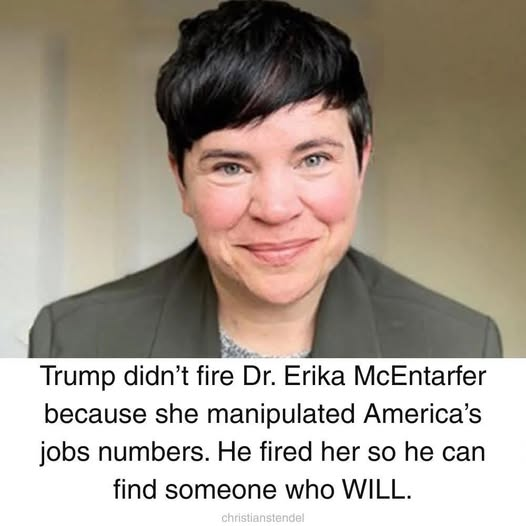
We all see what’s going on – Trump fired the Commissioner of Labor Statistics so he could replace her with someone who will lie for him.
By
David Culver, Norma Galeana, Evelio Contreras and Rachel Clarke, CNN reporters
Updated Aug 7, 2025
The Dalles, Oregon —
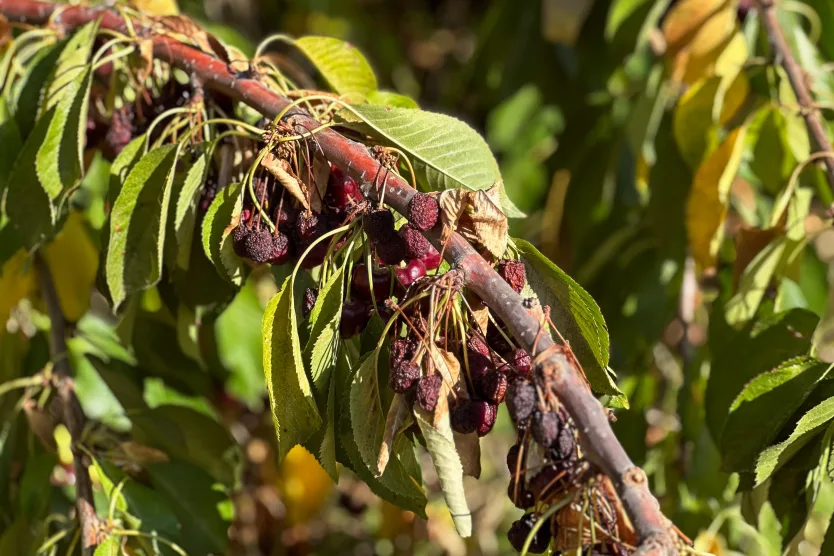
The cherries are rotting on the trees in Ian Chandler’s orchards. Branch after branch hang heavy with fruit the Oregon farmer calls “mummified” — dark, shriveled and unappetizing.
They should have been picked a couple of weeks ago to tempt shoppers at markets and stores, or processed to garnish Shirley Temple mocktails, shiny and fat, promising bursts of sweetness.
The lost harvest has hit almost a quarter of Chandler’s 125 acres of cherry trees — not because of bad weather, disease or blight, just because there was no one to pick the fruit.
“What you’re going to see is a bunch of fat, happy raccoons this winter,” Chandler said ruefully, standing amid his still burdened trees. “Unfortunately, we weren’t able to harvest these.”
He said he’s built up a loyal seasonal workforce for his Wasco County operation called CE Farm Management, about 90 minutes from Portland, with the same people coming year after year and staying in touch with birth announcements and Christmas cards in between. But this year half of them did not arrive, and many of his neighbors were scrambling for pickers too. All told, Chandler said he will lose $250,000-$300,000 of revenue, left to rot on the trees.
“It’s lost revenue for the operation, which is one thing, but it’s also lost revenue for the workers that would have been able to pick them had they been here,” he said.
“The beginning of the season, it coincided, unfortunately, with a lot of really strong immigration enforcement down in southern California, where our workforce comes from, and that had a chilling effect on people wanting to move.”
Chandler’s pickers are mostly Latinos who follow the harvests in the west and northwest. But with raids by Immigration and Customs Enforcement on cities and workplaces and detentions and even deportations ensnaring many with no criminal records, he has seen a dramatic drop-off in labor this year.
It’s a situation that’s being repeated across the nation as crops ripen for harvest. The US Department of Agriculture estimates 42% of hired crop farmworkers are undocumented immigrants, with no authorization to work. Another 26% are immigrants who have become citizens or permanent residents.
Since April, 1.4 million people have dropped out of the US labor force — 802,000 of whom were foreign-born, according to the Bureau of Labor Statistics. Farmworkers are not tracked in the official monthly jobs reports, but analysts agree immigration policy is having an impact generally across the nation.
The issue has come to the attention of President Donald Trump, who promised help for the agricultural sector in a Tuesday morning phone interview with CNBC. “I take care of the farmers. I love the farmers. They’re a very important part of this country, and we don’t want to do anything to hurt the farmers,” he said.
Vice President JD Vance has said his preferred solution is automation. But Chandler’s farm won’t be mechanized — he believes cherries are best harvested by hand, preferably an experienced one to not rip off next year’s crop that’s already showing as buds. He does hire locally, but he says Oregonians, whether they are students on summer break or adults looking for full-time employment, only last in non-picking positions, like scanning buckets of produce or driving a tractor.
“I worked in high school in the cherry industry back in the 90s and then got back into this industry back in 2011 until current. You do not find people who are normally born here in the United States, unless they’re children of immigrants who are already doing this work, who want to work in this kind of industry,” he said. “It just doesn’t exist.”
Nevertheless, everyone hired by Chandler provides identification and work authorization so he does not know who may be in the country illegally.
“We’ve had relationships with these workers for years,” he said. “You talk to a family, you get a good relationship with them, they recommend more family members, and that’s how you build up your workforce. You could have all the children born in the United States, but if mom’s still trying to work through the immigration system, and has an issue, the whole family might say, ‘Look, we’re not going to risk it, because we don’t want mom to get picked up, so we’re going to stay down in California.’ So, then we lose our workforce.”
One of those absent from Oregon farms this year is a woman who told us to call her Lisa. She has permission to work through the Deferred Action for Childhood Arrivals (DACA) program, but asked her actual name not be used for fear it might hamper her DACA renewal. Her three young children are all US citizens, but she worries about her mother and stepfather who have lived in the US for decades as undocumented workers and so she stayed in California.
“My parents are agriculture workers and seasonal workers, so every summer they will migrate to the state of Oregon to work the cherry season,” she said, adding that she and the children would often join them. “But this year, we decided to stay home just to be safe.”
While Chandler pointed out the financial loss he and his workers will suffer this season, Lisa highlighted the impact on small farmers like Chandler. And both said the federal government will also lose out.
“There is no shady under-the-table stuff. It’s all above board,” Chandler said, noting the deductions he made from each worker’s check to pay federal and local taxes and make contributions to Medicare and Social Security. “There seems to be a big disconnect when (opponents say,) ‘There’s this shadow economy of undocumented people being paid in certain ways.’ No, everything is above board. Everybody shows documentation to work.”
Lisa said about $150 was automatically deducted from her paycheck of some $900, and she thought the same was true for her parents even though they cannot file for a tax refund or use Medicare or Social Security, both of which they pay into.
The tax argument was raised by Trump too in his CNBC interview. “We’re going to be coming out with rules and regulations. I mean, you’ll see a farmer with the same person working for him for 20 years. The person’s even paying taxes and other things,” Trump said, drawing a distinction between hard-working undocumented immigrants who work on farms and those who commit violent crimes.
Patrick Soon-Shiong, the billionaire who purchased the Los Angeles Times for $500 million in 2018, said Monday he is taking the ailing newspaper public.
Speaking on “The Daily Show,” Soon-Shiong told host Jon Stewart the newspaper will take the company public over the course of the next year. The billionaire did not clarify when that would happen.
“We literally are going to take the LA Times public and allow it to be democratized and allow the public to have the ownership of this paper,” Soon-Shiong told Stewart. “We think over the next year we will. I’m working through (that) with an organization that’s putting that together right now.”
The move follows years of trouble at the Times. In early 2024, The Times cut 20% of its workforce, approximately 115 reporters, following the departure of the paper’s top editor, Kevin Merida.
In October, the Times came under fire after Soon-Shiong blocked the paper’s endorsement of then-Vice President Kamala Harris over Donald Trump for president, prompting the resignation of the paper’s editorial board editor, Mariel Garza.
Since then, the Times’ entire editorial board has resigned, with the last departure coming in February. According to NPR, around 20,000 subscribers canceled their digital subscriptions.
“Whether you’re right, left, Democrat or Republican, you’re an American,” he said on Monday.
Over the past year, the billionaire has criticized his own paper for what he described as veering “very left” and said he would balance the paper’s editorial board with voices that “trend right.”
The paper has had high-profile missteps in its transformations, such as a briefly-introduced AI-imbued tool that sympathized with the Ku Klux Klan.
Who would invest in a losing newspaper is a mystery to me.

Today is Flag Day but it has turned into Sad Day as the president has an Army Parade, people are demonstrating calling this No Kings Day, and thousands of Hispanics have fear of arrest and deportation.
The lawn was not cut. I called the gardener. His wife said he feared for arrest and told me he is in hiding.
Hotel workers, restaurant workers, farm workers and many other groups are living in fear.
This is one Flag Day we will never forget.
In an interview with CNBC, chief financial officer John David Rainey confirmed that Walmart will be enforcing “higher prices” on four popular grocery items. These include bananas, avocados, coffee, and roses due to tariffs on Costa Rican, Peruvian, and Colombian imports. Nearly one-third of Walmart’s inventory comes from countries that’ve been impacted by President Trump’s imposed tariffs. These include China, Mexico, Canada, Vietnam, and India.
“We will do our best to keep our prices as low as possible, but given the magnitude of the tariffs, even at the reduced levels announced this week, we aren’t able to absorb all the pressure given the reality of narrow retail margins,” Doug McMillon, Walmart’s chief executive, said on a call with analysts on Thursday.
If Walmart, America’s largest retailer, can’t avoid raising their prices can any other retailer avoid raising their prices.
What part of MAGA is this Unnecessary trade war?

Story by Ron Dicker of Huffington Post
The Economist is counting the days until President Donald Trump’s second term is over.
In a blistering cover this week, the outlet portrayed a wounded and bandaged symbolic eagle under the headline “Only 1,361 Days To Go.”

That would be the amount of time left in Trump’s presidency after his first 100 days is up at the end of the month. He has spent his first months dismantling government agencies, sparking a trade war, defying the courts over deportations and trying to strong-arm Ukraine into submitting to its invader, Russia.
The Economist summed up his strategy in the cover story, which examines the “lasting harm” he has already done:
“The method is to bend or break the law in a blitz of executive orders and, when the courts catch up, to dare them to defy the president. The theory is one of unconstrained executive power—the idea that, as Richard Nixon suggested, if the president does something then it’s legal.”
This injured eagle might need more than bandages to heal.
Opinion by Robert Reich, a professor of public policy at Berkeley and former secretary of labor.
If the Trump regime can dictate what the universities of America teach or research or publish, or what students can learn or say, no university is safe.
Not even the truth is safe.
If the Trump regime can revoke student visas because students exercise their freedom of speech on a university campus, freedom of speech is not secure for any of us.
If the Trump regime can abduct a permanent resident of the United States and send him to a torture prison in El Salvador, without any criminal charges, no American is safe.
What do we do about this?
We stand up to it. We resist it. We denounce it. We boldly and fearlessly reject it —regardless of the cost, regardless of the threats.
As columnist David Brooks writes in his column yesterday (I’m hardly in the habit of quoting David Brooks):
It’s time for a comprehensive national civic uprising. It’s time for Americans in universities, law, business, nonprofits and the scientific community, and civil servants and beyond to form one coordinated mass movement. Trump is about power. The only way he’s going to be stopped is if he’s confronted by some movement that possesses rival power.
But what does a national civic uprising look like?
It may look like a general strike — a strike in which tens of millions of Americans refuse to work, refuse to buy, refuse to engage in anything other than a mass demonstration against the regime.
And not just one general strike, but a repeating general strike — a strike whose numbers continue to grow and whose outrage, resistance, and solidarity continue to spread across the land.
I urge all of you to start preparing now for such a series of general strikes. I will inform you of what I learn about who is doing what. (One possible place to begin is here.)
In the meantime: This evening, Friday, April 18, bells will be sounded in Boston’s Old North Church (the one-if-by-land church where lanterns signaled Paul Revere to warn the Minutemen of the approaching troops) and in churches across the country, to celebrate the 250th anniversary of the Battles of Lexington and Concord, which began the American Revolution. I urge you to have your place of worship join in the ringing. (More information can be found here.)
Tomorrow, Saturday, April 19, protests are being organized around the country by 50501. See here.
My friends, what the Trump regime has unleashed on America is intolerable. It is time — beyond time — for a national civic uprising. We must take action.
Should you be interested, here’s what I said yesterday at a rally on Berkeley’s famed Sproul Plaza, the site of the beginning of the Free Speech Movement, a little over 60 years ago.
—
This is not going to happen in the near term because a majority of Americans today support Trump.
Having launched a historic global trade war that set the stock market on rollercoaster week, Trump’s approval ratings were bound to change. His presidential approval rating remained steady over the first two months and even reached his all time highest rating in either of his terms.
However, his third month in office is showing that the American public’s opinion has soured amid the onslaught of tariffs and trade wars and the mounting fears of a possible recession.
According to the HarrisX polls, Trump’s approval rating has dropped since he took office, but still above water with an overall job approval rating of 48% versus 46% that disapprove.
Amid last week’s tariff turmoil, the Quinnipiac University Poll shows 72% of voters think tariffs will hurt the U.S. economy in the short-term while only 53% think the tariffs will hurt in the long-run and 41% think it will help the economy in the long-run.
According to Rasmussen Reports daily polling, Trump has enjoyed over a steady job approval rating over over 50% on any given day since his inauguration — until April 3 — the day after the sweeping tariff announcement. His rating has since slipped lower every day to a current 47% approval and 51% disapproval.
The U.S. unemployment rate rose to 4.2% in March 2025, the highest level since November and slightly above market expectations of 4.1%.
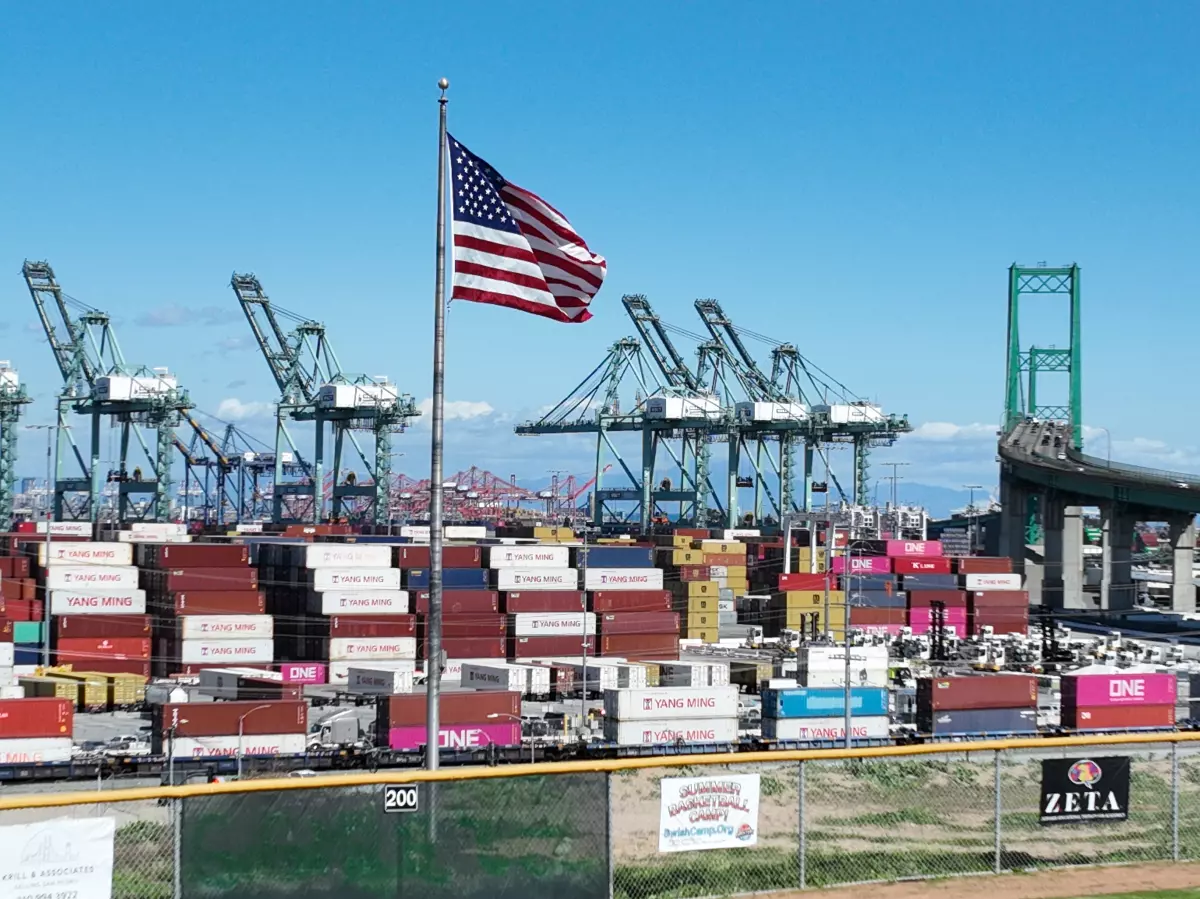
The Port of Los Angeles alone supports 136,000 jobs in the city. The combined Port of Los Angeles and Port of Long Beach support 186,000 jobs in the Los Angeles/Long Beach area.
California Gov. Gavin Newsom on Wednesday announced a lawsuit contesting President Trump’s executive authority to enact international tariffs without congressional support, which he likened to the commander-in-chief taking a “wrecking ball” to America’s global reputation.
The legal action argues that the International Emergency Economic Powers Act that Trump cited to impose tariffs does not grant the president the ability to unilaterally adopt tariffs on goods imported to the U.S. The suit from California is the first challenge from any state against Trump’s trade policy.
California’s legal case rests on an argument that the International Emergency Economic Powers Act, which specifies the actions the president can take if he declares a national emergency in response to a foreign national security, foreign policy or economic threat, does not give Trump the authority to enact tariffs.
“The reality is the U.S. Constitution gives Congress the power of the purse,” Bonta said. “It’s Congress’ responsibility to set and collect taxes, duties and excises, including, yes, tariffs, not the president’s. Congress hasn’t authorized these tariffs, much less authorized imposing tariffs only to increase them, then pause them, then imminently reinstate them on a whim, causing our nation and the global economy whiplash. Trump is attempting to override Congress and steamroll the separation of powers.”
The tariffs appear to be on weak legal ground, given the president’s decision to rely on the International Emergency Economic Powers Act, said Stratos Pahis, associate professor of law and co-director of Block Center for the Study of International Business Law at Brooklyn Law School.
Donald Trump, an unsuccessful business man, with a high approval rating by the public, is destroying America’s economy and the G.O.P. is bowing to his wishes.
The question is where the people needed for all those manufacturing jobs come from?
“Trump’s ‘will he, won’t he’ tariff chaos is just one more con on working people.”
That’s what Melinda St. Louis, Global Trade Watch director at the watchdog group Public Citizen, said in a Wednesday statement after U.S. President Donald Trump announced a 90-pause for what he has called “reciprocal” tariffs, excluding China.
It seems Donald Trump wants a recession. Why? A recession will drive down the price of real estate, companies, and shares of stock. Trump and his fellow billionaires want o buy everything on the cheap and then enjoy the ride upward-no matter the cost to working people.
“OUR PLAN IS WORKING PERFECTLY AND IS JUST A NEGOTIATING TACTIC BUT IT IS ALSO GOING TO BE PERMANENT AND WE WILL BE THE WORLD LEADER IN TEXTILES AND NOW THERE IS A PAUSE AND EVERYONE NEEDS TO CHILL BUT ALSO WE WILL NEVER BACK DOWN AAAAAAHHHHHH.”

US stocks tumbled today after the White House clarified that its tariff on all Chinese goods was at least 145% — even higher than previously believed. This comes a day after US stocks skyrocketed following President Donald Trump’s announcement of a 90-day pause on all “reciprocal” tariffs, except for China. Beijing, meanwhile, implemented its own retaliatory tariffs of 84% on US goods.
• Trade negotiations: Trump just defended his tariff policy in a Cabinet meeting, saying his administration is “working on deals” with multiple countries. Earlier today, the EU announced it would pause its retaliatory US tariffs for negotiations. Even after Trump’s U-turn, economists say the damage is done.
DOW down 1,835.94, S&P 500 down 281.5 5.5% mid-day April 10,2025
A majority of Americans voted for Donald Trump!
 Coast Contact