California Alone is the Fifth Largest Economy in the World

It is accurate to say that California is a challenging place to live if you are not a millionaire. It is very difficult for median income families.  Median household income for California was $67,739 in 2016. Housing costs are among the highest in the nation. Gasoline is currently averaging $3.63 a gallon for regular. That gasoline price is matched only by Hawaii.

Despite those challenges California’s gross domestic product is only surpassed by the entire United States, China, Japan, and Germany.

The reason for this situation is the multiple economic engines.

-Silicon Valley: the area south of San Francisco is the home of Facebook, Alphabet previously known as Google, Hewlett-Packard, Oracle, Intel, Cisco Systems, Nvidia, Netflix, Tesla, and many less known tech companies.

-Hollywood: Really all of Los Angeles is the television and movie entertainment capital of the world. CBS, NBC Universal, Disney, Paramount, Sony, and Warner Brothers are all in metropolitan Los Angeles.

-Tourism: According to the Los Angeles Tourism & Convention Board, 48.3 million tourists visited L.A. in 2017, an increase of more than 2 percent over 2016 and the seventh consecutive year of record-breaking results. The total number of visitors to San Francisco last year rose 2.3 percent to 16.9 million.

-Import and Distribution: The two largest ports in the United States are Long Beach and Los Angeles. 40% of all goods imported enter through those two ports. They are then moved to distribution warehouses in Los Angeles, Riverside, and San Bernardino.

-Agriculture: California produces a sizable majority of many American fruits, vegetables, and nuts: 99 percent of artichokes, 99 percent of walnuts, 97 percent of kiwis, 97 percent of plums, 95 percent of celery, 95 percent of garlic, 89 percent of cauliflower, 71 percent of spinach, and 69 percent of carrots (and the list goes on. California is the leading US state for cash farm receipts. I have seen California strawberries in Toronto Canada.

-Manufacturing: Manufacturers help to drive California’s economy, with $142.39 billion in manufactured goods exports in 2016.

These are the reasons that nearly 40 million people see the state as the heart of economic opportunity.
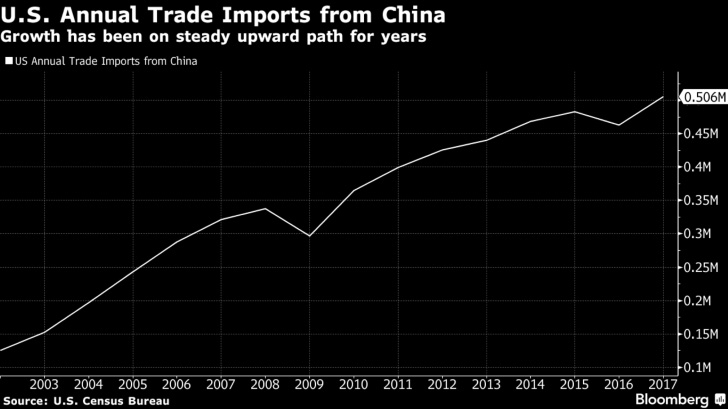

The Largest U.S. Trade Deficit Is With China

Why is President Donald Trump imposing tariffs on China?

More than 65 percent of the U.S. trade deficit in goods was with China. The $375 billion deficit with China was created by $506 billion in imports. The main Chinese imports are consumer electronics, clothing, and machinery.

America only exported $130 billion in goods to China.

As this graph indicates this is not a new phenomenon. It goes back to the late 1900s.

China currently assembles the majority of Apple’s iPhones in its Shenzen, China, location by Foxconn. That company maintains factories in countries across the world, including Thailand, Malaysia, the Czech Republic, South Korea, Singapore, and the Philippines. A second company, Pegatron, is a relatively recent addition to the iPhone assembly process also in China.

High End clothing brands we all lust after really have to work hard to minimize the production costs while keeping their products “luxurious” and “high end”. China is their go to manufacturing location. Who are they?
1. PRADA
2. COACH
3. ARMANI
4. BURBERRY
5. MULBERRY
6. MARC JACOBS
7. D&G

Chinese factories manufacture winter coats, gloves, mittens and hats for consumers around the world. These factories also produce maternity clothes and infant clothes as well as wedding dresses and tuxedos. Underwear, T-shirts and slips are among the items exported from China to consumers around the world. Sports caps are also produced in China as are belts and bras.

Luggage, machinery, and furniture are also made in China.

The consequence of the outsourcing of all that manufacturing has resulted in a major loss of good paying blue collar jobs in America.

Trump is correct when he points out that both political parties stood by and did nothing as the jobs left the country.

We couldn’t stop the outsourcing but our government did nothing to train people in new jobs that are needed in the 21st century.

While Trump has accurately identified the problem he does not appear to understand the needed solution. His solution of applying tariffs will only harm the American economy by raising the cost of consumer goods.

Article I of the US Constitution vests the power to set tariffs in Congress. The president has the power to impose tariffs at his discretion only because Congress has passed laws granting him that power. If Republicans in Congress think Trump has a bunch of dumb, destructive ideas about trade, they could pass new laws that strip him of that power.

Congress is in total grid lock. They won’t do anything to counter the new tariffs.

We are headed for a trade war. The last time that happened was 1930. Smoot-Hawley Tariff Act, formally United States Tariff Act of 1930, also called Hawley-Smoot Tariff Act, U.S. legislation (June 17, 1930) that raised import duties to protect American businesses and farmers, adding considerable strain to the international economic climate of the Great Depression.

Wall Street bankers are not given to grovelling. But in June 1930 Thomas Lamont, a partner at J.P. Morgan, came close. “I almost went down on my knees to beg Herbert Hoover to veto the asinine Hawley-Smoot Tariff,” he recalled. “That Act intensified nationalism all over the world.”

Toys “R” Us and the Leveraged Buyout

This is capitalism at its worst.

Corporate raiders were the final straw that ended Toys “R” Us.  Bain Capital was founded in 1984 by Bain & Company partners Mitt Romney, T. Coleman Andrews III, and Eric Kriss, after Bill Bain had offered Romney the chance to head a new venture that would invest in companies and apply Bain’s consulting techniques to improve operations.  Those techniques destroyed companies but made Bain a success for its owners.

The Toys “R” Us collapse is not a new phenomenon. It has made buyers of companies rich and destroyed the target company. Blame the private equity firms Bain and Company, KKR & Co. L.P. and Vornado Realty Trust for the bankruptcy. Toys “R” Us was taken private by KKR, Bain and Company, and Vornado in 2005, it took on a lot of debt, leaving the company with repayments that have crippled it in a period of declining sales.

A leveraged buyout, commonly referred to as an LBO, is a transaction that companies use to acquire other businesses. The buyout involves a combination of equity from the buyer, along with debt that is secured by the target company’s assets. The deal is structured so that the target company’s assets and cash flows are used to pay for most of the financing cost. The main disadvantage of this financing is that, once the deal is completed, the target business is very leveraged. This scenario allows for little margin of error. A problem with liquidity, such as the loss of a few key customers, could put the business in serious distress.

Rolling Stone magazine reports that of the 25 companies that private equity firms bought in the 1980s that borrowed more than $1million in junk bonds, half went bankrupt.

Do you remember Mervyn’s department stores?  It was an American middle-scale department store chain based in Hayward, California, and founded by Mervin G. Morris. It carried national brands of clothing, footwear, bedding, furniture, jewelry, beauty products, electronics, and housewares.  Mervin G. Morris founded the first Mervyn’s store in San Lorenzo, California on July 29, 1949.  By 1978 the company had grown to a chain of more than 50 stores in three states,[7] and Mervyn’s was acquired by the Dayton Hudson Corporation (now Target Corporation). Mervyn’s kept its separate identity as a Dayton Hudson subsidiary. In September 2008, Mervyn’s sued the private equity firms involved in the leveraged buyout of the chain, alleging that the deal had stripped the retailer of its real estate assets, forcing it into bankruptcy. Mervyn’s said in the suit that Cerberus Capital Management and its partners had used the increased rent to finance the buyout.

31,000 Toys ‘R’ Us employees: No job and no severance

America’s Economy is Booming

Now that Donald Trump has been president for over a year he gets the credit for what happens to the United States economy. Good or bad he will be blamed or honored. 

As it stands today that makes his presidency a success.  Despite a recent decline the stock market has reached new highs, car sales are high, and job growth has gone from quite good to very good.  Tax cuts have put more money in everyone’s pocket.

313,000 jobs were created in the month of February 2018. This is not fake news.  This is a report from the Bureau of Labor Statistics that was released today.

Trump’s primary reason for giving him your vote was that he would bring back jobs.  He appears to be on track to fulfill that campaign promise.

Democrats may believe they have a chance of winning control of the House of Representatives in November but that has to be based on Trump’s personal behavior, his continued support of the NRA, and his support of White nationalist groups.  While those are upsetting issues, “It’s the economy, stupid” coined by Bill Clinton strategist James Carville still is the primary issue.  It still holds true today.

The Democratic Party has not been the friend of labor.   They talked a good game as the United States was overwhelmed with low cost imports that drove out car manufacturing to garment manufacturing to electronics manufacturing.  Your iPhone is made in China and Bangladesh and China probably made most of the clothes you wear.  

If the GOP holds both houses of Congress in this fall’s election be prepared for even more changes to American life.

Unintended Consequences

The lower income tax rates passed into law this past December seemed like a wonderful idea.  Who can object to bonuses and higher take home pay?

The U.S. stock market indexes fell sharply today (Friday, February 2, 2018) as investors digested a stronger-than-expected jobs report that stoked inflation fears.  “The details of this jobs report, especially the numbers behind the wage growth suggest that companies are competing for workers and the shortage of skilled workers is pushing up wages. The trend in inflation is ticking higher and the big question is whether the incoming Fed, which is more hawkish, will allow the economy run hotter in the short term or tighten aggressively,” said Quincy Krosby, chief market strategist, at Prudential Financial.


Investopedia: A government or economy often defines full employment as any rate of unemployment below a defined number. If, for example, a country sets full employment at a 5% unemployment rate, any level of unemployment below 5% is considered acceptable. Full employment, once attained, often results in an inflationary period. The inflation is a result of workers having more disposable income, which would drive prices upward.


The short term benefit of lower income tax rates are obvious.  It results in a bigger paycheck for almost all workers.  However, with America’s unemployment rate at 4.1% for the past four months and below 5% since November 2016 the shortage of workers along with lower corporate taxes could easily result in a horrible surge in inflation.

Many of us saw the consequences of high inflation.  In 1974 and again 1979 to 1981 we experienced inflation as high as 14.7% in a single month.  We spent using a credit card knowing that the repayment would be in cheap dollars.  Buying a home meant paying an inflated interest rate on the mortgage.  We refinanced when the rate fell.

 I have read nothing about economist’s concerns of higher inflation.  The Federal Reserve Board did not raise rates at last Wednesday’s meeting. They left its benchmark interest rate unchanged in a range of 1.25 percent to 1.5 percent, a relatively low level that the Fed said would help support continued job growth and stronger inflation.


Wow! Is the Fed correct or are stock market investors correct?  When you are working you can demand a pay raise to compensate for inflation but if you are retired inflation can destroy your retirement plans.  Roaring inflation will also destroy the party in power in Washington.

Mall owner Westfield sold for nearly $16 billion

The end of brick and mortar retail bonanza.

Westfield, the Australian firm that operates 33 malls across the United States, is being bought by Unibail-Rodamco, a European property investment firm based in France. The real sales price may be $24.7 billion. That higher amount was reported by another web site. The Westfield web site claims the value of its properties at $32 million. Whatever the sales price is we can most definitely say it is in the billions of dollars.

The combined company will have 104 shopping centres around the world. Westfield’s two (soon to be three) London sites were mentioned as particularly attractive for the new owners.

In the Los Angeles metropolitan area the list includes malls in
Century City
Culver City
Sherman Oaks (Fashion Square)
Santa Anita
Canoga Park (Topanga and Village)
Valencia
Palm Desert

The issue for all malls is the growth of internet marketing. Amazon, Apple, and Walmart are the three really big participants. They are referred to as E-commerce companies.

Amazon boasted of being the biggest employer of all the internet companies with a workforce of 268,908 people in 2015 and generated revenues of $70 billion. The growth has been spectacular as it is reported that Amazon’s latest reported revenue is now over $94 billion.

Who are the richest people in the world?

I do not know what value this information is to anyone.  It is more or less an answer to the question, who are the richest people in the world?  Following is a list of the 25 richest.

Jeff Bezos, Nationality: American, Source of wealth: Amazon (Total net worth $99.6B). The richest man in the world!
Bill Gates, Nationality: American, Source of wealth: Microsoft (Total net worth $89.9B)
Warren Buffet, Nationality: American (Total net worth $83.1B)
Amancio Ortega, Nationality: Spanish (Total net worth $76.2B)
Mark Zuckerberg, Nationality: American, Source of wealth: Facebook (Total net worth $73.1B)
Carlos Slim, Nationality: Mexican (Total net worth $62.1B)
Bernard Arnault, Nationality: French (Total net worth $61.6B)
Larry Ellison, Nationality: American, Source of wealth: Oracle (Total net worth $54.4B)
Larry Page, Nationality: American, Source of wealth: Google (Total net worth $51.5B)
Ingvar Kamprad, Nationality: Swedish (Total net worth $50.6B)
Sergey Brin, Nationality: American, Source of wealth: Google (Total net worth $50.2B)
David H. Koch, Nationality: American (Total net worth $47.8B)
Charles Koch, Nationality: American (Total net worth $47.8B)
S. Rob Walton, Nationality: American, Source of wealth: Walmart (Total net worth $46.2B)
Jack Ma, Nationality: Nationality: Chinese (Total net worth $46.2B)
Jim Walton, Nationality: American, Source of wealth: Walmart (Total net worth $45.6B)
Alice Walton, Nationality: American, Source of wealth: Walmart (Total net worth $44.9B)
Francoise Bettencourt Meyers, Nationality: French (Total net worth $44.3B)
Pony Ma, Nationality: Chinese (Total net worth $40.2B)
Mukesh Ambani, Nationality: Indian (Total net worth $39.8B)
Sheldon Adelson, Nationality: American (Total net worth $35.5B)
Hui Ka Yan, Nationality: Chinese (Total net worth $34.5B)
Steve Balmer, Nationality: American, Source of wealth: Microsoft (Total net worth $34.2B)
Li Ka-Shing, Nationality: Chinese (Total net worth $33.7B)
Jacqueline Mars, Nationality: American, Source of wealth: Mars Candy (Total net worth $33.4B)

Corporate America Must Prove Tax Reform is Good for Average Americans

Lowering the tax rate from the current 35% to the planned 20% will be a dramatic change for corporations. The GOP controlled congress contends that their planned corporate income tax cuts will result in more investment in new business and higher wages for American workers. Will it actually happen? We will have to wait until next year.

Read this report from CNBC.
A meeting of CEOs might seem to be a friendly gathering place for President Donald Trump’s chief economic adviser Gary Cohn, former president of Goldman Sachs. But at a gathering of chief executives hosted by the Wall Street Journal on Tuesday November 14, business leaders called into question one of Cohn’s top arguments for slashing the corporate tax rate to 20 percent.

When one of the Journal’s editors asked the crowd if they planned to up their capital expenditure if the GOP’s tax plan went through, only a smattering raised their hands.

There’s little evidence to support the claim that tax breaks boost employment numbers.

A National Bureau of Economic Research study published in 2014 found “little evidence that corporate tax cuts boost economic activity” unless implemented in a recession.

Far from being short on cash, corporations are sitting on record amounts.

The informal poll was not the only disappointment for Cohn on Tuesday. Another non-scientific poll conducted at the gathering found that more than half of the CEOs present didn’t believe that Congress would pass a major tax bill by the end of the year.

Cohn had previously told reporters that tax legislation would be advanced by the end of the year, calling it a “once in a lifetime opportunity.”

Is this an opportunity to improve America’s middle class or an opportunity for higher dividend payments to shareholders?

We will know after the tax cut is put into effect. If the result of this tax cut does not provide higher incomes for the middle class the Republicans will lose in the next election.

America’s Car Sales

I continue to be a fan of midsized sedan automobiles. They offer enough space to provide comfortable accommodations for four people and with a little squeezing accommodate three people in the back seat along with a trunk that will hold two large suitcases for travel.

I don’t have to climb into sedans as I must if I drive an SUV or crossover vehicle. I can slide into a car with ease. So it is surprising to me that those SUVs or crossovers are now more popular than cars.

The other thing I find surprising is that American brands are not the big sellers. Could it be that Americans prefer quality over brand? Obviously the answer is yes.

Sales of midsized cars for the first 8 months of 2017.


Toyota Camry          247,775        Market share 20%

Honda Accord         221,013         Market share 18%

Nissan Altima          183,292         Market share 15%

Ford Fusion            138,489          Market share 11%

Chevrolet Malibu     117,173         Market share 10%

Hyundai Sonata        97,929         Market share   8%

Kia Optima                74,722         Market share   6%

Volkswagen Passat   45,994        Market share   4%

Subaru Legacy          33,559        Market share   3%

Mazda 6                   24,814        Market share   2%

Chrysler 200             16,562        Market share   1%

Buick Regal                 8,288        Market share >1%

All Others                   1,122        Market share >1%


Toyota’s U.S. sales chief, Bill Fay, said consumers’ shift from cars to SUVs is one of the most dramatic the industry has ever seen. Three years ago, trucks and SUVs represented 50% of the U.S. market. They closed 2016 at 63% of total sales, and analysts don’t see that changing anytime soon. Boomers and millennials both like the space and the higher ride that SUVs offer, and improvements in fuel economy make them competitive with cars. The Honda CR-V was the bestselling SUV in the U.S. last year, with sales up 3% to 357,335.

Obviously I am in the minority.