Pacific Rim Tran-Pacific Partnership Agreement is not Dead!

Talks on the Pacific Rim trade pact (TPP) have stalled. And some international media are blaming Canada: Justin Trudeau did not show up to meet other leaders.

Regardless of who is to blame, it does appear that a TPP agreement might still be completed. It will be the United States that will be the loser because the other nations will have a valuable free trade zone while the United States will be denied access to the many business opportunities that free trade provides.

The following article appeared in the Toronto Star newspaper.

DANANG, VIETNAM—Trade ministers from 11 Pacific Rim countries said they reached an agreement Saturday to proceed with the free-trade Trans-Pacific Partnership deal that President Donald Trump abandoned it. However, an immediate formal endorsement by the countries’ leaders meeting in Vietnam appeared unlikely.

A statement issued in the early hours Saturday said an accord was reached on “core elements” of the 11-member pact. The compromise was delayed by last-minute disagreements that prevented the TPP leaders from meeting to endorse a plan on Friday.

“Ministers are pleased to announce that they have agreed on the core elements of the Comprehensive and Progressive Agreement for Trans-Pacific Partnership,” the 11 nations said in a statement.

Japan’s delegate to the talks, Economy Minister Toshimitsu Motegi, told reporters that disagreements that cropped up Friday had been resolved in five hours of talks that stretched late into the night.

“We have confirmed there was no mistake about us having reached a basic agreement,” Motegi said.

Despite enthusiasm for sticking with the plan following the U.S. withdrawal under Trump in January, criticism over various issues persists. Detractors of the TPP say it favours corporate interests over labour and other rights.

Aspects of the trade pact have raised hackles also over a requirement that companies be allowed to sue governments for lack of enforcement of related laws.

The proposed basic agreement reached in Danang said that the ministers maintained “the high standards, overall balance and integrity of the TPP while ensuring the commercial and other interests of all participants and preserving our inherent right to regulate, including the flexibility of the parties to set legislative and regulatory priorities.”

The TPP member countries are trying to find a way forward without the U.S., the biggest economy and, before Trump took office, one of its most assertive supporters. Trump has said he prefers country-to-country deals and is seeking to renegotiate several major trade agreements to, as he says, “put America first.”

Trump reiterated his markedly different stance on trade before the 21-member APEC summit convened late Friday with a gala banquet.
The U.S. president told an APEC business conference that “we are not going to let the United States be taken advantage of anymore.” He lambasted the World Trade Organization and other trade forums as unfair to the United States and reiterated his preference for bilateral trade deals, saying “I am always going to put America first.”

Trump said he would not enter into large trade agreements, alluding to U.S. involvement in the North American Free Trade Agreement and the TPP.

In contrast, Chinese President Xi Jinping told the same group that nations need to stay committed to economic openness or risk being left behind.

The Chinese president drew loud applause when he urged support for the “multilateral trading regime” and progress toward a free-trade zone in the Asia-Pacific. China is not part of the TPP.

APEC operates by consensus and customarily issues nonbinding statements. TPP commitments would eventually be ratified and enforced by its members.

But even talks this week on a declaration to cap the APEC summit had to be extended for an extra half day as ministers haggled over wording. It’s unclear what the exact sticking points were, but officials have alluded to differences over the unequal impact more open trade has had on workers and concerns over automation in manufacturing that could leave many millions in a wide array of industries with no work to do.

As a developing country with a fast-growing export sector, this year’s host country, Vietnam, has a strong interest in open trade and access for its exports to consumers in the West. The summit is an occasion for its leaders to showcase the progress its economy has made thanks largely to foreign investment and trade. Danang, Vietnam’s third largest city, is in the midst of a construction boom as dozens of resorts and smaller hotels pop up along its scenic coastline.

APEC’s members are Australia, Brunei, Canada, Chile, China, Hong Kong, Indonesia, Japan, South Korea, Malaysia, Mexico, New Zealand, Papua New Guinea, Peru, Philippines, Russia, Singapore, Taiwan, Thailand, the U.S. and Vietnam.
Saber Rattling Will Not Deter Kim Jong-un

Saber rattling will not deter Kim Jong-un in his obsession to obtain an ICBM that can strike the United States.

First, the United States and South Korea conducted joint missile exercises off the east coast of the South Korean peninsula. Then, on July 8, American B-1 bombers flew over the Korean Peninsula, where they were joined by South Korean and American fighter jets. Now it is reported that the THAAD missile defense system will be tested.

All of this is saber rattling. The United States is unlikely to start a war with North Korea. The loss of life, likely hundreds of thousands of people, would be too high.

There are many things the United States can do to force North Korea to take the action it wants including telling China that exports to the U.S. will be limited unless there is clear evidence that North Korea has begun dismantling its nuclear and missile technology.  If I were president of the United States I would give China 60 days to produce verifiable results. 

Businesses in the United States will suffer if we limit imports from China but this is national security taking priority over American business interests. What President Trump needs to do is obvious but does he have the courage to take the needed action?

Alex Jones the Conspiracy Theorist

Alex Jones has made a living selling conspiracy theories.  In every instance he appears to believe that the government has an ulterior motive. If you say that someone has an ulterior motive for doing something, you believe that they have a hidden reason for doing it.

Jones has now been given the gift of appearing on Megyn Kelly’s program tonight.  That decision by NBC only gives legitimacy to Jones’ theories.  I am disappointed in NBC.  The likely viewership of the program and the possible income the network might obtain is clearly more important than honesty.  I hope the number of people watching is very low.  However, since the public appetite for the outrageous never seems to end NBC will probably have a big hit.

Newsweek’s online web site provides Jones’ top conspiracies.

  1. New World Order: The world’s elite are planning on “exterminating” 80% of the world’s population so that the remaining population can live forever thanks to advanced technologies.
  2. 9/11 Was an Inside Job: Jones describes himself as “one of the very first founding fathers of the 9/11 truth movement.” He claims that was in “inside job” orchestrated by the U.S. government to enslave the world.
  3. Major shootings, Bombings Were “False Flag” Operations: Jones sees “false flags” including Oklahoma City, Boston Marathon bombings as events orchestrated by elites.
  4. Obama is “Global Head” of Al-Qaeda: Jones called Obama “the Global Head” accusing him of funding and arming terrorist organizations to achieve his own political goals.
  5. Government Creates Homosexuality: Jones said the government is using juice boxes to make children gay to slow and eventually revers the growth of population. In one of his popular videos je claims that chemicals in the water are “ turning the freaking frogs gay.”

Perhaps NBC sees the Kelly program is just another form of entertainment and not to be taken seriously.  Sadly too many people do take everything they see on television seriously.

Golden Parachutes and extraordinary pay for the undeserving

Greed and incompetence are rewarded in corporate America. Just ask Robert Coury, Marissa Mayer, and John Stumpf. These are the three people I am highlighting but there are many more. A 57 cent ignition switch was not replaced in 2.6 million Chevrolet Cobalts and Saturn Ions at the price of 13 deaths.

Mylan (MYL) was already under fire for a relentless series of price hikes on a two-pack of EpiPens by 400% over seven years. The controversy badly damaged Mylan’s reputation and wiped out billions of dollars of market value. Yet Mylan still lavished former CEO Robert Coury with $98 million in pay for 2016 as he transitioned to the role of executive chairman.

Marissa Mayer leaves Yahoo with nearly $260 million. This is after she failed to make the company a success. In fact it was bought by Verizon who saved Yahoo from bankruptcy. Mayer, who will not be sticking with Verizon (VZ, Tech30) now that Yahoo and its other digital media unit AOL are being combined under one operating unit called Oath, will also receive $23 million in severance payments to walk away from Yahoo.

In 2012, John Stumpf, former CEO of Wells Fargo Bank, had total compensation of $22.87 million with a base salary of $2.8 million, $3,300,000 in cash bonuses, $12.5 million in stock granted, and $15,000 in other compensation. Stumpf retired just weeks after he was grilled by two congressional panels over the way the bank handled an alleged scam where upwards of 2 million accounts were created by employees without the knowledge of customers. The accounts were allegedly opened so thousands of employees could meet aggressive sales goals set by management. Stumpf was widely criticized for the way he handled the questioning, pushing the blame to lower-level employees and not holding upper-level executives, including himself, responsible.

Those were just three of the oligarchs that are receiving millions of dollars while the U.S. Census Bureau reported in September 2014 that: U.S. real (inflation adjusted) median household income was $51,939.

What’s Wrong with California?

To answer the title question: Nothing!

The talk at some discussion groups that I attend revolves around the argument that California and especially Los Angeles is on the verge of collapse due to high taxes, high public debt, and a significant loss of private enterprises moving to other states. That perception is not in keeping with reality.

For the most part Californians accept the multi-ethnic makeup of the society. Thus we find large populations of Asians and Hispanics throughout the state. The Los Angeles LGBT Center is one of the largest and most experienced providers of LGBT health and mental healthcare, supported by a research team working to advance the care and treatment of lesbian, gay, bisexual, and transgender people.

California alone as a nation would economically be the 6th largest economy in the world. The five ahead of us are the U.S., China, Japan, Germany and the United Kingdom. The U.S. Bureau of Economic Analysis reported that California’s GDP was $2.5 trillion in 2015, up 4.1 percent from a year earlier.

California is the largest producer of Pima cotton in the United States. The California cotton industry provides more than 20,000 jobs in the state and generates revenues in excess of $3.5 billion annually.

California is largest producer of fresh vegetables in the United States says the US Department of Agriculture. California strawberries are found in the markets of Toronto Canada.

Industry Week lists the 500 largest U.S. companies each year. Last year California surged ahead of Texas, 64 companies to 55. By revenue, the biggest manufacturers in California together contributed $881 billion to the state’s coffers, while the biggest in Texas contributed $847 billion. There is not one other state that employs over 1 million people in manufacturing. Texas at 750,000 is in second place. This is US Census data.

40% of all imports and exports of the U.S.A. are moved through the Los Angeles/Long Beach harbor facilities. This figure does not include goods that are shipped by air cargo.

Speaking of air traffic, Los Angeles International Airport (LAX) is the third busiest in the United States.  That makes Los Angeles a major tourist destination. Santa Monica, Beverly Hills, Hollywood, and the amusement parks draw millions of people and that means thousands of jobs.

San Francisco and San Diego are major tourist destinations for the entire world.  Last year we stayed at the Fisherman’s Wharf Sheraton Hotel.  The desk informed me that their primary of guests comes from other countries.   

Los Angeles is a world leader in architecture. The Los Angeles Times this past Sunday (May 21, 2017) published a catalogue of 186 pages showing the works of major architect in this city. Titled DesignLA, it pictured the work of those talented people who include Frank Gehry.

As to education, California has some of the most highly regarded universities in the world. UCLA, USC, UC Berkley, Stanford, and CSUN are just the top of an outstanding educational system that draw thousands of students from around the world.

Silicon Valley and San Francisco are the heart of high tech for the entire world.  Facebook, Google, Apple, Tesla are the four most famous of those companies but there are many others as well.

Los Angeles is still home to important aerospace companies including JPL, Rocketdyne, and Space X. 

Los Angeles is the entertainment capital of the world. All the major movie studios are based in metropolitan Los Angeles. All television networks have large studios in Los Angeles.

New Jersey has the highest effective property tax rate at 2.38% and is followed closely by Illinois (2.32%), New Hampshire (2.15%), and Connecticut (1.98%). California is happily in 34th place with an effective rate of .81%. My source: https://taxfoundation.org/

California gasoline tax will be the highest in the nation thanks to the latest increase in that tax that will take effect November 1, 2017. This is clearly a serious mistake.

California state government bonds are rated AA- by both Fitch and Standard and Poor’s, Aa3 by Moody’s.

I have not even discussed the weather that is the most obvious reason there was a mass migration to California after WW2 and is still a major drawing point for so many in the rest of the United States. We moved from Philadelphia where you can rely on rain if you plan a picnic in the park and that is in the summer. Winters can best be described as miserable at best.

Evolution of American Industry

Valued at nearly $20 trillion, the U.S. economy is the largest in the world. Maintaining a competitive edge necessitates remaining diversified and dynamic. While this means that some U.S. industries thrive, others inevitably decline or are rendered obsolete.

As certain industries fade, so do hundreds of thousands of American jobs. 24/7 Wall St. analyzed employment figures from 2006 to 2015 from the Bureau of Labor Statistics to determine the 25 fastest dying industries. Employment in each industry on this list declined by at least 43%, and in the top two by at least 80%.

At least one of three broad factors is behind the decline in each of the fastest dying industries. The first factor is cost reduction. Cheaper labor abroad has caused many American companies to outsource manufacturing operations. In China, for example, the minimum monthly wage in the garment industry is less than $150 a month. Perhaps not surprisingly, the bulk of clothing Americans import was made in China.

Click here to see America’s 25 dying industries.

Click here to see America’s 25 thriving industries.

In addition to outsourcing, robotic automation in U.S. factories have hurt employment in manufacturing. The sector has shed nearly 2 million jobs in the past decade, a 12.8% decline. Of the 25 fastest dying industries, 10 are in the manufacturing sector, and seven of those are related to clothing and other textiles.

The second cause for massive employment declines in certain industries is the wide adoption and exponential growth of new technologies. Online streaming services and on-demand programming are largely responsible for the 61% employment decline in DVD and video tape manufacturing and the 89% decline in the video rental industry. Similarly, the proliferation of cellphones and smartphones has greatly reduced employment in both telephone manufacturing and photofinishing, industries where employment has declined by 51% and 60%, respectively.

Finally, broad macroeconomic conditions have also contributed to lower employment in many industries. Most notably, within the last 10 years, the subprime mortgage crisis and resulting recession have contributed to a considerable drag on construction. Since 2006, new home construction has declined by 51%. Over the same time period, the broad construction sector has shed over a million jobs, or 15.3% of total employment. The land subdivision and framing industries were hit especially hard, with employment declining by 57% and 55%, respectively.

To identify the dying industries, 24/7 Wall St. reviewed employment growth from 2006 through last year for 704 U.S. industries in the fourth level of detail in The North American Industry Classification System (NAICS) by the U.S. Census Bureau. All data, including the number of establishments within each industry, average weekly and annual wages, as well as breakouts of these data over government, private, and local levels were retrieved from the U.S. Bureau of Labor Statistics’ (BLS) Quarterly Census of Employment and Wages (QCEW). The BLS tracks industry employment by tallying the number of workers in establishments whose primary sources of revenue fall within a given industry. As a result, a given establishment along with all of its employees may be reclassified depending on business decisions and market performance. For the finance and insurance industry, where the primary source of revenue for a fund, trust, or financial vehicle can change from a single trading decision, industry employee counts may not be comparable from one year to the next. To help ensure that 10-year employment changes reflected natural growth, all industries related to the management of funds, trusts, and other financial vehicles were excluded.

This is not the kind of data Donald Trump wants to see.  He, along with millions of people who have lost their jobs, does not want to face the realities of a world economy.  Instead of working to retain outdated technologies the US government should be spending its time training the population in technologies of the 21st century.  We have the money to change but we lack the will.

Trump just signed off on killing your Internet privacy protections

The article on CNN reads, “Trump signed into law a resolution that repealed protections requiring Internet service providers to get your permission before collecting and sharing data. These protections — which had not yet gone into effect — were approved by the Federal Communications Commission in the final days of the Obama administration.”

It is panic over absolutely nothing.

This resolution changes nothing. It only reinforces an existing reality. Here is the reality.

– I apply for life insurance and the carrier does an investigation of my past life. I am not qualified for their lowest quotation because they learn something about my life that they consider to be concerning. Where did they get that information?

– I do a search on-line for information about the 2017 Chevrolet Cruze and immediately every car maker offering competitive models has advertising in the header of my screen.

– The internet constantly bombards me with advertising that an algorithm has concluded will interest me.

– My bank has studied my buying habits and concluded I should have a new credit or debit card. They send the card to me without my request.

You think this resolution will change anything? No it won’t because almost every company knows almost everything about you now.

Barely Half of 30-Year-Olds Earn More Than Their Parents

Sorry, Young People: You Probably Won’t Make as Much Your Parents Did

As wages stagnate in the middle class, it becomes hard to reverse this trend

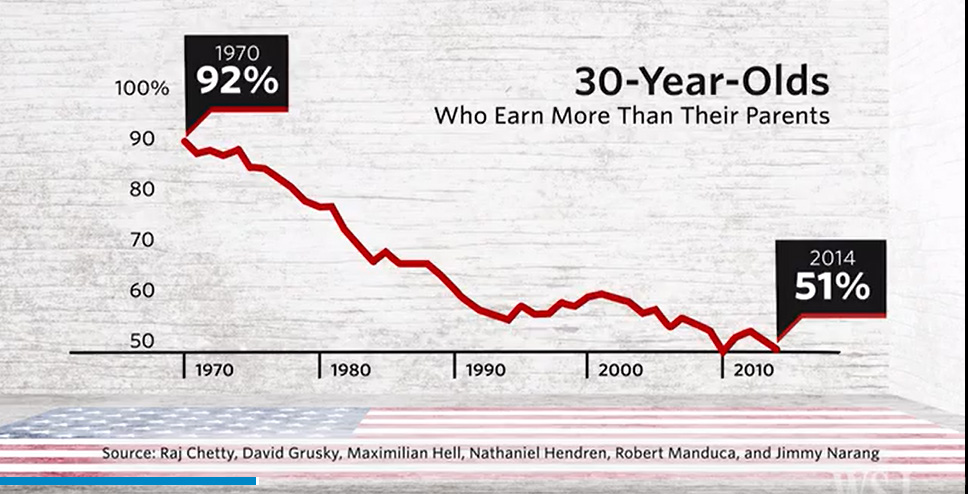
From a report in the Wall Street Journal dated December 8, 2016.   Barely half of 30-year-olds earn more than their parents did at a similar age, a research team found, an enormous decline from the early 1970s when the incomes of nearly all offspring outpaced their parents. Even rapid economic growth won’t do much to reverse the trend.

30-year-olds-earning-less-than-their-parents

Wage stagnation has taken heavy toll since 1970s

“My parents thought that one thing about America is that their kids could do better than they were able to do,” said Raj Chetty, a prominent Stanford University economist who emigrated from India at age 9 and is part of the research team. “That was important in my parents’ decision to come here.”

What’s more, even if President-elect Donald Trump fulfills his promises of rapid economic growth, the trend won’t be reversed significantly. Even if income levels grew 3.8%, the percentage of 30-year-olds who out-earn their parents would bump up to just 62%, the Wall Street Journal reports.

The study was conducted by economists and sociologists at Stanford, Harvard and the University of California. They used tax and census data to compare the earnings of 30-year-olds starting in 1970 to that of their parents.

What the report does not do is explain why wages are stagnant. I will give you my take on this horrible reality. I did earn more than my parents but only because of inflation.

When I married in 1969 my salary was $10,000 per year. According to the United States bureau of Labor Statistics your income today, based upon the CPI Inflation Calculator, that salary equates to $65,866.  My father never earned that inflation adjusted salary.

There have been many reasons for the stagnant salaries.  Three come to mind almost immediately. 

First management earned ten to twenty times the average income of most employees in the earlier parts of the 20th century.  Today management earns 200 to 300 times the average income of most employees.

Second many jobs have been outsourced other countries.  That has resulted in more potential employees seeking the remaining jobs.  Thus with more people looking for work employers can push down the pay they have to offer.

Third, many jobs have been automated thanks to artificial intelligence (AI), and computerization.   Have you seen the inside of an auto manufacturing facility?  Automation has eliminated many jobs from welding to painting.  Warehouses are now so automated that less material handlers are needed.  Office workers, I am one of them, now have computers that perform many of the manually performed functions that were done using typewriters and spreadsheets. That too reduced manpower needs. Less manpower translates to an oversupply of workers and that translates to lower pay. It is all about supply and demand.

It is unlikely that any government of any political party will change this trend.  I hope I am wrong.

Buyer Beware

Caveat emptor is a Latin term that means “let the buyer beware.”

I was in a J.C. Penny store just few days ago buying two shirts and pair of pajamas.  The items were all on counters that informed me they were on sale.  When I took the items to the check-out counter I was given another 5% discount.  That of course made the purchase an even better deal.  There were sale signs everywhere.  Almost everything in that store seemed to be on sale.

A strategic mistake made in 2011 at JC Penney, regarding its pricing strategy –replacement of sales through coupons with everyday low prices. The Ron Johnson plan was implemented when he took the helm of the company, modeling the company’s stores after those of Apple.  Sales declined disastrously during his tenure.  People like to buy things that are “on sale.”

Here in metropolitan Los Angeles there are at least 20 Macy’s department stores.  Advertising is almost daily in the newspapers.  There is always a sale.  30% off, 40% off, 50% off along with One Day Sales are part of the usual pitch.  I have never believed any of the advertising.  My wife and daughter do believe the advertising.  They are probably part of the larger group than doubters like me.

Los Angeles City Attorney Mike Feuer apparently agreed with my suspicions.  Feuer’s office has filed lawsuits against four big retailers for deceptive advertising that allegedly misled shoppers into believing that thousands of products were on sale at a hefty discount.

The attorney’s office provided examples of misleading ads by Macy’s, Sears, J.C. Penny and Kohl’s.  One example is the April, 2016, Sears online ad for Kenmore washing machine with a “regular” price of $1,179.99 and a “sale” price of $999.99. However, the purported “regular” price was a false reference price.  The argument is that the washer was never advertised at the regular price.

California law bans retailers from advertising a higher original price unless a product was actually available at that price within three months of the ad running. Feuer said the evidence his office collected focused on thousands of online transactions, but that he had reason to believe the practices also were underway at stores.

Should there be such a California law?  After all shouldn’t the words “buyer beware” apply to the purchase of any item at any price?