Los Angeles booms as a startup hub

From The Economist, Nov 5th 2016

surfing-at-venice-beach
Surfing at Venice Beach

HOLLYWOOD has produced plenty of films about underdogs rising to claim the limelight. Now Los Angeles is experiencing its own real-life Cinderella story, as the area’s technology scene has been transformed from backwater to boomtown in just a few years. Hordes of venture capitalists from northern California, once long dismissive of their southern neighbour, now regularly commute in search of deals in a less heavily hunted spot than the Bay Area. In 2016 the city’s startups received around $3bn in funding, around six times more than in 2012, according to CB Insights, a research firm.

Evan Spiegel went to Stanford University in the heart of Silicon Valley, but he wanted to live and work close to the sea. So he based his new company one block from the Pacific in Venice Beach, which is better known in Los Angeles for its silicone-enhanced bodies than the silicon chips that gave the Valley its name. Mr Spiegel’s firm, Snap, is best known for its ephemeral Snapchat social-media messages and is now valued at a whopping $18bn. Other successful technology firms are thriving nearby, including Dollar Shave Club, an e-commerce firm recently sold to Unilever for $1bn; Ring, a “smart” doorbell company, and Riot Games, maker of “League of Legends”, a popular online multiplayer contest.

Los Angeles is now the third-most-prominent outpost for startups in America, after San Francisco and New York. It has several advantages, including good universities, warm weather, a relaxed culture, proximity to San Francisco and much lower costs. Michael Schneider, the boss of Service, a customer-relations startup, reckons he would need to have raised at least 40% more money if based in San Francisco, “just to pay for the same space and people”.

Although Los Angeles has fewer experienced engineers, those that are there tend to be more loyal, not least because there are fewer firms out to poach them. Startups can convince people to move. Ophir Tanz of GumGum, an advertising startup, says he has recruited several employees looking for a more balanced life away from cities like New York and San Francisco.

Los Angeles may at last be getting the attention it deserves. “The original monetisation of the internet was created here, not Silicon Valley,” says Mark Suster, a venture capitalist with Upfront Ventures, referring to pioneers such as Applied Semantics, bought by Google. But for Los Angeles to establish itself as an enduring place for startups, it needs Snapchat to continue to thrive and go public, which could happen as soon as next year.


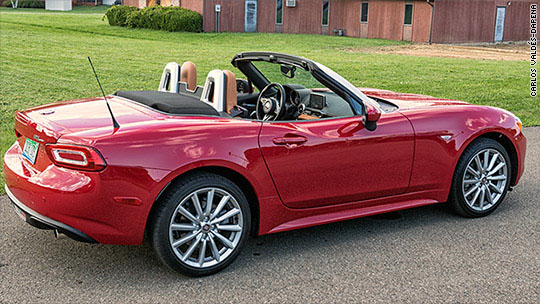
Fiat Spider — Italian fun via Japan

fiat-124-spider-2017
  Fiat revives the 124 Spider


I dreamed about buying a Fiat 124 in the 70s but it was a stick shift and my new wife said NO to the idea.  So I settled for something that was a very conservative sedan. Ugh!

The collaboration between Mazda and Fiat to share the latest MX-5 roadster platform sees its Italian iteration with the Fiat 124 Spider. But the Spider is more than a rebadged Miata. The Fiat carries a 1.4-liter turbocharged four-cylinder MultiAir engine from the Fiat stable that generates 160 horsepower and 184 lb.-ft. of torque. With a price tag around $28,000, the slightly luxurious Fiat Spider Lusso is similar to a tony Mazda. The MX-5 155 hp has a 2.0-liter four.

Road & Track says “One of these cars is very good. The other is truly excellent.”

Consumers Reports has yet to review this car.  That organization always cautions people that first year models can be buggy and it is best to wait for the second year of car design.

Still it might be fun to at least take the Spider on a test drive.


America’s Free Enterprise System Is Coming to an End!

attSo the wealthy have the power to do as they wish. These are oligarchs. They are only interested in accumulating unbelievable wealth that will provide their family generations of luxurious living without ever having to work a day in their lives. As our society evolves into a nation controlled by those very wealthy, the vast majority of Americans are becoming ever poorer. Donald Trump talks about the shrinking middle class and the 45 million people either in poverty or near poverty. He is correct in pointing out the discrepancy but he really doesn’t have a solution. He is one of those oligarchs. Those oligarch just don’t care no matter what they say.

Thus we see AT&T buying Time Warner. In what way will this benefit society? It won’t. What it will do is put more power in the hands of a few. It will be a more controlled society.

Wells Fargo may pay a fine but its power remains. The rest of the banking industry is just happy they have not been caught in some other manipulation.  The former Wells Fargo CEO John Stumpf “retires” with a $100 Million plus retirement package.

This is a sad collapse of the free enterprise system where individuals can open small businesses and make a living. Privately owned drug stores, food markets, and hardware stores were part of the American well of life. Now its Walgreens, Walmart, Kroger, and Home Depot that control the price we pay and the jobs we have.

Automation at Work

Where have all the jobs gone? That is the question asked by so many people.  Of course many have gone to low labor cost countries but that is not the entire answer.  The new 2017 Honda Civic Hatchback is being assembled in the U.K.  That is not a country known for its low labor costs.  This model will be sold in the United States, Canada and elsewhere.  The video is a little too long but notice that there are no people in the video for over 4 minutes.  Then the number of workers is small.  The car is welded and painted without  human interaction.  That part is all automated.  Assembly of the parts still requires human activity but if Honda and the other car manufacturers can find a way to do automation they will employ that opportunity.

2017 Honda Civic sedans will go on sale in the U.S. and Canada this month. The sedans are assembled Greensburg, Indiana, and in its Alliston, Ontario, Canada, plant. The Civic Hatchback will be manufactured in Honda’s U.K. Manufacturing plant in Swindon, England, but make no mistake, the 1.5-liter double overhead cam, direct-inject turbocharged, in-line four-cylinder engine is all Japanese.

How Rich do you have to be?

Wells Fargo CEO Stumpf retires but won’t receive severance pay. That headline reads nicely but it does not reveal all the facts. He will receive more than $100 Million in vested stock and a 401(k) exceeding $24 Million. Forbes magazine reports that “Even though he left on a low, John Stumpf, former CEO of Wells Fargo, will take about $133.1 million into retirement. ’’

What does a man do with $100 Million? I understand that as CEO of Wells Fargo he headed the second largest banking company in the United States but does that entitle him to earn so much money that his family will live in luxury for generations?

Take a look at the board of Directors of Wells Fargo or any other giant corporation and you will see that those directors are almost always part of a very wealthy economic club that sustains their way of life and works to keep their average employees at the same low pay that is 1/20 to 1/30 of theirs.

Stock holders don’t care as long as their shares continue to appreciate and they receive their dividend checks.

Our free enterprise society was built on the right to earn as much money as you can regardless of who remains in poverty and who does not have the money to provide their children with a good college education.

 Forbes Billionaires: Full List Of The 500 Richest People In The World 2016 tells me that we have a world where the rich get richer and the poor get poorer. Neither Donald Trump nor Hillary Clinton will change that reality.

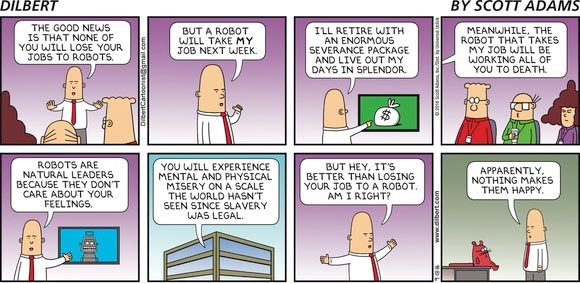
Manufacturers returning to America means jobs for robots, not people

Another article in the Los Angeles Times re-states what I have been writing about for a few years. https://coastcontact.wordpress.com/2013/02/08/impact-of-technology-on-the-u-s-economy/

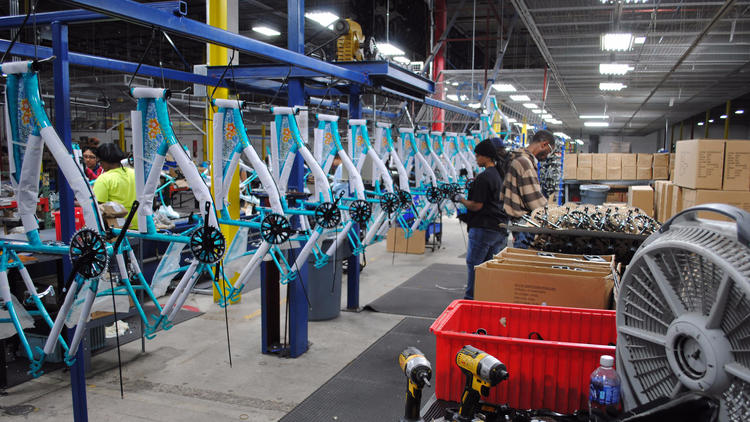
Workers at Bicycle Corporation of America assemble bikes - LA Times 8-14-2016

Workers at Bicycle Corporation of America assemble bikes for Wal-Mart, Target and other retailers. (Bicycle Corporation of America)

Here’s a little reality check on the current presidential campaign and promises by both Donald Trump and Hillary Clinton to bring back jobs from overseas.

It’s about a private Michigan company called Ranir, which makes, among other things, the business end of electric toothbrushes. After spending two years and millions of dollars to reengineer its toothbrush heads, Ranir brought back fully one-fifth of that production from China to its facility in Grand Rapids.

There’s just one catch: Thanks to the new robotic manufacturing process that Ranir adopted, it takes only four workers at the American plant to do the same job that almost certainly required dozens more in China.

The story goes that William Lee, an English minister, grew tired of hearing the incessant clicking of his wife’s knitting needles. Alternate versions of the story say that Lee was trying to win the affections of a lady who was more interested in her knitting than she was in him. In 1589, he modified the looms that were used to create rugs with hooks that would form loops that would be released during each pass of the thread, thereby knitting a whole row at once. Lee left his church work and went to secure the blessing of the queen (Elizabeth I) to ensure that no one else could create such a device and allowing him to make a healthy profit. Elizabeth denied his request and Lee went to France to try the same thing. Henri IV granted Lee the rights that he asked for, but was soon assassinated leaving Lee to die poor in 1610. Lee’s brother, James, took the idea back to England and was assisted by a man named Ashton in Nottingham in creating the first knitting factory. It wasn’t long before it was so cheap to create machine knitted clothing that many local hand-knitters were petitioning the government for limits of the business. (Sound familiar?) Lee’s design remained virtually unchanged until the 1700s when it was modified to include the kitting frame and later to accept other materials like lace and silk or create ribbed materials that could stretch.

Just as hand knitters in 1600 could not stop progress, today American factory workers are asking the United States government to stop progress. They might delay progress but in the end things will not be as they were during the industrial revolution.

Yes! It does hurt!


Odd American Automobiles


1960 Checker Marathon


Checker Marathon

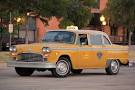
Checker Taxi was an American taxi company. It used the Checker Marathon produced by Checker of Kalamazoo, Michigan.  Although you could buy the car for personal use it was manufactured primarily for the cab company.  It’s boxy design offered easy access to the rear seat and a large trunk.  The first cars were on the streets of New York and Chicago in 1963 and were built through 1978. July 26, 1999 was the last day for the company.


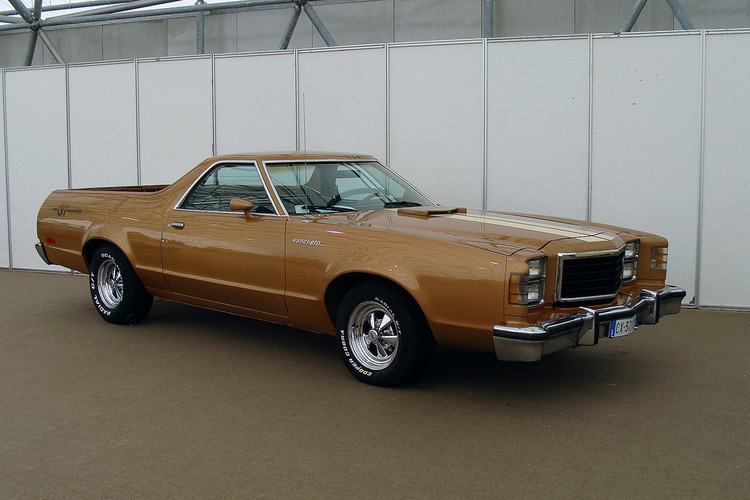
1977 Ford Ranchero


Ford Ranchero

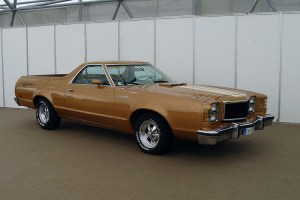
In 1957, the Ford Ranchero introduced American consumers to the Australian oddity of the “coupe utility,” a two-door coupe with a truck bed fused to the rear end. Ford Australia had invented a car that could take the family to church or throw cargo in the back, a compromise between a commercial utility vehicle and the wheel-bed and cost of a passenger vehicle. So while it might look like a small pickup truck, the Ford Ranchero was built on the body of a station wagon.

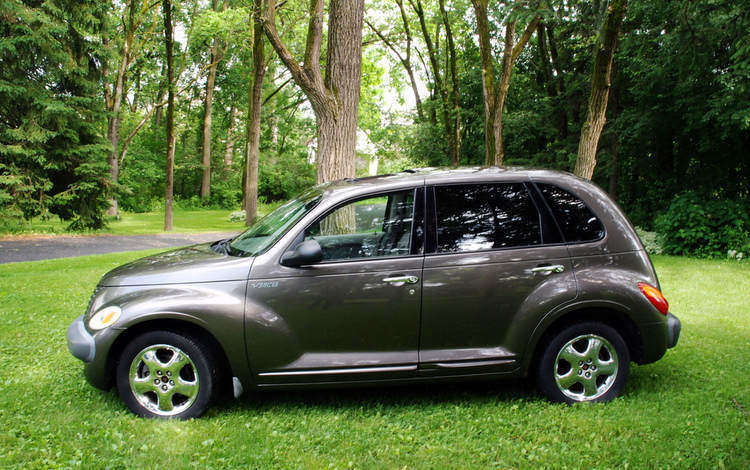
2001 Chrysler PT Cruiser


Chrysler PT Cruiser

At one point in time, the Chrysler PT Cruiser won Car of the Year. Now, the PT Cruiser is a series regular on lists of the worst cars ever made. What explains the dramatic fall of this controversial vehicle? It’s not just changing tastes, although that’s part of the equation. The PT Cruiser just didn’t stand up to scrutiny. First launched in 2001, the PT Cruiser was a 5-door hatchback designed to evoke the gangster getaway cars of the 1930s, featuring smooth curves, fat fenders, and a high roofline.

OLYMPUS DIGITAL CAMERA

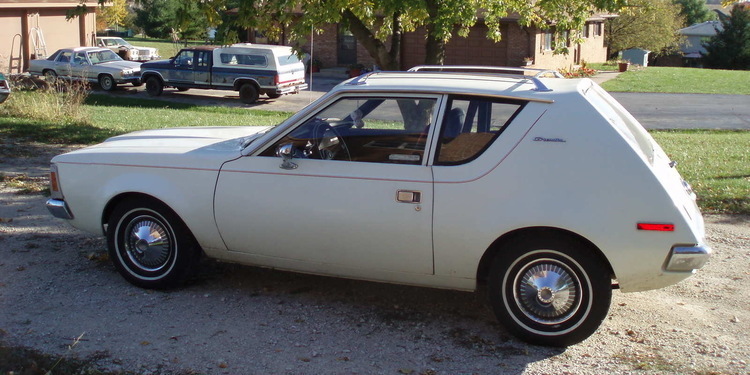
AMC Gremlin

Love it or hate it, the AMC Gremlin has to be one of the strangest designs of the last fifty years. This little two-door hatchback epitomized the wonky economy cars of the 1970s. The Gremlin was the brainchild of American Motors Company, a now-defunct automaker with a storied tradition as America’s underdog. The Gremlin was dirt cheap with great gas mileage and AMC aimed the cheekily-named car at people who wanted something a little cute and a lot different.
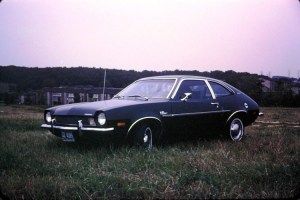
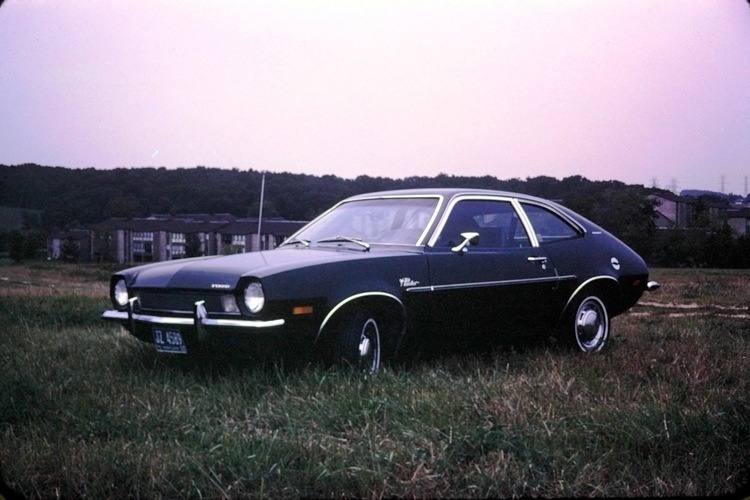
1971 Ford Pinto


Ford Pinto

The Ford Pinto was nothing special, in and of itself. It was a relatively boring and practical subcompact economy car designed to compete with Japanese imports. Uncomfortable bucket seats, uninspired lines, and a subpar inline 4-cylinder engine meant that the 1971 Pinto was never going to turn heads. Unfortunately, Ford sacrificed reliability for production speed and cost. In 1977, damning reports emerged that the tiny car had squeezed the fuel tank right behind the rear bumper—resulting in explosive fires in the event of a crash.
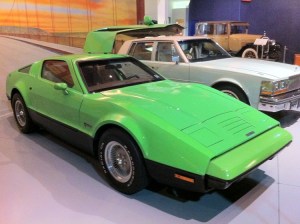
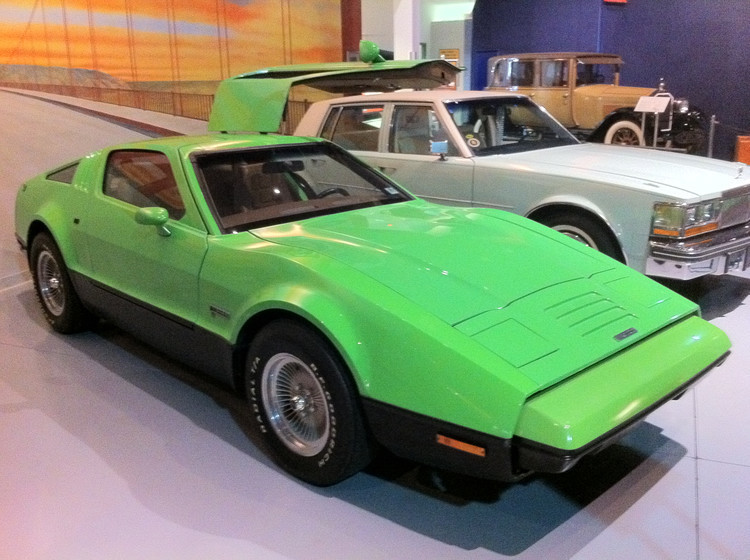
1974 Bricklin green right


Bricklin SV-1

What happens when a multi-millionaire decides he wants to start his own automaker and slaps his name on the car? The Bricklin SV-1. This bizarre two-door coupe with gullwing doors and the appearance and color of a plastic toy was the pet project of Malcolm Bricklin. Bricklin convinced investors to sink millions into a brand-new car company and manufacturing plant in New Brunswick. Only 2,854 had rolled off the assembly line when investors balked and the government forced the company into receivership.
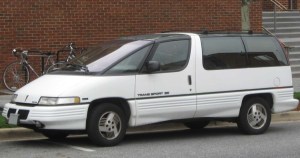
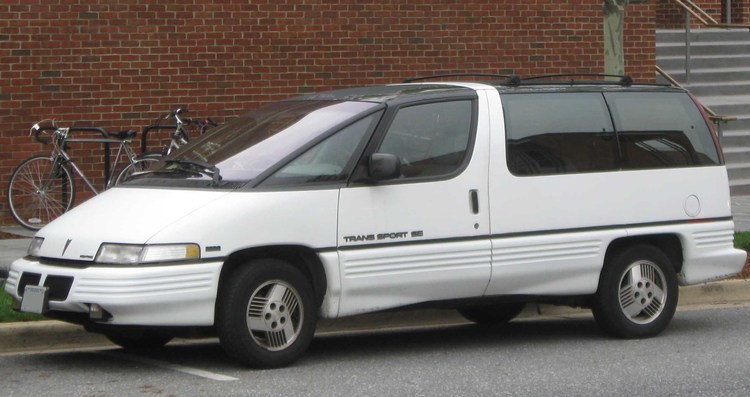
1990 Pontiac Trans Sport


Pontiac Trans Sport

The Pontiac Trans Sport was a real disappointment even for minivan buyers. In 1986, General Motors was determined to contest Chrysler’s dominant position in the minivan market.
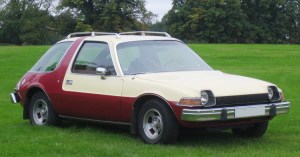
1975 AMC Pacer


AMC Pacer

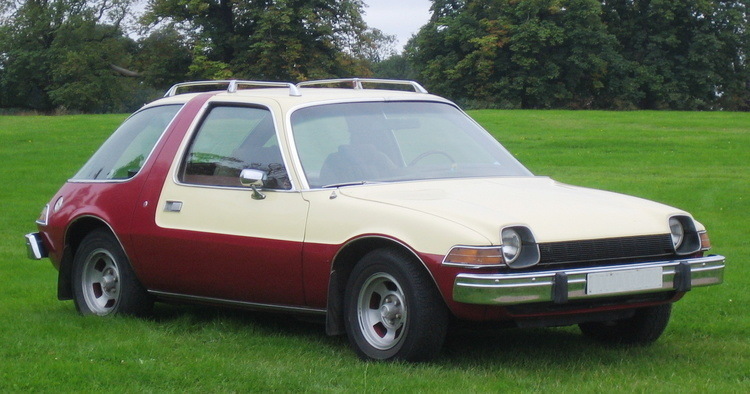
When the AMC Pacer came out in 1975 it was the toast of the automotive press, which called it “futuristic,” “bold” and “unique.” AMC even produced an electric version to respond to the gasoline crisis of the 1970s. The enormous glass bubble windshield and bizarre rear window earned the Pacer the moniker “the flying fishbowl.”  In production from 1975 to 1980.
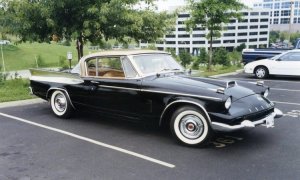
1958 Packard Hawk


Packard Hawk

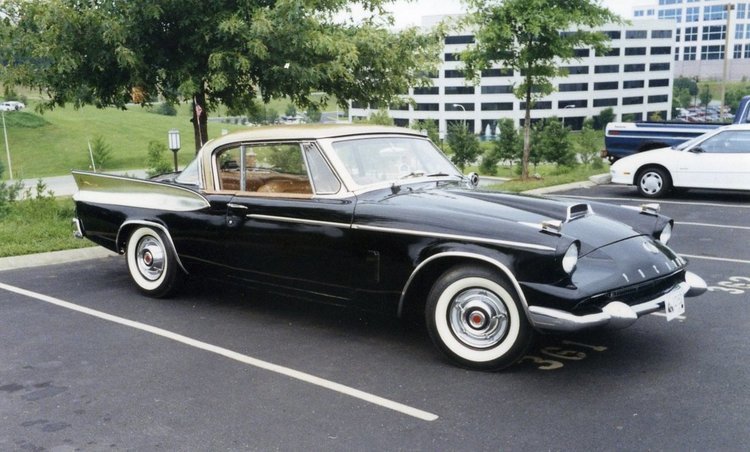
What happens when you combine two legacy automakers and pump out a shoddy combination of two great cars? The 1958 Packard Hawk, the last gasp of a dying marque. In 1954, the Big Three were starting to put the hurt on the competition. Smaller car companies were under a lot of pressure to compete and “merger fever” led to the marriage of Studebaker and Packard. Packard had been a luxury carmaker while Studebaker had a larger customer base and manufacturing capability.
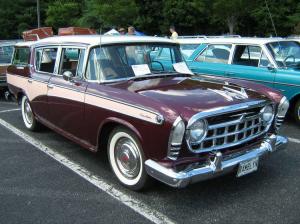
1957 Rambler Custom Cross-Country wagon AnnMD-e

Rambler Cross Country

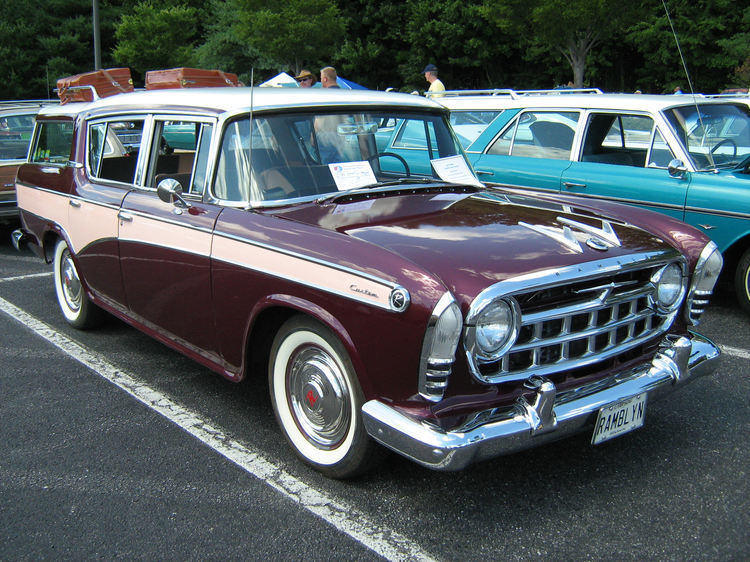
The Rambler was a wonky car that earned its place in American car history by standing out from the crowd in a good way. Rambler was a popular make produced by the American Motors Company but in 1957 the new company was still figuring out how to market and sell the vehicles. In 1954, AMC had been formed by the merger of the Nash-Kelvinator and Hudson Motor Car Company and the Ramblers had been rebadged interchangeably as Nash and Hudson cars and in 1955, the Rambler Six was a big hit. The affordable but stylish car pioneered the compact car in America! Drivers loved the new size and in 1957, AMC rebadged the Ramblers as their own marque to capitalize on their popularity. The Rambler Six was joined by the Rambler Cross Country, a four-door hardtop station wagon based on the previous compact.
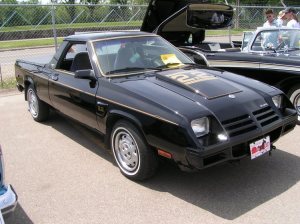
MINOLTA DIGITAL CAMERA

Dodge Rampage

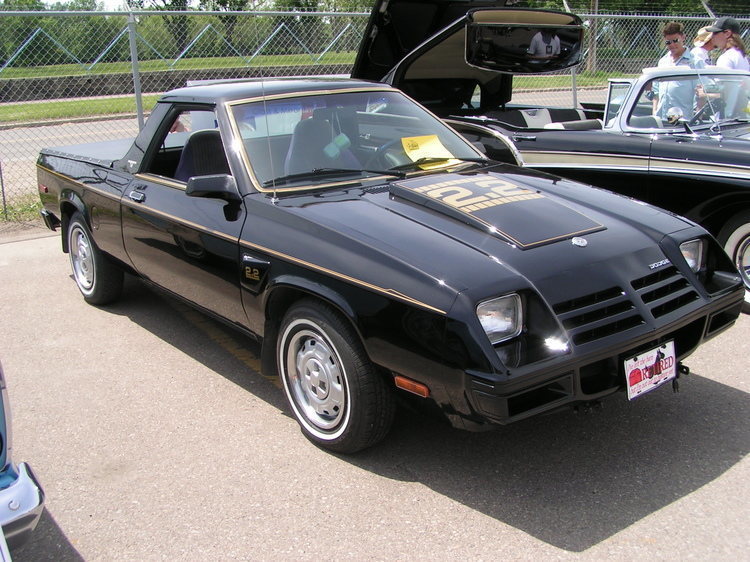
The 1982 Dodge Rampage is another coupe utility that had a bad attitude for an underperforming vehicle. The two-door coupe utility was built on a unibody subcompact car with a tiny cargo bed. Chrysler based the Rampage on the light L platform designed in response to the 1970s energy crisis. Unfortunately, what that means is that the Dodge Rampage ended up looking like a toy rather than a real car, but Dodge wanted it to be a monster truck! Let’s just say that it makes sense that the Plymouth clone using the same frame and design was called the “Scamp” rather than the “Rampage.”
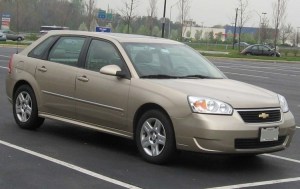
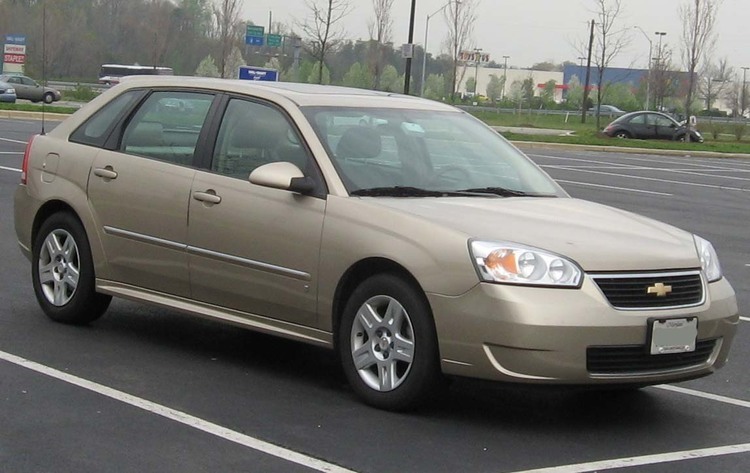
2004 Chevrolet Malibu Maxx


Chevrolet Malibu Maxx

In 2004, Chevrolet made the bizarre decision to take the solid if unremarkable Malibu and try and market an overloaded hatchback as an “extended sedan.” Hatchbacks were always a tenuous sell—attracting a certain type of driver who wanted efficiency and economy more than style or performance—and the Malibu was fighting an uphill battle to avoid falling in with the hatchback crowd.
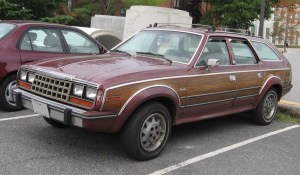
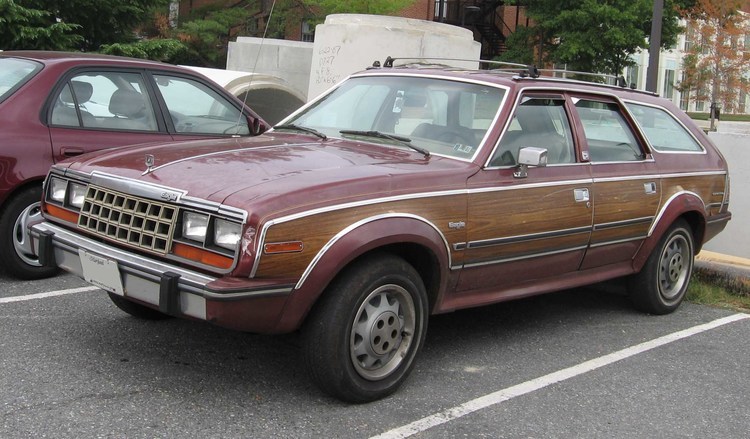
1979 AMC Eagle Wagon


AMC Eagle Wagon

Sometimes a wonky design can work miracles. Once again, AMC was back to pioneer a new market segment: the very first compact four-wheel drive passenger vehicle. Now it’s known as the very first crossover SUV. But at the time, AMC needed to update its aging passenger fleet and made a smart move to combine economy and fuel efficiency with the rugged appeal of the popular AMC Jeep. The resulting car was designed to be comfortable with good handling on the pavement and offroad. It wasn’t a full-fledged recreational vehicle, but an added benefit for regular drivers. AMC quickly added a station wagon marketed to families and drivers looking for an adventurous vehicle with good performance, and the Eagle Wagon was an immediate hit especially in regions with a lot of snow.
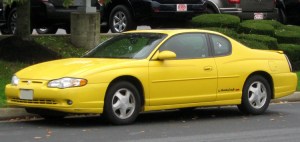
2000 Chevrolet Monte Carlo


Chevrolet Monte Carlo

The Chevrolet Monte Carlo billed itself as a “Super Sports” car drawing on Chevrolet’s racing legacy…and fell very, very short. The two-door coupe had sporty lines, but GM made some strange decisions when it came to the interior and what went under the hood. If you approached the Monte Carlo SS from the side, it looked good—not great, but good.
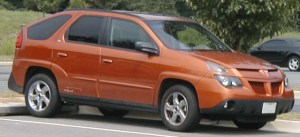
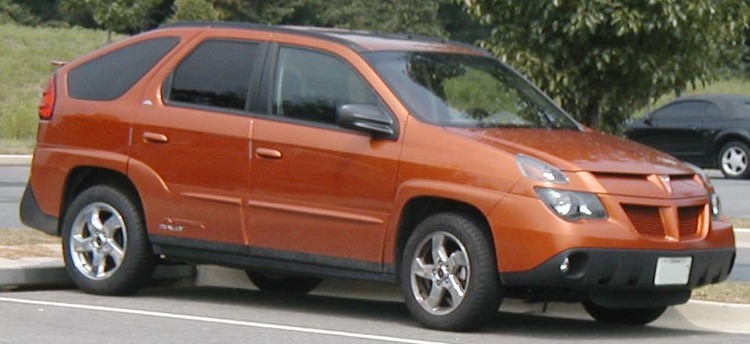
OLYMPUS DIGITAL CAMERA

Pontiac Aztek

Who can forget the car that killed Pontiac? The 2001 Pontiac Aztek will go down in history with one of the strangest designs in history. General Motors was trying to jumpstart a design renaissance after a decade of dull and uninteresting vehicles—unfortunately, it went a little too far with the Aztek. The designers were told to be aggressive, and they drafted an edgy mid-size sports crossover. On paper, Pontiac was trying to appeal to young new car buyers who wanted a fresh vehicle. But design drift saw the Aztek laden with the frills and features of a minivan, including an unfolding rear door with indented seats, a central console with a removable cooler, and even a camping add-on with an attachable tent and an inflatable mattress. Foolishly, the features jacked up the price to $22,000-$27,000, outside the price range of its target demographic of young consumers.  If the Aztek had the style to match the features and the price, maybe it wouldn’t have mattered.
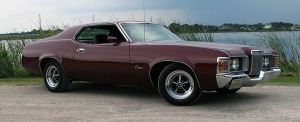
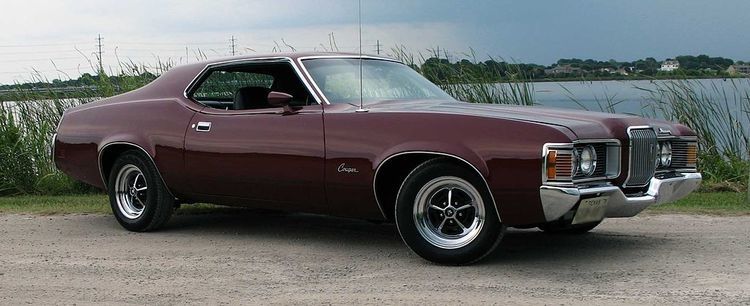
1971 Mercury Cougar


Mercury Cougar

The 1971 Cougar is a great example of the unfortunate decisions that can kill a great car. When the 1964 Ford Mustang first appeared it created a brand new type of car: the pony car, muscular and stylish but compact and affordable. Mercury was a marque that produced upscale versions of Ford vehicles at a higher price point, and in 1967 Mercury created a similar pony car to complement the Ford Mustang with a premium coupe with luxury and serious power. The handsome Cougars had a European flair and plush interior that differentiated them from their Ford counterparts without sacrificing speed and size. But in 1971, Mercury did everything it could to kill a great pony car.  A significant redesign witnessed the loss of the handsome flair of the original make.
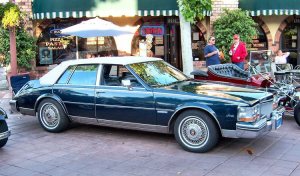
1980 Cadillac Seville


Cadillac Seville

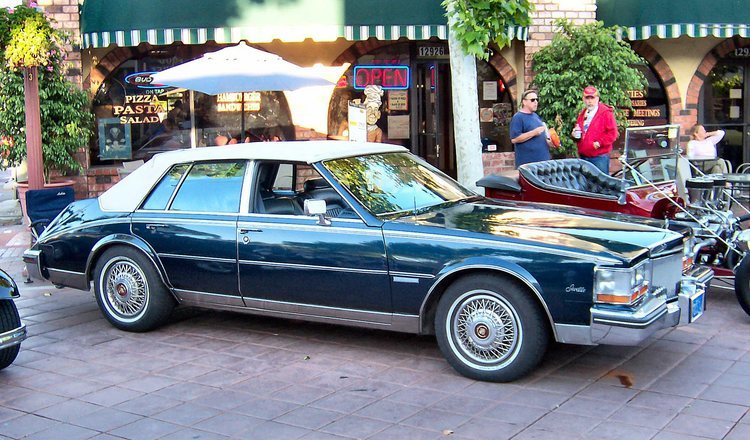
The 1980 Cadillac Seville was just a design disaster on almost every level. 1975, Cadillac struggled with competing luxury imports from Germany, BMW and Mercedes-Benz. Studies had shown that Cadillac attracted an exclusively older crowd, and GM decided to design a new sedan to attract younger buyers. The 1975 Cadillac Seville was a brand-new car, smaller and more compact than ever before with a crisp and angular appearance. Still, the new buyers were older than GM wanted, especially wealthy middle-aged women who liked a smaller car that was easier to park! GM design chief Bill Mitchell wanted to experiment further rather than stay the course and, unfortunately, designers created a car that appealed to his…unique…tastes.
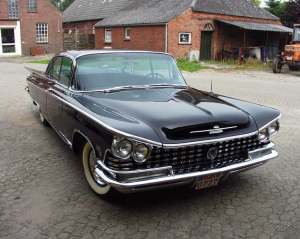
OLYMPUS DIGITAL CAMERA

Buick Electra 225

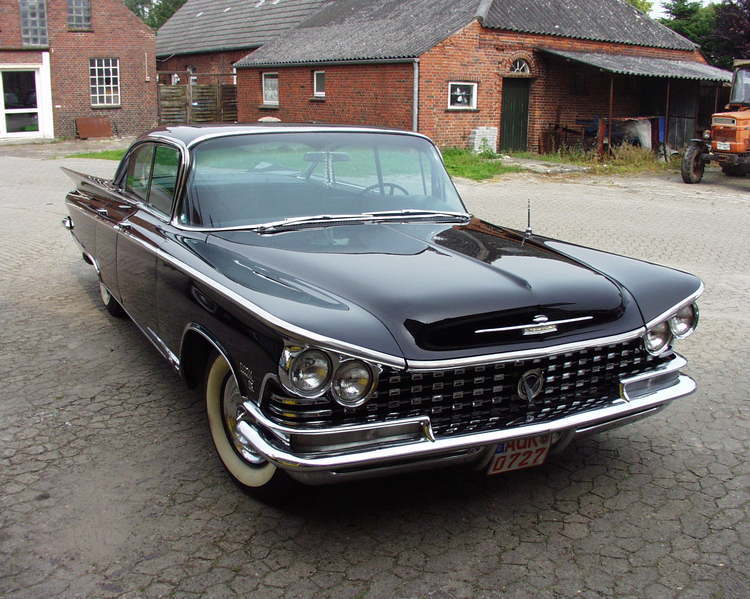
Some cars have style. Some cars have muscle. Some cars are just…bold. The colossal 1959 Buick Electra 225 was the last, best “King of Chrome.” Over eighteen feet long, the 225-inch “deuce and a quarter” was 4,900 pounds of premium in-your-face American automobile. In 1959, Buick was looking to reverse two years slump in sales with something fresh and bold. They radically redesigned the Buick lineup with all-new styling, wide molding, slanted headlights, and “delta” fins along the trunk that looked like a rocket ship. The Electra 225 was the crown jewel of the new lineup with impressive trim and luxury features.
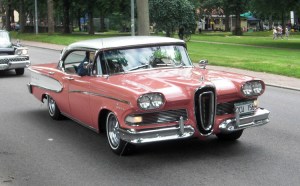
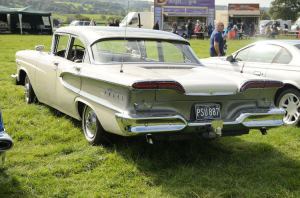
1958 Edsel Pacer1958 Edsel - rear photo


Edsel

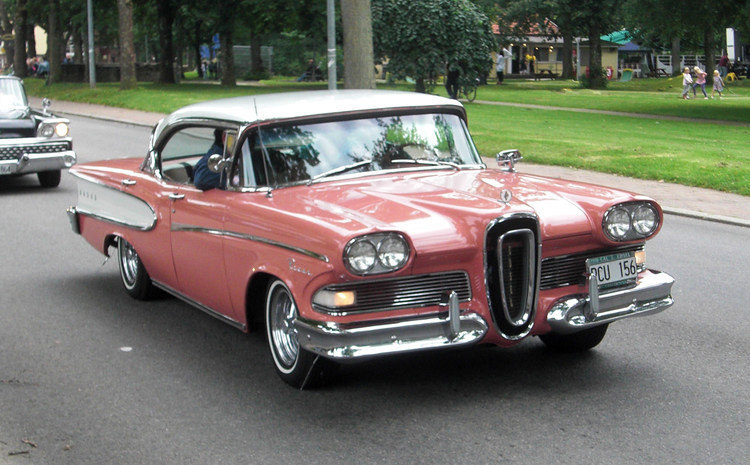
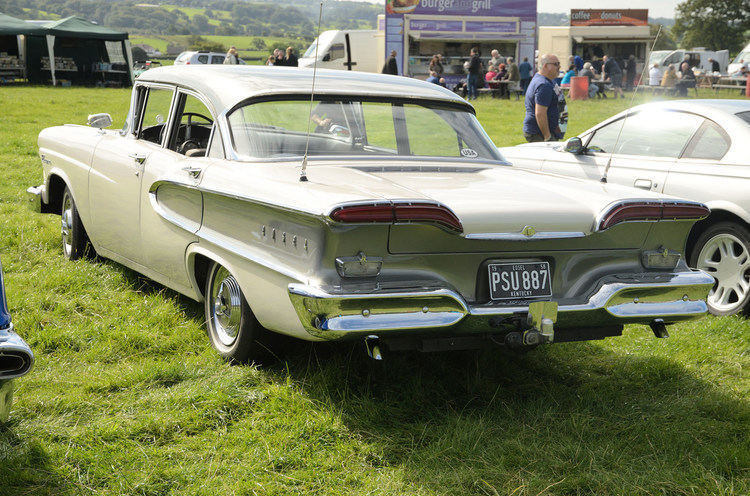
The fall of Edsel became a synonym for corporate disaster. You might not have heard of Edsel unless you’re a vintage car collector because Edsel cars were only produced and sold from 1957 to 1960. Developed as a new marque for Ford, Edsel was supposed to be a luxury car that could compete with Chrysler and GM and pioneer new technologies and a stunning new style.
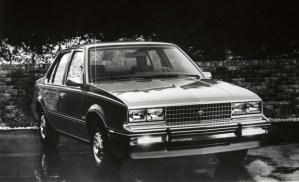
1982 Cadillac Cimmarron


Cadillac Cimarron

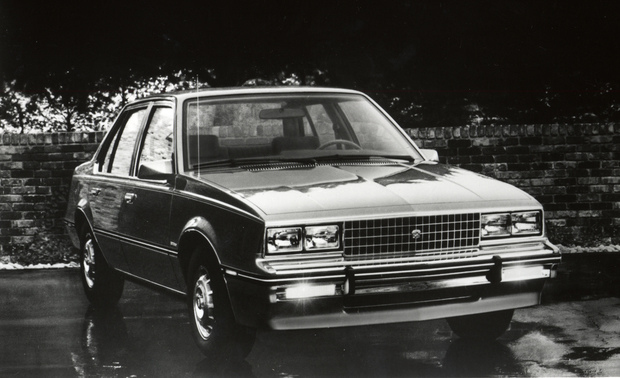
In 1982, Cadillac was back with a second attempt to sell a compact car against all odds. After the disappointment of the understrength, undersized Seville, you’d think that Cadillac would have been more careful! Cadillac still needed a new car that was less like a cargo barge and more like a speedboat. Smaller and more efficient imports from the likes of Mercedes-Benz continued to cut into Cadillac’s market share. While Cadillac struggled to identify a new design and a new name, General Motors had been working on a new platform known as the “J-Body” and Cadillac, desperate to bring a nimbler car onto the market, seized on the opportunity to cut costs and speed up production. Infamously, GM’s President Pete Este even warned Cadillac General Manager Ed Kennard that the new frame wasn’t ready for a luxury car, saying, “Ed, you don’t have time to turn the J-car into a Cadillac.” Kennard didn’t listen, or, worse, he didn’t care. The Cadillac Cimarron was born, a strange combination of poor engineering and wonky branding.
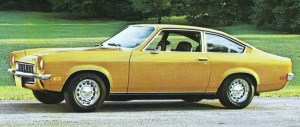
1971 Chevrolet Vega


Chevrolet Vega

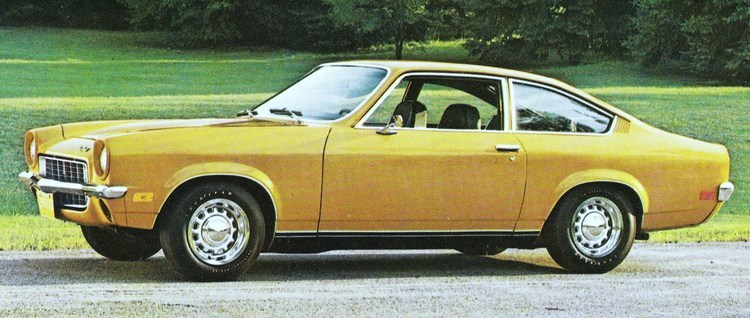
The Chevrolet Vega as a kissing cousins with the Ford Pinto, the Vega lacked the explosive legacy of the Pinto but was plagued with a series of disastrous recalls. At first, the Vega seemed like a promising vehicle that could compete with a wave of imported compacts from Japan and Germany. The Vega had sleeker lines than the Pinto, with decent fuel economy and good handling. Initial sales were brisk, and soon hundreds of thousands were in the hands of drivers. That was when the first problems began to appear, compounded by the fact that the fraction of real lemons was magnified by the sheer volume of vehicles on the road!

1953 Hudson Jet


Hudson Jet

The crippling cost of developing and marketing the Hudson Jet was the final nail in the coffin for the small automaker. While the Jet was hardly a terrible vehicle, it was not a great one either, and the oversized and overpriced sedan was an ignoble end for the Hudson Motor Car Company. Hudson had once been one of the largest automakers in America, but by 1951 the company was struggling to compete with the Big Three. Saddled with an aging stable of luxurious full-sized cars when the market was shifting towards smaller and more practical vehicles, Hudson knew it needed a bold new model to recapture the public interest and put drivers in the seat. Unfortunately, money was tight, and Hudson didn’t have the financial leeway to take a lot of chances or develop a new full-sized vehicle that would appeal to their current owners. Instead, they pinned their hopes on a new “compact” inspired by the Nash Rambler.

1961 Metropolitan


Metropolitan

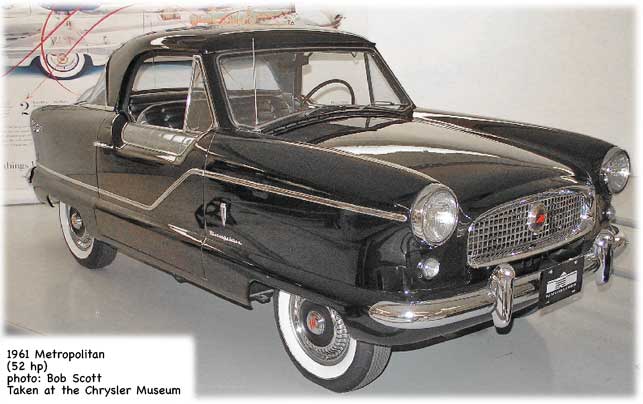
This car is usually called the Metro. After launching the popular Rambler, Nash worked for many years on an even smaller car. Its first public concept, the NXI (Nash Experimental International), was shown in 1949, followed after one year by the NKI (Nash Kelvinator International). The name of the car was to be NKI Custom until shortly after production began, and new badges had to be retrofitted to early cars. The concepts were designed by independent stylist William Flajole, using the Fiat 500 chassis and running gear; the Nash Metropolitan was styled by Battista “Pinin” Farina.

Nash engineered the body and suspension, but they used Austin’s little 1.2 liter (73 cubic inch) four-cylinder A-40 engine. Small but well engineered, the engine had aluminum pistons, overhead valves, a counterbalanced crankshaft, and a Zenith downdraft carburetor. Its low compression (7.2:1) allowed it to use poor gasoline, but it only had 42 horsepower; 0-60 times were around 30 seconds, nearly double that of the flat-head six-cylinder Plymouth Savoy. The transmission was a three-speed manual column shift.

Starting in 1954, Austin built the Nash Metropolitan under contract, using Fisher & Ludlow bodies, in Longbridge, England. The car was then shipped to the United States. There were two models, both two-doors: a convertible and hardtop. They were unit-body designs, at a time when most cars were body-on-frame.

Shortly before the Metropolitan was launched, Nash merged with Hudson to form the American Motors Corporation. It would later drop both brands in favor of Rambler and, later, AMC, but for now, the staid, upscale Hudson dealers were sent Hudson Metropolitans.
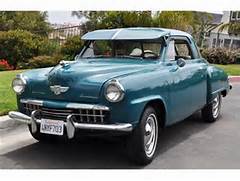
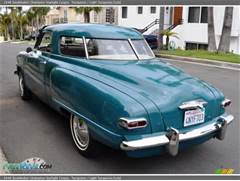
1948 Studebaker Coupe1948 Studebaker Coupe Rear


Studebaker

The Studebaker 1948 Coupe was a big hit. The design was unique because the rear looked like the front.
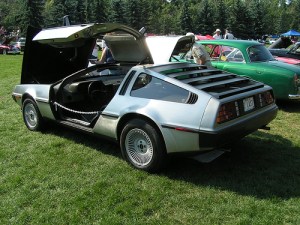
1983-Delorean-dmc


DeLorean DMC-12

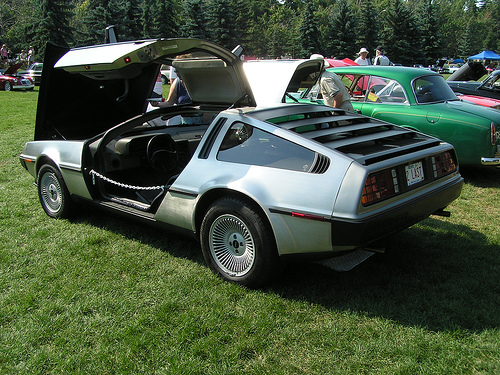
The DeLorean DMC-12 is a sports car that was manufactured in Northern Ireland to be sold in America from 1981 to 1982. The car is most commonly referred to as the DeLorean, as it was the only model ever produced by the company. The first prototype appeared in 1976 and 9,000 DeLoreans were produced by 1982, when production stopped. Today, only about 6,500 of these cars are believed to exist. This car is most well known for being used as a time machine in the “Back to the Future” movies.

Goodbye to Chain Department Stores

Macy's North Hollywood Closing 8-4-2016The Sears near my home was in a shopping center that includes many of the major department store chains including Macy’s, Nordstrom’s, Target, and Neiman Marcus. The store is now sealed off with metal siding and block walls.

The impact of Amazon and other on-line sales companies is really starting to take its toll.   Amazon, Wal-Mart Lead Top 25 E-commerce Retail List. Total annual retail e-commerce sales are $201 billion, according to the 180 companies tracked by eMarketer. For the top 25 retailers, total annual e-commerce sales come in at $159 billion, with Amazon Inc., Wal-Mart Stores Inc. and Apple Inc. taking the top three spots. According to eMarketer, Amazon’s e-commerce sales are $79.3 billion while Wal-Mart has $13.5 billion and Apple totals $12 billion. After Walmart is Apple, Staples, and Macy’s.   More than 50% of Williams-Sonoma’s sales are done on-line.

So while Macy’s may be seeing an increase in-line sales they are closing or have closed at least 40 stores this year. Four in the Los Angeles area include their Century City store (that is next to Beverly Hills). This list does not include all of the targeted stores as they just today announced the closing of a North Hollywood store that was opened 61 years ago by May Company.

Fortune magazine reports that 78 Sears and Kmart stores are also closing.

There are many other chains of specialty stores from women’s fashions to sporting goods and sportswear that are also facing declining sales.

What will happen to all the malls that have been built across the nation? One high end mall in Woodland Hills California, called the Promenade, is now mostly deserted and rumor has it that the buildings will be torn down and apartment houses will replace the shopping. Westfield is the owner and has not revealed its plans.

Does this also means more lost jobs? Well, no.  New distribution centers are being erected by the on-line retailers.

Nothing is forever!

Trump Killing NAFTA Could Mean Big Unintended Consequences for the U.S.

Donald Trump intends to renegotiate NAFTA.  In a speech given today he laid out a seven-point plan to change U.S. ‘failed trade policies’, including withdrawing from the Trans-Pacific Partnership (TPP) and renegotiating NAFTA.

Following is an article that appeared on Bloomberg.com on October 1, 2015.  This article points out the benefits of NAFTA.

by Eric Martin

Ending the deal would hurt American manufacturers. For consumers, backing out might mean price increases on everything from cars to fruits and vegetables.

Donald Trump has pledged to renegotiate or terminate the North American Free Trade Agreement, saying that it’s been a disaster for the U.S.

And the billionaire front-runner for the Republican nomination isn’t the first presidential candidate to bash the deal: Since its inception (Ross Perot warned of a “giant sucking sound” pulling jobs to Mexico), Nafta has been a popular punching bag for politicians. Despite the idea’s popularity, pulling out of Nafta could have all sorts of unintended consequences for U.S. businesses and the economy.


1. America’s biggest export market would be jeopardized

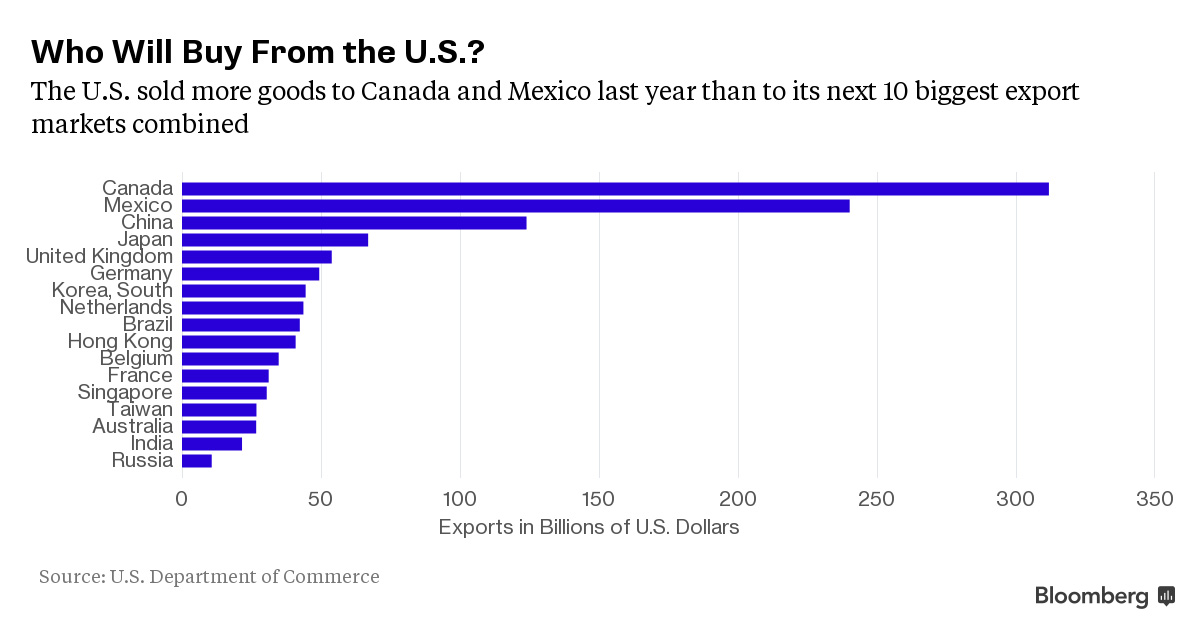
U.S. goods exports to Canada and Mexico have quadrupled since Nafta took effect in 1994, rising to about $550 billion last year. That’s more than sales to China, Japan, the U.K., Germany, South Korea, Brazil, India, Russia and Hong Kong combined.

  Exports in Billlions of Dollars While critics have decried Nafta and other free-trade agreements for opening U.S. markets to foreign products, the deal actually lowered tariffs in Canada and Mexico even more than in the U.S. The American government applied an average tariff of just 4.3 percent to imports from Mexico and 5.1 percent to those from Canada before Nafta, while Canada had a 9.7 percent tax on imports from the U.S. and Mexico’s tax was 12.4 percent, according to a study last year led by Gary Hufbauer, an analyst at the Peterson Institute for International Economics.

A return to the tariffs pre-Nafta would mean “our exporters have more to lose in the immediate shock” than Canada and Mexico, Hufbauer said in an interview.


2. Jobs already gone wouldn’t return

As with any trade agreement, jobs were both created and destroyed after Nafta took effect as the workforce in each nation was realigned based on comparative advantage. In their search for lower costs for production chains, U.S. companies have moved jobs abroad—some to countries that have free trade with the U.S. and others to nations that don’t.

“If we didn’t have Nafta, would things like clothing and automobiles that are produced in Mexico be produced in the United States? No,” said David Gantz, who teaches trade law at the University of Arizona. “They’d be produced in China or somewhere that the labor costs are a lot lower. One needs to look at what the alternatives would be.”


3. The American economy overall would lose

Thanks to Nafta, U.S. consumers have enjoyed the benefits of cheaper imports from goods manufactured in Mexico. Scrapping the trade agreement might force Americans to stomach higher costs, from flat-screen TVs to Nissans to guacamole: Mexico is the world’s top producer of avocados.

Hufbauer estimates that Nafta trade growth makes the U.S. $127 billion richer each year, not only because of the boost to American exporters but also because of these benefits to U.S. consumers. That’s about $400 per person.

“It’s not always visible to people because much of the benefit is at the checkout counter,” Hufbauer said.


4. American drivers could pay more for gasoline

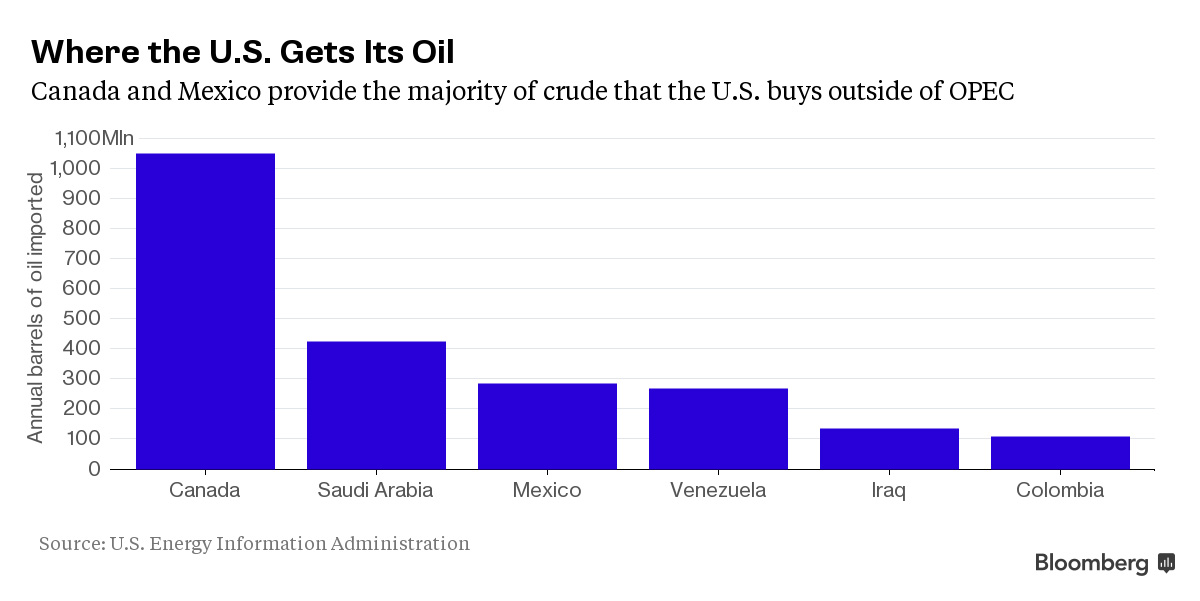
Canada and Mexico accounted for about half of U.S. oil imports in 2014, more than all the nations in OPEC combined and 84 percent of the oil the U.S. bought from outside the cartel.

Where the U.S

While a supply glut has driven oil prices to near a six-year low, there’s no guarantee things will stay that way.  Ending Nafta could make the U.S. more reliant on imports from Saudi Arabia, Venezuela and other OPEC members when global demand rebounds down the road.

Nafta gives the U.S. preferential access to oil, limiting the scenarios in which Canada can restrict energy exports to the U.S. If the U.S. didn’t import oil from its Nafta partners, it could do so at higher cost from other countries, some of which aren’t as friendly to the U.S. as Mexico or Canada.