American Publishing in Decline

This situation makes me cry. I have been a subscriber of Newsweek, BusinessWeek, and Los Angeles Times for decades.

A few years ago, in 2008, there was a columnist in BusinessWeek magazine who wrote about the decline in the print media and how it would affect even some of the largest news outlets. That was when BusinessWeek was owned by McGraw-Hill. The magazine was sold to Bloomberg LP in October 2009. Bloomberg has made the magazine flourish if size of the weekly is an indicator. Perhaps that is one of the exceptions. Since Bloomberg is privately held there are no pubic reports on its performance.

Meanwhile newspapers have not done too well. The Graham family had owned both Newsweek and the Washington Post. Newsweek stopped publication and the Washington Post was bought by Jeff Bezos, founder of Amazon. That makes the paper privately owned too.

My home town newspaper, the Los Angeles Times, owned by Tribune Publishing in Chicago, is reducing its staff by 50 or more persons this month. The reductions include significant editors and station managers. Among those being given buyout are the main politics editors for City Hall and California, the bureau chiefs in New York, Seattle, San Francisco, San Diego, Las Vegas and London, all of the obituary writers, most of the “backfield” editors who handle national and foreign stories, the top editors of features and Sunday Calendar, the editor in charge of Column One stories, the wine columnist, the editor in charge of editing standards, as many as a half dozen photographers, at least that many copy editors, and many more in various positions. Sports columnist Bill Dwyer and general things about Los Angeles columnist Sandy Banks are among the leading writers that will be gone. The Tribune Company has put their printing plant near the downtown area up for sale. Will there be a newspaper after all this is done?

I love the internet but the damage it has brought to news publications has been devastating.

What’s Wrong with the TPP?

What is wrong with NAFTA, TPP, and other free trade agreements that lower tariffs?

The United States is the dream country for capitalists. The limits on corporations are minimal. Very big companies buy each other out (called a merger) with few government efforts to control the likely outcome of near monopoly. The latest example in Walgreens drug company’s plan to buy Rite-Aid drug company.

Those same companies are now referred to as multi-nationals. General Electric is a creation of Thomas Edison but consider that the company now has facilities in 130 countries. GE has invested over $200 million in a flexible new “brilliant factory” in Pune, India. This information is from GE websites.

Heinz Ketchup sits on the tables of restaurants in Paris. It is not packaged in the United States.

The United States currently imposes low tariffs on most of the goods imported into this country. The TPP will eliminate those tariffs on the other 11 countries. That probably won’t impact the amount of goods being imported. The agreement also lowers the tariffs that other countries impose on imported American goods and that appears to be a good thing.

However when those goods are shipped overseas that are in limited supply in the United States that will drive up the prices in America. An example is chicken. Tyson Foods processes 41 million chickens a year. If they can sell some of those chickens in other countries that will reduce the number of chickens available for sale in America. Less supply translates to higher prices. That means higher profits for Tyson.

If you manufacture something in the United States where $15 to $25 per hour is a common pay rate, why not manufacture your goods in Vietnam, Peru or Malaysia where pay rates are significantly lower and import the products to America?

John Deere and Caterpillar are two companies that will benefit from lower tariffs in other countries. The problem is there are too few companies that are in the category of big machines.

The United States has lost millions of jobs to lower pay rate countries. The benefit to company shareholders is obvious.   The loss of jobs in America is obvious. The rich typically get their way. I predict capitalism will prevail. I also predict the end of the middle class in America.

Buy-Outs, Forced Retirement and Age Discrimination

Your employer is in financial difficulty and needs to find a way of saving cash until there is a recovery.

If you work for a newspaper or magazine you are in an industry that is in serious decline then recovery is in doubt. The Washington Post seems to have recovered thanks to a purchase by Jeff Bezos, founder of Amazon. BusinessWeek magazine was bought by Michael Bloomberg and is thriving. Newsweek and U.S. News and World Report are gone. Tribune Publishing Company that owns the Chicago Tribune, the Los Angeles Times and other newspapers is in dire straits.  The Los Angeles Times is currently attempting to offer buy-outs to their staff.  Sports writer Bill Dwyre, a gray-haired man with years of experience and probably high pay just announced his retirement.  Other outstanding columnists with that paper are probably also going to take their leave.

General Motors and Ford Motor Company both went through some very difficult economic times as have   many other companies.

In every instance they all followed the same path. Cut the high cost employees and reduce the pay to the remaining employees. I know people who were part of the buy-out, those who faced the reduced pay, and those who were simply laid-off. I was party to that situation more than once.

The issue for those losing their jobs is their age. Once you are older, 55 or older, obtaining another job at the same pay as was previously received is difficult and in most cases impossible.

Age discrimination is rampant and impossible to prove. “Age discrimination involves treating someone (an applicant or employee) less favorably because of his or her age. The Age Discrimination in Employment Act (ADEA) only forbids age discrimination against people who are age 40 or older.” That is the statement posted on the EEOC on their web site.

From Forbes magazine dated January 31, 2014

The Ugly Truth About Age Discrimination (abridged)

“So then the headhunter said something that took my breath away,” said my caller, Philip.

“He told me that his client looked at my resume and said it looked great, but then he found my LinkedIn profile and decided I’m a little long in the tooth for the job.”

I was silent. That took my breath away, too.

“Long in the tooth?” I asked. “As in old?”

“Exactly,” said Philip. “The headhunter actually told me that the client said I was too old for the job. I asked him if that was illegal – I’m pretty sure it is – and he said that the client’s view is that if they don’t interview me, I’m not a candidate, so it’s not discrimination.”

“That’s false,” I said, but even as I said it, I knew that it doesn’t make any difference.

What is Philip going to do – sue the employer he never met because a third-party recruiter told him that one hiring manager made an inappropriate comment? So-called Failure to Hire cases are notoriously hard to bring and even harder to prove. As long as the organization ends up hiring someone who is qualified for the job, how could Phil ever prove that he was rejected because of his age? It’s not as though the organization is going to publish the new hire’s age for all the other candidates to see.

Age discrimination is everywhere. I hear more examples of age discrimination than I hear about sex discrimination, racial discrimination and every other kind put together. I expect that’s because some employers believe that older workers aren’t as nimble or perhaps aren’t as easy to train. Some of them undoubtedly worry that an older person is necessarily overqualified, and thus likely to bolt the minute a better job comes along.

I was there too. At the age of 60 in an interview the president of the company, he asked me if I was a grandfather. My answer was no and that was accurate. The thought running through my head was I would not be obtaining this job. To my surprise I did receive the job offer. I went on to two promotions proving that older employees can thrive.  Could I have brought a successful suit against that employer? There was no proof that the question was asked.

I know of no solution. Businesses thrive, businesses shrivel, life goes on. As the population ages the issue of age discrimination will fade away.


How Big Business Continues to Take More from Everyday Americans

Walgreens Drug company, officially named Walgreens Boots Alliance Inc., on Tuesday agreed to buy Rite Aid Corp. for about $9.4 billion, combining two of the nation’s largest drugstore chains as they bulk up to increase their profits. The claim is that they are doing this to better compete in the rapidly changing health care industry.

The two companies didn’t say whether they would shutter stores or lay off workers after the deal closes. But they did say that “decisions will be made over time regarding the integration of the two companies” and that Walgreens “plans to further transform Rite Aid’s stores to better meet consumer needs.”  A Rite Aid is about 3/4 mile from my house and a Walgreens is about one mile from my house.  Do you think both will remain open after this consolidation?

Soon when you say “I am going to the drug store” no one will ask which one because there will be only one. That is also likely to happen in the retail food market business as Kroger continues its march to own all the general purpose food stores no matter what the brand name is on the front of the building. In Los Angeles both Ralphs and Food 4 Less are owned by Kroger.

The dismaying part of this march to consolidation is the reduced competition and the ensuing price hikes. No matter what those companies say, when there is reduced competition there are price increases.

The saddest part of this situation is that our congress sits on its hands and does nothing to stop the consolidations. This is the reason that Donald Trump, Ben Carson, and Bernie Sanders are all doing well in the presidential polling. They say that they will stop the control of our society by the wealthy.

Can we believe those outsiders? The insiders certainly have not done the job.

Costco Goes for the Wealthy

Costco’s basic idea was opening low cost warehouse stores, not located in higher cost shopping centers, and offering a no frills limited selection of goods that could be had in bulk at significantly lower prices.

Old Costco #2My nearby Costco was an abandoned warehouse next to a Home Depot and across a boulevard from a Salvation Army facility that includes housing for some very poor people. Adjoining that property is apartment complexes for a struggling working class community.

There were people always sitting on the curb hoping to obtain day jobs. That is probably the consequence of the Home Depot. Some shoppers were uncomfortable with the environment and would not shop at that Costco.

Despite my description of that Costco it was a very busy place. Weekends were always packed with shoppers to the extent that a very large parking lot was near capacity and lines in the store checkout were long.

Just 2½ miles away Westfield (the Australian shopping center developer) owns the Westfield Topanga Mall that houses high end stores including a Neiman Marcus department store.   That mall is on the perimeter of Warner Center and just 3 miles from Kim Kardashian and Jay z’s home in Hidden Hills and about 4½ miles from Calabasas which is the home of many entertainment and sports stars.

First Day Opening #2So Costco, understanding that wealthy people have more money to spend than the rest of us, closed their 20 year old warehouse and moved the 2½ miles into a new building that still has warehouse racking inside but offers the things that only the very wealthy can afford.

What could they offer that is not at your usual Costco?

Louis Vuitton and Chanel Handbags for $1500 (no picture).

Louis XIII Liquor$6500 bottles of Louis XIII Cognac.

$23K Wedding Ring

$23,000 wedding ring.

 Patek Philippe Watch

 A $19,000 Patek Phillipe watch.

 $150K Round Diamond Solitare Pendant

A $150,000 5.34 carat Round solitaire pendant on what must be a diamond studded necklace. Click the picture to confirm that price. 

There are no words that I can write to portray my astonishment.

Auto Manufacturers Cannot be Trusted

Once again we have been reminded that auto manufacturers cannot be trusted. Remember that fact when you shop for your next car.

I always held Toyota in the highest regard. I used Toyota as a standard when urging my employees to do their best. I would say, “I want Toyota quality.” Those were my words in the 1980s and 1990s, well before Toyota’s developed an acceleration problem that cost lives. In my opinion there has never been an adequate explanation of the cause of that problem. Toyota ended up paying out a staggering $1.3 billion to settle lawsuits related to unintended acceleration, and in some of those cases the drivers were probably at fault.

General Motors kept quiet about the ignition switch that would shut off while their cars were in motion. That too cost lives. 13 people died. Almost 780,000 Chevrolet Cobalts and Pontiac G5s were recalled and the company paid a $35 million fine. What is sad is that it would have only cost 57 cents to fix each faulty ignition switch.

Now we have the VW installed software that masks the real performance of its diesel cars. There is no direct impact on the buyers of the cars but the company and its dealers will notice a substantial decline in sales.  The company management is to blame for this stupid decision.  20% of German exports are cars shipments.  Imagine what the impact will be on German factories.

How many other industries lie about their products?  

GE says it may move up to 500 jobs overseas

When Donald Trump said “we-are-led-by-veryverystupidpeople” you probably thought he was exaggerating.  The GOP lead congress refused to re-authorize the U.S. Export Import Bank on the grounds that it was helping companies that don’t need any help.  This is the consequence of that very stupid decision.

By ASSOCIATED PRESS

General Electric LogoGeneral Electric Co. may move about 500 American jobs overseas because Congress did not renew a government program that allows foreign companies to borrow money to buy U.S. products, the industrial conglomerate said Tuesday.

Authorization for the U.S. Export Import Bank was not approved by Congress, forcing it to stop lending July 1. Foreign companies use the agency to buy expensive U.S. products when bank loans are not possible.

As a result, GE says 100 jobs from a Houston plant that makes gas turbines will move to Hungary and China in 2016. The Fairfield, Connecticut, company says those countries have lending options in place for customers.

“We do not make today’s announcements lightly and in fact, have done everything in our power to avoid making these moves at all, but Congress left us no choice when it failed to reauthorize the Ex-Im Bank this summer,” said John Rice, GE’s vice chairman.

Another 400 jobs could be created in France instead of factories in South Carolina, Maine and New York if the company wins projects it is bidding on. The projects require financing, and the export credit agency in France has agreed to provide it.

GE said it’s bidding on projects valued at $11 billion that require export financing. It said it has reached agreement with the French export credit agency to provide a line of credit for global power projects. GE said the line of credit will initially support potential orders in international markets that include Indonesia.

To access the required export credit for its customers of its aeroderivatives turbines, GE will move its final assembly from the U.S. to Hungary and China. As related projects are bid and won in these two product lines, GE said it will move approximately 500 jobs from Texas, South Carolina, Maine and New York to France, Hungary and China.

The embattled and little-known banking agency has been at the center of a fight between tea party Republicans who say it’s not needed and Democrats and some Republicans — backed by manufacturers and large businesses — who say it promotes trade and helps create jobs.

The Ex-Im Bank’s principal role is to guarantee commercial bank loans to foreign businesses and governments to buy U.S. products. U.S. taxpayers would be responsible for a loan if a company operating overseas defaults on a bank loan used to buy a product made by a U.S. company.

Copyright © 2015, Los Angeles Times

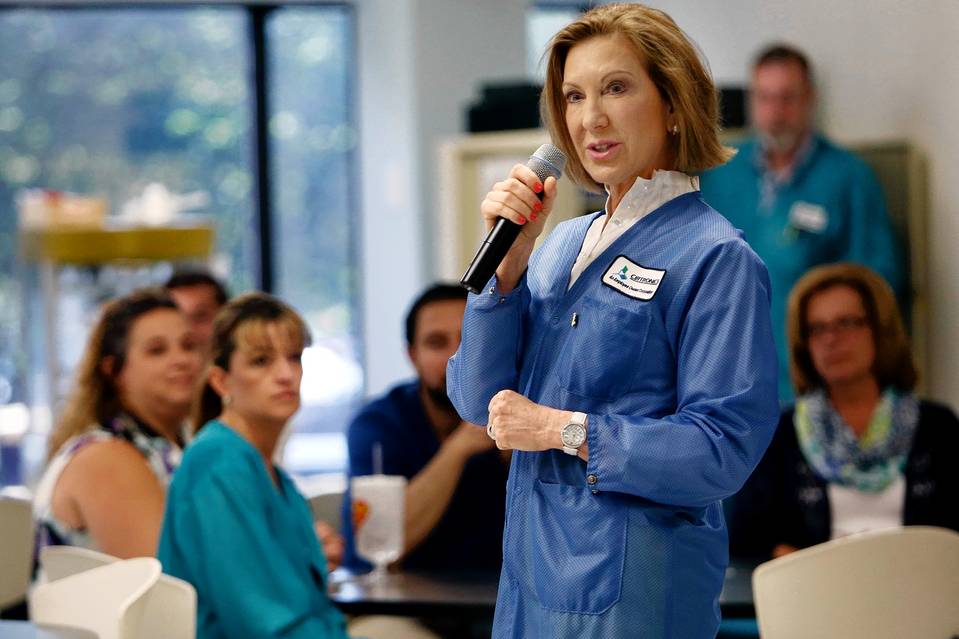
What non-Californians don’t know about Carly Fiorina — but should

Occasionally I post an article appearing in a local newspaper or a magazine article that I view significant.  This is one of those times.  Michael Hiltzik is a regular columnist in the Los Angeles Times.  Although this is a long column it will be worth your while to read.

The most surprising takeaway from last week’s Republican presidential debate — next to the difficulty of puncturing Donald Trump’s helium-powered candidacy — was the mass anointing of Carly Fiorina as the Candidate to Watch.

Carly FiorinaPraise for the former Hewlett-Packard CEO’s performance at the introductory undercard debate spanned the full range of news outlets. The conservative National Review remarked on her “poise and her well-crafted answers,” and CNN paid homage to her “sharp knowledge of the issues.”

Fiorina told the latter that she went into the debate aware that “only 40% of Republicans even know who I am.”

She must be talking about people outside the state of California. Here in the Golden State, we know Carly Fiorina very well. We know her as the under-performing CEO of one of Silicon Valley’s marquee corporations, and even better for her losing campaign against Sen. Barbara Boxer in 2010.

So as a public service, let’s share with the rest of the country what we’ve learned about Carly Fiorina. We’ll start with her dismal political record.

Even before her 2010 campaign against Boxer could get off the ground, it was poleaxed by the revelation that she had failed to cast a ballot in 75% of the California elections for which she was an eligible voter. She missed presidential primaries in 2000 and 2004, and the primary and general elections in 2006, including a Senate reelection run by Democrat Dianne Feinstein. She skipped the primary and general elections in 2002, a gubernatorial election year, as well as the historic recall vote that brought Arnold Schwarzenegger to the governor’s seat.

In an Orange County Register op-ed announcing her Senate candidacy in 2009, she explained lamely: “I felt disconnected from the decisions made in Washington and, to be honest, really didn’t think my vote mattered because I didn’t have a direct line of sight from my vote to a result.”

Socialism

When Chris Matthews asked Debbie Wasserman Schultz explain the difference between Democrats and Socialists she wouldn’t answer the question. Instead she chose to respond by comparing Democrats to Republicans. The question was again brought up on Meet the Press.


So even after that Hardball interview Ms. Schultz either was not prepared to answer the question restated by Chuck Todd or she fears the comparison. However Chris Matthews did define the difference in stating that America is the country of free enterprise that is supported by both political parties.

CHRIS MATTHEWS: “Democrats have had a record in this country for 200-some years of being for social security, Medicare, civil rights, interventions in the market, but not getting rid of the market. Clearly, they accept the power and the efficiency of a capitalist system. Socialists do not. This is a fundamental difference.”

Too bad Wasserman Schultz didn’t say that.

A socialist is someone who supports the political philosophy of socialism, which is a governmental system that advocates community ownership and control of all lands and businesses rather than individual ownership.

Bernie Sanders is an Independent and an avowed socialist. He admits it.

That definition of socialism forces me to not support Bernie Sanders for the presidency.

When Everything Was So Great!! ??

From Dutchman a HuffPost community moderator on 7-29-2015                                   

This is for the “everything was great when Republicans were president” crowd.

Here is my updated (as of market close last Friday) analysis of the inflation-adjusted S&P 500 returns.

Source data is available from Standard and Poors (www.standardandpoors.com) and the Bureau of Labor Statistics ( href=”http://www.bea.gov“>www.bea.gov)

Peak to Valley loss for the S&P 500 from October, 2007 through January, 2009: -50.9%. Who was president then?

Cumulative return to the S&P 500 since February, 2009: +111%
And then there’s this: Rank of the best performing presidenti­­al administra­­tion for the annualized return of the S&P 500 “under their watch”:

Clinton: 14.26%

Eisenhower : 13.38%

Obama: 13.15%

Kennedy: 11.10%

Bush I: 11.01%

Truman: 9.99%

Reagan: 9.51%

Roosevelt: 8.67%

Johnson: 7.16%

Carter: 1.20%

Nixon/Ford : −2.16%

Bush II: −5.18%

Hoover: −17.33%

Amazing! The president with the 3rd best annualized real return of the S&P 500 “under his watch” since the CRSP records begin in 1926 is OBAMA!!!!!  And he did much better than the GOP hero, Mr. Reagan did.

More importantly, in aggregate and individual­­ly, Republican presidents are TERRIBLE for the S&P 500.

Annualized, real return of the S&P 500 since 1926 under Democratic presidenci­­es: 9.57%

Annualized, real return of the S&P 500 since 1926 under Republican presidenci­­es: 3.85%

Moreover, 8 of the 10 WORST YEARS for the S&P 500 occurred under Republican Presidents .

The worst years are:

1931: -43.35% (Hoover)
2008: -37.00% (Bush II)
1937: -35.02% (Roosevelt )
1974: -26.45% (Nixon)
1930: -24.0% (Hoover)
2002: -22.1% (Bush II)
1973: -14.67% (Nixon)
2001: -11.87% (Bush II)
1941: -11.58% (Roosevelt )
1957: -10.79% (Eisenhowe­­r).

And then there’s this:  the ONLY presidents to ever see the S&P 500 lower after they left office than when they came in were Republicans.

Facts. You gotta love them. Unless you’re a conservative.