American Corporations try to Dodge U.S. Taxes

As more and more giant American corporations try to dodge U.S. taxes by moving overseas, Sen. Bernie Sanders on Friday, July 25, announced legislation to ban those businesses from receiving lucrative U.S. government contracts. Sanders said that he will file an amendment to a Department of Defense authorization bill to prohibit the U.S. government from awarding federal contracts to companies that reincorporate overseas to avoid paying U.S. income taxes.  “I have a message for these corporate deserters: You can’t be an American company only when you want corporate welfare from American taxpayers or you want lucrative contracts from the federal government. If you want the advantages of being an American company then you can’t run away from America to avoid paying taxes.”

Sanders announced the legislation on the same day pharmaceutical giant AbbVie said it plans to take over Shire, its European rival, in a merger that would allow the Chicago-based drug maker to reincorporate in Britain and lower its effective U.S. income tax rate from 22 percent to just 13 percent by 2016.

Walgreen’s, the giant drugstore chain, recently announced that it is considering moving its corporate headquarters from the U.S. to Switzerland to avoid $4 billion in U.S. taxes over the next five years.  According to a recent report from Americans for Tax Fairness, nearly a quarter of Walgreen’s $72 billion in sales last year came from Medicare and Medicaid.

At least a dozen other major companies are considering abandoning America through a loophole in the tax code known as corporate inversion.  Such inversions allow U.S. companies to move their corporate headquarters overseas by merging with a foreign company in a low-tax country, even though most of their profits and sales occur in America.

Sanders last year introduced the Corporate Tax Dodging Prevention Act (S.250) that would prohibit these companies from receiving tax breaks by shifting their headquarters to the Cayman Islands and other offshore tax havens. That bill would also stop rewarding companies that ship jobs and factories overseas with huge tax breaks. The Joint Committee on Taxation has estimated in the past that the provisions in this bill will raise more than $590 billion in revenue over the next decade. Nearly two-thirds of the companies who have established subsidiaries in tax havens have registered at least one in Bermuda or the Cayman Islands, according to a June 2014 report from Citizens for Tax Justice.

Companies that have received billions in corporate welfare and have made billions in profits should not be allowed to renounce their U.S. citizenship to avoid paying U.S. taxes,” Sanders said.


RULES ARE RULES!

RULES ARE RULES!

The Good news: It was a normal day in Sharon Springs , Kansas , when a Union Pacific crew boarded a loaded coal train for the long trek to Salina .

The Bad news: Just a few miles into the trip a wheel bearing became overheated and melted, letting a metal support drop down and grind on the rail, creating white hot molten metal droppings spewing down to the rail.

The Good news: A very alert crew noticed smoke about halfway back in the train and immediately stopped the train in compliance with the Governmental Regulations.

The Bad news: The train stopped with the hot wheel over a wooden bridge with creosote ties and trusses. When crew tried to explain to higher-ups they needed to move the train, they were instructed not to move the train because Federal Regulations prohibit moving the train when a part is defective.

Well okee-dokey then, and the pictures tell the rest.

As always the Government knows what is best for us

Fire on the bridge #1Fire on the bridge #2Fire on the bridge #3

REMEMBER, RULES ARE RULES!

Don’t ever let common sense get in the way of a

Government Regulation.

And now they decide your health care!

West Coast’s Tallest Tower Finally Getting Sky-High View Deck

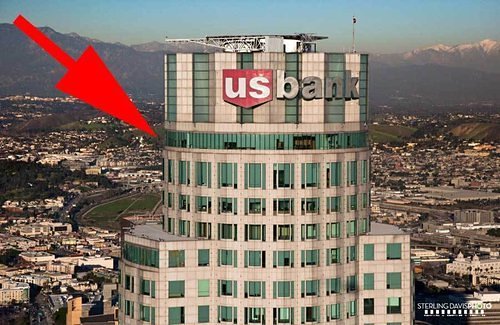
US bank bldg top floors

photo from LA Curbed

Arrow points to planned new observation deck

 This will be great for business.  Tourists will be flocking downtown.

The owners of the 72-story US Bank Tower, the tallest building on the West Coast (for now), will open up a public viewing deck like a real Empire-State-building-style tourist trap. The building is 310.3 m (1,018 ft). Top floor, 294.92 m (967.6 ft).  Maybe next they’ll light the Hollywood Sign! The 1989 building, formerly known as the Library Tower, will stay an office building, but get a new observation area on the sixty-ninth and seventieth floors, which will be connected by a new stairway; existing terraces on the sixty-ninth will be opened up as well, reports the LA Times. Meanwhile, the seventy-first floor, which has 18-foot ceilings and 360-degree views of Los Angeles, will get a new restaurant.

Plus new entry for tourists and a very high price. >>

US Bank visitors will enter through a new second-floor portal with upgraded elevators and newish owners Overseas Union Enterprise Ltd. will also give the US Bank sign a “modernization” and add a curb cut at the Fifth Street entrance for passenger loading and unloading. Local mega-firm Gensler will design all of the changes.

Tourist traps do not come cheap: OUE will charge $25 a head, but thinks it can pull in half a million visitors a year. Broker/blogger Brigham Yen found that pricing is in the range for similar attractions: Chicago’s Willis Tower costs $19, the Empire State Building is $29 to the eighty-sixth floor. CN Tower in Toronto Canada costs $28.80 – LookOut Level at 346 m (1,136 ft.).

Not too far away from the US Bank building, however, the Wilshire Grand hotel/office building is under construction and set to be the new tallest tower in the West when it’s finished in 2017. It will have an observation deck, infinity pool, and restaurant on its roof, which according to Yen will still be lower than the US Bank Tower’s new deck.


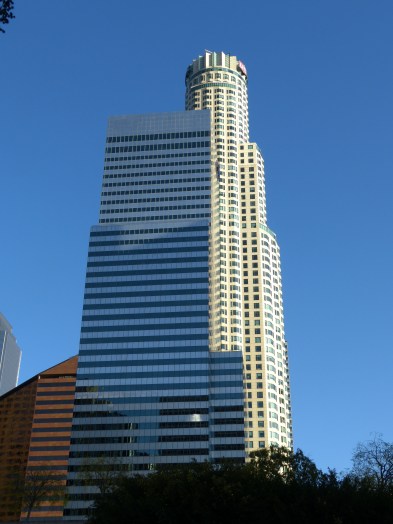
source http://la.curbed.comUS Bank Bldg from 5th and Fig

my photo taken with Panasonic FZ150

Big Brands Close Factories in Bangladesh

This situation was brought to my attention by the Toronto Star newspaper based in Toronto, Canada. That is the reason I like to read foreign press reports.

When governments do not protect their citizens who will? We all remember the Rana Plaza factory collapse in Bangladesh which took the lives of 1,129 people and injured thousands more on April 24, 2013. That was not the first time there have been building code violations. Corruption and bribery in Bangladesh is well known.

Historically the Triangle Shirtwaist Factory fire on March 25, 1911 in Brooklyn New York killed 145. High levels of corruption in both the garment industry and city government generally ensured that no useful precautions were taken to prevent fires. The Triangle Shirtwaist factory’s owners were known to be particularly anti-worker in their policies and had played a critical role in breaking a large strike by workers the previous year.

Finally the Bangladesh issue is being addressed, but not by their government. A North American-led group of companies operating in Bangladesh said Friday, July 11 2014, that it had closed or partially shut seven factories for remediation after inspectors found structural problems and safety concerns.

Bangladeshi garment workers arrive for work in Dhaka

The Alliance for Bangladesh Worker Safety said it will extend compensation to workers for up to four months if they are unable to work due to the closures.— The current group of 26 includes the following companies: Ariela and Associates International LLC; Canadian Tire Corporation, Limited; Carter’s Inc.; The Children’s Place Retail Stores Inc.; Costco Wholesale Corporation; Fruit of the Loom, Inc.; Gap Inc.; Giant Tiger; Hudson’s Bay Company; IFG Corp.; Intradeco Apparel; J.C. Penney Company Inc.; The Jones Group Inc.; Jordache Enterprises, Inc.; The Just Group; Kohl’s Department Stores; L. L. Bean Inc.; M. Hidary & Company Inc.; Macy’s; Nordstrom Inc.; Public Clothing Company; Sears Holdings Corporation; Target Corporation; VF Corporation; Wal-Mart Stores, Inc.; YM Inc.

The four months compensation is a wonderful gesture. My question is what will those workers do to make a living if building owners and manufacturing businesses do not co-operate? As poor as their pay may be it is more than they earned before the factories came to Bangladesh.

Why the Rich get much Richer

Monopoly ManOn My 28 I posted a commentary titled Goodbye Middle Class.” On June 26 David Lazarus posted this column in the Los Angeles Times.

His column abridged, (underlined and bold not part of the Times editing)   At CVS Caremark, it doesn’t pay to be really good at your job. The nation’s second-largest drugstore chain adjusts its annual raises to how much an employee makes. The higher your salary, the lower your raise. The top workers at CVS stores — those earning the highest hourly wage for their job classification — are “red lined” by the company and receive no raises at all. CVS, which gave its chief executive a 26% raise last year to almost $23 million in total compensation, isn’t alone in making sure its rank-and-file workers don’t make too much money.

And this is why, in any discussion of income inequality, we keep reaching the same point — the rich get richer, while everyone else gets table scraps. “It’s not personal. It’s business,” said Mike Lipis, a Los Angeles compensation consultant. “You’re trying to make the most of your limited compensation dollars.”

I wrote recently about a report showing that the head of CVS, Larry Merlo, enjoyed the widest gap in the country between a CEO’s salary and that of his less-worthy underlings. According to compensation researcher PayScale, Merlo’s $12.1-million salary last year was 422 times the size of the median CVS wage of $28,700.

A top-performing CVS pharmacy technician earning a base wage of $9.30 an hour will similarly merit a 4.75% raise. But a red-lined pharmacy technician earning $15.67 an hour will see no raise.

Politicians have an excellent issue for the coming elections. It’s a good bet that none of them will even address the pay discrepancy. The reason? The source of the contributions for their campaigns.

Don’t look for the media to emphasize the salary discrepancies. Those heading the media companies are some of the highest paid people.

Leslie Moonves, CEO of CBS Corp.  $62,157,026 in 2012

Philippe P. Dauman, CEO of Vaicom Inc.$37,165,750 in 2013

Marissa A. Mayer, CEO of Yahoo Inc.  $36,615,404 in 2012

Robert A. Iger, CEO of Disney Co.  $34,321,055 in 2013

David M. Zaslav, CEO of Discover Communications $33,349,798 in 2013

California set for more exports, strong manufacturing


Los Angeles Harbor
Los Angeles Harbor

Click on above photo to see a full screen view of ship unloading operations

The outlook for growth in California is optimistic, according to a Beacon Economics report predicting expansion in manufacturing and exports and a job market recovery driven by more than low-wage work.

The report, conducted for City National Bank, notes that 56% of new jobs created in the state in the last year are in industries with average annual wages above $50,000. Most of those positions, according to the report, are full-time.

The findings seem to challenge other economists’ assertions that wages aren’t keeping pace with the job recovery. More low-wage positions will be created or opened by 2020 in Southern California than will mid-level or high-paying jobs, according to the Center for Continuing Study of the California Economy.

But according to Beacon, employers in the professional and business services field added 24,300 new jobs statewide since the fourth quarter. That’s more than half of the 44,200 net nonfarm job gains made in the state in the same period.

That’s more than half of the 44,200 net nonfarm job gains made in the state in the same period. The industry pays $29.11 an hour on average as of May, according to the Bureau of Labor Statistics.

The Beacon report also said that California’s 1.2% job growth in the first quarter trailed the 1.5% nationwide rate.

But Los Angeles and Orange counties each created 12,200 new jobs in the first quarter, helping pull the statewide unemployment rate down 0.3 percentage point from the fourth quarter to 8.1%.

And the Central Valley, often maligned as an economic dead zone, is showing surprising strength, according to Beacon.
The south San Joaquin Valley, which includes Fresno, Tulare and Kern counties, has boosted nonfarm employment by more than 50% in the last 25 years. The population has also swelled at nearly double the overall state rate.

The workforce participation rate in the state ticked up to 62.6% from 62.4% the previous quarter and the proportion of people working part-time due to economic reasons fell 0.6 percentage point to 6.8%, according to the report.

Beacon added that California’s growth slowed slightly in the first quarter due to the frigid, stormy weather bedeviling the rest of the country earlier this year.

Real gross state product, a metric of economic output, grew just 2.8% after surging 4.2% during the fourth quarter, according to the report. But manufacturing, thought by many experts to be a shriveling industry, continues to support a generous portion of the California economy.

The state is responsible for producing a quarter of the computers and electronics made in the country, according to the report. The products, which constitute nearly half of all California manufacturing output, are centered in Silicon Valley and, to a lesser degree, in the Los Angeles metropolitan area.

Beacon estimates that exports leaving California rose 2.8% in the first quarter from the fourth. The effects of a weak dollar, slower growth in China, Europe shaking off its recession and Japan emerging from a decade-long stagnancy will likely propel increasing outbound trade for the rest of the year.

Copyright © 2014, Los Angeles Times

Los Angeles Harbor


I take full responsibility!

What does, “I take full responsibility” mean?

Politicians use those words when a government function does not operate as expected.  Doesn’t taking responsibility mean facing a punishment?

As reported on AOL.COM General Motors CEO Mary Barra addressing employees at the automaker’s vehicle engineering center said that the company has fired 15 people associated with those failures and disciplined five others. Earlier documents had revealed that GM knew of the Chevrolet Cobalt ignition-switch problems for more than a decade, but had done nothing to fix the problem.

The Deepwater Horizon Oil Spill (aka BP Oil Spill) was one of the worst oil disasters in history. More than 200 million gallons of crude oil was pumped into the Gulf of Mexico for a total of 87 days. BP CEO Tony Hayward was transferred to another job but were any of those working on the oil derrick fired? The answer appears to be NO.

The Upper Big Branch Mine disaster occurred on April 5, 2010 roughly 1,000 feet (300 m) underground in Raleigh County, West Virginia at Massey Energy‘s Upper Big Branch coal mine located in Montcoal. Twenty-nine out of thirty-one miners at the site were killed. Was anyone charged with a crime?

Shoddy care in Veteran’s Administration hospitals goes back to at least 1945 when President Harry Truman accepted the resignation of VA Administrator Frank Hines after a series of news reports detailing shoddy care in VA-run hospitals, according to a 2010 history produced by the Independent Inspector General. The latest action was the Veteran’s secretary resigning. Who is responsible for the loss of life?

This is all about people in high places not being held accountable for their actions or inaction. Not in every instance but too frequently when lives are at stake.

Ship captains seem to be the rare exception. Most recently the captain of the ferry, Sewol, sinking off the coast of South Korea, the captain of the Costa Concordia off the coast of Italy, and the captain of the Exxon Valdez sinking off the Alaskan coast have all faced criminal charges.

Everyone who is connected with the loss of life should be held responsible. To me that means fines, penalties, and some jail time too!

Goodbye Middle Class

The J.C. Penney closing of 33 stores is a reflection of the decline of the middle class. Comments by readers of this Huffington Post article, I believe, accurately appraises this situation. There is nothing being said about how Penney’s will recover.

Sears Holdings Corp. (SHLD:US) plunged the most in more than a year after forecasting a fourth-quarter loss and saying sales during the holiday period dropped. The loss in the quarter ending Feb. 1 will narrow to $250 million to $360 million, or $2.35 to $3.39 a share, the Hoffman Estates, Illinois-based company said yesterday in a statement. The net loss a year earlier was $489 million, or $4.61 a share.

If these stalwarts cannot survive the message is clear. The middle class, that was the bread and butter for those retail stores, is shrinking away.

It is not an overnight event. As those middle incomes and retired middle class families die the replacements come in just two categories. They are the poor and the well to do. Evidence of this situation is the age of McDonald’s employees. The average age of a fast-food worker in 2013 was almost 30. That is data published by Bloomberg Businessweek. The Bureau of Labor Statistics says that more than 35% of the unemployed have been in that predicament for more than 27 weeks. Most of them had well paying middle class jobs.

Meanwhile the median annual compensation for the CEOs of S&P 500 firms is now reported to be above $10 Million. Carol Meyrowitz, the CEO of TJX, earned over $20 Million in 2013. TJX owns Marshall’s, TJ Max, and Homegoods stores. Anthony Petrello was the highest paid CEO earning more than $68 Million last year.

Of course the board of directors of every company is free to pay whatever they deem a fair salary. Government does not set salaries in a free society. Those CEOs must be worth the pay they receive. Or is it the rich protecting the rich? Does the CEO work harder than the clerk?

So what is to become of most Americans? Look for more food stamps, more housing subsidies, and more broken homes.

Private enterprise does not care about its employees. They are interested in maximizing their profits. Don’t like it? Open your own business. That is the way capitalism works.

Merger and Acquisition Leads to Monopoly

What if there was just one phone company, one television service provider, and one company owning all the supermarkets? Do you believe that prices would be lower or higher?

This proposed $48 billion merger of AT&T with DirectTV along with the proposed Comcast-Time Warner Cable merger will enable two very large companies to become even bigger. The benefit will be reduced competition for the newly formed businesses. The impact will be higher cost cable and satellite TV service for the public. Unless the public is very vocal these mergers will be approved. The company lobbyists will begin making their rounds to congressional offices starting now. Every congressman needs to be scrutinized before the next election.

AT&T is a relatively small player in its offering called U-Verse television service. Their acquisition of DirectTV will make them a major participant in the TV service business. AT&T claims this will in no way reduce competition. That is the same argument Comcast makes in its proposed purchase of TWC. The consequences are more significant than merely permitting two or three companies dominating the delivery of television services.

There will be less competition and the decisions those companies make will determine the programs you watch.

Interestingly Morningstar, the on-line evaluator of stocks and bonds, does not believe there is any financial or strategic benefit in the AT&T acquisition.
“The biggest benefit to AT&T from this deal would be increased leverage in negotiating with content owners like Disney. By highlighting the fact that other pay television providers need to keep pace with Comcast and putting its own deal forward, AT&T is forcing regulators to consider a world with significantly increased concentration in media distribution.”

Consumer Reports lobbying arm, Consumers Union, says that neither of these consolidations are good for consumers.

Both Federal Communications Commission and Department of Justice must approve this merger. The Washington Times reports that every single member of the Senate Judiciary Committee, holding hearings on the Comcast purchase of TWC has taken money from Comcast.

So if you were betting on the approval of that purchase, what do you believe the outcome will be?

Middle Class and Working Class Have No Voice

“Total nonfarm payroll employment rose by 288,000, … the number of unemployed persons, at 9.8 million, decreased by 733,000.” These statements were copied from yesterday’s Employment Situation Summary issued by the U.S. Bureau of Labor Statistics.

The difference of 445,000 are the former workers who have decided to stop looking for work. The issue is not what their source of income will be. The issue for this discussion is the .4% drop in unemployment. At 6.3% the Federal Reserve can now say the goal of 6.5% has been achieved. We can now further reduce our bond buying (quantitative easing) program. The program goal is to keep interest rates low as an aid to business to encourage borrowing.

Did private enterprise respond as desired? It appears business saw the advantage of outsourcing manufacturing to other nations as the preferred business choice.

Congressional actions did not support the Federal Reserve. Rather than imposing taxes on companies that outsource or providing funds to build infrastructure congress did nothing.

Many reading this believe that congress did the right thing by not taking any action. That is the reason our economy is in its current condition.

The rich are happy! The poor? Well, they have no voice.