Collusion – The Near Monopolies Control so Much of America’s Private Enterprises

Collusion: Synonyms are conspiracy, complicity, involvement, agreement, knowledge, consent, approval.  Which of those words defines the U.S. congressional responsibility for just five major banks controlling most of this nation’s economy? 

The United States government is a partner in the near monopoly of private enterprises that permeate our society. Don’t believe me? Read on.

Do you suspect there is price fixing in the price of gasoline in the United States? Here is a list of the major companies in the USA.

USA
76 Stations
BP (Arco)
Chevron
Conoco
Exxon
Mobil
Phillips 66
Shell
Texaco

In your neighborhood the prices are never more than a few cents apart.

How difficult would it be for Chevron, Mobil, Shell, and Arco (the stations in my area) to meet discretely on a golf course and agree on the pricing? The answer is it wouldn’t be too hard.

Few companies have a true monopoly in any market. More common are “virtual monopolies” or “near-monopolies” that exist due to geography or brand recognition. When consumers hear the term monopoly, the first thing that comes to mind is often price-fixing. Unfortunately they are correct. Jello Brand gelatin desert has a near monopoly. Intel processor chips had a near monopoly in PC computers. Bill Gates and his immediate inner circle earned an over the top fee for his Office programs. To this day he is still either the richest man in the world or nearly so.

Read more: http://www.businessinsider.com/the-next-7-american-monopolies-2010-11?op=1#ixzz2zgO5D4Lj

During the Senate hearing on Comcast’s takeover of Time Warner Cable, Sen. Al Franken said the cable giant has over 100 lobbyists making its case. That is one lobbyist for every senator. Consumers Union says over 264,000 people have sent messages to congress asking that the merger be stopped. Comcast current share of the cable industry is estimated at 30%. Time Warner Cable current share of the cable industry is estimated at 19%.

The Kroger Co. is a major retail food market company that simply keeps growing larger and larger. The company is based in Cincinnati, Ohio. This is the latest posting on their web site. “We are delighted to welcome Harris Teeter to the Kroger Family of Stores.” That company owns Thumb Stores; Heritage Farms Dairy; HarrisTeeter Supermarkets, Inc. That company has stores in North Carolina, South Carolina, Virginia, Georgia, Tennessee, Florida, Maryland and Delaware. With the exception of Maryland and Delaware, Kroger already has Kroger stores in those states. So whether you shop at Harris Teeter or Kroger you are shopping at the same company. Kroger ownership is widespread under a variety of names: Kroger, Dillons, Fred Meyer, Fry’s, QFC, Ralphs, Food 4 Less, Smith’s, and now Harris Teeter. This is not a complete list. Kroger Co. also approached Safeway about buying part of its operations. Kroger’s share of the entire retail food sales is unknown but the company has the largest share of the U.S. market.

Ticketmaster competitors are nowhere to be found. The company seems to have a lock on all sales of tickets for concerts, live theater, and sporting events. As an Example I logged into the Hollywood Bowl/Los Angeles Phil and found the web site’s basic address is Ticketmaster.com. Their fee is 8% to 10% of the price of the tickets. The only option to avoid the fee is a visit to the box office. There is no alternate sales agent. Ticketmaster had a more or less monopolistic position in the ticketing market after the purchase of its main competitors Ticketron and Live Nation.

LensCrafters is owned by Luxottica Group S.p.A. That company is the world’s largest eyewear company, controlling over 80% of the world’s major eyewear brands. Its best known brands are Ray-Ban, Persol and Oakley. This company was featured in a 60 Minutes program. The company owns

Eyeglasses that are either plastic or wire frames cost almost as much as a computer.

Everyone is a victim! Our elected government is a partner in this crime!
If It Ain’t Broke Don’t Fix It!

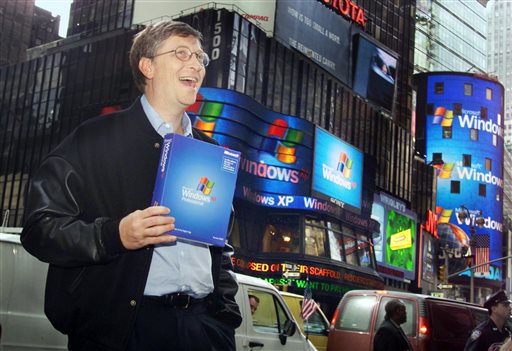
Bill Gates Introduces Windows XP Oct 25, 2001

Bill Gates introduces Windows XP October 25, 2001

Windows XP was the most widely used operating system until August 2012. On April 8, 2014, Microsoft will no longer support Windows XP according to its life-cycle policy, focusing on Windows 7 instead. While users can still run XP after Tuesday. Microsoft says it will no longer provide security updates, issue fixes to non-security related problems or offer online technical content updates.

This operating system was originally released in 2001 but remains very popular. Many people have refused to update because the system functioned so well.

More recently Vista and the newest touch screen system (8.0/8.1) are glaring evidence of how so-called improvements have proven disastrous. I personally have delayed upgrading from Vista with a new CPU because the “tile version” of windows requires a complete relearning of the operating system. My experience my wife’s year old lap top has been a challenge.

XP appealed to a wide variety of people and businesses that saw it as a reliable workhorse and many chose to stick with it instead of upgrading to Windows Vista, Windows 7 or 8.

Windows 9 is rumored to be released in April of 2015. Googling “windows 9.0” results in little in recent information. Desktop users might well be disappointed. Either way April 2015 seems a long way off.

O Canada, you sensible land!

You may already know that the U.S. dollar and Canadian dollar are almost identical in value . Currently the US dollar will buy about $1.10 Canadian. Just a few months ago the situation was reversed. Toronto and Vancouver homes are as expensive or more expensive than the same property in Los Angeles. Their housing boom tracked the U.S. boom before 2008. The exception is they did not experience the melt down. The price of homes has continued to rise throughout Canada. To quote the Financial Post: “Home ownership a passion for Canadians. It is a passion for ownership that has put Canada in the elite company of countries with estimates that more than 70% of households now own their own home.”

O Canada, you sensible land!

By Jay MacDonald · Bankrate.com
Monday, May 9, 2011
Posted: 9 am ET


What’s the best way out of our bubble-bust-bubble mortgage muddle that has resulted in a record 2.87 million  American foreclosures last year alone? The answer may lie due north.

O Canada, you have no doubt watched our housing-driven Great Recession with  the stern if sympathetic eye of a schoolmaster who well knows the fate of all  undisciplined schoolboys.

During our financial meltdown, not a single Canadian bank failed. Less  than 1 percent of Canadian mortgages are in arrears. And this in a land that  doesn’t even afford its homeowners the courtesy of a tax break on their mortgage  interest!

I was gob-smacked by a recent McClatchy report out of Toronto with the  headline, “Canada’s mortgage system works.” Of course, compared to our system,  falling as it does somewhere between a faulty pachinko game and three-card  Monte, most of the developed world could make the same claim.

Canada owes its housing stability in large part to a conservative regulatory  environment that holds its 71 federally regulated lenders to stricter  underwriting standards and larger reserve requirements for potential losses than  does its U.S. counterpart.

There is no Canadian equivalent of Fannie Mae and Freddy Mac, which purchase  mortgages from banks and bundle them into bonds. Did I mention that Fannie and  Freddy have been in government conservatorship since mid-2008?

As far as tax incentives go, Canadian homeowners are allowed an exemption on  capital gain from the sale of their primary residence, period. Yet their  homeownership rate is equal to or greater than ours here in Sud Moosejaw.

Stuart Gabriel, a finance professor at UCLA, sees it this way:

“They’ve insisted all along on the more rigorous mortgage underwriting, and  because of that never found themselves originating subprime and no-doc mortgages … some very basic items such as stringency of underwriting seem to go a long  way.”

Indeed. Now I’ll grant you, corralling a total of 71 lenders for 34 million  citizens may be a tad easier than wrangling 8,000-plus FDIC-insured lenders  serving 310 million. But it’s still ironic that Canada’s conservative mortgage  system is unfazed while our “free market” version – and I use those quotation  marks intentionally – has resulted in the largest financial meltdown since the  big one.

O Canada, please send some of your common sense our way as we attempt to  dismantle our house of cards and start over. Hopefully with  two-by-fours.

Read more:  http://www.bankrate.com/financing/mortgages/o-canada-you-sensible-land/#ixzz2vnqaMrGJ Follow us: @Bankrate on Twitter | Bankrate on Facebook

Continuing High Unemployment

Today’s employment report for February is another set of contradictory results.  175,000 jobs were added to payrolls.  The number of long term unemployed has remained stubbornly high at 37% (or even higher) of the total unemployed since January of last year.  There were two months when the number dropped below this level but they were most likely statistical errors as they were not consecutive months.

Other nations would be happy with the unemployment rate that the USA is experiencing, 6.7%. That is not a fair comparison.  Americans are used to an unemployment rate of 5%.   That is a number that was last seen in April 2008.

Despite government optimism there is nothing on the horizon that says we will see any number near 5% in 2014.

Two issues make changes in unemployment likely. 1) Low cost labor in other countries.  2) Technology has reduced the need for so many workers.  Those long term unemployed need re-training into new careers that are experiencing labor shortages.

Conservative politicians won’t allow government funding of those kinds of programs.  They complain about welfare and long term unemployment benefits but won’t allow themselves to see the benefits of re-training programs.  If there was a conservative president making a case for re-training a conservative congress would enact the needed legislation.  Since Barack Obama is a Democrat no programs will be enacted.  It’s all about politics.

Where do we go from here? No where as long as there is a divided government.  Look for changes in 2017.  It makes me sad and dismayed.

Income inequality: Nothing New!

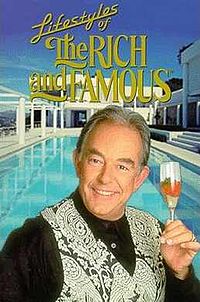
Lifestyles_of_the_Rich_&_FamousThe following article was in The Week magazine dated February 7, 2014.  Their title was Income inequality: Why does the gap keep widening?  Then the article proceeds to tell readers that it hasn’t widened.  It’s just great political rhetoric that might help win elections.

 Perhaps it’s the strong rhetoric of Pope Francis and President Obama, or the growing sense that the economic recovery is leaving the poor and the middle class behind. But income inequality-an issue that once preoccupied liberal policy wonks and scruffy Occupy Wall Street activists-has suddenly become “part of the mainstream kitchentable debate” in America, said Michael Hiltzik in LATimes.com.

 A startling new Gallup poll finds fully two thirds of adults either somewhat or very dissatisfied with the distribution of wealth in this country-and that includes 54 percent of Republicans. The rich just keep getting richer, said Harry Bruinius in CSMonitor.com, and “the public has been taking notice.” Since 2009, 95 percent of U.S. economic gains have gone to the wealthiest 1 percent of the population. Wall Street stocks and corporate profits are soaring to all-time highs, yet on Main Street, salaries have been stagnant, and millions can’t find jobs that pay middle-class salaries. Americans who once believed that anyone could climb the ladder with hard work and talent now suspect that the system is “stacked against them.”

The rich may be getting richer, said Nick Gillespie in TheDailyBeast.com, but that doesn’t mean it’s getting harder to join their ranks. A study released last week by Harvard economists shows that a child born into the poorest fifth of U.S. households has the same 7.8 percent chance of climbing the ladder into the richest fifth as he or she did 50 years ago. That figure is “unacceptably low,” but “upward mobility” is still happening. To address income inequality with effective policies, said David Brooks in The New York Times, we have to understand its real roots. The “growing affluence of the rich” isn’t causing the problems of the poor. Those problems are the result of globalization’s impact on “low-skill jobs,” and even more importantly, of social and cultural factors. America’s underclass lives in a world of broken homes, crime-filled communities, dysfunctional schools, and personal chaos. That’s what is keeping people stuck at the bottom, not the growing wealth of the top 1 percent.

Now there’s a convenient rationalization, said Matthew O’Brien in TheAtlantic.com. The reality is that as the rich award themselves with all the gains created by technology and cheap labor, they’ve come to inhabit “a different world.” Their kids grow up with $40,000-a-year preschools, tutors, private lessons, special college prep, and on and on. On this unlevel playing field, how do kids from the bottom 90 percent compete? Those at the top of the social ladder have one overriding goal, said David Horsey in the Los Angeles Times: “to protect what they have and get even more.” That’s why wealthy individuals and corporations flood Washington and state capitols with political contributions. It’s no accident that people who make $20 million on investments pay lower tax rates than struggling plumbers and teachers. Unless the rich suddenly get a conscience, the U.S. will soon be “the world’s biggest banana republic,” with the ruling plutocrats living behind gilded gates.

So what’s the answer? said Mickey Kaus in The Wall Street Journal. Democrats may moan about inequality, but when it comes to policies that might reverse the trends, “they got nothin’, as comedians say.” Raising the minimum wage? Hiking the top tax rates? Please. Small tweaks to the status quo will not “stop the top 10 percent from taking home 50 percent of the nation’s income.” Let’s face it: Everyone may be talking about income inequality, but thus far, it’s a problem without a solution.

Free Trade Brings Creative Destruction

The Trans Pacific Partnership (TPP) is a brainchild of Barack Obama.  Consider this posting I made on February 22, 2014.

Creative destruction occurs when something new kills something older. A great example of this is personal computers.  Free Trade is another example.

NAFTA was President Bill Clinton’s naive plan to increase American trade while helping our neighbors.  It has not worked out as promised.


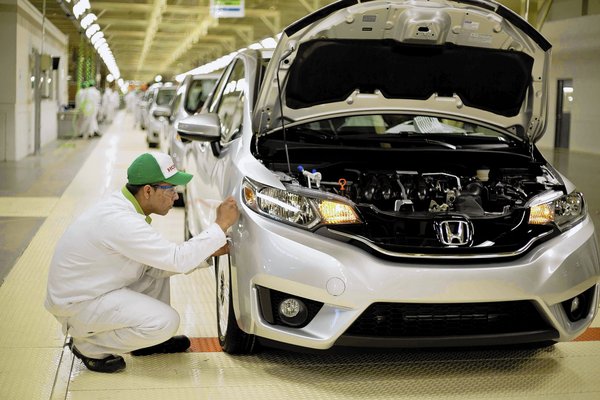
Mexico becoming a driving force in auto production

Honda Fit rolls off the assembly line at a new $800 million factory near Celaya, Mexico

Mexico, with its low labor costs, has been the beneficiary of the free trade agreement.  More products have entered the United   States from Mexico than ever before.    In 2013, according to our census bureau, $226 Million in products were exported and $280 Million were imported.  That number is on a path to increase dramatically over the next few years.  The reason is that Mexico has become the assembly floor for many products made in other countries.  The Los Angeles Times article titled “Mexico becoming a driving force in auto production” tells of the average hourly labor cost in their assembly plants of $8 versus an average hourly rate in the United States of $37.  These are the kinds of pay rates that drove American manufacturers to southern states in the USA.

What is the United States doing about this financial advantage?  Nothing!  Rather, the president of the United States, the Prime Minister of Canada, and the President of Mexico have just had meetings in Mexico at a town named Toluca (home of the Fiat 500 assembly plant), near Mexico City, discussing ways to further the NAFTA agreement.

Barack Obama claims to be concerned about the poorest in our nation and enhancing middle class opportunities.  How are more free trade agreements bringing jobs to the non-tech workers that assemble cars, refrigerators, and televisions?  They are not.  It’s creative destruction at work.

Lawmakers Intimidate VW Workers

Government interference at it’s best. Using the people’s tax money to threaten the people.

Submitted by Thom Hartmann, an NPR contributor, on 17 February 2014

It’s illegal for an employer to intimidate workers trying to form a union, but apparently it’s just fine when a lawmaker does it. On Friday, workers at a Volkswagen Plant in Chattanooga, Tennessee voted against joining the United Auto Workers union. However, that vote may have turned out differently if workers weren’t pressured by Republican Governor Bill Haslam and Senator Bob Corker.


In the days leading up to that vote, Governor Haslam warned that he would take away Volkswagen’s state tax incentives if workers unionized, and Senator Corker claimed that a no vote would lead to the production of a new SUV at that plant. Volkswagen flatly denied Corker’s claim, and expressed their support for the workers, but that wasn’t enough to relieve the fear created by these powerful Republicans.

The UAW issued a statement saying, We’re outraged by politicians and outside special interest groups interfering with the basic legal right of workers to form a union.  And, they may ask the National Labor Relations Board to overturn Friday’s vote. For decades, we’ve seen corporations fight to block workers from organizing, but these extreme anti-worker tactics are a new low for politicians.


Hopefully, the NLRB will overturn this vote, and give workers a chance to make their decision without intense pressure and lies from those in public office. Either way, it’s clear who Governor Haslam and Senator Corker really work for, and every voter should remember that during the next election.

Unsinkable Cruise Ship Industry

Most of us know about the original cruise ship disaster, the “unsinkable ship” struck an iceberg in the North Atlantic on its maiden voyage in 1912 and sank into the icy water, killing more than 1,500 of its 2,200 passengers and crew.  That was the Titanic.  Despite that event cruise ship travel has been a booming business.  Statistics show the annual number of cruise ship passengers exceeds 20 million people.

Here is a list of the worst cruise events.  The latest is a Princess ship with almost 200 ill passengers.

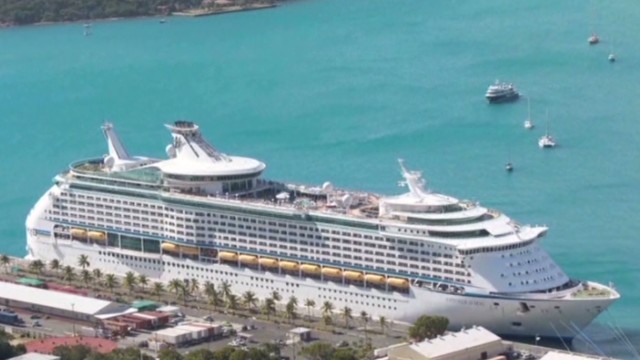
Royal Caribbean Explorer of the SeasRoyal Caribbean Explorer of the Seas: The ill-fated Royal Caribbean cruise ship returned home Wednesday with an ignoble mark. Nearly 700 crew and passengers fell ill. This is the highest number of sick people reported on any cruise ship in two decades, Centers for Disease Control and Prevention data show.

Carnival Triumph: What was supposed to be a four-day jaunt to the Caribbean became an eight-day nightmare when an engine fire left the ship floating in the Gulf of Mexico without power, air-conditioning, or a working septic system.

Carnival Splendor: Carnival’s Splendor suffered a similar fate as Carnival’s Triumph in November 2011. Both were stranded by engine fires, though the Splendor was left floating in the Pacific Ocean. After three days the Splendor and its 4,500 passengers were towed back to the San Diego Bay.

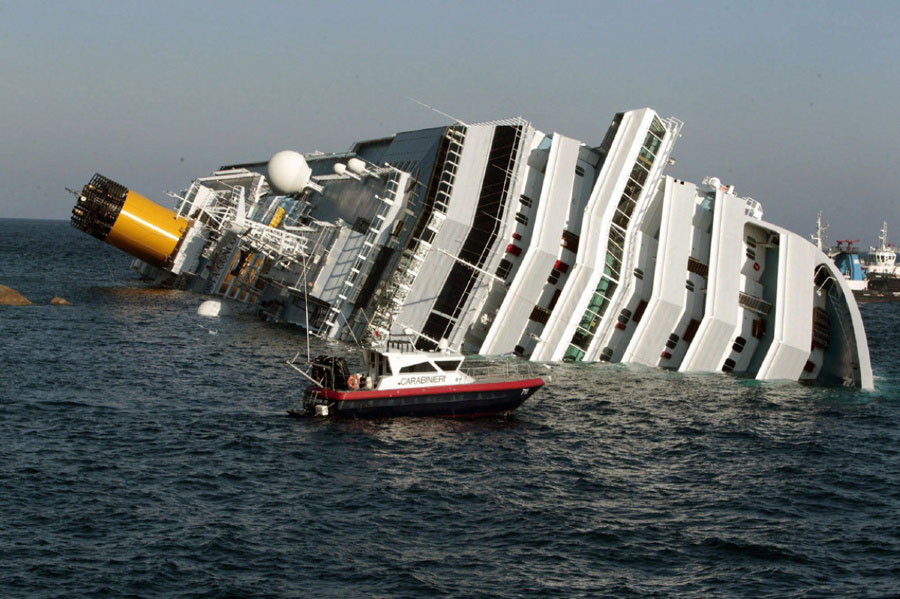
Costa Concordia #1Costa Concordia: This Italian cruise ship ran aground on a reef off the coast of Tuscany, Italy, in January 2012 and toppled onto its side. Of the 4,200 aboard, 32 died and 64 were injured, according to the Associated Press. The half-submerged ship is still being removed.

Seabourn Spirits: In 2005, while 100 miles off the coast of Somalia, pirates in speedboats attacked the small cruise ship. The pirates fired on it with machine guns and rocket-propelled grenades before the captain changed course and got away. None of the ship’s 300 passengers were hurt, and the ship made it to the Seychelles where the rocket damage was repaired.

Celebrity Mercury: More than 400 of the 2,600 passengers and crew onboard the Mercury were stricken ill in 2010 in what the Centers for Disease control deemed a norovirus outbreak. The virus caused widespread vomiting and other gastrointestinal ills on the ship, which left from Charleston, S.C.

Norwegian Dawn: At least 62 cabins were flooded when a 70-foot wave smashed into the Dawn, in 2005. About 300 of the ship’s passengers disembarked early, in Charleston, after the storm had passed.

S.S. Eastland: In 1915, just three years after the Titanic sank, the S.S. Eastland passenger tour ship rolled over while in port in downtown Chicago. More than 840 of its 2,500 passengers died in the accident.

Organic Food – It’s all about the Money

From the USDA National Agricultural Library

“Organic farming entails:
• Use of cover crops, green manures, animal manures and crop rotations to fertilize the soil, maximize biological activity and maintain long-term soil health.
• Use of biological control, crop rotations and other techniques to manage weeds, insects and diseases.
• An emphasis on biodiversity of the agricultural system and the surrounding environment.
• Using rotational grazing and mixed forage pastures for livestock operations and alternative health care for animal wellbeing.
• Reduction of external and off-farm inputs and elimination of synthetic pesticides and fertilizers and other materials, such as hormones and antibiotics.
• A focus on renewable resources, soil and water conservation, and management practices that restore, maintain and enhance ecological balance.”

I am sure you understood the meaning of this double talk. I am especially fascinated with the meaning of “Use of biological control, crop rotations and other techniques to manage weeds, insects and diseases.”

costco-organic-price-list-863x1024

COSTCO has jumped on the band wagon of organic foods. On my last visit they handed me their special offer valid from Jan 13 to Feb 9. It was a catalog of 26 items. All items are marked USDA ORGANIC.

Huffington Post has this headline Organic Food Is Not Healthier Than Conventional Produce: Study.” The report said “Stanford University doctors dug through reams of research to find out – and concluded there’s little evidence that going organic is much healthier, citing only a few differences involving pesticides and antibiotics.”

“Consumers can pay a lot more for some organic products but demand is rising: Organic foods accounted for $31.4 billion sales last year, according to a recent Obama administration report. That’s up from $3.6 billion in 1997.”

No wonder COSTCO has decided to offer organic foods. It’s the money!

The Drought of 2014

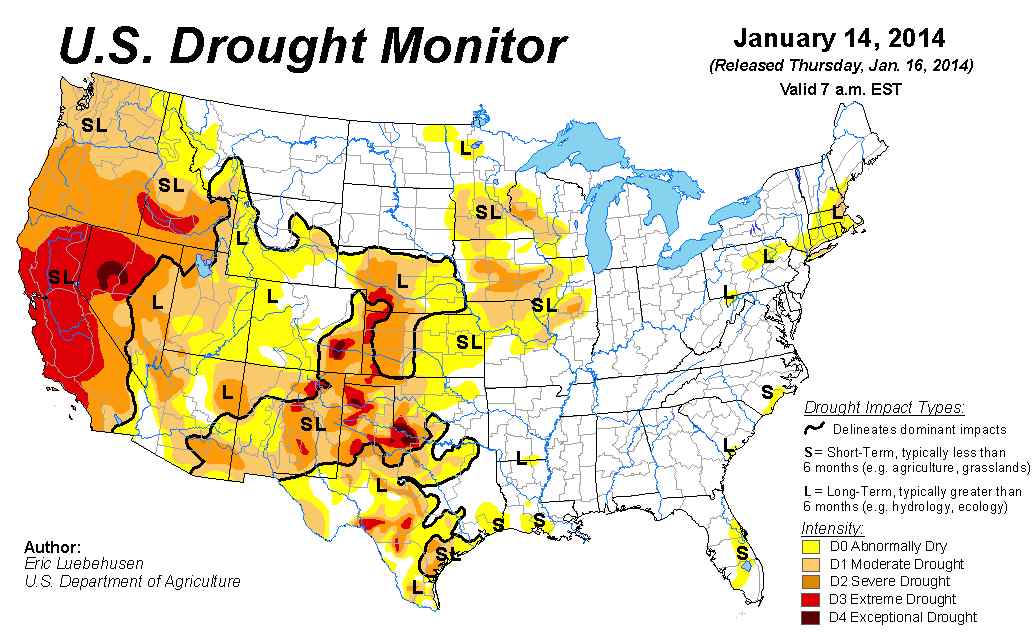
Drought MonitorMost Californians already knew that there is a drought covering most of the state. California Governor Jerry Brown has named this rainless winter an official drought. The real purpose of the declaration is to obtain federal aid, reduce enforcement of some environmental regulations, and most importantly convince voters to approve an $11.1 Billion water bond proposal.

More than $13 Billion has been spent on California water projects since the year 2000. The newest bond proposal is not new. It has been bandied around for at least four years. The only reason there has not been a proposal on the ballot has been the serious economic conditions of this state.

This ballot measure, if it does appear, will not add one additional drop of water to the state’s water supply. There will be no more water for urban areas and no additional water for farming or live stock. This proposal will provide profits for construction companies.

Sacramento Bee reporter and columnist Dan Walters says this bond issue doesn’t address the issues. Traci Sheehan on the California Progress Report web site has identified all the newspapers that oppose this waste of money.

Fear of water rationing will be the tool of choice to convince passage of this boondoggle.