Predicted to Disappear in 2014

I was listening to a radio program, while driving, that was listing predictions of product changes in 2014. The one that caught my attention is the end of digital cameras. The reason is the impact of smartphones. Those phones have excellent built in cameras that are getting even better with every new version. They provide both still and video formats. Why carry around a camera when similar quality is available in your phone? So it appears to be a goodbye to most digital cameras. The high end single lens reflex cameras costing $1,000 or more for well off hobbyists and professionals will continue to be available.

What about other predictions?

24/7 Wall Street offered their take of 10 brands that will disappear in 2014:
JC_Penney_store,_Aventura_Mall_(Aventura,_Florida,_2006)1. J.C. Penney department stores
2. Barnes & Noble’s Nook reader
3. Martha Stewart Living Magazine
4. LivingSocial, a daily deals website similar to Groupon
5. Volvo cars in the United States
6. Olympus camera
7. Women’s National Basketball Association (WNBA). The Los Angeles Sparks have already discontinued functioning
8. Leap Wireless, a very small competitor to AT&T and Verizon
9. Mitsubishi Motors in the United States
10. Road & Track auto magazine

24/7 forgot to include Incandescent Light Bulbs. Maybe some will still be available in 2015 but it will be very few. Sears department stores are also in serious trouble as the company is in its third year of losses.

Can you add anything to this list?

The American Skills Gap

The skills gap in U.S. manufacturing has hit a vast array of industries that are having trouble filling their workforce needs with properly trained workers who can step right in and help companies.

As an example, across the jobs spectrum in the laser industry, from designing equipment, to finding workers to install and repair laser machinery, to manufacturers that need skilled employees on the plant floor, the lack of workers with the necessary skills has become a major problem.

To believe an exhaustive new report by the Organization for Economic Cooperation and Development (OECD), the skill level of the American labor force is not merely slipping in comparison to that of its peers around the world, it has fallen dangerously behind.  A new OECD study finds that the US is well behind its global competitors in math, reading, and computer skills.

The highly skilled in the United States earn a much larger wage premium over unskilled workers than in most, if not all, other advanced nations, where regulations, unions and taxes tend to temper inequality. So if the rewards for skills are so high, why is the supply of skilled workers so sluggish?  The answer is not clear.

Socioeconomic status is a barrier. Not only is inequality particularly steep, little is done to redress the opportunity deficit of poorer students. Public investment in the early education of disadvantaged children is meager. Teachers are not paid very well, compared with other countries. And the best teachers tend to end up teaching in affluent schools.

To speed growth, we must close the widening skills gap that exists in all of our industries.  Washington lawmakers do not appear to be inclined to take the proactive lead that is necessary.  This means that large companies and industry organizations will have to take the lead.  That can be accomplished through lobbyists in the capitol or sponsoring training programs.  The question is will private industry take the lead when labor costs are so much lower in other nations?

Sources for this article is news.thomasnet.com/IMT/2013/12/10, The New York Times,OECD  

The Great American Society

Black Friday at the mallWhat a great society we live in, in the United States.  The Associated Press reported that Consumer borrowing rose $18.2 billion in October.

The article is a celebration of American’s willingness to go into further debt.  For October the report says seasonally adjusted debt has reached $3.08 trillion.

It’s all because we are a consumption society.  Whatever we want we buy.  We simply hand our credit card over to the clerk or enter the card number as we buy on-line.  All is well until the bank sends out our bill.  No problem that we spent six thousand dollars.  The minimum payment is only $129.00 per month.  We can handle that.

Businesses in the United States rely on this behavior.  Even as the economy was crashing in 2008 and 2009, the manufacturers and retailers knew that this troubled time would pass.

So here we go again.  After all it’s the poorly educated that continue on the same path.  Society does not know how to resolve the problem.  The Poorly Educated is partly the result of bad habits handed down from one generation to the next and the capabilities of those who are poor.  Not all of us can learn to be a doctor or do computer coding.  Not all of us are willing to put in the long hours necessary to make a small business thrive.  Few of us have the capabilities and good fortune to be a Bill Gates or Warren Buffett.

What we all can do is control our desire to spend so that we can provide our families with some financial security when the bad stuff happens.

The Stock Market is thrilled – You should not be …

Happy Face

In case you were hoping that America’s three-decade-long trend toward extreme wealth inequality was starting to reverse itself, Pew has some bad news for you.

Nothing has changed.

The rich are still getting richer… and everyone else is still getting hosed.

Today’s monthly job report reinforces that fact.

Out of the marvelous 204,000 new jobs “Leisure and hospitality employment rose by 53,000 in October.  Within the industry, employment in food services and drinking places increased by 29,000, the same as its average monthly gain over the prior 12 months.

Employment in retail trade increased by 44,000 in October, compared with an average monthly gain of 31,000 over the prior 12 months.”

In other words of the 204,000 new jobs 97,000 were in low  paying positions.  Most of these jobs pay less than $15.00 an hour.  At $600 per week (15 x 40 hours) their total annual income is $31,200.  That number is below middle class.  Those in the $10 to $12 hourly pay rate are clearly part of the poor.

So celebrate the number of new jobs if you must.  Just realize that this society is creating a nation of poor people.

Wal-mart is making money and so are the owners of corporate stocks.

More Than Half of Wal-Mart’s Hourly Workers Make Less Than $25,000

I have written about the low pay that is received by retail is destroying the middle class.  Here is a confirmation posted on businessweek.com.
Walmart

By  October 23, 2013

Wal-Mart Stores (WMT) is the country’s biggest private employer. Its low wages have incited labor protests and congressional criticism, and have created a cottage industry of public policy research. The company has responded with facts and figures that sometimes raise as many questions as they answer.

Now Wal-Mart has provided some new and useful information: More than 475,000 of its 1 million hourly store employees earn at least $25,000 a year for full-time work. This figure comes from Bill Simon, the president and chief executive officer of Walmart U.S., who presented (PDF) it at Goldman Sachs’s (GS) Global Retailing Conference last month. The statistic, which was listed under the heading “Great job opportunities,” means as many as 525,000 full-time hourly employees earn less than $25,000 a year.

OUR Walmart, the union-backed workers’ group that’s been staging protests and asking for higher wages, pointed this out during a press conference in Washington, D.C., on Wednesday. (The company’s presentation is also on its website.) Three store associates, as well as three Democratic members of the House of Representatives, called on the retail giant to pay all of its full-time workers at least $25,000 a year.

“A decent wage is their demand—a livable wage, of all things,” said Representative George Miller (D-Calif.). The problem with companies like Wal-Mart is their “unwillingness, not their inability, to pay that wage,” he said. “They hand off the difference to taxpayers.” Miller was referring to a congressional report (PDF) released in May that calculated how much Walmart workers rely on public assistance. The study found that the 300 employees at one Supercenter in Wisconsin required some $900,000 worth of public assistance a year. Catherine Ruetschlin, an analyst at Demos, the progressive policy center, noted during the press conference that raising wages can be good for the overall economy. “Putting money into workers’ wallets puts cash in the registers of retailers, and with it the need for new employees,” she said. “We estimate that a raise to $25,000 a year would lead to at least $11 billion of new GDP and generate 100,000 new jobs.”

“We have hundreds of thousands of associates who are making $25,000 a year or more,” says Kory Lundberg, a Wal-Mart spokesman. “And the opportunity exists for those who aren’t to grow into the career they want. We promote 160,000 people a year.” Lundberg also explained how to parse some of Wal-Mart’s figures. The company has 1.3 million hourly workers, which led OUR Walmart to claim at the press conference that 825,000 of them made less than $25,000 a year. Lundberg points out that Simon’s presentation was referring to the 1 million who work in the stores. (The rest work as truck drivers and at the Bentonville (Ark.) headquarters, among other places.) So about 52 percent of its associates make less than $25,000 a year—not 63 percent.

Then Lundberg led me deep into the company’s website to find where Wal-Mart states its average full-time hourly wage: $12.83. How many employees work full-time? Wal-Mart will only say that it’s the majority.

Which 100 global fashion brands signed the accord to beef up safety in Bangladesh?

From the Toronto Star

There are two shocks from this article.

1) A nine year old working in a garment factory.

2) Where is Hudson’s Bay, Wal-Mart and Target?

Meem, 9, at work in a Bangladesh garment factory

Meem, 9, at work in a Bangladesh garment factory. (Raveena Aulakh/Toronto Star)

Six months after the devastating Rana Plaza collapse in Dhaka, Bangladesh, 100 of the world’s leading garment brands and retailers have signed a binding, 5-year legal agreement aimed to drastically improve safety conditions for workers.

The Bangladesh Fire and Safety Accord now covers 2 million workers in 1,600 factories used by 100 brands, the Swiss-based union IndustriALL announced on Thursday along with the UNI Global Union.

Both unions are working with the brands and other non-governmental organizations to implement the accord, which will bring inspections to all the 1,600 factories within 9 months. If factories are found to have fire, electrical or structural problems, the brands must work with the factory owners to pay for the needed upgrades. All inspections will eventually be posted on the accord’s website.

“We are delighted to reach this  landmark figure. With this support we can make a difference on the ground. We  are sending a strong message to all the companies that stand outside of the  Accord: sign up and get engaged,” said UNI general secretary Philip Jennings in a release.

The Star sent reporters Raveena Aulakh and Rick Westhead to Bangladesh to chronicle the state of the garment industry in the series the Clothes on Your Back.

Who has signed the Accord? Check out the list below:

Abercrombie & Fitch
Ahlens
Aldi South
Aldi North
American Eagle Outfitters
Arcadia Group
Auchan
Belotex
Benetton
Bestseller (CHB)
Bonmarche
Brands Fashion
C&A
Camaieu
Carrefour
Casion Global
Charles Vogele
Chicca
Comtex
Colombus Textilvertrieb GmbH
Coop Danmark
Cotton On
Dansk Supermarked
Datex
Debenhams
Distra
DK Company
El  Corte Ingles
Ernsting’s Family
Esprit
Fashion Linq
Fat Face
Forever New
GEBRA
Groupe Casino
G-Star
H&M
Helly  Hansen
Hema
Hemtex
Hess Natur-Textilien GMBH
Horizonte
IC  Companys A/S
ICA Sverige
Inditex
JBC
Jogilo
John Lewis
Jolo Fashion
Juritex
K-Mart (Australia)
KappAhl
Karstadt
Kik
Klaus Herding GmbH
LC Waikiki
Leclerc
Lidl
Loblaw
Mango
Marks and Spencer
Matalan
Metro Group
Mothercare
Multiline Group
N Brown
New Look
Next
O’Neill Europe BV
Otto Group
Primark
Puma
PVH
PWT Group A/s (Texman)
REWE  Group
River Island
s.Oliver
Sainsbury’s
Schmidt Group
Scoop  NYC/Zac Posen
Sean John Apparel
Shop Direct Group
Speciality  Fashions (Aust)
Stockmann Switcher
Target (Australia)
Tchibo
Tesco
Topgrade International Uncle Sam GmbH
UNIQLO
Van Der  Erve
Vaner Group
Voice Norge AS
We Europe BV
Woolworths
Wünsche Group
Zeeman

Tea Party Vision for the United States

There is no end to Tea Party demands.  With each win they go on to make more demands.  That is the behavior of an extortionist.  Their real intent is to reduce the United States Federal government to a very limited bureaucracy that cedes most functions to the individual states.  The result will be the end of the United   States as a consequential power in the world.  They appear to be winning.

America’s enemies couldn’t be happier.

From the National Tea Party Federation

The Tea Party movement’s objectives:

        • Fiscal Responsibility
        • Constitutionally Limited Government
        • Free Markets

debt_ceiling_big

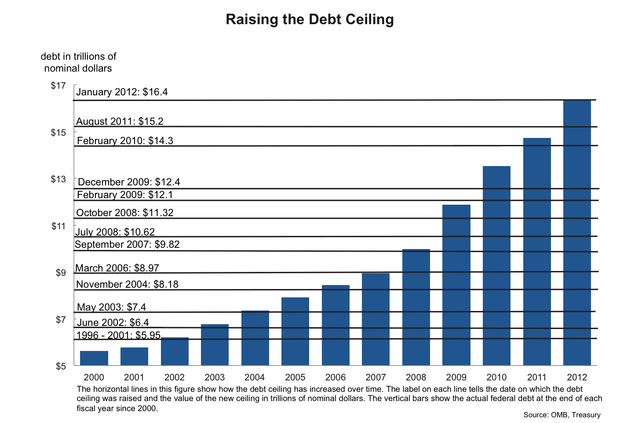
So Fiscal Responsibility means no borrowing at all.  That would reduce the federal budget.  The debt ceiling is currently $16.4 Trillion.  In August of 2011 the ceiling was $15.2 Trillion.  Current deficit spending amounts to about 1/3 of the money spent each year.  What does that mean in terms of impact on society?  Reports say that the current government shutdown has resulted in reducing the government payroll by 15%.  That number does not include planned layoffs of contractors who say they will begin layoffs next week at Lockheed Martin and Sikorsky Helicopter and the thousands of smaller businesses that supply government with a variety of goods.

Constitutionally Limited Government means limiting the federal government to only those responsibilities specifically defined in the Constitution.  Translate that to mean no subsidies for any business or industry, no welfare grants or other aid to any business or individual, no agriculture department, no FAA, no FTC, no FDA, no SEC, no government departments for any function that is part of the 21st century.  Medicare, Social Security, and other social programs would have to be eliminated.  Of course the individual states could run those programs.

Free Markets really means no government interference with any private enterprise even if that means monopolies.  Drug manufacturers could make and sell anything they want regardless of its effectiveness or safety.  Food inspections would not occur because they would interfere with free markets.

Would these programs reduce the impact of the United States in the world?  I say the United States would be reduced in every way in the 21st century.  Our impact – well we would not have any impact.