A Reliable Source for Oil

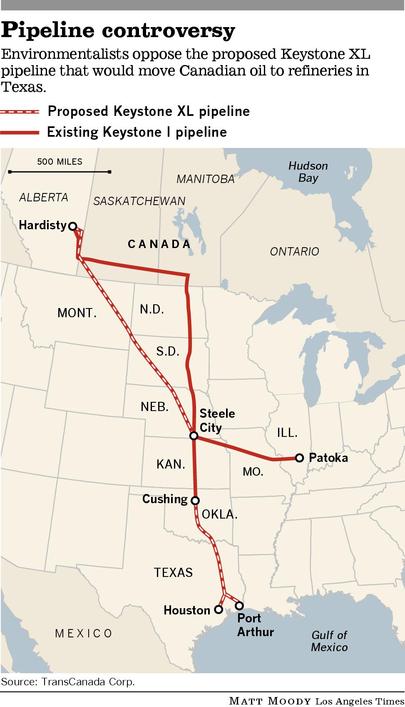
The proposed Keystone XL oil pipeline from Canada to the Texas Gulf Coast would not have “significant impacts” on the environment, the State Department has concluded, removing a major barrier to construction of the $7-billion project.
The problem is that environmentalists and others oppose the idea on the grounds that tar sand extraction (usually called fracking) because water tables will be impacted in the mining area.  There have been reports on American television of enough gas in water pipes to ignite them at their outlets.  This is obviously a serious issue.

The question of a new pipeline from Alberta to Texas should be what will the Canadians do if the United States says no to the project?  It appears Canadian are determined to extract oil from their soil in Alberta despite the opposition.  The answer is they will sell the crude oil to another country.  That would most likely be South Korea, China, or Japan.  There are already plans to build the Northern Gateway pipeline from Alberta through to British Columbia’s northern coast.  Some say this is a fake play by the Canadian government.  No matter, a greater reliance on oil from Canada will benefit the United States with more jobs and a dependable source of supply.

President Obama may be caught in this controversy because if his decision is a “no,” Republicans will say the decision is anti-business and is a job killer.  They would be correct.

Source for this article is the Los Angeles Times and Scientific American.

Hewlett-Packard is Losing its Roots

Can you imagine McDonald’s deciding to change their menu so drastically that they would no longer sell hamburgers?  That is the kind of change Hewlett-Packard is contemplating.

It was 1983 and I was working for Dataproducts Corporation.  That was one of the largest manufacturers in the world of line printers that used dot matrix technology and printed a complete line of data at one time.  There was manufacturing of both the printers and the ribbons that fit them.  The company also manufactured ribbons for many other printer manufacturers.

There I was standing on the shipping dock when a quality control person informed me and another employee that Hewlett-Packard was testing a new technology called ink jet printing.  No printer ribbon was required.  I whistled and said Dataproducts would be dead if it did not develop new technology.  I was correct.  There is no Dataproducts  today. 

Very shortly after that discussion I owned an HP DeskJet 500 printer.  I still own an HP inkjet printer and an HP computer.  HP went on to buy Compaq Computer.  Now HP has decided to abandon its biggest unit that builds both computers and printers.  Those two product groups have been the heart of the company.

Léo Apotheker became HP’s new chief executive and president this past year.  His experience is at SAP.  SAP is a software company so it is no surprise that he would direct the company to a software orientation.  This is a mistake because the company has a history of hardware development and marketing.  The dramatic drop in the company’s stock price tells me that I am not alone in this view.

Apple Plans To Invest In a Sharp Factory

Apple Inc. (AAPL), that is the company that manufactures iPod, iPad, and iPhone, has $76 billion in cash on hand.  That is more money than the GDP of 2/3 of the world’s countries.

Morningstar reported today that Apple will “invest $1 billion in Sharp’s Kameyama plant in Japan, without elaborating.  Their source is a Reuters news agency report.

One comment on this story read in part:                                                              “But not in the USA. Now, if we are talking about job creation tell us Mr. Jobs why Apple is not helping out. Surely we can make LCD screens here. Where is your corporate responsibility to country?”

A second comment contradicts the first saying in part:                                      “You can’t force (or expect) companies to accept lower returns due to patriotism, nationalism etc. Capital is portable, it is agnostic. It seeks the highest risk adjusted returns, just like water flowing downhill. The solution is creating an environment where Companies are better off investing here, rather than outside the country. There are tons of drivers for this, regulatory, legal, labor costs, tax, FX hedging etc.”

My opinion is both are correct.  We are faced with a conundrum.  A company’s first loyalty should be to its shareholders.  At the same time there ought to be some loyalty to your nation.  Here is perfect opportunity for the president of the United States to get on the phone and talk to the COO of Apple, Timothy D. Cook , and perhaps to Steve Jobs too.  “How can we induce you to bring jobs back to the States?”  A good negotiator could make some headway.  Perhaps the negotiator is the president’s chief of staff, Bill Daley, who is known to have excellent ties to the business community.

When Bill Daley is done talking to Apple executives he needs to move on to the leaders of other large American companies.

An Economy in Free Fall

Tourneau in Westfield Topanga is no more

A free falling object is an object that is falling under the sole influence of gravity.  No one knows where the object will land.  A free falling economy is undefined but appears to be an economy that is collapsing.  No one knows where it will end.  Jobs are disappearing, businesses are closing, and the only purchasing is for necessities of life.  Those necessities are water, food, and power for cooking and heat.

Happily most of us are not in that stage now but we seem to be going that way.  The government is functioning poorly at best, jobs are difficult to find, and businesses are closing.  These are all the facts that brought us the Great Depression.

Of course no one in our government and no one in the media want to use the word “depression.”  The mere suggestion of “depression” might start the population to believe it can happen again.

“Double dip, here we come,” said Colin Barr in Fortune.com.

The private sector should be the engine of hiring, but it’s holding back because of “scant demand,” said Phil Izzo in The Wall Street Journal.

“Let’s face it”, said David Leonhardt in The New York Times: The “old consumer economy is gone, and it’s not coming back.”

One big difference this time is the lack of government hiring, which tends to “blunt the bleeding of the private sector” during downturns, said Morgan Housel in TheMotleyFool.com. Since 2010, the public sector has cut nearly half a million jobs, par­ticularly at the state and local levels, because of “plunging tax receipts.” Add those job losses to the steep declines in manu­facturing, construction, and retail, and you can see why “most respected economists don’t see employment hitting pre-recession levels until 2014 at the earliest.”

The Federal Open Market Committee of the Federal Reserve issued a statement yesterday that read in part:      

To promote the ongoing economic recovery and to help ensure that inflation, over time, is at levels consistent with its mandate, the Committee decided today to keep the target range for the federal funds rate at 0 to 1/4 percent.  The Committee currently anticipates that economic conditions–including low rates of resource utilization and a subdued outlook for inflation over the medium run–are likely to warrant exceptionally low levels for the federal funds rate at least through mid-2013.

I never shopped in Tourneau in Westfield Topanga but it was a very large store.

Does anyone believe this economy will recover before 2013?  Write your explanation here.

Bad News for the Unemployed

Businesses Use of More Automation means Fewer Workers

CBS Evening News featured a news item this past week about a Georgia factory, Impulse Manufacturing, that uses robots to do much of the welding, lasers to cut through sheets of steel, and computers to track productivity.  The owner, Ron Baysden, says a laser can churn out one part in 30 seconds — work that used to take 18 men and 30 minutes to complete.  He went on to say “A lot of my competitors did not survive 2009.  We survived because we spent a lot of money and investments in technology.”

Newsweek also had an article this week titled “Who Needs Humans?”  The article offered the same message.  The magazine provided these five situations that are humorous but ominous.

Librarian
A new library at the University of Chicago boasts a robotic system that can find and fetch books faster than humans can.

Bartender
Ohio’s Motoman Robotics sells a robot bartender called RoboBar that mixes drinks in less time than humans-and can crack lame jokes, too.

Taxi Driver                                                                                                  Google has been working on a car that can drive itself, and is asking the city of Las Vegas for permission to try it out as a taxi service.

Call Girl                                                                                                             Why hire an “escort” when you can buy Roxxxy, a sex robot by Bell Labs, who comes with lifelike skin and artificial intelligence?

Soldiers
The Pentagon is making a big push into robotic fighting systems, like the MULE, Lockheed Martin’s robotic truck that can fire missiles at an enemy.

Then there are the maquiladoras.  They are the manufacturing plants in Mexico located near the United States border.  They are located in many of the towns and cities from Tijuana to Reynosa and Rio Bravo.  Maquiladoras are owned by U.S., Japanese, and European countries and some could be considered “sweatshops” composed of young women working for as little as 50 cents an hour, for up to ten hours a day, six days a week.  Courtesy of NAFTA (the North American Free Trade Agreement), taxes and custom fees are almost nonexistent, which benefit the profits of corporations.

What is even more astonishing is that the Obama administration along with Republicans is planning to pass free trade agreements with Colombia, Panama, and South Korea.  They will create jobs.  The jobs happen to be in those countries, not the United States.  The explanation for this is simple.  Our elected officials want to be re-elected.  It’s big business that give the big donations. 

A Love Affair with Detroit

Bob Lutz, the recently retired General Motors vice chairman, has had a continuing love affair with Detroit.  He recently wrote an article about America’s renewed love affair with Detroit.  He contends in the Reuters column that while it’s true that Detroit’s Big Three have been afforded a “historic window of opportunity” by the tragedy of Japan’s earthquake and tsunami, it is a mistake to believe Detroit’s resurgence will be reversed when Japanese car supplies build up again. He says domestic carmakers are now producing the most competitive products in their history. Japanese brands have suddenly developed “a curious inability to produce winning designs.”  One reason is the Japanese yen’s new strength against the U.S. dollar, which makes Japanese cars more expensive to sell in the United States. To compete on price,Toyota, Nissan, and Honda are cutting back on features. Gone are “the Hondas that scream ‘buy me’ thanks to their lovely proportions and superb interior.”

I do wonder if he ever reads anything that is contrary to his views.  My favorite car review magazine is Consumers Reports.  Unlike other car magazines it takes no advertising and so can provide honest evaluations.

The entire Chrysler line was reviewed in the just published August 2011 edition of Consumers Reports.  In every category from family sedans to SUVs their vehicles rated at the bottom of the scale with the exception a Chevrolet Tahoe that rated even lower.  Consumers says, “Chrysler is on the right path but still has a long way to go.”  This is sad when you consider that Chrysler was the originator of the minivan.

In every vehicle type American made cars rated lower than those manufactured in Japan and South Korea.  One exception was the Chevrolet Traverse rating higher than a Honda Pilot.

Many foreign brands are actually assembled in the U.S.A.  That includes my 2004 Toyota Camry.

Sorry Bob, you may love Detroit but my next car is not likely to be a domestic brand.

Wall Street Journal Fights Back

The Wall Street Journal published a lengthy editorial Sunday stressing the integrity of both its publication as well as its former publisher and CEO, Les Hinton. “In nearly four years at the Journal, Mr. Hinton managed the paper’s return to profitability amid a terrible business climate,” the paper’s editorial board wrote. “He did so not solely by cost-cutting but by investing in journalists when other publications were laying off hundreds. On ethical questions, his judgment was as sound as that of any editor we’ve had.” The paper also addressed the scandal-ridden papers also owned by their parent company, and the sharks circling around its leader, Rupert Murdoch. “The Schadenfreude is so thick you can’t cut it with a chainsaw. … We realize how precious that reader trust is, and our obligation is to re-earn it every day.”

Of course one could ask if he committed no crime then why did he resign?

Read it at Wall Street Journal

“Giant Sucking Sound” Returns

ABC World News reported just this past week that 98% of all clothes in the United States are imports.

It was reported in the Los Angeles Times on June 30, 2011 that the White House is pushing for free trade agreements with South Korea, Columbia, and Panama.   At the same time they are concerned about the loss of American jobs.  The concern is about “the 46 year old male, the family breadwinner, with a high school education who had worked more than a decade in a factory that is closing.”

This is astonishing.  The Democratic Party, they are the party that claims to be concerned about America’s middle class and poor, is pushing for these treaties to be passed.  The GOP opposes the treaties because of a requirement that training for those losing their jobs is included in the laws.  They too seem to favor exporting more jobs.

How many jobs have we lost to free trade?  The Economic Policy Institute estimates more than 500,000 job have been lost in the United States to Mexico.  US Bureau of Statistics lists imports from Mexico have increased from $134 billion on 2002 to $229 billion in 2010.  Exports in the same period increased from $97 billion to $163 billion.