Shouldn’t the Market Decide Debit-Card Fees?

This Businessweek item in the June 20, 2011 edition asks a question we should all ask.  How much government interference in business is too much?

The Dodd-Frank financial reform law requires the Federal Reserve to set a limit on how much banks may charge for processing debit-card transactions. The average fee now is 44¢ per transac­tion. The Fed has proposed a limit of 12¢ beginning July 21.

The banks, naturally, don’t care for this. These transaction fees bring them about $20 billion a year. So they have been conducting one of those ludicrous lobbying campaigns that sweep over Washington from time to time, warning of higher prices, re­duced services, plagues of locusts, more naked congressmen on Twitter, and just about any deplorable development you can think of if the new regulations are allowed to go through. On June 8 the Senate defeated a proposal to delay the limit for six months to allow time for further study.

The banks’ campaign against the price cap is so elaborate, expensive, and sometimes disingenuous that it is natural to assume they must be in the wrong. They’ve spent millions on lob­bying. Organizations with preposterous names such as Americans for Prosperity (who isn’t?) gin up letter-writing cam­paigns, and consultants stage other “grass-roots” activities to give the impres­sion that citizens are deeply concerned about this issue-which they aren’t.

Shenanigans aside, the big banks are in the right. Why should the gov­ernment set the price for using a debit card? Most prices in our economy are set by the market-an arrangement that’s worked pretty well over the past couple of centuries. If 44¢ is more than this service really costs, surely one of Amer­ica’s thousands of banks will take a deep breath and offer to do it for 42¢.

If Visa and MasterCard have enough market power to prevent that from hap­pening, the answer is antitrust, not price controls. It’s too bad that America’s banks don’t have enough confidence in free markets to make an honest argu­ment on their own behalf.

It was announced today that the final decision by the Federal Reserve is a 21¢ fee.  Interestingly both Visa and Master Card stocks went up after a hold on trading.
Republican Plan for America’s Job Creators

This is the GOP plan copied from Jobs.GOP.Gov
 
Summary of the Plan


Empower Small Business Owners and Reduce Regulatory Burdens:


  • Require congressional review and approval of any government regulations that have a significant impact on the economy or burden small businesses.


  • Audit existing and pending regulations to identify and address those that hinder economic growth.

Fix the Tax Code to Help Job Creators:

  • Increase American competitiveness to spur investment and create more American jobs by streamlining the tax code and lowering the tax rate for businesses and individuals including small business owners to no more than 25%.
  • Reform the tax code to allow American businesses to bring back their overseas profits without having to pay a tax penalty so they can invest in our economy and create American jobs.

Increase Competitiveness for American Manufacturers:

  • Pass the three pending free trade agreements with Colombia, Panama, and South Korea to create up to 250,000 jobs.
  • Continue to open new markets to American made products.

Encourage Entrepreneurship and Growth:

  • Modernize our patent system to protect our nation’s innovators, discourage frivolous lawsuits, and expedite patent reviews.
  • Re-Authorize and improve federal programs and approval processes to streamline development of new products. Remove barriers to building a first class workforce so that the United States can compete in the global marketplace and lead the way in technological development and growth.

Maximize Domestic Energy Production to Ensure an Energy Policy for the 21st Century:

  • Promote lower energy prices through increased domestic production. Encourage all forms of energy production.

Pay Down America’s Unsustainable Debt Burden and Start Living Within our Means:

  • Build upon the House Republicans’ Budget by enacting significant spending cuts.

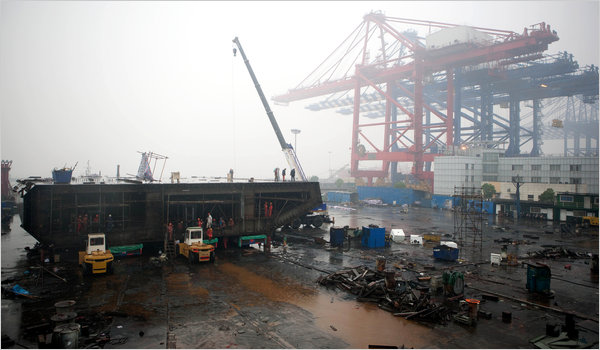
An American Bridge Made in China

Workers at Shanghai Zhenhua finish the welding on a section of the eastern span of the San Francisco-Oakland Bay Bridge

The United States had established itself as the industrial center of the world.  Somehow we have lost that standing to China.  It should be a wake up call to America when we must import steel spans for a new San Francisco-Oakland Bay Bridge from a country that we considered our economic opponent.  Should we blame Richard Nixon and Henry Kissinger for opening trade with China? No!  We should we blame ourselves for our own in-fighting while the rest of the world passes us by.

The New York Times featured this article “Bridge Comes to San Francisco With a Made-in-China Label” in today’s paper.  The eye opener in the story is Pan Zhongwang, a 55-year-old steel polisher, is a typical Zhenhua worker. He arrives at 7 a.m. and leaves at 11 p.m., often working seven days a week. He lives in a company dorm and earns about $12 a day.

How can America compete in a global world that will pay some of its workers $12 a day?  We must set aside our political and philosophical ideas and come together or the United States will cease to be the power it was in the 20th century.

American Recessions are Nothing New

When Barack Obama was inaugurated president the unemployment rate was 7.8%.  That was January 20th, 2009.  Subsequently the unemployment rate rose to 10.1% in October 2009.  Since then it dropped to 8.8% in March of this year but has now risen to 9.1%.  That was a bit of a roller coaster.

Despite the federal government’s best efforts the unemployment rate rose from 3.2% in 1929 to 23.6% in 1932. It never dropped below 14% until 1942 when WWII was in process.  The massive expenditures of the war proved that Keynesian theory does work but the cost is astronomical.

On “John King, USA” on Thursday, Richard Quest said he was looking for a low increase in jobs of 90,000 to 120,000.  That number is twice the BLS reported increase of 54,000 new jobs.

Friday evening: “CBS Evening News,” Harry Smith (lead story): “Tonight, too much firing, not enough hiring: The economic recovery hits a detour. But the president says it would have been a lot worse without the auto bailout” … “NBC Nightly News,” Brian Williams (second story after John Edwards): “Hitting home: Americans are feeling it every day. And tonight, new evidence is out on the economy stalling out” …ABC’s “World News,” George Stephanopoulos, filling in for Diane Sawyer, (second story after Edwards): “Surprisingly bad unemployment numbers fuel new worries about the economy: Is the recovery in reverse?” “John King, USA” started with an interview of Chrystia Freeland, of Reuters and Dr. Peter Morici, Professor at the R.H. Smith School of Business at the University of Maryland, with both of them agreeing that the focus in Washington should be on jobs but it’s on debt reduction.

While Mitt Romney is correct in saying, “He can’t keep blaming George Bush”, neither he nor any other politician has offered a coherent plan to revise the economy and bring back jobs.

The history of recessions and panics in this country goes back to 1797.  That first panic is listed as one of the 13 worst in America’s history.

Our economic system appears to have an inherent flaw.  Despite Ben Bernanke’s study of the Great Depression,   he does not know how to avoid recessions and does not know how to speed a recovery any more than anyone else.  No doubt, eventually this recession will end.  We just don’t know when.

Our Imagination Deficit

This disturbingly accurate description of America today deserves your attention.

Posted on May 29, 2011 on Truthdig.com
By E.J. Dionne, Jr.

While the United States remains utterly frozen in a debate about budget deficits and all the things that government shouldn’t do, other countries are marrying public and private resources to make themselves stronger and more competitive.

While the United States is not even sure we should have gone halfway toward providing health insurance to all of our citizens, other democratic countries long ago began using government to cover all their citizens—and have health costs far lower than ours.

While Americans pay less in taxes than the citizens of other rich countries—and currently pay the smallest share of their incomes for taxes since 1958—one house of Congress thinks the only thing that can be done to help the country is to cut taxes even more.

While other countries have jumped ahead of us in green economics, we have backed away from any effort to put a price on carbon to battle climate change and promote new technologies. In the Republican Party, politicians have to apologize for even thinking about global warming.

Read the rest at Truthdig.com

“Inside Job”

I just finished watching the documentary movie “Inside Job.”  It is outstanding!

This is a 2010 Oscar-nominated documentary that presents in comprehensive, yet cogent detail, the pervasive and deep-rooted corruption that led to the global economic meltdown of 2008.

It’s an appalling portrait of the American financial system.  Interviews are conducted with some of America’s leading economists and politicians.

It’s somewhat long at 1 hour and 48 minutes.  The first and last segments are the best.

Government Nationalizing Business

If your company does business with the government does the government have a say in how it is operated or where you locate operations?

“Living wages,” now adopted by over 50 local governments, require employers that have some financial interaction with the local government to pay covered employees a living wage that is significantly above the federal or state minimum wage.

The National Labor Relations Board (NLRB) filed a complaint recently over Boeing’s plans to open a second plant in South Carolina, a “right-to-work” state, instead of expanding its operations in Puget Sound, Washington, where its workers are unionized. The new South Carolina facility is for the production of the company’s 787 Dreamliner plane.

Boeing’s Washington workers belong to the International Association of Machinists and Aerospace Workers (IAM). The IAM went on strike four times since 1989, costing Boeing at least $1.8 billion in revenue. The new plant in South Carolina would be a non-union facility.

The government agency decided nearly two years after the fact that Boeing’s actions were retaliation for the IAM’s repeated shut downs of commercial aircraft production, including a strike lasting almost 60 days costing billions.

There might be another reason for Boeing’s decision to re-locate to South Carolina. The cost of labor.  In Washington the median hourly pay for Production Operations is $16.56.  In South Carolina the median hourly pay for the same category is $14.49.  When you are employing thousands of people, that $2.07 difference per hour adds up to a significant savings.  These numbers are from the Bureau of Labor Statistics.

According to Boeing’s financial reports, 37% of its “Earnings from Operations” were from Military aircraft.  Like General Motors, Boeing relies on the United States government for support.  Of course they have the right to direct Boeing operations. Or do they?  Is this another case of creeping government control of everything?  Wasn’t that the system used in the U.S.S.R.?  As I recall it failed.

Gas Price Investigation

Is this business or politics?

Here is the title of an April 25, 2006 posting by Fox News.

Bush Announces Gas Price Investigation

WASHINGTON — With gas prices on the rise, President Bush on Tuesday offered suggestions for reducing oil costs, including increasing refinery capacity and conservation, to diversify away from oil through the use of alternative fuels like ethanol.

Under pressure from lawmakers and the public who have alleged price gouging by oil companies, the president also said he has ordered a probe of price manipulation and market speculation. On Tuesday, he also ordered a temporary halt of deliveries to the Strategic Petroleum Reserve.

Read the rest of this article here.

Today President Obama called for an investigation of price gouging.

Obama orders investigation of gas prices

LOS ANGELES (KABC) — President Barack Obama has ordered the Justice Department to investigate potential price gouging at the pump.

Attorney General Eric Holder will appoint a task force to examine both gasoline sales and potential manipulation in oil markets.

Read the rest here.

It’s politics!  The president does not have the power to control gasoline prices.  Check the price in other free market nations and you will find the cost of gasoline is more there than in the United States.

Apple Crushes Forecasts Again, iPad Backlogged

Looking for a good stock for investing? Consider these facts.

(Reuters) – Apple Inc’s results smashed Wall Street’s expectations after iPhone and Mac sales scaled new heights while iPad supplies could not keep up with roaring global demand.

“We sold every iPad 2 we could make and the demand was stunning,” Apple Chief Financial Officer Peter Oppenheimer told Reuters in an interview.

The company’s stock — which is trading at roughly 18 times forward earnings, versus 19 times for Google and 10 times for Microsoft — is considered a must-have in any technology portfolio.

Apple’s I series of products have not been duplicated by any other company. Morningstar’s listing of competitors are: Hewlett-Packard Company, Sony Corporation ADR, Microsoft Corporation, Dell Inc. All of these companies have worthwhile products. None of these companies offers a similar product line.

iPad Competitors? The Motorola Xoom launched to sales that were okay but not breakthrough, the BlackBerry Playbook has gotten hopeful though mixed reviews. There is also the HP TouchPad, as well as Android Honeycomb tablets by manufacturers such as Toshiba and Motorola that have not yet been well reviewed. The Samsung Galaxy Tab has received an excellent rating by Consumers Reports.

Although I am not a fan of Apple products, Morningstar predicts a “$475 fair value estimate.” Today’s stock price is in the $350 to $352 range.

America’s Jobs – Part 2

The ultimate hypocrisy!

We all think of General Electric as the all American company.  That company has provided Americans with everything electric from vacuum cleaners to radios and television sets.  We still have a 13” color television in the kitchen that won’t die.  The company was started by Thomas Edison.  Remember President Ronald Reagan was a television spokesperson for GE before he entered politics.

That is all changed now. The company has a reported 287,000 employees around the world.  It has expanded to manufacturing jet engines for aircraft to building nuclear electrical generating facilities.  After the tsunami in Japan it became public that the six reactors in the Fukushima I Nuclear Power Plant had been designed by General Electric.

Big American companies that we all thought were loyal Americans have rapidly shifted their workforces abroad.  Calling Time Warner for aid with my Wi-Fi system I learned that the nice lady helping me was located in Manila, Philippines.  She had perfect English.

When did offshoring become so prevalent? The trend began in earnest in the late 1970s at large manufacturers such as General Electric. GE’s then CEO, Jack Welch, who was widely respected by other corporate chieftains, argued that public corporations owe their primary allegiance to stockholders not employees. Therefore, Welch said, companies should seek to lower costs and maximize profits by moving operations wherever is cheapest. “Ideally,” Welch said, “you’d have every plant you own on a barge to move with currencies and changes in the economy.” Not only did GE offshore much of its manufacturing, so did its parts suppliers, which were instructed at GE-orchestrated  “supplier migration seminars” to “migrate or be out of business.”

President Obama Picks Jeffrey Immelt, GE CEO, To Run New Jobs-Focused Panel .  And you thought that Barack Obama was for the American people.