This week’s fatal shooting of UnitedHealthcare CEO Brian Thompson has unleashed a wave of public feeling — exasperation, anger, resentment, helplessness — from Americans sharing personal stories of interactions with insurance companies, often seen as faceless corporate giants.
In particular, the words written on ammunition found at the shooting scene — “delay,” “deny” and “depose,” echoing a phrase used to describe how insurers dodge claim payouts — amplified voices that have long been critical of the industry.
Currently, depending on the market segment you’re looking at, Kaiser, Anthem Blue Cross, Blue Shield of California, Health Net, Aetna, United (group), and AARP (Senior) are the main carriers in California.
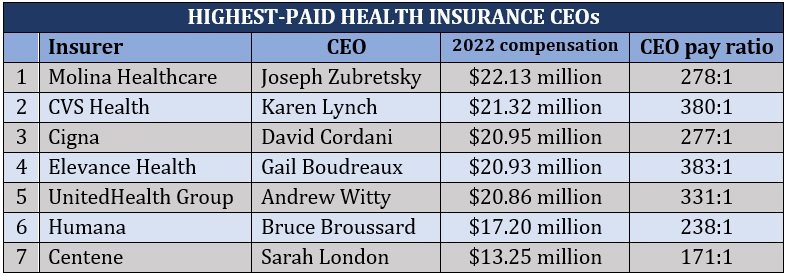
According to insurancebusinessmag these are the highest paid CEOs of the largest companies in the United States.
Will the killing of Brian Thompson change anything about the for profit health insurance companies? NO!
Los Angeles Times owner Patrick Soon-Shiong, who blocked the newspaper’s endorsement of Kamala Harris and plans to overhaul its editorial board, says he will implement an artificial intelligence-powered “bias meter” on the paper’s news articles to provide readers with “both sides” of a story.
Soon-Shiong, the biotech billionaire who acquired the Times in 2018, told CNN political commentator Scott Jennings – who will join the Times’ editorial board – that he’s been “quietly building” an AI meter “behind the scenes.” The meter, slated to be released in January, is powered by the same augmented intelligence technology that he’s been building since 2010 for health care purposes, Soon-Shiong said.
“Somebody could understand as they read it that the source of the article has some level of bias,” he said on Jennings’ “Flyover Country,” podcast. “And what we need to do is not have what we call confirmation bias and then that story automatically, the reader can press a button and get both sides of that exact same story based on that story and then give comments.”
Soon-Shiong said major publishers have so far failed to adequately separate news and opinion, which he suggested “could be the downfall of what now people call mainstream media.”
The comments prompted a rebuke from the union representing hundreds of the Times’ newsroom staffers, which said Soon-Shiong had “publicly suggested his staff harbors bias, without offering evidence or examples.”
“Our members – and all Times staffers – abide by a strict set of ethics guidelines, which call for fairness, precision, transparency, vigilance against bias, and an earnest search to understand all sides of an issue,” the Los Angeles Times Guild said in a statement Thursday. “Those longstanding principles will continue guiding our work.”
The contentious moves from the paper’s owner also led to the resignation of Harry Litman, a senior legal affairs columnist for the Times’ Opinion page.
“My resignation is a protest and visceral reaction against the conduct of the paper’s owner, Dr. Patrick Soon-Shiong. Soon-Shiong has made several moves to force the paper, over the forceful objections of his staff, into a posture more sympathetic to Donald Trump,” Litman wrote Thursday. “Given the existential stakes for our democracy that I believe Trump’s second term poses, and the evidence that Soon-Shiong is currying favor with the President-elect, they are repugnant and dangerous.”
Litman’s resignation comes days after Kerry Cavanaugh, the Times’ assistant editorial page editor, also announced her exit, Status first reported. In addition to his sweeping changes to the editorial board, a person familiar with the matter said Soon-Shiong has begun reviewing the headlines of all opinion pieces before publication. A spokesperson for the Times did not respond to CNN’s request for comment.
The moves come as Soon-Shiong looks to restructure the newspaper’s editorial board, telling CNN last month that he plans to balance the paper’s opinion section with more conservative and centrist voices in the wake of President-elect Donald Trump’s victory.
“If we were honest with ourselves, our current board of opinion writers veered very left, which is fine, but I think in order to have balance, you also need to have somebody who would trend right, and more importantly, somebody that would trend in the middle,” Soon-Shiong told CNN in November.
The restructuring follows Soon-Shiong’s divisive decision to block a drafted endorsement of Vice President Harris two weeks before Election Day, which resulted in the resignation of several members of the paper’s editorial board, staff protests, and thousands of readers canceling their subscriptions. Just three of the editorial board’s eight members now remain, according to the Times website. On Wednesday, Soon-Shiong told Jennings that when the editorial board shared it had “pre-packaged” a presidential endorsement “without having met with any of the candidates,” he was “outraged.”
“I did not want our paper to be part of that method of providing information or misinformation or disinformation,” he said.
“Everybody has a right to an opinion, that’s fair,” Soon-Shiong said, underscoring that the paper needs to “actually create some level of balance when it comes to opinion and columnist, and then we need to actually let the reader know this is opinion.”
In his resignation Thursday, Litman called the owner’s decision to spike the presidential endorsement a “deep insult to the paper’s readership.”
“Trump has made it clear that he will make trouble for media outlets that cross him,” Litman wrote. “Rather than reacting with indignation at this challenge to his paper’s critical function in a democracy, Soon-Shiong threw the paper to the wolves. That was cowardly.”
Mariel Garza, the editorials editor of the Los Angeles Times, resigned on Wednesday after the newspaper’s owner blocked the editorial board’s plans to endorse Vice President Kamala Harris for president.
“I am resigning because I want to make it clear that I am not okay with us being silent,” Garza in a conversation with Columbia University School of Journalism. “In dangerous times, honest people need to stand up. This is how I’m standing up.”
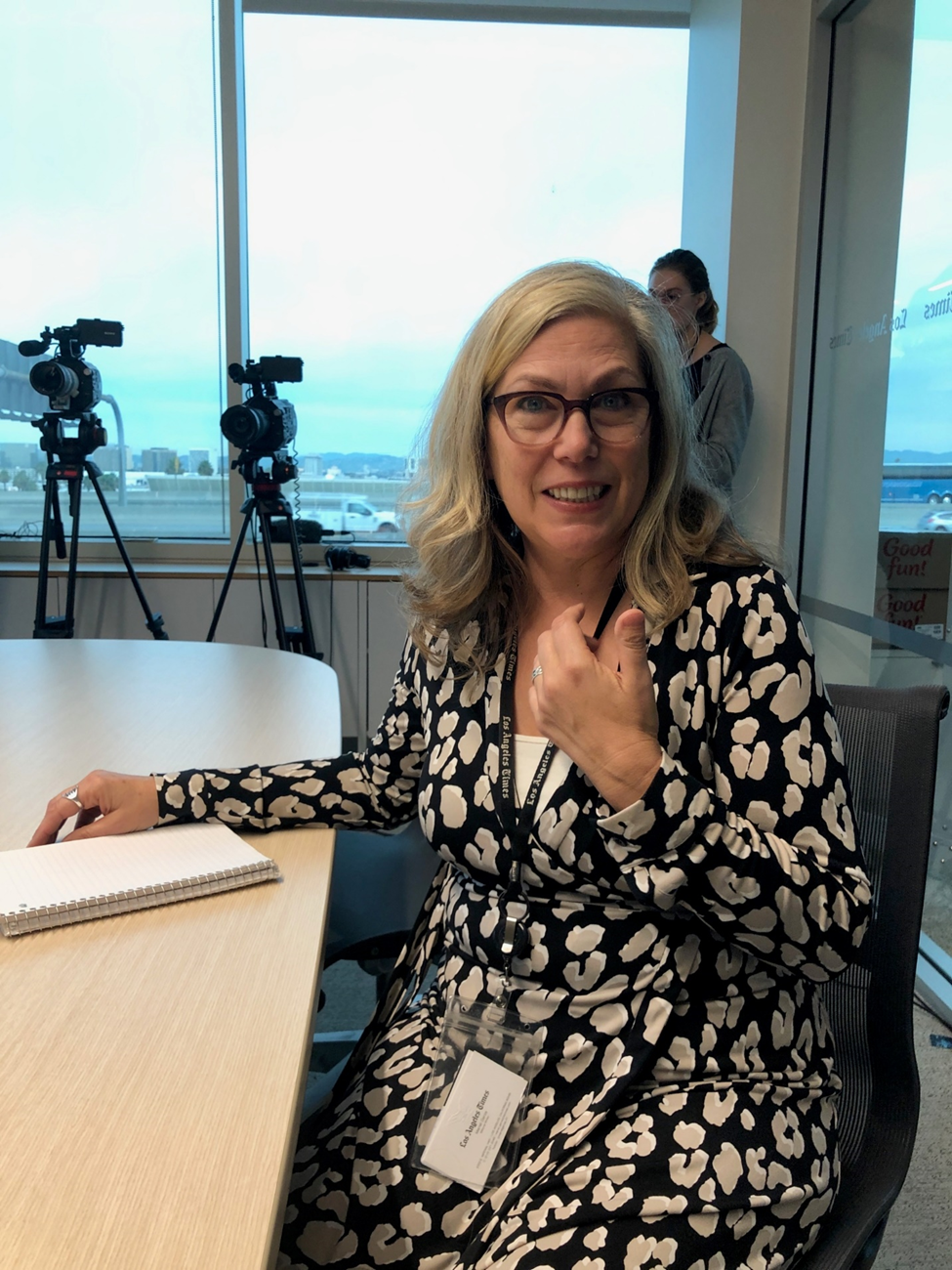
Terry Tang is Executive Editor, Los Angeles Times.
Terry,
Ever since Dr. Soon-Shiong vetoed the editorial board’s plan to endorse Kamala Harris for president, I have been struggling with my feelings about the implications of our silence.
I told myself that presidential endorsements don’t really matter; that California was not ever going to vote for Trump; that no one would even notice; that we had written so many “Trump is unfit” editorials that it was as if we had endorsed her.
But the reality hit me like cold water Tuesday when the news rippled out about the decision not to endorse without so much as a comment from the LAT management, and Donald Trump turned it into an anti-Harris rip.
Of course it matters that the largest newspaper in the state—and one of the largest in the nation still—declined to endorse in a race this important. And it matters that we won’t even be straight with people about it.
It makes us look craven and hypocritical, maybe even a bit sexist and racist. How could we spend eight years railing against Trump and the danger his leadership poses to the country and then fail to endorse the perfectly decent Democrat challenger—who we previously endorsed for the US Senate?
The non-endorsement undermines the integrity of the editorial board and every single endorsement we make, down to school board races. People will justifiably wonder if each endorsement was a decision made by a group of journalists after extensive research and discussion, or through decree by the owner.
Seven years ago, the editorial board wrote this in its series about Donald Trump “Our Dishonest President”: “Men and women of conscience can no longer withhold judgment. Trump’s erratic nature and his impulsive, demagogic style endanger us all.”
I still believe that’s true.
In these dangerous times, staying silent isn’t just indifference, it is complicity. I’m standing up by stepping down from the editorial board. Please accept this as my formal resignation, effective immediately.
Good news for Kamala Harris and the Democratic Party.
President Joe Biden touted the better-than-expected jobs data in a post on X Friday morning.
“Great news for American workers and families: Today, we learned our economy gained over 250,000 new jobs in September and unemployment is back down at 4.1%. With today’s report, we’ve created 16 million jobs, unemployment remains low, and wages are growing faster than prices.”
Fed Chair Powell: “There’s really nothing that I can point to in the economy that suggests that a downturn is more likely than it is at any time.”
The September jobs report also showed an uptick in wage growth, with average hourly earnings growing by 0.4% for the month. That brings the annual rate up to 4% from 3.9% seen in August, according to Friday’s report.
If you are in your 60s with too little retirement savings, you aren’t alone. The median balance in defined contribution plans of those ages 55 to 67 is just $87,571, according to the Vanguard How America Saves Report.
Financial concerns are a fact of life for America’s retirees. In fact, an AARP survey found that 20% of adults ages 50+ have no retirement savings, and more than half (61%) are worried they will not have enough money to support them in retirement.
It’s not a comfortable financial position, as a $50,000 nest egg only allows you to withdraw around $2,000 in annual income, assuming you follow the 4% rule to set a safe withdrawal rate. With Social Security only replacing around 40% of pre-retirement income, $2,000 to spend each year from savings simply won’t cut it. You must find ways to boost your savings.
Be wary of quick money making schemes. Bernie Madoff’s Ponzi scheme, which ran for decades, defrauded thousands of investors out of tens of billions of dollars. Investors put their trust in Madoff because he created a front of respectability, his returns were high but not outlandish, and he claimed to use a legitimate strategy. In 2009 Madoff was sentenced to 150 years in prison.
My solution to this dilemma was a Reverse Mortgage on my house. It is an expensive choice but I can continue living in my house for the remainder of my life and Social Security pays my other bills.
Forget Multi-Level Marketing Businesses as a source of income. They are mostly Pyramid schemes. They can look remarkably like legitimate MLM business opportunities and often sell actual products, maybe even ones you’ve heard of. But if you become a distributor for a pyramid scheme, it can cost you and your recruits — often your family and friends — a lot of time and money that you won’t get back.
I did not write this. As a child I visited Winnipeg every summer as baby and until the age of 10 in 1948. My family stayed at my grandparent’s house at 136 Cathedral Avenue. I Remember visiting Eaton’s numerous times.
—
WHEN I WAS growing up in Winnipeg in the 1960s, there were essentially two places to shop: Eaton’s and the Bay. Eaton’s was the store my grandmother frequented, checking for bargains in its basement every week, eating lunch in the sedate Grill Room. The Bay was vaguely hipper. I remember it still had elevator operators then as well as its own library and post office, though the in-house orchestra was gone. Both stores had a kind of majesty to them, unaware they had peaked as retail ideas.
The decline of the downtown Winnipeg Bay store resembled Hemingway’s description of bankruptcy—gradual, then sudden. It was the company’s national flagship store until 1974, but with the advent of malls in that decade, it began to lose its currency. By 2019, the downtown core of Winnipeg had largely hollowed out, and some of the Bay floors were closing. What remained felt like a dismal Soviet-era shopping experience under gloomy lights. The store was built in 1926 at a cost of around $5 million; at the time of its closing, in November 2020, Cushman & Wakefield, a commercial real estate firm, valued the building at $0.
Here in Los Angeles shopping malls have closed and many chains of stores have gone into bankruptcy. Eaton’s is gone in Canada and May Company in the United States is gone. Local California chains are now all gone.
Hudson’s Bay owns Sak’s Fifth Avenue they are now consolidating with Neiman Marcus.
Macy’s net income for the quarter ending April 30, 2024 was $0.062B, a 60% decline year-over-year.
So where did I buy my new sneakers (tennis shoes)? Amazon. It seems everyone is buying on line.
“It’s the economy stupid” was a phrase coined by James Carville in 1992, when he was advising Bill Clinton in his successful run for the White House. And it is still true today.
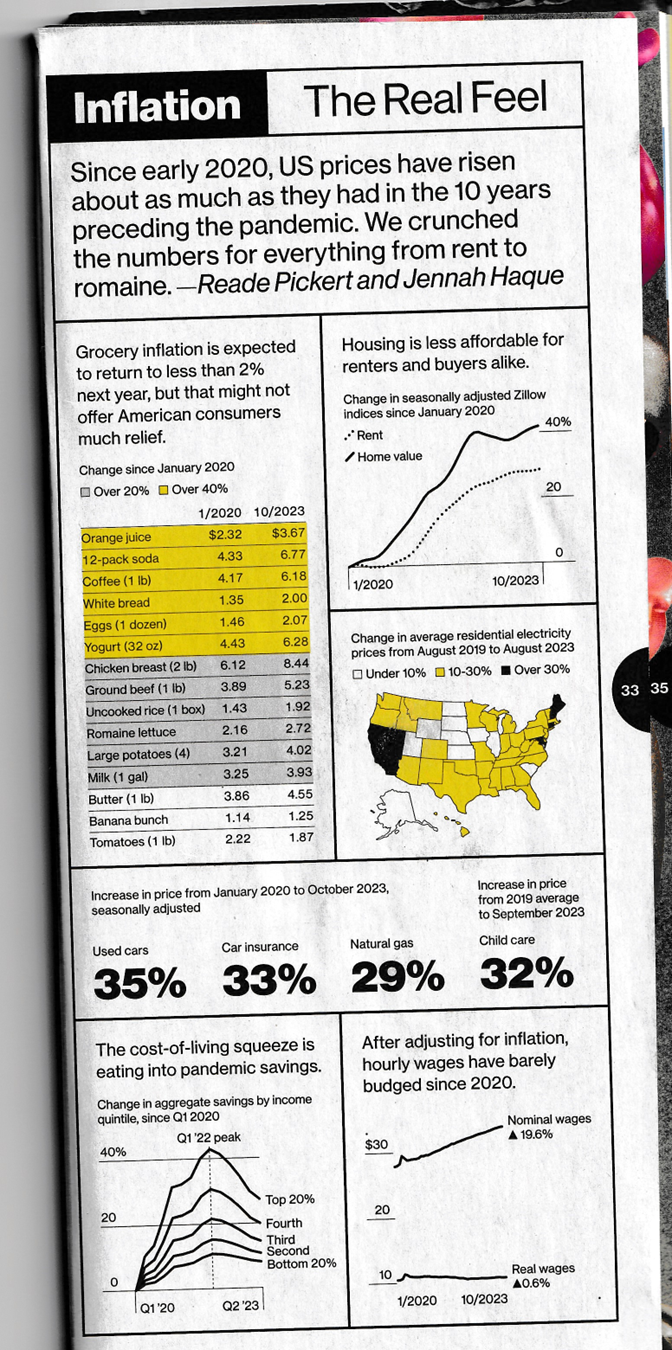
The Biden administration may want you to believe that inflation is not real but they are telling you a lie. This report from the latest Bloomberg Business Week provides the facts. In my own personal life my Quaker Oats Apple and Cinnamon now provides 8 packets down from 10 in a box. My shaving cream is now in a 7 ounce container down from 10 ounces. Next year’s inflation rate of an expected 2% won’t be bringing prices down.
Once upon a time there were four daily newspapers in Los Angeles. The Examiner, Herald Examiner, Mirror, and Times. Today the Times is the remaining paper and It is not doing well. The circulation The Times reported daily circulation in October 2010 was 600,449,[48] down from a peak of 1,225,189 daily and 1,514,096 Sunday in April 1990. Today the daily circulation is reported at 142,382.
The Southern California News Group, owner of the San Fernando Valley Los Angeles Daily News was created when the Los Angeles News Group (owners of nine local daily newspapers and websites) and its parent company Media News Group (MNG) acquired Freedom Communications (owners of the Orange County Register and Riverside Press-Enterprise). All this was an effort at surviving the shrinking subscriber base. For now that effort has been a success.
The Los Angeles Times is not alone in the decline of its circulation. Every web site paints a picture of declining newspaper revenue throughout the country. The Philadelphia Inquirer had a daily circulation of 648,000 in 1968 but today it is down to 101,000. Not being able to sustain a profit it is now owned by a non-profit organization in Philadelphia.
It appears that the Washington Post and the New York Times are both continuing to thrive. That says that if you are big enough you can survive. So it appears that local newspapers will be part of the past.
The four Warner brothers, who created the studio celebrating its centennial this month. The Jazz Singer, the first popular talking film, single-handedly changed motion pictures forever. My Four Years in Germany was a post World War I film that foreshadowed World War II Germany.
This article was written by Martin Cooper, President of Cooper Communications, supervised public relations for the Academy of Motion Picture Arts & Sciences for 10 years. It was published in the Warner Center News in Woodland Hills, California.
It started like most fairy tales…
Once upon a time, there were four Wonsal brothers, Hirsz Mojżesz, Aron, Shmul and Izaak. The first three were born in Krasnosielc, a largely Jewish village north of Warsaw; the youngest was born in Canada.
Their father, Benjamin, fleeing anti-Semitism and economic privation, left Poland in 1888 for Baltimore, changing his name to Warner. The four brothers changed their first names to Harry, Albert, Sam and Jack.
That is just the beginning of the fairy tale of the four Warner Bros.
Sam found a job as a projection operator at an amusement park in Ohio; he soon saw the possibilities of motion pictures. Purchasing a projector and a portable screen, the brothers traveled around Ohio and Pennsylvania, presenting screenings of The Great Train Robbery and other films.
In 1903, they opened their own moving picture theatre, the Bijou (some histories said the theater name was the Cascade), in New Castle, Pennsylvania, and, a few years later, began producing their own films. Like so many others, the lure of Southern California’s weather and its distance from Thomas Edison’s license fee demands that his company be paid a royalty on every film screened, was irresistible.
In 1918, from their new Culver City production facility, they released their first full-length motion picture, My Four Years in Germany; it was the precursor to anti-German and socially conscious films for which Warner Bros. became known during World War II.
The semi-documentary is based on the experiences of the American a m b a s s a d o r to Germany from 1913 to 1917, James W. Gerard. The opening shot sets the tone: A Prussian officer in full regalia sits in his office and looks up at a framed slogan on his wall that reads “Nothing can confer honors and fame upon a Prince except the Sword.”
In a prescient c o m m e n t foretelling the Blitzkrieg of World War II, the German Foreign Minister explains why his country cannot negotiate: “We cannot surrender our greatest asset, sudden and overwhelming assault.”
While the nearly two[1]hour silent film is dated by today’s standards, the Los Angeles Daily Times review of May 21, 1918, included: “My Four Years in Germany is the motion picture of the hour, of the century. It is momentous history, with almost the power and grip of life itself. It will be treasured in our archives. It will mold millions of Americans into heroic stature…”
Made for $50,000, this film grossed a surprising $1.5 million; it was the first hit for the brothers Warner. Its success encouraged them to concentrate on film production rather than distribution and provided the funds for them to purchase a studio in Hollywood.
And so, on April 4, 1923, Warner Brothers Pictures, Inc., was formally established, 100 years ago this month. (Happy centennial birthday, Warner Bros.!)
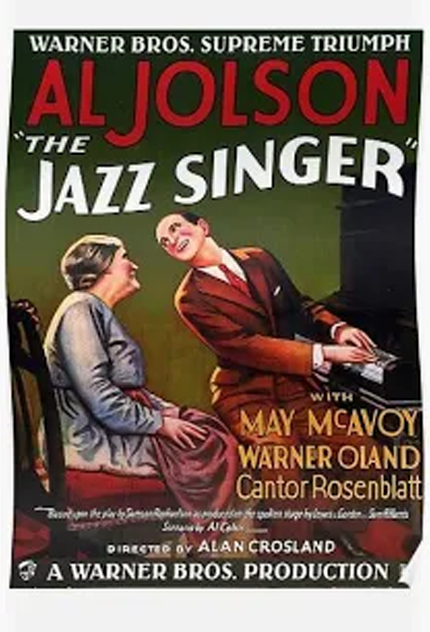
In 1927, Warner Bros.’ enjoyed a financial windfall from the first talkies: The Jazz Singer, followed by The Singing Fool. If one film can be said to have changed motion pictures more than any other, it would be The Jazz Singer. It cost $422,000 to make and grossed $2.6 million… and put Warner Bros. on the map.
Both films starred Encino resident Al Jolson and provided the studio the funds to buy a majority of First National Pictures.
The year before The Jazz Singer premiered, in 1926, First National purchased 62 acres of farmland in Burbank and built its own studio. As part of its acquisition of First National, Warner Bros. decamped from Hollywood to the First National studio lot, and the San Fernando Valley has been its home ever since.
Under the agreement, Warner Bros. gained access to First National’s chain of affiliated theaters, while First National acquired the rights to use Warner Bros.’ Vitaphone sound system. A number of Warner Bros. films were branded First National Pictures until July 1936, when First National Pictures, Inc., was dissolved. In the decade 1930-1939, Warner Bros. produced more than 575 pictures…a staggering record: many classic hits, many so-so features, and more than a few duds. The studio didn’t shy away from near-salacious titles during this decade: Playing Around, Loose Ankles, She Couldn’t Say No, and The Flirting Widow (1930); The Naughty Flirt, Other Men’s Women, Misbehaving Ladies, The Hot Heiress, and Compromised, (1931); and, in 1932, Street of Women, Ladies They Talk About, and Beauty and the Boss, to name but a few.
Perhaps it’s better to focus on the truly wonderful cinematic offerings the Burbank studio brought forth during the decade, one film per year: The Dawn Patrol (1930); Little Caesar (1931); I Am a Fugitive from a Chain Gang (1932); Lady Killer (1933); Here Comes the Navy (1934); Captain Blood (1935); The Story of Louis Pasteur (1936); The Life of Emile Zola (1937); Jezebel (1938); and Dark Victory (1939).
The fairy tale of the four Warner brothers continued into the following decade.
…And they lived happily ever after (except they didn’t, as we’ll see next month).

 Coast Contact