Obama’s Gas Price Migraine

The price for gasoline in Los Angeles is almost exactly the same as pictured below.  This Wall Street Journal columnist is simply stating the facts.  Today’s report of the White House considering releasing oil from America’s emergency strategic oil reserve is a futile effort.  Past releases have had little impact on pricing.  There is no shortage of oil.  The real problem is that America has no plan for energy independence.
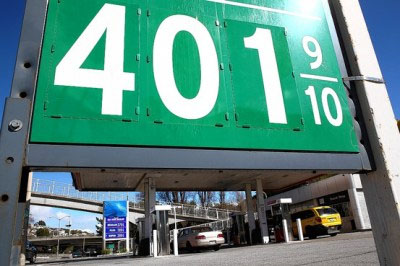
 

Posted price for a gallon of gasoline, San Francisco, Calif., Feb. 25

Obama’s Gas Price Migraine

By: Kimberley Strassel

The Obama administration has its share of headaches: a possible government shutdown, Arab unrest, the union uprising. The real migraine may be a firestorm over gasoline prices.

Oil last week topped $100 a barrel, and gas has hit $4 a gallon in pockets of the country. The price is expected to keep heading up. This pain is being felt by a public still dazed by recession.

An immutable fact of expensive gasoline: Americans will find someone to blame. We can expect in coming months to hear many sober analysts attempt to explain the complex reasons for rising oil prices: inflation, Middle East tremors, growing demand. Expect, too, for all those reasons to vanish behind what most Americans will see as the far more obvious (and graspable) cause: President Obama’s regulatory assault on domestic oil and gas production.

This is, after all, a White House that has put at the center of its domestic agenda its goal of a “green economy,” which hinges on making fossil fuels too expensive for Americans to purchase. In January 2008, candidate Obama told the San Francisco Chronicle that under his cap-and-trade plan, “electricity rates would necessarily skyrocket.” Steven Chu, now Secretary of Energy, told this newspaper in the same year: “Somehow, we have to figure out how to boost the price of gasoline to the levels in Europe.” That would be, oh, $10 a gallon.

In March of last year, Mr. Obama reversed or scaled back nearly every major offshore oil opportunity that has come about since the price spike of 2008—effectively reimposing a moratorium on drilling off the coasts. His administration has killed leases in developmentally crucial areas of Alaska. His EPA has refused to issue permits. The White House used the BP oil spill as an excuse to also shut down the deep-water Gulf.

Onshore? Interior Secretary Ken Salazar has revoked oil-and-gas leases. The EPA is suffocating the coal industry with regulation. One of the president’s only clear State of the Union proposals was to raise taxes on oil and gas. The White House’s energy policy, says Dan Kish of the Institute for Energy Research, is “embargoing our own energy supplies to drive up their costs.”

Democrats are already desperately spinning the press on why none of this will matter politically. Yes, the party took heat for its antidrilling policies in 2008, but it won’t be the same this time. Americans, they say, just witnessed an oil spill; they are okay with a drilling ban. And so long as economic recovery stays on track, no one will sweat an extra buck a gallon. And so on.

The Democrats are right about one thing: It won’t be the same as 2008. It will be politically worse. Nobody should forget the extraordinary public fury over $4 gas in 2008. The rage was enough to take Mr. Obama’s flailing presidential opponent, John McCain, and propel him ahead in the polls, where he stayed until the financial crisis. Remember also that when oil prices peaked in July 2008, the unemployment rate was 5.7%.

President Bush largely escaped public blame. How could anyone lay high oil prices on a guy the left had spent eight years slamming as an “oil man”? But President Obama’s anti-oil record is evident, and Republicans (who, unlike in 2008, run the House), will use their bully pulpit to directly connect prices to the Obama energy freeze.

This week we’ve seen the first rumblings of the oil-price political freight train that’s coming. Senate Minority Leader Mitch McConnell highlighted a Democratic proposal to raise gas prices with new levies on oil and gas, deeming it the “minivan tax.” Washington state Rep. Doc Hastings, chairman of the House Natural Resources Committee, grilled Interior Secretary Ken Salazar Wednesday about the administration’s de facto moratorium on deep-water drilling permits. Behind the scenes, GOP members are touching up energy bills, to provide a further contrast with the administration.

The White House sniffs trouble and this week rushed to issue its first Gulf deep-water permit since the spill. Yet the administration has so much wrapped up in its green-energy agenda—stimulus grants, subsidies, programs in every department—it seems unwilling to do more. The EPA has refused to budge on controversial carbon-emissions regulations. The president is now pushing for a “clean energy” mandate, the ugly stepchild of cap and trade. The White House is trying to recruit gullible Republicans to a “comprehensive” energy bill, though its goal appears to be to cloak a further renewable agenda behind the few bones it would toss to natural gas or nuclear.

The administration took a midterm election beating because the public saw it move to the left of reality on spending and health care. Rising gas prices now threaten to catch it out the same way on energy. If it wants to recapture public favor, it will have to make a major shift.

US Jobless Claims down 20K To 368K In Feb 26 Week

The number of U.S. workers filing new claims for unemployment benefits unexpectedly dropped last week, pointing to continued improvement in the jobs market as the economy picks up speed.

The S&P 500 and the Dow Jones Industrial average are up over 1.5%.  The rise was the result of the lower unemployment claims and higher than expected retail sales reports from such companies as Target, Macy’s, and Heinz (Heinz 3Q Profit Up 20% on Strength in North America).

We still have a long way to go but at last there is light at the end of this horrible recession.

Drill Baby Drill!!

What ever happened to “Drill Baby Drill”?

John Hofmeister, founder and CEO of the non-profit group Citizens for AFFordable Energy and former CEO of Shell Oil, keeps sounding the alarm but no one seems to be listening. As recently as February 24 he appeared on Parker Spitzer saying what he has said before. In addition he said we have plenty of oil within the United States; we just don’t want to deal with the messy business of extraction.

John Hofmeister on FBN “Varney & Company” 2/28/2011
The price of gasoline continues to rise. So what is the Obama administration doing about it? What should it do? Listen to John Hofmeister’s comments on this and likelihood of $4 a gallon gasoline this year.


The AP reported today “Oil prices climbed Tuesday as Iran clamped down on anti-government protesters and unrest in the Middle East threatened to keep energy prices high for months to come.”

What will it take to change our objections to utilizing our own resources? Perhaps the answer is gasoline at $5.00 per gallon.

The Possible new Mining of Asbestos

You thought this was an issue that had been put to bed.  So did I.  AOL News brought this item to my attention.

ASBESTOS, Quebec — A plan to increase production from Canada’s last asbestos mine near this town named for the deadly mineral has enraged physicians and public health workers around the globe.

The following information was taken from a law firm that helps those suffering from Mesothelioma.  That is a form of cancer believed to be caused by exposure to asbestos particles.

Throughout time, asbestos has been used in a variety of contexts. The fiber was originally used by the Greeks who loved it as a fire-proof table cloth that could be tossed in the fire for cleaning whenever it got dirty. Since then, the use of asbestos has expanded into a variety of areas. At the peak of its use and through the late 1980s, asbestos was used in more than 3,000 products in homes.

A large number of products using asbestos are used in construction and industrial products. Asbestos is used in various construction components because it is both fireproof and provides insulation. It is excellent for insulating against sound from other room as well as insulating against heat.

Some products in buildings and industrial applications that contain asbestos include:

– Floor tiles and sheet flooring
– Decorative plaster or artex
– Acoustic plaster
– Textured paints
– Spray coatings
– Roofs, gutters, downpipes
– Wall panels
– Door linings
– Floors and walls
– Loft insulation- Lift shaft linings
– Soffits/fascia boards
– Brake linings
– Fire safes/filing cabinets
– Packing materials
– Ventilation system linings/laggings
– School blackboards

The prevalence of asbestos in such a wide variety of products that are used in such a wide variety of areas means that almost anyone can be at risk of exposure. Some of the most commonly affected individuals include contractors, car mechanics, shipworkers, firefighters, clean-up crews, and numerous other groups.

Due to the risk of asbestos, individuals should be careful to take any and all precautions possible for avoiding the inhalation of the deadly fiber. While the fiber has numerous uses in the construction and industrial world, it is deadly for human beings. So far, asbestos is the only known cause of Mesothelioma, a deadly cancer, and asbestosis, a lung disease.

Asbestos fibers do not immediately trigger disease and cancer. It usually takes more than one exposure to the fiber to trigger or result in asbestosis or mesothelioma.

Hard Choices

This is an example of how business does what it must do to survive and grow.

From Bloomberg Businessweek, January 31 – February 6, 2011

Michael El-Hillow
“I wrote to the governor of Massachusetts, and we went to everyone we could think of-Congress, our banks. Nobody could help us”

Evergreen Solar‘s CEO on firing 800 workers, closing his U.S. factory, and the lure of lower costs and greater government subsidies in China

We make silicon wafers that go into solar panels. In 2008 we decided to build a plant in Massachusetts to be near our research and development facility. There was a groundswell of optimism that the U.S. was going to take the lead in the drive for alternative energy.

There were challenges from the start. Lehman Brothers was our banker and had almost a third of our outstanding shares as part of a financing transaction. That disappeared in Lehman’s bankruptcy and cost us about $300 million. Then we went to the federal government to get help from the TARP funds, but they said no because we weren’t a financial institution.

In December 2008 we were approached by a Chinese company, Jiawei, which was impressed with our wafer technology. The Chinese government agreed to support a loan that would cove two-thirds of our expansion in China. The subsidies we received from the government here covered less than 5 percent of the cost of our U.S. plant. We received $20 million and some future tax credits, but you can’t pay taxes if you don’t make money.

One mistake was making the U.S. facility too large. We should have made it a quarter the size. I wrote to the governor of Massachusetts, and we went to everyone we could think of-Congress, 0ur banks. Nobody could help us. Then, late last year, prices went down 10 percent in one month for the modules we sell-on top of steadily falling prices for the last three years. That left us no choice but to stop making panels in the U.S. and shift our focus to making wafers in China. The access to capital startups there is staggering.

About 800 people in our U.S. factory will lose their jobs, but the company wouldn’t have survived if we didn’t make this choice. Now we’ll focus on what we do best. If we had stayed here, we would have been insolvent by September. We needed to do this to survive, although my hope that some day more jobs will come back here, -As told to Diane Brady

The Closing of Borders and other Book Stores

It was bound to happen.  The iPad, Kindle e-book reader, Nook, and others have been a signal that the end of the printed books may be coming.

After all look  at all the magazines that have recently died or are currently dying.  U.S. New and World Report, Newsweek, Gourmet Magazine, and many others .  Major newspapers have been struggling too.

It’s all due to the fact that too many of you are on the internet.  WordPress, Blogspot, and the Huffington Post have all been part of the new wave of digital communications.

The Los Angeles Times lists the following Borders book store closings in Southern California. 

Cerritos: Cerritos Towne Center, 12741 Towne Center Drive

Chino: Chino Spectrum Town Center, 3833 Grand Ave.

El Cajon: Parkway Plaza East, 159 Fletcher Parkway

Glendale: Glendale Marketplace, 100 S. Brand Blvd.

La Habra: La Habra Westridge Plaza, 1310 S. Beach Blvd.

Long Beach: Los Altos Market Center, 2110 Bellflower Blvd.

Long Beach: The Pike at Rainbow Harbor, 101 South Pine Ave.

Los Angeles: Westfield Century City, 10250 Santa Monica Blvd.

Los Angeles: Howard Hughes Center, 6081 Center Drive, Suite 118

Mira Loma: Eastvale Gateway, 12423 Limonite Ave.

Montclair: Perimeter Plaza, 5055 S. Plaza Lane

Orange: The Block at Orange, 20 W. City Blvd.

Oxnard: Esplanade Shopping Center, 241 W. Esplanade Drive

Pasadena: South Lake Avenue, 475 S. Lake Ave.

Pico Rivera: Pico Rivera Town Center, 8852 Washington Blvd.

Rolling Hills Estates: The Promenade on the Peninsula, 550 Deep Valley Drive, Suite 261

San Diego: Gaslamp District, 668 6th Ave.

Sherman Oaks: Ventura Boulevard, 14651 Ventura Blvd.

Tustin: The District at Tustin Legacy, 2493 Park Ave.

Valencia: Valencia Town Center, 24445 Town Center Drive

Yorba Linda: 22401 Old Canal Road

$35 Billion of Waste and More

Jon Carl of ABC World News asked Speaker of the House, John Boehner, about three projects that are total waste.

Republicans say they want to slice $1.7 billion out of the government’s budget for buildings.  However, not mentioned in the Speaker’s press conference is the more than $5 billion spent every year  on ethanol subsidies that neither help the environment nor save energy; $6.2 billion in tax credits for oil and gas companies flush in record profits; and $3.5 billion for an extra engine for the F-35 fighter jet that the Pentagon doesn’t want.

Mr. Carl could have also mentioned the C-17 cargo plane.  The Air Force hasn’t asked for more money to buy C-17s since 2007. That year the Air Force wanted 12, and Congress bought it 22. In 2008, the Air Force wanted none, but Congress bought 15. In 2009, the request was also zero, and Congress bought eight. In 2010, the Air Force once again asked for no C-17s, and lawmakers bought 10.  Since 2007, Congress has spent more than $10 billion buying C-17s.

Could the cuts have anything to do with eliminating those programs that are not in Republican districts?

Economic Recovery is On the Way

At long last the drop in new Weekly Initial Job Claims is significant. It was 384,000 in the week of July12, 2008. Since that week, claims have not been below 404,000 and been as high as 670,000. Finally last week’s claims fell to 383,000. This is VERY GOOD NEWS!

The U.S. labor market is gradually improving as the recovery gains momentum. Last year at this time I could roll a bowling ball through the local shopping mall (Westfield Topanga) and not hit anyone because most people were in fear of losing their jobs. Today the mall is moderately busy and seems busier every week.

Is the recession over? No! Unemployment in California was at 12.5% during December. We still have long way to go.

Today’s 20 Fastest-Growing Occupations

Acccording to Anthony Balderrama, CareerBuilder.com writer

Here are the 20 fastest-growing occupations between 2008 and 2018*:

1. Biomedical engineers
Percent change: 72 percent
Number of new jobs: 11,600
Annual median salary: $77,400
Why they’re growing: As the population ages, demand for new health-care equipment designed by biomedical engineers will increase.

2. Network systems and data communications analysts
Percent change: 53 percent
Number of new jobs: 155,800
Annual median salary: $71,100
Why they’re growing: Companies will continue to upgrade technology (such as networks) and will need to expand their IT workforce.

3. Home health aides
Percent change: 50 percent
Number of new jobs: 460,900
Annual median salary: $20,460
Why they’re growing: As the population gets older and lives longer, home health aides will see a rise in demand.

4. Personal and home care aides
Percent change: 46 percent
Number of new jobs: 375,800
Annual median salary: $19,180
Why they’re growing: The aging population will require more medical attention, often at home rather than in medical facilities.

5. Financial examiners
Percent change: 41 percent
Number of new jobs:  11,100
Annual median salary: $70,930
Why they’re growing: Financial institutions are under increasing watch by the government and will continue to be for the next decade, which provides many new opportunities for financial examiners.

6. Medical scientists, except epidemiologists
Percent change: 40 percent
Number of new jobs: 44,200
Annual median salary: $72,590
Why they’re growing: Advances in biotechnology have created new opportunities for medical scientists over the past two decades and are on track to continue.

7. Physician assistants
Percent change: 39 percent
Number of new jobs: 29,200
Annual median salary: $81,230
Why they’re growing: Health-care facilities will use physician assistants to ease some responsibilities from physicians who are being given heavier workloads.

8. Skin care specialists
Percent change: 38 percent
Number of new jobs: 14,700
Annual median salary: $28,730
Why they’re growing: Spas and other cosmetic centers are expanding at a fast pace and skin care specialists are some of their most in-demand employees.

9. Biochemists and biophysicists
Percent change: 37 percent
Number of new jobs: 8,700
Annual median salary: $82,840
Why they’re growing: Continued advances in biotechnology create opportunities for new research and development careers.

10. Athletic trainers
Percent change: 37 percent
Number of new jobs: 6,000
Annual median salary: $39,640
Why they’re growing: As Americans focus on preventative health care and organizations support these efforts, athletic trainers will see an increase in responsibilities and job opportunities.

11. Physical therapist aides
Percent change: 36
Number of new jobs: 16,700
Annual median salary: $23,760
Why they’re growing: In general, all physical therapy services will be in higher demand, and the need for aides will rise along with them.

12. Dental hygienists
Percent change: 36 percent
Number of new jobs: 62,900
Annual median salary: $66,570
Why they’re growing: Due to the aging population and an increased emphasis on health care, dental health services will create more opportunities for dental hygienists.

13. Veterinary technologists and technicians
Percent change: 36 percent
Number of new jobs: 28,500
Annual median salary: $28,900
Why they’re growing: The need for technologists and technicians will outpace qualified candidates who are graduating from institutions, creating an increased demand.

14. Dental assistants
Percent change: 36 percent
Number of new jobs: 105,600
Annual median salary: 32,380
Why they’re growing: Due to an aging population and better preventative dental care habits for adults and children, dental assistants will see rapid growth in the coming decade.

15. Computer software engineers, applications
Percent change: 34 percent
Number of new jobs: 175,100
Annual median salary: $85,430
Why they’re growing: Advances in technology and a continued reliance on computer networks ensure organizations of all industries will need software engineers.

16. Medical assistants
Percent change: 34 percent
Number of new jobs: 163,900
Annual median salary: $28,300
Why they’re growing: Medical assistants will increasingly assume some health-care provider roles in order to alleviate the increasing demands of physicians.

17. Physical therapist assistants
Percent change: 33 percent
Number of new jobs: 21,200
Annual median salary: $46,140
Why they’re growing: As the population ages, many people will turn to physical therapy for an increased quality of life.

18. Veterinarians
Percent change: 33 percent
Number of new jobs: 19,700
Annual median salary: $79,050
Why they’re growing: Pet owners are willing to spend more money for the health and well being of their pets, thereby putting veterinarians in high demand.

19. Self-enrichment education teachers
Percent change: 32 percent
Number of new jobs: 81,300
Annual median salary: 35,720
Why they’re growing: The types of coursework offered in this field are expected to broaden and create new positions for teachers.

20. Compliance officers, except agriculture, construction, health and safety, and transportation
Percent change: 31 percent
Number of new jobs: 80,800
Annual median salary: $48,890
Why they’re growing: Compliance officers are one of the fastest growing occupations due to tighter restrictions and more scrutiny on financial institutions.

*Growth rates and salary information for all occupations based on data from the BLS.

Canada Is Booming


Canada’s population is less than the population of California.  They released their jobs report on Friday for January.  As the United States created 36,000 jobs, Canada created 69,200 jobs.  In other words a country that is very similar to the United States but apparently different is flourishing.  The consequence is that American dollar is now worth less than the Canadian dollar by one cent. Ten years ago the Canadian dollar could be bought for 75 cents.  One year ago the Canadian dollar cost 90 cents.


What are they doing in Canada that the United States isn’t doing?