Japanese Gardens in Los Angeles

I have visited these garden three times.  The garden has creeks and large man-made lakes and ponds.  The 6½ acre (2.6 ha) park uses the reclaimed water from the adjoining Donald C. Tillman Water Reclamation Plant.

The water from the reclamation facility can only be used for irrigation and is not cycled into the general water supply.  The facility purifies waste water, removing it from the sewer system. This reclaimed water from the West San Fernando Valley is also used to fill Lake Balboa in the adjoining park as well as providing year round water to the LA River.

The reclamation facility has also been used as a backdrop in films and TV, including Star Trek‘s Starfleet Academy and Soilent Green.

More photos of the garden at https://www.flickr.com/photos/coastcontact/

or click here

The Fury of Mother Nature

First it was the Thomas fire that started in Ventura County in California and spread north to Santa Barbara County.  Even as the fire was about 95% controlled the rain came in the very same area.  Without ground cover the dirt and rock washed down canyon slopes into Montecito.  The result was the flood bringing more deaths than the fire.

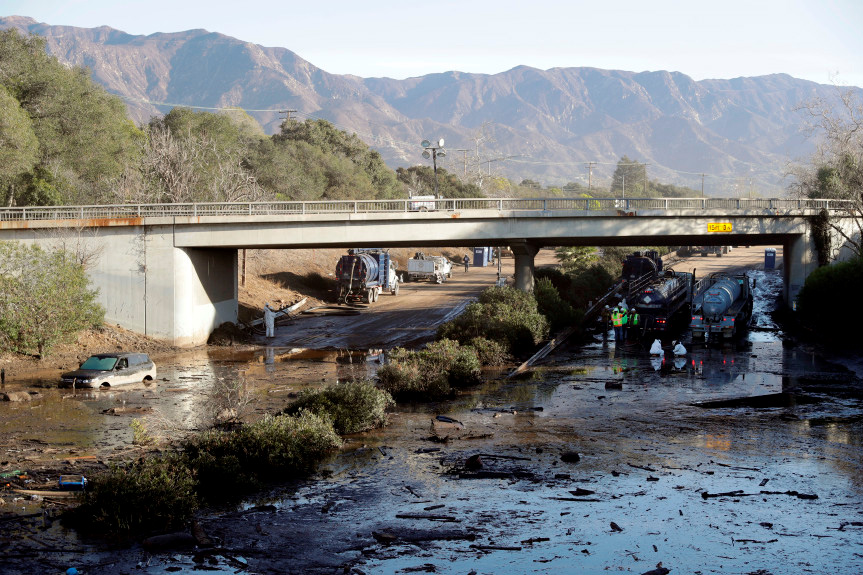
This is not a river.  It is U.S. 101 in Montecito, California

Tanker trucks sucked muddy water from flooded sections of U.S. 101, the only direct major artery between Los Angeles and the Santa Barbara region.There is no date set when the highway will re-open.  Montecito mudslide deaths now total 19.  Searchers are still digging through the mud and muck looking for survivors.

Poverty in California

It’s hard to believe that there is significant poverty in California. The Los Angeles Homeless Services Authority say there are over 57,000 homeless in this county alone. That reality is made obvious by the growing number of homeless encampments that have sprung up all over the city.

More than a third of California households have virtually no savings and are at risk of financial ruin. That data was compiled by Prosperity Now, a Washington, D.C.-based organization seeking to help people — particularly people of color and those with limited income — achieve financial security and prosperity. Even if the data is half as bad as reported it would still mean that about 15% of the population is in serious trouble.

The report says that more than 37 percent of California households have so little cash saved that they couldn’t live at the poverty level for even three months if they lost a job or suffered another significant loss of income.

No emergency fund
The scorecard also shows that 46 percent of households in the Golden State didn’t set aside any savings for emergencies over the past year, a higher percentage than the national rate of 43.7 percent.

It doesn’t help that 21.1 percent of California jobs are in low-wage occupations. The scorecard found that 21.4 percent of Californians experienced income volatility over the past year, a situation that most often results from irregular job schedules.

Households of color
It gets worse for households of color. They are nearly twice as likely to live below the poverty line as white households — 18.2 percent compared to 9.7 percent — and they are much less likely to own a home or other assets that could help boost their long-term financial stability.


Less than half of California’s households of color (43.9 percent) own homes, compared to 62.5 percent of white, non-Hispanic households. Moreover, 60.7 percent of Latino households and 56.7 percent of black households have virtually no savings and are considered “liquid asset poor,” compared to 28.2 percent of white households fitting that category.

“Beyond providing a cushion to get families through emergencies, increased savings and wealth allow families to invest in their futures and gain ground for future generations,” Prosperity Now President Andrea Levere said in a statement. “It’s clear that far too many people are stuck in economic limbo.”

High housing costs
Lars Perner, an assistant professor of clinical marketing at the USC Marshall School of Business, said California’s high housing costs have put many households on shaky financial ground.

“The cost of housing in California is exorbitant,” he said. “That’s a big part of the problem. People pay a disproportionate amount of their income toward housing.”

The report finds that nearly 20 million U.S. households (16.9 percent of the total) have zero or negative net worth. That means they owe more than they own.

Getting on track
The scorecard suggests several policies that could help get struggling households on track, including adopting policies that encourage saving, increasing the minimum wage, providing better access to home ownership and boosting retirement security.

Workable solutions are lacking. Meetings by various community groups might be interesting to attend but none of our elected government officials have any worthwhile ideas.

What’s Wrong with California?

To answer the title question: Nothing!

The talk at some discussion groups that I attend revolves around the argument that California and especially Los Angeles is on the verge of collapse due to high taxes, high public debt, and a significant loss of private enterprises moving to other states. That perception is not in keeping with reality.

For the most part Californians accept the multi-ethnic makeup of the society. Thus we find large populations of Asians and Hispanics throughout the state. The Los Angeles LGBT Center is one of the largest and most experienced providers of LGBT health and mental healthcare, supported by a research team working to advance the care and treatment of lesbian, gay, bisexual, and transgender people.

California alone as a nation would economically be the 6th largest economy in the world. The five ahead of us are the U.S., China, Japan, Germany and the United Kingdom. The U.S. Bureau of Economic Analysis reported that California’s GDP was $2.5 trillion in 2015, up 4.1 percent from a year earlier.

California is the largest producer of Pima cotton in the United States. The California cotton industry provides more than 20,000 jobs in the state and generates revenues in excess of $3.5 billion annually.

California is largest producer of fresh vegetables in the United States says the US Department of Agriculture. California strawberries are found in the markets of Toronto Canada.

Industry Week lists the 500 largest U.S. companies each year. Last year California surged ahead of Texas, 64 companies to 55. By revenue, the biggest manufacturers in California together contributed $881 billion to the state’s coffers, while the biggest in Texas contributed $847 billion. There is not one other state that employs over 1 million people in manufacturing. Texas at 750,000 is in second place. This is US Census data.

40% of all imports and exports of the U.S.A. are moved through the Los Angeles/Long Beach harbor facilities. This figure does not include goods that are shipped by air cargo.

Speaking of air traffic, Los Angeles International Airport (LAX) is the third busiest in the United States.  That makes Los Angeles a major tourist destination. Santa Monica, Beverly Hills, Hollywood, and the amusement parks draw millions of people and that means thousands of jobs.

San Francisco and San Diego are major tourist destinations for the entire world.  Last year we stayed at the Fisherman’s Wharf Sheraton Hotel.  The desk informed me that their primary of guests comes from other countries.   

Los Angeles is a world leader in architecture. The Los Angeles Times this past Sunday (May 21, 2017) published a catalogue of 186 pages showing the works of major architect in this city. Titled DesignLA, it pictured the work of those talented people who include Frank Gehry.

As to education, California has some of the most highly regarded universities in the world. UCLA, USC, UC Berkley, Stanford, and CSUN are just the top of an outstanding educational system that draw thousands of students from around the world.

Silicon Valley and San Francisco are the heart of high tech for the entire world.  Facebook, Google, Apple, Tesla are the four most famous of those companies but there are many others as well.

Los Angeles is still home to important aerospace companies including JPL, Rocketdyne, and Space X. 

Los Angeles is the entertainment capital of the world. All the major movie studios are based in metropolitan Los Angeles. All television networks have large studios in Los Angeles.

New Jersey has the highest effective property tax rate at 2.38% and is followed closely by Illinois (2.32%), New Hampshire (2.15%), and Connecticut (1.98%). California is happily in 34th place with an effective rate of .81%. My source: https://taxfoundation.org/

California gasoline tax will be the highest in the nation thanks to the latest increase in that tax that will take effect November 1, 2017. This is clearly a serious mistake.

California state government bonds are rated AA- by both Fitch and Standard and Poor’s, Aa3 by Moody’s.

I have not even discussed the weather that is the most obvious reason there was a mass migration to California after WW2 and is still a major drawing point for so many in the rest of the United States. We moved from Philadelphia where you can rely on rain if you plan a picnic in the park and that is in the summer. Winters can best be described as miserable at best.

California powered the nation

In March, California produced about 20% of the job growth in the entire country, which added 98,000 jobs last month. The state is huge, but it only accounts for about 11.5% of the country’s employees, which means that it is punching above its weight.

“We get beaten up for being a high-cost and high-tax state … but we have been outperforming many states,” said Robert Kleinhenz, an economist at Beacon Economics, a Los Angeles consulting firm.

California alone was responsible for 16% of the country’s growth from 2014 to 2016, according to Kleinhenz’s analysis.

California piled on 19,300 jobs in March and its unemployment rate dropped to 4.9%, according to figures released Friday by the state’s Employment Development Department. That’s the first time since December 2006 that the jobless rate has fallen below 5%.

It was another month of solid but not breathtaking job gains in a state that has slowed a bit after years of unbridled growth.

Still, California grew faster than the rest of the country in March, expanding at a rate of 2.1% year over year, compared with 1.5% nationwide. Californians were still slightly more likely to be unemployed; the U.S. jobless rate hit 4.5% in March.

The standout sector in March was construction, which increased payrolls by 18,900. The information sector — which includes tech businesses in Silicon Valley and moviemakers in Hollywood — faltered last month, cutting head count by 9,400.

Los Angeles County gained a net 16,000 jobs in March. The county’s unemployment rate fell to 4.6%, down from a revised 4.8% in February.

Source: Los Angeles Times

More Rain than We can Handle

Southern Californians are unaccustomed to rainy days.  It rained yesterday from about 7 a.m. to about 7 a.m. today. I have a rain gauge in the backyard.  4.2 inches of rain was not a record but was one of the rainiest days we have had since 1997 when I started collecting data.

The Mojave Desert and adjoining mountain areas are more susceptible to significant rainfall.  A local television station was on Highway 138 just a few miles west of Interstate 15 reporting on the blocked two lane roadway.  As the reporter is giving an update from inside the vehicle a wave of water rolled across the desert surface that looked like a wave at the beach.

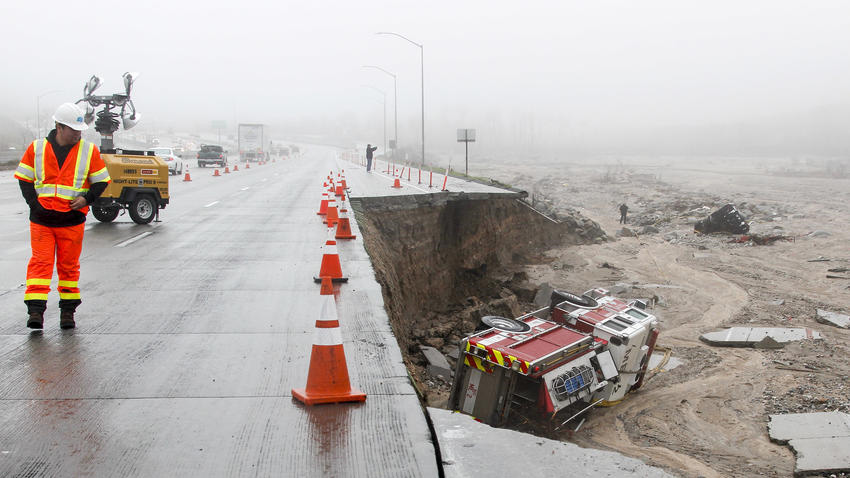
Nearby a few hours later, on Interstate 15 in El Cajon pass a fire truck was helping people evacuate from their cars, when the freeway itself collapsed sending the truck into a ditch.  That same local television station was there when that happened and you actually saw the truck quickly fall.  No one was injured as the crew was helping motorists.

fire-truck-falls-due-to-rain

With more than 22.5 inches of rain to date this season is one of the rainiest I have recorded.  The rainiest I have recorded was 48.3 inches in the 1997-98 El Nino year.  Long range forecasters had predicted this season would be a La Nina dry year.  So much for long range forecasting.

The following photo taken by a Daily News reporter in Studio City, that is near Universal Studios. That area is in the city of Los Angeles.

rainy-day-in-san-fernando-valley

Two vehicles fell into the 20-foot sinkhole in Studio City Friday and firefighters had to rescue one woman who escaped her car. (Photo by Rick McClure for SCNG)

Firefall returns to Yosemite National Park

The last Firefall was on Thursday, January 25, 1968. Since it was winter, no crowd was present.  The cameras I owned in those days could not capture the image.  The Firefall was a daily event that occurred in Yosemite Valley.  Traffic stopped and so did everything else at 9 PM every night.  It took an hour for the traffic to clear.  It was a pollution problem for Yosemite National Park,

The Yosemite Firefall was a summer time event that began in 1872 and continued for almost a century, in which burning hot embers were spilled from the top of Glacier Point in Yosemite National Park to the valley 3,000 feet below. From a distance it appeared as a glowing waterfall. The owners of the Glacier Point Hotel conducted the firefall. History has it that David Curry, founder of Camp Curry, would stand at the base of the fall, and yell “Let the fire fall,” each night as a signal to start pushing the embers over.

firefall-photo-not-taken-by-me


Now to replicate the past artificial lighting has brought back the effect.  It is a challenge for photo hobbyists.  It is claimed that it is a natural phenomenon.

firefall-illuson-2017

Report predicts LA County will add 346,000 jobs by 2020

This is both good and bad news.  Metropolitan Los Angeles is experiencing growth while many other large cities are shrinking. Chicago come to mind as a city that has lost 1/3 of its population.  The key sentence in the following article is Unfortunately, many of those jobs are low paying positions that would make it tough for someone to support a family.” The median price of a home in LA County is $526,000 according to Zillow. They have gone up 6.5% over the past year and Zillow predicts they will rise 1.6% within the next year. The solution for low paid workers is to commute to work. That could mean a one and half hour travel time.   Many people are doing exactly that. Outbound freeways are jammed with cars every evening.
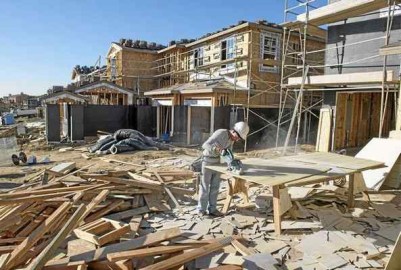
LA County Home Construction 

A new report from the Los Angeles County Economic Development Corp. reveals that L.A. County will add 346,00 jobs between 2015 and 2020, including 20,900 in the construction industry. Leo Jarzomb — Staff photographer

By Kevin Smith, San Gabriel Valley Tribune

Posted: 06/01/16, 12:41 AM PDT | Updated: 14 hrs ago

Los Angeles County is expected to add 346,000 jobs between 2015 and 2020 across a broad range of industries, according to a report released today.

The Los Angeles County Economic Development Corp.’s annual “People, Industries and Jobs” report shows that 123,000 of those jobs will be in the city of Los Angeles.

Construction, professional and business services, education and health services and leisure and hospitality will see the biggest growth rates in percentage terms. But the lion’s share of new jobs will come from administrative and support services (57,560), Food services and drinking places (39,510), social assistance (34,30) and professional and technical services (33,300).

Unfortunately, many of those jobs are low paying positions that would make it tough for someone to support a family.

On the plus side, construction is expected to add 20,900 jobs, which bodes well for both housing activity and commercial expansion.

Southern California’s construction industry took a heavy hit during and after the Great Recession, which began in late 2007 and ended in June 2009, as developers pulled back on building housing projects and commercial developments — sometimes curtailing activity altogether.

“We’ve been waiting for that industry to rebound,” said economist Christine Cooper, the LAEDC’s senior vice president and lead author of the report. “It has just been really hard.”

But the industry is rebounding and Southland developers have a variety of residential projects in the works.

KB Home, for example, has 10 housing developments underway in Los Angeles County in such communities as Santa Clarita, Van Nuys, Palmdale, Pomona, West Covina and Los Angeles.

An annual report on the company’s website shows that KB delivered 8,196 homes throughout its various U.S. markets last year compared with 7,215 the previous year and 7,145 in 2013. KB’s revenues have likewise risen, topping out at more than $3 billion last year compared with the $2.4 billion the company generated in 2014.

“As the housing market recovers, construction industries are expected to make a robust recovery,” the LAEDC report said. “Housing starts are showing signs of life after a dismal few years, and will be needed to meet pent-up demand.”

The report notes, however, that L.A. County’s economic recovery has been generally disappointing and that the region didn’t recover all of the jobs that were lost during the recession until last year. Moreover, the recovery that has taken place doesn’t take into account the job growth needed to accommodate the county’s ongoing population and labor force growth.

The report also shows a clear correlation between educational attainment and unemployment.

In 2014, the jobless rate for L.A. County residents with a high school education or the equivalent was 9.4 percent, nearly double the 5 percent rate for those with a bachelor’s degree or higher. That same kind of disparity played out in the city of L.A.

The median annual earnings for an L.A. County resident with a high school education or the equivalent was $26,049 in 2014. That figure is dismal when compared with the yearly median income of someone with a bachelor’s degree ($50,976) or someone with a graduate or professional degree ($71,596).

The largest share of working residents in the county (33.3 percent) earn $15,000 to $35,000, and nearly 8 percent earn just $15,000 or less. Still, Cooper said progress is being made on the education front.

“We’ve been doing these reports for a number of years and we’re seeing that more young people are gaining higher levels of educational attainment,” she said. “We see that as a really bright spot.”

That may be bright. But a not-so-bright portion of the study shows that nearly 323,300 of the 2.19 million families who were living in Los Angeles County in 2014 had their incomes fall below the poverty level in the previous 12 months. A large portion of that number included children and young working age adults.

Single mothers with children under 18 accounted for nearly 40 percent of those living below the poverty line.

“The good news is that our region is adding jobs across most industries, and is expected to continue its expansion,” Cooper said. “However, although we are seeing some job growth in high-paying industries, it is clear that not enough of our projected job gains are skilled, well-paying jobs that will support middle class incomes. We need to work together to change this trajectory, by fostering job creation in our leading export-oriented industries, which tend to pay higher wages and strengthen regional prosperity overall.”

Cooper said California’s new minimum wage requirements, which will boost the minimum wage to $15 an hour by 2022, will likely have some negative effects.

“Some businesses will choose to replace lower skilled workers will people who have higher skills,” she said. “And it will also lead to an increase in automation.”


If Donald Trump Becomes President of the United States

 I saw the above presentation by Donald Trump on Fox News channel this morning. It is apparent that he has not backed down on any of his opinions. That is a troubling possibility for the U.S.A.

 Just listen to his words!

Besides building a wall between the United States and Mexico he would impose a 35% tariff on goods manufactured in Mexico. The consequence of that would be 1) higher prices for all the consumer items bought in the United States from Mexico and 2) the United States has a positive trade balance with Mexico of $182 Billion and the million jobs created by that trade balance would be lost.

China holds $1.3 Trillion in U.S. treasury notes. A 45% tariff on those goods imported from China (his plan) would not only destroy their sales of consumer goods to America, it would create a trade war. China would most likely demand repayment of the notes. Donald Trump, who believes in bankruptcies when he doesn’t want to pay his debts, would do what? Refuse payment. That decision would cause worldwide economic panic and the destruction of the American economy.

Saudi Arabia would also demand payment on the notes it holds ($116.8 billion) and just might embargo the oil sold to American oil companies.

Japan holds $1.1 Trillion in American notes. You think they will simply pay 100% of the bill for our troops in their country?

Market Watch says on their web site that “45% of Americans pay no federal income tax” and that converts to 77.5 million households do not pay federal individual income tax.” So when Donald Trump on his web site says “If you are single and earn less than $25,000, or married and jointly earn less than $50,000, you will not owe any income tax. That removes nearly 75 million households – over 50% – from the income tax rolls”, what is he telling you?

When Donald Trump says we will have the most powerful military in the world, what is he telling you? Well actually nothing. You see America’s military is the most powerful in the world today.

There is no drought in California. The weatherman are all wrong. Donald Trump says so. So it must be true!

Think smoke and mirrors. Think of Alice in Wonderland. Think the powerful Oz. That would be someone behind a curtain who has no power at all.

You think we have problems now. Donald Trump will destroy in just a few years what has taken over 200 years to build. The United States is the greatest country in the world today!

$12 Billion Man Buys into Tribune Publishing

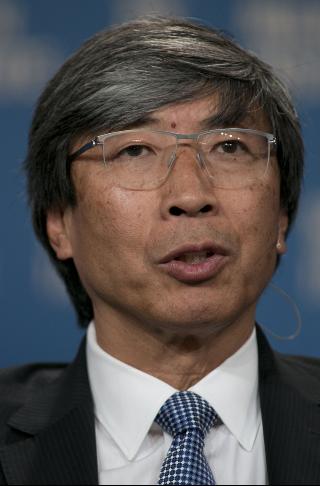
Patrick Soon-Shiong Tribune Publishing said this morning that Patrick Soon-Shiong, by some accounts the wealthiest man in Los Angeles, is buying 12.9 percent of the company’s stock and paying $15 a share, the elevated price that Gannett has offered in a bid to take over the company. Soon-Shiong will become the second-largest shareholder, get a seat on the board of Tribune Publishing and be vice-chairman. The Los Angeles Times says it will be a $70.5 million investment. The company is also entering into a licensing deal with Soon-Shiong’s NantWorks for use of what Forbes calls in its story “over 100 machine vision and artificial intelligence technology patents for news media applications.” Per Forbes, Tribune would earn the first $80 million in revenues from NantWorks’s AI patents and a 6% royalty after that. Tribune would issue 333,333 shares of stock to a NantWorks subsidiary, NantStudio.

Patrick Soon-Shiong is a South African-born American surgeon, medical researcher, businessman, philanthropist, and professor at University of California at Los Angeles.

Forbes magazine estimates Mr. Soon-Shiong’s wealth at $11.9 Billion as of today. He was born in South Africa and holds degrees from University of the Witwatersrand, University of California, Los Angeles, and University of British Columbia. He is 63 years old and married. He is currently chairman of the Chan Soon-Shiong Family Foundation and chairman and CEO of the Chan Soon-Shiong Institute for Advanced Health, National LambdaRail, the Healthcare Transformation Institute and NantWorks, LLC.[5] In October 2010, he bought Earvin “Magic” Johnson’s minority ownership stake in the Los Angeles Lakers. He lives in the Brentwood neighborhood of Los Angeles.

This proves you don’t have to be a flamboyant loudmouth to be a billionaire.