Next week, on Tuesday, January 27, we will mark International Holocaust Remembrance Day to honour the six million Jewish lives taken during the Holocaust.
This was posted by a Canadian web site. I wonder what Americans will be posting.

Next week, on Tuesday, January 27, we will mark International Holocaust Remembrance Day to honour the six million Jewish lives taken during the Holocaust.
This was posted by a Canadian web site. I wonder what Americans will be posting.


By Hailey Branson-Potts, Staff Writer for Los Angeles Times

This is an abridged article.
Since his reelection in November, Trump has upended the typically friendly relationship between the U.S. and its northern neighbor. He has mocked Canada by calling it America’s “51st state” and repeatedly referred to former Prime Minister Justin Trudeau as “governor.” And he has threatened to use “economic force” to annex the country, whose population of 40 million is about the same as California’s.
Trump in February invoked emergency powers to justify stiff new tariffs on Canadian imports, arguing in an executive order that the trafficking of illegal drugs — namely, fentanyl — across the northern border constituted a dire threat to American security.
After Trump’s separate 25% tariff on imported automobiles went into effect last week, Canadian Prime Minister Mark Carney, who called the levies a “direct attack” on his country, slapped a 25% retaliatory levy on vehicles imported from the United States.
In Palm Springs, the snowbirds who were already here before Trump took office are leaving for the season. The question is: Will they return?
Two Canadian airlines this spring ended their seasonal service to and from Palm Springs International Airport earlier than initially planned, airport spokesman Jake Ingrassia said in a statement to The Times.
“Flair Airlines and WestJet have slightly shortened their seasonal service to Vancouver and Winnipeg, respectively,” Ingrassia said. “The airlines have advised the airport that these adjustments are in response to the current operating environment and shifts in demand.”
Kenny Cassady, director of business development for Acme House Co., which manages vacation rental properties in Palm Springs, said Canadians often book stays of one to three months a full year in advance, returning to the same properties annually.
“But when it comes to rebooking for next year? They’re just declining,” said Cassady, who also is a board member for Visit Greater Palm Springs, a tourism marketing agency for the Coachella Valley.
Donald Trump wants to annex Canada and Greenland. To accomplish that goal without an invasion he is using tariffs. Trump doesn’t want to use the military to obtain his objectives. Vladimir Putin’s effort to annex Ukraine using his military is a message that Trump should not use military force to reach his objectives.
Mr. Trump followed through on a threat at midnight Wednesday to slap 25-per-cent tariffs on aluminum and steel from all countries including Canada, Mexico, South Korea, Australia and Europe. The 27-nation European block joined Canada with retaliatory tariffs of US$28-billion on American goods.
“These tariffs are completely unjustified, unfair and unreasonable,” Canada Finance Minister Dominic LeBlanc told a news conference on Wednesday, warning U.S. protectionist measures will hurt American and Canadian consumers.
U.S. Commerce Secretary Howard Lutnick said the tariffs put in place Wednesday will stay in effect until there is a strong U.S. aluminum and steel industry. That is not a likely scenario.
Ontario premier Mr. Ford on Monday announced a 25-per-cent surcharge on electricity exports to three U.S. states, but suspended it Tuesday after a call with the Commerce Secretary. The Premier said Mr. Lutnick “extended an olive branch” to start a conversation about the future of the United States-Mexico-Canada Agreement.
Canadian Foreign Affairs Minister Mélanie Joly said she’ll once again told Mr. Rubio that Canadians are fed up with Mr. Trump’s call for the annexation of Canada. “Everything that has to do with the 51st state rhetoric is unacceptable,” she said.
The President also defended his whipsaw approach to tariffs, after weeks of threats followed by retreats – and then new rounds of levies.
“It’s called flexibility,” he said. “It’s not called inconsistency.”
Will the American congress assert itself? The authoritarian has control for now.
“Canadians are preparing to create a retail blackout on Feb 28 of all U.S retailers doing business here 9 (in Canada). For one day, show them we have the power when provoked. Absolutely no purchases from Walmart, Home Depot, Best Buy, Amazon, McDonald’s, Staples, Gap, Toys r Us , Costco or any other US retailers. For one day, support only small or large CANADIAN or MEXICAN producers and companies. It’s time to STAND UP for ourselves. BE STRONG AND BE PROUD. Spread the word!”
Imagine if, for just one day, Canadians chose not to spend a single dollar at U.S.-owned retailers operating in the country. What kind of impact would that have? Would it send a strong message, shake up the economy, or fizzle out as a symbolic gesture?
Three days until we find out!
Story by Ali Velshi of MSNBC. A 4 min read
Since entering office, President Donald Trump has been ambitious about territorial expansion. Sounding more like Donald the Conqueror, he’s insisted the United States take ownership of the Gaza Strip and the Panama Canal, he’s proposed buying Greenland from Denmark and he’s pitched Canada on joining our union as the 51st state. At his inauguration, Trump took America’s original expansionist slogan and blasted it skyward, “We will pursue our manifest destiny into the stars, launching American astronauts to plant the Stars and Stripes on the planet Mars.”
American history has seen the country grow in size and Betsy Ross’ flag grow in stars but Trump’s ideas ebb between delusions of grandeur and old-fashioned gunboat diplomacy.
There was Trump’s announcement that the United States would “own” Gaza, sending Palestinians to neighboring countries and establishing a “Middle East riviera.” With literally zero specifics laid out by the White House as to how exactly this would happen, this idea has received bipartisan and international condemnation as logistically impossible.
Trump has also set his sights on “seizing back” the Panama Canal, which was signed over to Panama by the late President Jimmy Carter in 1977. Trump has erroneously claimed that China is running the canal, which is actually operated by an independent authority in Panama. A subsidiary of a Hong Kong company runs two of the canal’s ports but doesn’t control access to the canal.
Trump has also floated the idea of purchasing Greenland from Denmark, a concept that, while not new in the grand scheme of American history, stands firmly against the interests of the people of Greenland, whose prime minister has said bluntly, “We want to be Greenlanders.”
Then there’s Canada, the second-largest country by land mass on the planet. It’s also my home country. While I can’t speak for Panamanians or Greenlanders, I do have a suggestion for my fellow Canucks on this:
Trump has offered Canada the chance to become the 51st state, but I say, why stop there? Canada has 41 million people, spread throughout 10 provinces and three territories. So, if Canada were to become part of America, some changes would be in order.
First of all, Congress would have to grow. That would mean Canada, as part of the new America, would net at least 54 seats in the House. For context, the 20 states with the smallest populations have just 46 House seats among them all.
But here’s problem No. 1: This little thing called the Permanent Apportionment Act of 1929. That act mandates that the House is no bigger than 435 members. So, if you did the math, combining Canada’s population with America’s and dividing it by 435, Canada would net 47 seats. Those seats would be taken away from states all over the country. Who’s going to tell voters that Trump gave their congressional representation to a guy in Saskatchewan?
That’s just the House of Representatives. What about the Senate? Trump is only offering for Canada to become one state with two senators. But Canadian provinces, like American states, compete with one another. They aren’t going to be interested in all snuggling up into one state.
Each province would have to be its own U.S. state. So Canada wouldn’t be the 51st state; it would be states 51 through 60, at the very least, meaning Canada would have 20 senators. It would be the largest reorientation of political power in America since women were given the right to vote in 1920.
Trump is specifically asking Canada to join as just one state for that reason. Statehood for Canada would likely swing power away from Republicans. That’s one of the reasons most Republicans have long opposed statehood for Puerto Rico and Washington, D.C. They assume both would become Democratic strongholds, increasing the Democrats’ control in Congress.
If the thought of a couple of senators from Puerto Rico representing people who are already American citizens scares Republicans, I wonder how 20 from the land of maple syrup, Mounties and “Anne of Green Gables” would go over?
While it’s difficult to compare American and Canadian politics directly, we have some sense of how Canadians, or what might come to be known as “Camericans,” might vote:
Canada has a multiparty parliamentary system but in 2003, the conservative parties united under one banner. Since then, the conservatives have received, on average, about 35% of the popular vote in each election. On average, the left-of-conservative parties have received a combined 63% of the popular vote.
Expansion from Canada to the Gulf of America might be a fun idea for Trump … until our nice neighbors up north kick his party oot of office and install a liberal supermajority. And we haven’t even talked about what this would do to the Supreme Court.
Of course, in typical Canadian politeness, Prime Minister Justin Trudeau said there’s “not a snowball’s chance in hell” that Canada joins America. But, Canada, if I were you, maybe the chance to take over your noisy neighbor from the inside isn’t the worst idea in the world.
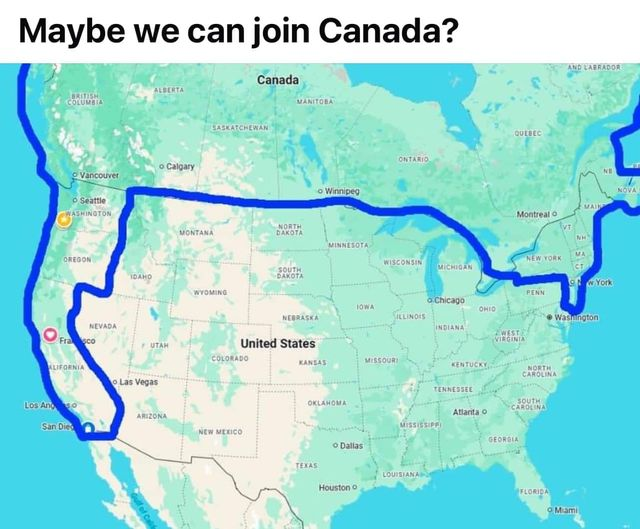
A fun fantasy. Secession was decided in the U.S. Civil War. It can’t be done.
My question is would Canada accept parts of the United States? The only reason would be adding warmer Pacific Coast states.
It’s fun to fantasize.

I was born in Bancroft Ontario. Does anyone know where that is?
A link provided by a Canadian cousin of mine. You can see all the Americans that are from Canada.
Canada has become the destination for many people fleeing violence in their home country. Has the United States relinquished its moral authority? Was the Statue of Liberty given to the wrong nation?
By Alex McKeen Vancouver Bureau, Toronto Star Fri., Aug. 13, 2021
Canada has announced an expanded program to resettle Afghan refugees as territories in Afghanistan fall rapidly to the Taliban.
Immigration Minister Marco Mendicino said Friday the program will welcome 20,000 Afghans, targeting those who belong to groups vulnerable to persecution by the Taliban.
Those groups will include: “Women leaders, human rights defenders, journalists, persecuted minorities, LGBTQI members, and family of previously resettled interpreters,” Mendicino said.
The government made the announcement amidst pressure to expedite its program to resettle those who were employed by Canada during its efforts in Afghanistan, such as interpreters.
Deputy Prime Minister Chrystia Freeland on Friday acknowledged what she called Canada’s “moral duty” to help resettle Afghans who have worked for Canadian Forces and the Canadian Embassy.
On July 23, under pressure from the veteran community and advocates, Ottawa announced a new program to expedite the resettlement of its former employees including translators, drivers, cleaners and cooks.
The effort has been plagued by questions and controversy, including whether the extended families of those who previously came to Canada are eligible for assistance.
Under the newly extended resettlement program, those families will be eligible. Mendicino said they will be able to come to Canada through family-class sponsorship and refugee programs.
 Coast Contact