
Canada Day is the national day of Canada. A federal statutory holiday, it celebrates the anniversary of Canadian Confederation which occurred on July 1, 1867
Canada Day is the national day of Canada. A federal statutory holiday, it celebrates the anniversary of Canadian Confederation which occurred on July 1, 1867

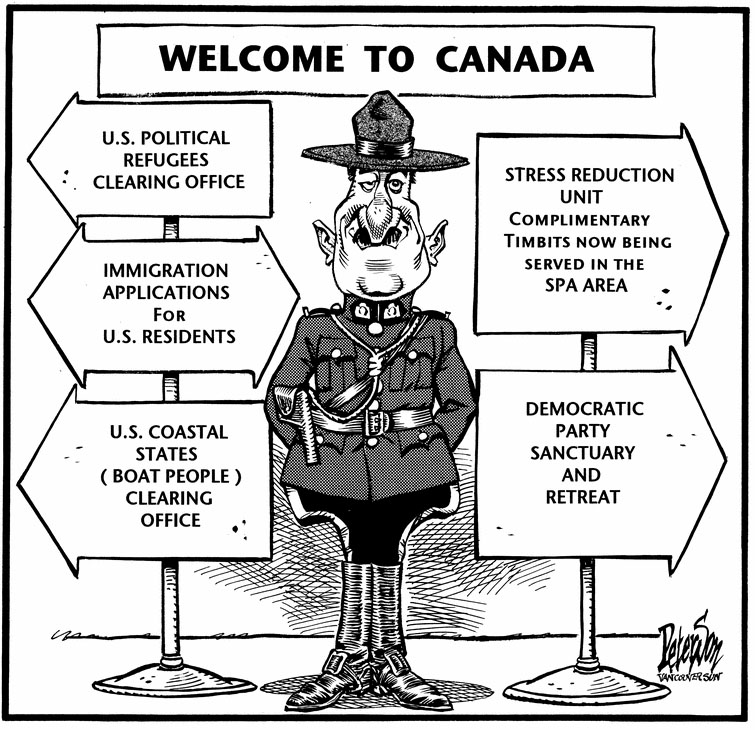

Yes it is very cold in most of Canada in the winter. The exception is Vancouver, British Columbia on the Pacific coast where it rains in buckets. So weather is not Canada’s best feature. However, the people are super friendly, helpful, and caring. Over 20% of the population are immigrants and while the population is majority White the country has open to immigrants from everywhere. Just half of Vancouver’s population is European White.
A driver plowed a rental van through a crowd of pedestrians on a busy Toronto sidewalk Monday, killing 10 and injuring 15, in Canada’s worst mass killing in almost three decades.
Capital punishment was removed from the Canadian Criminal Code in 1976. It was replaced with a mandatory life sentence without possibility of parole for 25 years for all first-degree murders.
After the killing spree on Yonge Street will there be a change in attitude about capital punishment in Canada? I have no idea. Canadians are peace loving people.
California does have a capital punishment law. Killers are sentenced to death. As of Aug 24, 2017 there were 747 people in their “death row.” Due to delays and legal challenges, the state hasn’t executed a prisoner more than a decade. Only 13 men have been put to death since capital punishment was restored in 1978.
Clearly California really does not put killers to death. Giving those killers a death sentence probably gives satisfaction to the families that lost loved ones to killers. Is that a good enough reason to keep the law in place? It has been said that Death row inmates have a greater likelihood of dying of old age than actually facing their death through a lethal injection.
A total of 57 countries retain the death penalty law, according to Amnesty, while executions were recorded in 23 nations in their statistics for 2016.
My belief is that if death penalties were actually carried out in a timely manner (trial – found guilty – limited delay for trial errors – limited delay for claims of innocents) then there would be less killing.
Happy 150th Canada!
My parents were born and raised in Winnipeg, Canada. My father told me numerous times about the cold winter weather. He said it reached 40 degrees below zero on the coldest days. It did reach 24 degrees below this past January. Both those temperatures are dangerous to humans beings. 110 km or 68.35 miles from Emerson (U.S. Canadian border) to Winnipeg. Winnipeg is a pretty city in the summer.

By Alexandra Zavis | Reporting from Emerson, Canada to the Los Angeles Times
The migrants staggered into this sleeping border town before dawn, cold and exhausted.
They had struggled through farm fields for hours in knee-deep snow, hoping to evade detection by the U.S. Border Patrol. A man cradling a baby wrapped in a puffy parka and gray blanket peered anxiously at the darkened clapboard homes.
“Is this Canada?” he asked.
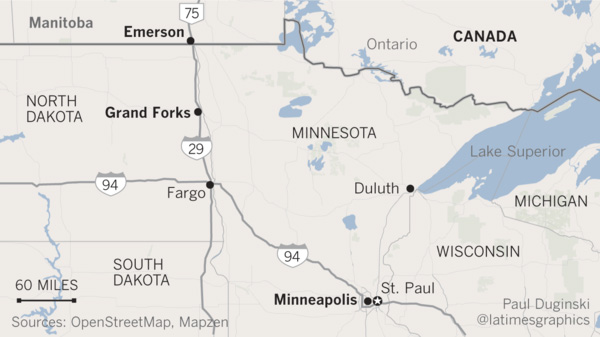
The tiny community of Emerson — population less than 700 — has seen its share of U.S. “border jumpers” over the years, but nothing like this. Until last year, residents might spot five or six strangers passing through town over the odd weekend, carrying backpacks and looking disheveled.
But since President Trump was elected last year on promises to crack down on illegal immigration and conduct “extreme vetting” of Muslims, the numbers have surged. Recently, at least 22 people sneaked across the border near Emerson in a single night, including the man with the baby, who said he was from Djibouti.
Two Royal Canadian Mounted Police vehicles pulled up to his group within minutes, lights flashing. The officers explained that they were going to arrest the migrants — six adults and three children — and drive them to a nearby border post to apply to remain in the country as refugees.
The migrants looked relieved. They are part of a small but rapidly growing population of asylum seekers who have lost hope that America will accept them and are embarking on a perilous trek north to petition for protection in Canada.
Some have already passed through up to a dozen countries, braving vast forests and raging rivers on a months-long odyssey across South and Central America before surrendering to officials at the U.S.-Mexico border. Others fly directly into major U.S. cities but, convinced they won’t receive refuge, head north from there.
Few are prepared for the harsh weather they will face on the icy prairies along the frontier between the Canadian province of Manitoba and the U.S. states of North Dakota and Minnesota.
Two men from Ghana lost most of their fingers to frostbite after getting lost in sub-freezing temperatures and are recovering in Winnipeg. Local farmers wonder whether they might find a body when the snow melts in the spring.
The two Ghanaians, Razak Iyal, 34, and Seidu Mohammed, 24, met for the first time on Christmas Eve at a bus terminal in Minneapolis.
Both men said they feared for their safety in their home country, Iyal because he had been assaulted by supporters of a rival political party, and Mohammed because he is bisexual.
But after making treacherous overland journeys to the U.S. from Brazil, they did not receive the welcome they expected. They were both detained the moment they showed up without passports at the San Ysidro border crossing between San Diego and Tijuana.
Iyal was placed in handcuffs and chains — standard procedure — for the flight to a detention facility in Arizona. “I was crying, ‘What is going on?’” he said. “Am I a criminal, or am I a terrorist or what?”
Neither could afford a lawyer to represent him in immigration court, and both lost their U.S. asylum cases.
After 22 months in custody, Iyal said, he petitioned successfully for release and went to stay with an uncle in New York while U.S. authorities tried to obtain travel documents from Ghana to deport him. Mohammed, who was freed on bond after about nine months in detention in California, joined a friend in Ohio.
Late last year, they both received word from their deportation officers that they should get ready to go back to Ghana.
In a panic, each started making inquiries about how to get to Canada. They were the only Africans at the Minneapolis station the night they met, so they caught a bus together to Grand Forks, N.D. There they found a driver willing to get them closer to the border — for $200 each.
It was past 11 p.m. and the temperature was around zero degrees Fahrenheit when the driver dropped the pair off by the side of the road and pointed in the direction of Canada.
As soon as they stepped into a farmer’s field, they sank into waist-deep snow. They had to use their hands to lift their feet out and lost their gloves. The wind picked up and blew Mohammed’s hat off. His eyelids froze shut. They both started feeling a horrible burning in their hands and feet.
Neither had ever heard of frostbite.
After walking about three hours, the men emerged onto a highway near Emerson. They could see the bright lights from the border post but were afraid to ask for help, in case they were sent back to the U.S.
Trucks lumbered by but didn’t stop. Finally, after they had waited about seven hours, a driver pulled over for them and dialed 911.
Video link: http://www.latimes.com/videogallery/
Most of those fleeing the U.S. for Canada avoid official ports of entry because of an agreement between the two countries to send back asylum seekers.
The arrangement is based on the principle, enshrined in international law, that those fleeing persecution should apply for asylum in the first safe country they reach. But once they set foot on Canadian soil, legally or not, they can petition for designation as refugees on that side of the border.
Migrant rights advocates argue that this encourages people to make dangerous illegal crossings and have called on the Liberal government of Prime Minister Justin Trudeau to rescind the agreement.
They contend that the U.S. can no longer be considered a safe place for asylum seekers to have their claims heard in light of recent orders issued by the Trump administration — including one this week that temporarily suspends refugee resettlement and bars travel from six Muslim-dominated countries.
Canada’s government so far has said it will uphold the deal with the U.S., noting that it provides “an orderly system of managing asylum claims.” But Trudeau has told Parliament that he won’t turn away refugees who enter illegally.
Bashir Khan, a Winnipeg immigration attorney, said the problems that are driving asylum seekers to flee the U.S. did not begin with Trump. “They are kind of not well-treated by the U.S. justice system,” he said.
He is representing 37 refugee claimants — including Mohammed and Iyal — who had asylum claims denied in the U.S. All were jailed upon arrival there and held for an average of seven months, he said. They had no idea how to fill out asylum forms and were not offered government-appointed lawyers.
In contrast, asylum seekers who enter Manitoba illegally are usually held for less than 24 hours, the time it takes to do security checks and file refugee claims. Local aid groups routinely help them complete the paperwork, and a government-paid attorney will represent them at the hearing — increasing the odds of a successful outcome.
Even with the recent surge, the number of asylum claims handled in the U.S. is significantly higher than in Canada, and applicants there might have to wait years for a decision because of a backlog of cases. Here, the average wait time is four months.
The number of asylum seekers crossing illegally into Canada has been growing for several years.
The biggest increase has been in Quebec province, where there are major cities on both sides of the border. The Canadian Border Services Agency said 1,280 of the refugee claims it handled in Quebec between April 2016 and early January 2017 were for people who entered illegally, three times the number in the previous fiscal year.
In Manitoba, 430 claimants entered illegally in the first nine months of the fiscal year, compared with 340 for all of 2016. The Royal Canadian Mounted Police have picked up more than 180 people in and around Emerson since then.
They include people from a number of African nations. But the biggest share, refugee advocates say, come from Somalia — one of the six countries targeted in Trump’s executive order.
Minneapolis, home to the largest Somali community in the U.S., is a six-hour drive from Manitoba. People there have seen Trump’s attempts to limit immigration and are growing increasingly fearful that they won’t be allowed to stay.
One recent border crosser said immigration enforcement agents raided the warehouse where he worked in the city. The 34-year-old Somali was still waiting for a decision on his asylum claim and hid behind machinery, afraid he too would be taken away.
He knew the trip to Canada would be dangerous, but decided he and his pregnant wife would have to risk it. Militants from the Shabab group killed his father and brother in Somalia’s war-ravaged capital, Mogadishu.
“America has changed,” he said. “That’s why I lost hope in America.”
The reception they received in Canada was very different from the U.S., he said. A pair of early morning walkers found the group they were with on the edge of Emerson and brought them home to warm up while they waited for the authorities to arrive.
The couple is now at a Salvation Army shelter in Winnipeg waiting for a hearing to determine if they can remain in Canada.
“This is our final and last hope,” said the man, who was afraid to give his name, in case it jeopardizes his refugee claim.
“It’s not only me,” he added. “There are hundreds of people coming who are fleeing from this new administration.”
The influx has been a source of tension in Emerson, a town of grain farmers, border agents, small business operators and many retirees. No one wants to leave people out in the cold. But some residents wonder why migrants are crossing illegally, and they worry about the safety of their town.
“It’s the bigger groups that are coming across that are starting to get a little more concerning,” said Greg Janzen, the chief elected official, in the Emerson-Franklin municipality. “Because as the groups get bigger, the law enforcement is going to have a hard time keeping up.”
At the Emerson Inn bar, patrons joke that Canada should build its own version of Trump’s border wall. Some people who never felt the need to lock their doors at night are now doing so.
But others aren’t so worried. Wayne Pfiel, the 46-year-old bartender, said he has talked to a number of border crossers who showed up at the hotel in the early hours. Most just wanted to know if they were in Canada and asked him to dial the authorities.
“I found one person by the front door,” he said. “I let him in and gave him a coffee…. I don’t like to see them freeze.”
When the first group of 19 Africans showed up last month, border officials didn’t have space to keep all of them at their office while they were being processed, and appealed to the town for help.
Brenda Piett, a volunteer emergency coordinator, opened up the community hall so the migrants could rest on makeshift beds. They looked hungry, she said, so she bought bread and Nutella to make sandwiches.
She doesn’t think the migrants would do anything that could jeopardize their chances to stay in Canada. “I just feel sad that they are having to make that journey,” said Piett, 57.
The Manitoba Interfaith Immigration Council, one of the main refugee resettlement agencies in the province, has been sending vans to collect the migrants after they are processed and bring them to Winnipeg. But the group’s shelter is now at capacity, so it had to enlist the help of the Salvation Army.
The Royal Canadian Mounted Police say they are mobilizing more resources and working with their U.S. counterparts to manage the flow.
In the stillness of the night, their vehicles patrol known crossing points on both sides of the border. Occasionally, an officer emerges to scan the tree line with a thermal imaging device, looking for signs of life.
When temperatures warm up, both sides are bracing for an even bigger surge.
Special correspondent Kristina Jovanovski in Toronto contributed to this report.
alexandra.zavis@latimes.com
This move to Canada idea is starting to look like a real possibility with two of the most disliked candidates for president that I can remember. How did that happen?
Many Americans are threatening to move to Canada after the next election.
An article in the Los Angeles Times titled “Escaping to Canada?” brought to my attention something I have been saying for months to my family. “If Donald Trump is elected president we are moving to Canada. And it might be easy since I was born there.” After all, I have been saying “Eh” all of my life and few people have even noticed.
The Times article certainly did not make the move sound easy. As an expatriate of the United States but keeping your citizenship will require considerable paper work in the form of reports to the IRS. The rest of what was written in the article really isn’t a consequential issue. They have washrooms instead of restrooms. “Aboot” is not something to get excited about.
Just Google the title of this piece “How Do I Move to Canada?” and eleven links will appear. The first is a posting by Air Canada. They really only tell you the air fare and suggest you give it a try by spending a week or two there.
I have not been there in the winter and that is the real test. The temperature reached 10º below zero this past February in Toronto. That was in Fahrenheit.
The warmest part of the country is Vancouver and surrounding towns. The issue there is lots of rainy days.
Then there is the sales tax. A 13% value-added tax charged on most goods and services sold in Ontario province and 12% in British Columbia.

Vancouver skyline from Stanley Park. It looks just like another American city.
So how badly do you, will you, hate the next president of the United States?
This tongue in check article was posted on a web site as if it was copied from the Manitoba Herald. That was newspaper that existed only a few months is 1887.

Crisis at the Canadian Border – A Prescient Look at the Consequences of a Republican Win in November
The flood of American liberals sneaking across the border into Canada has intensified in the past week, sparking calls for increased patrols to stop the illegal immigration. The Republican Presidential primary campaign is prompting an exodus among left leaning citizens who fear they’ll soon be required to hunt, pray, and live according to conservative ideas about the Constitution.
Canadian border farmers say it’s not uncommon to see dozens of sociology professors, global warming activists, and “green” energy proponents crossing their fields at night.
“I went out to milk the cows the other day, and there was a Hollywood producer huddled in the barn,” said Southern Manitoba farmer Red Greenfield, whose acreage borders North Dakota . “The producer was cold, exhausted and hungry. He asked me if I could spare a latte and some free-range chicken. When I said I didn’t have any, he left before I even got a chance to show him my screenplay, eh?”
In an effort to stop the illegal aliens, Greenfield erected higher fences, but the liberals scaled them. He then installed loudspeakers that blared Rush Limbaugh across the fields, but they just keep coming.
Officials are particularly concerned about smugglers who meet liberals near the Canadian border, pack them into electric cars and drive them across the border where they are simply left to fend for themselves after the battery dies.
“A lot of these people are not prepared for our rugged conditions,” an Ontario border patrolman said. “I found one carload without a single bottle of Perrier drinking water. They did have a nice little Napa Valley cabernet, though, and some kale chips.”
When liberals are caught, they’re sent back across the border, often wailing loudly that they fear retribution from conservatives. Rumors have been circulating about plans being made to build re-education camps where liberals will be forced to drink domestic beer and study the Constitution.
In recent days, liberals have turned to ingenious ways of crossing the border. Some have been disguised as senior citizens taking a bus trip to buy cheap Canadian prescription drugs. After catching a half- dozen young vegans in blue-hair wig disguises, Canadian immigration authorities began stopping buses and quizzing the supposed senior citizens about Perry Como and Rosemary Clooney to prove that they were alive in the ’50’s. “If they can’t identify the accordion player on The Lawrence Welk Show, we become very suspicious about their age,” an official said.
Canadian citizens have complained that the illegal immigrants are creating an organic-broccoli shortage, buying up all the Barbara Streisand c.d.’s, and renting all the Michael Moore movies. “I really feel sorry for American liberals, but the Canadian economy just can’t support them,” an Ottawa resident said. “How many art-history majors do we need in Canada?
 Coast Contact