Three and a half years to go!

President Theodore Roosevelt said “To announce that there must be no criticism of the president, or that we are to stand by the president, right or wrong, is not only unpatriotic and servile, but is morally treasonable to the American public.”

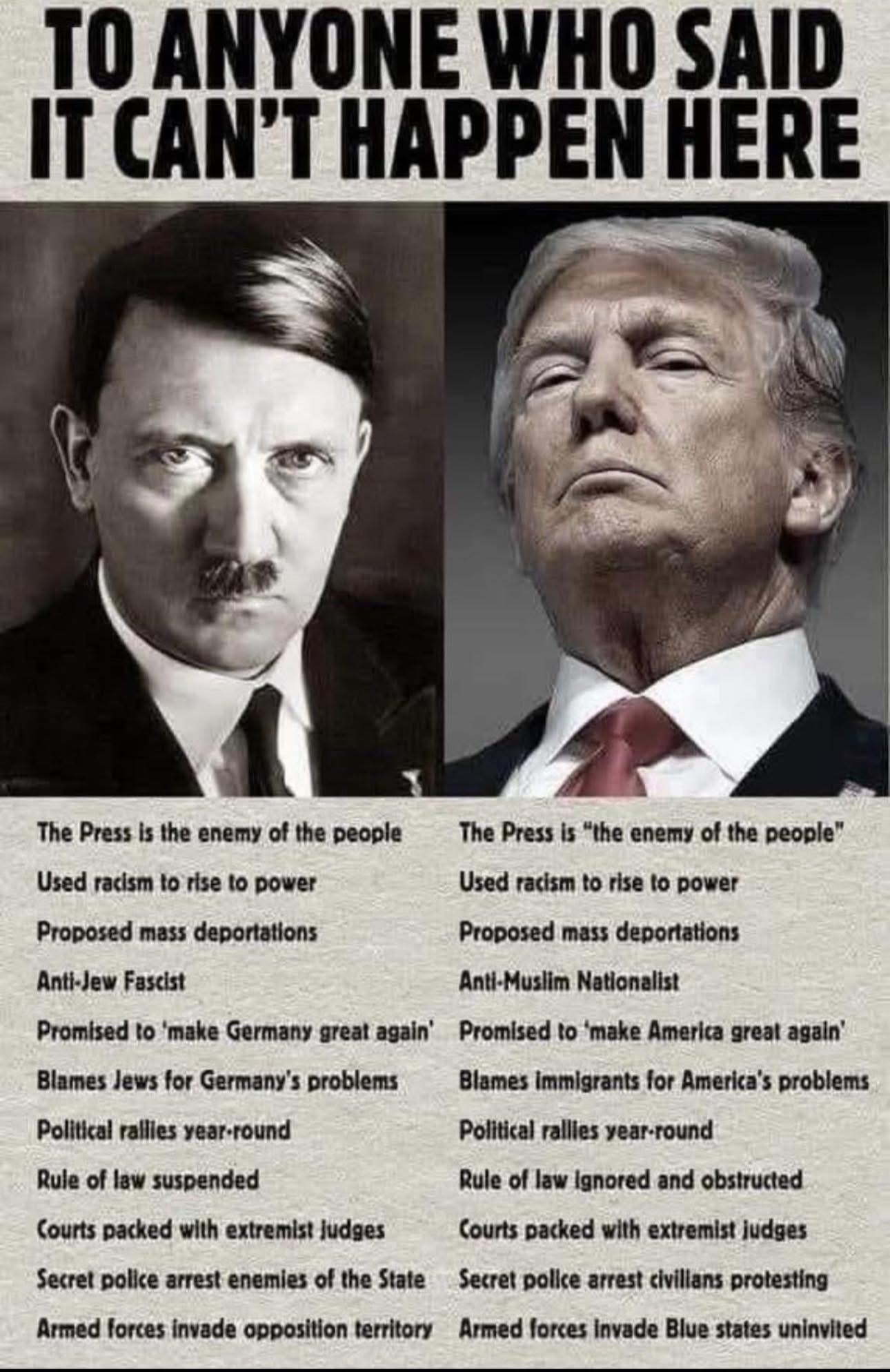
In merely four months Donald Trump has turned the United States from a functioning democracy into a country on the edge of a fascist dictatorship.

The following reports I found on the internet from reliable news sources confirm what my beliefs.                    

The courts including the Supreme Court have given the power for Donald Trump to do as he wishes. The Supreme Court has ruled that President Trump is at least presumptively immune from criminal liability for his official acts, and is absolutely immune for some “core” of them — including his attempts to use the Justice Department to obstruct the results of an election.

Since late February, President Trump has used the power of the presidency to punish law firms that he accuses of weaponizing the justice system and undermining the national interest, part of his promised campaign of vengeance against his perceived political enemies.

Donald Trump expanded on his threats to the media suggesting actions of the press should be deemed illegal and subject to investigation.

“I believe that CNN and MS-DNC, who literally write 97.6% bad about me, are political arms of the Democrat [sic] party and in my opinion, they’re really corrupt and they’re illegal, what do they do is illegal,” the president said during a contentious speech at the Department of Justice.

The Trump administration is seeking to exert extraordinary influence over American universities by withholding the kind of federal financial support that has flowed to campuses for decades. His claim it’s all about anti-semitism. His initial attack is on Harvard, a private university. But it has been expanded.

So far, seven universities have been singled out for punitive funding cuts or have been explicitly notified that their funding is in serious jeopardy. They are:

Now Trump is planning attacks on California universities who chose not to follow his directions.

Now Trump is planning to stop California’s environmental regulations.

What will Trump do next? I do not know. With more than 3 1/2 (three and a half years of his term to go it will be a bumpy ride.

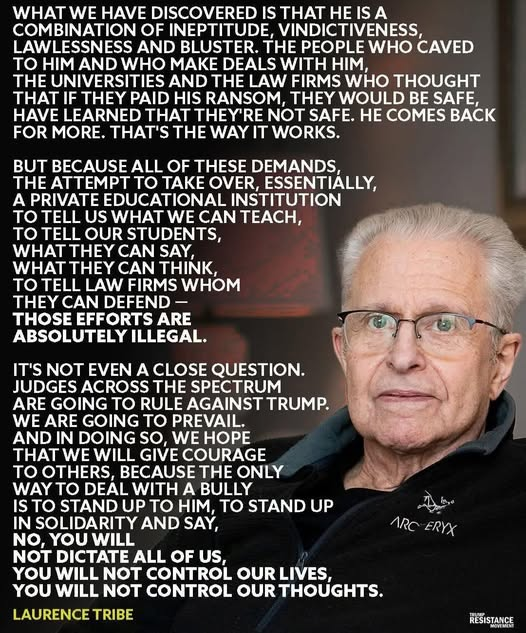
Laurence Tribe

#Harvard#LaurenceTribe worked at Harvard Law School for over 52 years. He graduated from Harvard College in 1962 with a Bachelor of Arts degree in mathematics and later earned his Juris Doctor (J.D.) degree from Harvard Law School in 1966.

He joined the Harvard Law School faculty as an assistant professor in 1968 and received tenure in 1972. He taught at Harvard Law School until his retirement in 2020, mentoring notable students like former President Barack Obama, Chief Justice John Roberts, and Justice Elena Kagan.

After retirement, Tribe holds the position of Carl M. Loeb University Professor Emeritus at Harvard University.

King Donald does as He Wants

Whereas the Constitution’s Foreign Emoluments Clause now provides:

[N]o Person holding any Office of Profit or Trust under them [i.e., the United States], shall, without the Consent of the Congress, accept of any present, Emolument, Office, or Title, of any kind whatever, from any King, Prince, or foreign State.

Trump’s plan to accept free Air Force One replacement from Qatar raises ethical and security worries

For President Donald Trump, accepting a free Air Force One replacement from Qatar is a no-brainer.

“I would never be one to turn down that kind of an offer,” the Republican told reporters on Monday. “I could be a stupid person and say, ‘No, we don’t want a free, very expensive airplane.’”

Past presidents couldn’t keep gifts of lions or horses. How could Trump accept a jet from Qatar?

MAGA media stars bash Trump’s reported Qatar plane gift, with some saying “it’s a bribe”

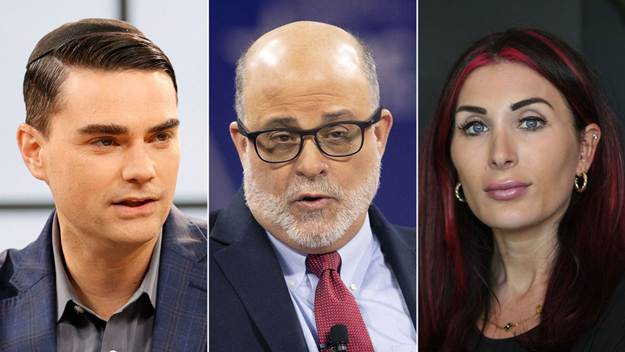
From left: Ben Shapiro, Mark Levin and Laura Loomer. 

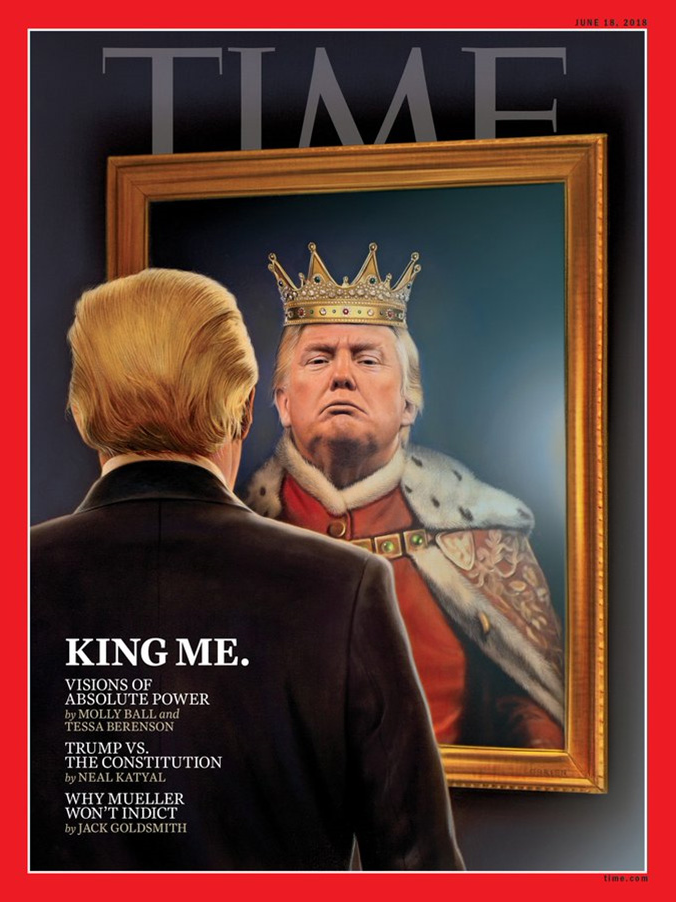
Is Donald Trump President or King of the United States?

Asked if he has to uphold the Constitution as commander-in-chief, the president responded, “I don’t know.”

Apparently Donald Trump does not take his Inauguration oath to uphold the Constitution as a meaningful process that is to be taken seriously.

After all. Trump views himself a King of America.

President Donald Trump said in an interview that aired today on NBC that he doesn’t know if he has to uphold the US Constitution as president, but said his administration will “obviously follow” what the Supreme Court decides.

The answer came during an exchange on NBC’s “Meet the Press,” when host Kristen Welker asked the president if citizens and noncitizens deserve due process in legal proceedings. The president initially responded, “I don’t know. I’m not, I’m not a lawyer. I don’t know.”

Pressed further by Welker, who cited the Fifth Amendment’s due process clause, the president said he was elected to deal with immigration and the “courts are holding me from doing it.”

“I don’t know. I have to respond by saying, again, I have brilliant lawyers that work for me, and they are going to obviously follow what the Supreme Court said. What you said is not what I heard the Supreme Court said. They have a different interpretation,” the president said.

Trump has expressed extreme frustration during the first few months of his second term as federal courts — including the nation’s highest court — have slowed his rapid deportation push amid legal challenges over whether migrants are being afforded due process.

Magazine Cover Puts A World Of Hurt On Trump’s First 100 Days

Story by Ron Dicker of Huffington Post

The Economist is counting the days until President Donald Trump’s second term is over.

In a blistering cover this week, the outlet portrayed a wounded and bandaged symbolic eagle under the headline “Only 1,361 Days To Go.”

That would be the amount of time left in Trump’s presidency after his first 100 days is up at the end of the month. He has spent his first months dismantling government agencies, sparking a trade war, defying the courts over deportations and trying to strong-arm Ukraine into submitting to its invader, Russia.

The Economist summed up his strategy in the cover story, which examines the “lasting harm” he has already done:

“The method is to bend or break the law in a blitz of executive orders and, when the courts catch up, to dare them to defy the president. The theory is one of unconstrained executive power—the idea that, as Richard Nixon suggested, if the president does something then it’s legal.”

This injured eagle might need more than bandages to heal.

An Eradic Behavior

“Trump’s ‘will he, won’t he’ tariff chaos is just one more con on working people.”

That’s what Melinda St. Louis, Global Trade Watch director at the watchdog group Public Citizen, said in a Wednesday statement after U.S. President Donald Trump announced a 90-pause for what he has called “reciprocal” tariffs, excluding China.

It seems Donald Trump wants a recession. Why? A recession will drive down the price of real estate, companies, and shares of stock. Trump and his fellow billionaires want o buy everything on the cheap and then enjoy the ride upward-no matter the cost to working people.

“OUR PLAN IS WORKING PERFECTLY AND IS JUST A NEGOTIATING TACTIC BUT IT IS ALSO GOING TO BE PERMANENT AND WE WILL BE THE WORLD LEADER IN TEXTILES AND NOW THERE IS A PAUSE AND EVERYONE NEEDS TO CHILL BUT ALSO WE WILL NEVER BACK DOWN AAAAAAHHHHHH.”

US stocks tumbled today after the White House clarified that its tariff on all Chinese goods was at least 145% — even higher than previously believed. This comes a day after US stocks skyrocketed following President Donald Trump’s announcement of a 90-day pause on all “reciprocal” tariffs, except for China. Beijing, meanwhile, implemented its own retaliatory tariffs of 84% on US goods.

• Trade negotiations: Trump just defended his tariff policy in a Cabinet meeting, saying his administration is “working on deals” with multiple countries. Earlier today, the EU announced it would pause its retaliatory US tariffs for negotiations. Even after Trump’s U-turn, economists say the damage is done.

DOW down 1,835.94, S&P 500 down 281.5 5.5% mid-day April 10,2025

A majority of Americans voted for Donald Trump!

Freedom of Speech and Thought under Attack

Speaking your mind shouldn’t cost you your job, your education, or your rights. But right now, that’s exactly what’s happening all across America.

Example One:

President Trump on Thursday renewed a call to defund NPR and PBS a day after top executives from the public broadcasters faced an intense grilling from GOP lawmakers on Capitol Hill.

“NPR and PBS, two horrible and completely biased platforms (Networks!), should be DEFUNDED by Congress, IMMEDIATELY,” Trump wrote late Wednesday on Truth Social. “Republicans, don’t miss this opportunity to rid our Country of this giant SCAM, both being arms of the Radical Left Democrat Party. JUST SAY NO AND, MAKE AMERICA GREAT AGAIN!!!”

Example Two:

Students at public colleges and universities are protected by the First Amendment freedoms of religion, speech, press, assembly and petition. Private schools do not have that protection.                         

Columbia University, officially Columbia University in the City of New York, is a private Ivy League research university in New York City. 

On 8 March, Immigration and Customs Enforcement (Ice) agents arrested Mahmoud Khalil, a graduate student at Columbia University, as he was returning from dinner with his wife in New York. The agents said the state department had revoked his student visa and green card, though he had never been accused of, let alone convicted for, a crime. He was held in detention in New Jersey, then transferred to Louisiana. He has still not been accused a crime.

Nevertheless, Donald Trump’s state department, headed by Marco Rubio, seeks to deport him under a provision of federallaw that gives him the power to deport someone if their presence in the country is deemed to “have potentially serious adverse foreign policy consequences for the United States”. Khalil’s crime? He was a lead organizer of Columbia’s protests for Palestinian rights.

“Who has the right to have rights? It is certainly not the humans crowded into the cells here,” Khalil, a Palestinian raised in exile in a Syrian refugee camp, wrote in a letter proclaiming his status as a “political prisoner”. He is the one of the most prominent targets of a chilling federal crackdown over pro-Palestinian advocacy in the US, particularly on college campuses. And he is one of the most forceful voices in The Encampments, a new documentary on the campus movement for Palestine that has drawn ire from across the US political spectrum, in particular the right.

Example Three:

The nation’s legal profession is being split between those that want to fight back against President Trump’s attacks on the industry and those that prefer to engage in the art of the deal.

Two big firms sued the Trump administration on Friday, seeking to stop executive orders that could impair their ability to represent clients. The lawsuits filed by Jenner & Block and WilmerHale highlight how some elite firms are willing to fight Mr. Trump’s campaign targeting those he doesn’t like, while others, like Paul Weiss and Skadden, have cut deals to appease the president.

In recent weeks, Mr. Trump has issued similarly styled executive orders against firms that he perceives as enemies and threats to national security. The orders could create an existential crisis for firms because they would strip lawyers of security clearances, bar them from entering federal buildings and discourage federal officials from interacting with the firms.

Trump consistently frames policy around ‘fairness,’ trading on American frustration

A long article worth reading.

By Kevin Rector, Staff Writer for the Los Angeles Times

In a sit-down interview with Fox News last month, President Trump and his billionaire “efficiency” advisor Elon Musk framed new tariffs on foreign trading partners as a simple matter of fairness.

“I said, ‘Here’s what we’re going to do: reciprocal. Whatever you charge, I’m charging,’” Trump said of a conversation he’d had with Indian Prime Minister Narendra Modi. “I’m doing that with every country.”

“It seems fair,” Musk said.

Trump laughed. “It does,” he said.

“It’s like, fair is fair,” said Musk, the world’s richest person.

The moment was one of many in recent months in which Trump and his allies have framed his policy agenda around the concept of fairness — which experts say is a potent political message at a time when many Americans feel thwarted by inflation, high housing costs and other systemic barriers to getting ahead.

“Trump has a good sense for what will resonate with folks, and I think we all have a deep sense of morality — and so we all recognize the importance of fairness,” said Kurt Gray, a psychology professor at University of North Carolina at Chapel Hill and author of the book “Outraged: Why We Fight About Morality and Politics and How to Find Common Ground.”

“At the end of the day,” Gray said, “we’re always worried about not getting what we deserve.”

In addition to his “Fair and Reciprocal Plan” for tariffs, Trump has cited fairness in his decisions to pull out of the Paris climate agreement, ban transgender athletes from competing in sports, scale back American aid to embattled Ukraine and pardon his supporters who stormed the U.S. Capitol on Jan. 6, 2021.

Trump has invoked fairness in meetings with a host of world leaders, including Japanese Prime Minister Shigeru Ishiba and British Prime Minister Keir Starmer. He has suggested that his crusade to end “diversity, equity and inclusion” programs is all about fairness, couched foreign aid and assistance to undocumented immigrants as unfair to struggling American taxpayers, and attacked the Justice Department, the media and federal judges who have ruled against his administration as harboring unfair biases against him.

Trump and Musk — through his “Department of Government Efficiency,” which is not a U.S. agency — have orchestrated a sweeping attack on the federal workforce largely by framing it as a liberal “deep state” that either works in unfair ways against the best interests of conservative Americans, or doesn’t work at all thanks to lopsided work-from-home allowances.

“It’s unfair to the millions of people in the United States who are, in fact, working hard from job sites and not from their home,” Trump said.

In a Justice Department speech this month, Trump repeatedly complained about the courts treating him and his allies unfairly, and reiterated baseless claims that recent elections have been unfair to him, too.

“We want fairness in the courts. The courts are a big factor. The elections, which were totally rigged, are a big factor,” Trump said. “We have to have honest elections. We have to have borders and we have to have courts and law that’s fair, or we’re not going to have a country.”

Before a meeting with NATO Secretary-General Mark Rutte this month, Trump complained — not for the first time — about European countries not paying their “fair share” to defend Ukraine against Russian aggression, and the U.S. paying too much.

“We were treated very unfairly, as we always are by every country,” Trump said.

Almost exclusively, Trump’s invocations of fairness cast him, his supporters or the U.S. as victims, and his critics and political opponents as the architects and defenders of a decidedly unfair status quo that has persisted for generations. And he has repeatedly used that framework to justify actions that he says are aimed at tearing down that status quo — even if it means breaching norms or bucking the law.

Trump has suggested that unfavorable media coverage of him is unfair and therefore “illegal,” and that judges who rule against him are unfair liberal activists who should be impeached.

The politics of feeling heard

Of course, grievance politics are not new — nor is the importance of “fairness” in democratic governance. In 2006, the late Harvard scholar of political behavior Sidney Verba wrote of fairness being important in various political regimes but “especially central in a democracy.”

Verba noted that fairness comes in different forms — including equal rights under the law, equal voice in the political sphere, and policies that result in equal outcomes for people. But the perception of fairness in a political system, he wrote, often comes down to whether people feel heard.

“Democracies are sounder when the reason why some lose does not rest on the fact that they are invisible to those who make decisions,” Verba wrote. “Equal treatment may be unattainable, but equal consideration is a goal worth striving for.”

According to several experts, Trump’s appeal is in part based on his ability to make average people feel heard, regardless of whether his policies actually speak to their needs.

Gray said there is “distributive fairness,” which asks, “Are you getting as much as you deserve?” and “procedural fairness,” which asks, “Are things being decided in a fair way? Did you get voice? Did you get input?”

One of Trump’s skills, Gray said, is using people’s inherent sense that there is a lack of distributive fairness in the country to justify policies that have little to do with such inequities, and to undermine processes that are in place to ensure procedural fairness, such as judicial review, but aren’t producing the outcomes he personally desires.

“What Trump does a good job at is blurring the line between rules you can follow or shouldn’t follow,” he said. “When he disobeys the rules and gets called out, he goes, ‘Well those moral rules are unjust.’”

People who voted for Trump and have legitimate feelings that things are unfair then give him the benefit of the doubt, Gray said, because he appears to be speaking their language — and on their behalf.

“He’s not just saying that it’s him. He’s saying it’s on behalf of the people he’s representing, and the people he’s representing do think things are unfair,” Gray said. “They’re not getting enough in their life, and they’re not getting their due.”

Lawrence Rosenthal, chair of the Center for Right-Wing Studies at UC Berkeley and author of “Empire of Resentment: Populism’s Toxic Embrace of Nationalism,” said Trump and his supporters have built him up as a leader “interested in fixing the unfairness to the working class.”

But that idea is premised on another notion, even more central to Trump’s persona, that there are “enemies” out there — Democrats, coastal elites, immigrants — who are the cause of that unfairness, Rosenthal said.

“He names enemies, and he’s very good at that — as all right-wing authoritarians are,” Rosenthal said.

Such politics are based on a concept known as “replacement theory,” which tells people to fear others because there are only so many resources to go around, Rosenthal said. The theory dovetails with the argument Trump often makes, that undocumented immigrants receiving jobs or benefits is an inherent threat to his MAGA base.

“The sense of dispossession is absolutely fundamental and has been for some time,” Rosenthal said.

John T. Woolley, co-director of the American Presidency Project at UC Santa Barbara, said Trump has “a remarkable capacity for constructing the world in a way that favors him” — even if that’s as the victim — and appears to be an “outlier” among presidents in terms of how often he focuses on fairness as a political motif.

“Certainly since his first term with impeachment, ‘the Russia hoax,’ ‘dishonest media,’ ‘fake news’ and then ‘weaponizing’ of justice — he’s constructed a kind of victim persona, in battle with the deep state, that is now really basic to his interaction with his core MAGA constituency,” Woolley said.

An idea for Democrats

In coming to terms with Trump’s win in November, Democrats have increasingly acknowledged his ability to speak to Americans who feel left behind — and started to pick up on fairness as a motif of their own, in part by zeroing in on mega-billionaire Musk.

In an interview with NPR last month, Rep. Alexandria Ocasio-Cortez (D-N.Y.) evoked the idea of unfairness in the system by saying American government is working for rich people like Musk, but not for everyone else. “Everything feels increasingly like a scam,” she said.

She and Sen. Bernie Sanders (I-Vt.) have since embarked on a nationwide “Fighting Oligarchy” tour, where they have blasted Musk’s role in government and questioned how his actions, or those of Trump, have helped average Americans in the slightest.

“At the end of the day, the top 1% may have enormous wealth and power, but they are just 1%,” Sanders wrote Friday on X. “When the 99% stand together, we can transform our country.”
Trump Does Not Have Absolute Power

Did Donald Trump have a face to face meeting with Chief Justice John Roberts or was it a telephone call? Either way Trump was apparently told he does not have absolute power over everything.

The consequence was Trump administration reinstated thousands of probationary federal workers. The Trump administration is making the move after several court orders ruled that the firings were not legal.

The decision reinstates at least 24,500 recently fired probationary workers following a pair of orders from federal judges last week that found the terminations pushed by President Donald Trump were illegal.

The reinstatements, spanning 18 departments, are outlined in a filing Monday by the Department of Justice in federal court in Maryland after a judge asked for a report on efforts to reinstate the employees.

The separate declarations from Trump officials within each of the departments offer the most detailed public account yet of the administration’s firing of recently hired or promoted probationary workers as part of Elon Musk’s Department of Government Efficiency’s push to drastically cut the federal workforce.

Here are the tallies of recently fired probationary workers, by department, the Trump administration says it is working to reinstate:

  1. Environmental Protection Agency: 419
  2. Department of Energy: 555
  3. Department of Commerce: 791
  4. Department of Homeland Security: 310
  5. Department of Transportation: 775
  6. Department of Education: 65
  7. Department of Housing and Urban Development: 299
  8. Department of Interior: 1,710
  9. Department of Labor: 167
  10. Consumer Financial Protection Bureau: 117
  11. Small Business Administration: 298
  12. Federal Deposit Insurance Corp.: 156
  13. Human Capital and Talen Management: 270
  14. General Services Administration: 366
  15. Treasury Department: 7,613 (including 7,315 IRS employees)
  16. Department of Agriculture: 5,714
  17. Department of Veterans Affairs: 1,683
  18. Department of Health and Human Services: 3,248

Conservatives have a 6-3 advantage on the high court and Trump himself nominated three of the current justices. The court has frequently sided with him in major cases, most notably the decision last year to grant former presidents wide immunity from criminal prosecution for their official actions. But in a series of emergency orders since Trump’s return to the White House, the court has preliminarily ruled against him.

At the same time, Trump appeared especially eager to woo Roberts during his joint address to Congress earlier this month.