Obfuscate

To obscure, muddy, cloud, and conceal.  Those were the objectives of two guests on ‘This Week with George  Stephanopoulos.”  US National Security Advisor H. R. McMaster and Newsmax Media CEO Christopher Ruddy who is now as an ABC News contributor.

I have put in bold what I think are some of the most interesting parts of this interview program.

RUDDY: So many stories, fake news stories, are becoming fact here. Where in the Russia investigation has there ever been an allegation that the president had done anything wrong with the Russians? Where is there any evidence?

Or in other words the New York Times and The Washington Post are creating fake news.

The real thing to read is the transcript of  Stephanopoulos talking to McMaster today, May 21, 2017 his Sunday morning talk show.

STEPHANOPOULOS: General McMaster, thanks for joining us today. I want to get to the trip, but first some questions about that meeting you all had with the Russian foreign minister. “New York Times”, as you know, reporting that here’s what the president said in the meeting. “I just fired the head of the FBI. He was crazy, a real nut job. I faced great pressure because of Russia. That’s take off.”

Is that what the president said?

H.R. MCMASTER, NATIONAL SECURITY ADVISER: Well I don’t remember exactly what the president said. And the notes that there apparently have I do not think are a direct transcript. But the gist of the conversation was that the president feels as if he is hamstrung in his ability to work with Russia to find areas of cooperation because this has been obviously so much in the news. And that was the intention of that portion of that conversation.

STEPHANOPOULOS: Did you know he was going to report that to the Russians? And what did you think when you heard it?

MCMASTER: Report what, George?

STEPHANOPOULOS: The — what you he said about James Comey. That he fired him and why.

MCMASTER: Well, the firing had been in the news. But I didn’t know in advance that the president was going to raise it, but as I mentioned he raised it in the context of explaining that that he has been — feels as if he’s been unable to find areas of cooperation with Russia, even as he confronts them in key areas where they’re being disruptive, like Syria for example, and the subversive activities across Europe. Their support for the — not only the Assad regime but for Iran and its activities across the Middle East.

STEPHANOPOULOS: Did you understand how this might look though to an average American right no? You have the President of the United States telling the Russian foreign minister, in their first meeting, that that the pressure is off because he’s fired the FBI director investigating Russian interference in the campaign. Does that seem appropriate to you?

MCMASTER: As you know, it’s very difficult to take a few lines, to take a paragraph out of what are — what appear to be notes of that meeting. And to be able to see the full context of the conversation.

As I mentioned last week, the really purpose of the conversation was to confront Russia on areas, as I mentioned, like Ukraine and Syria, their support for Assad and their support for the Iranians.

We’re trying to find areas of cooperation in the area of counterterrorism and the campaign against ISIS.

And so that was the intent of that conversation was to say what I’d like to do is move beyond all of the Russia news so that we can find areas of cooperation.

STEPHANOPOULOS: So, did the president confront them on their interference in our election? This was their first meeting?

MCMASTER: Well, there already was too much that’s been leaked from those meetings. And one of the things that I’m most concerned about is the confidence, the confidentiality of those kind of meetings, as you know, are extremely important. And so, I am really concerned about these kind of leaks, because it undermines everybody’s trust in that kind of an environment where you can have frank, candid, and often times unconventional conversations to try to protect American interests and secure the American people.

STEPHANOPOULOS: I understand your concern about leaks, but I could an see the — the feeling of perhaps someone likely on your staff or in your community who leaked this thinking they had a duty to leak it because you have this apparent contradiction.

The president disparaging the person who was investigating the Russians, but not confronting the Russians who interfered in our election.

MCMASTER: Well, as you know, the initial leak that came out was a leak about concerns about revealing intelligence source and methods, information that’s not even part of the president’s briefing. And so in a concern about divulging intelligence, they leaked actually not just the information from the meeting, but also indicated the sources and methods to a newspaper? I mean, it doesn’t make sense, George.

STEPHANOPOULOS: I take your point on that, although there’s also the question of whether or not it was right for the president to give that information to the Russians. But I just asked a direct question. Did the president confront the Russians on their interference in our election?

MCMASTER: Well, I’m not going to divulge more of that meeting. Those meetings, as you know, are supposed to be privileged. They’re supposed to be confidential. They’re supposed to allow the president and other leaders to have frank exchanges.

STEPHANOPOULOS: Well, let me ask just one final question, then, on that meeting. Sean Spicer has spoken out, the president’s press secretary. He said by grandstanding and politicizing the investigation into Russian’s actions, James Comey created unnecessary pressure on our ability to engage and negotiate with Russia.

You’re the president’s national security adviser, do you agree that the former FBI’s director grandstanding and politicizing, those are Sean Spicer’s words, hurt our ability to deal with Russia?

MCMASTER: I think what’s been hurting our ability to deal with Russia more than any other factor, has been Russia’s behavior. But since President Trump has taken action in Syria, we think that there may be opportunities to find areas of cooperation in places like Ukraine, places like Syria in particular.

STEPHANOPOULOS: After your first press conference on that meeting, your friend and former colleague, retired Colonel John Neagle told NPR that you’re in an impossible situation, because the president expects you to defend the indefensible. What’s your reaction to that?

MCMASTER: I don’t think I’m in an impossible situation. I think what the president expects and what is my duty to do as national security adviser and as an officer in our army is to give my best advice, to give my best, candid advice. Nobody elected me to make policy. What my job is, is to give the president options, to integrate the efforts across all of our agencies and departments. And then once the president makes decisions, to help him execute those decisions to protect and advance the interests of the American people.

So, I find no difficulty at all serving our nation and serving the president in my current capacity.

STEPHANOPOULOS: But if the president did put you in that position as you wrote about with President Johnson and Vietnam, would you resign? Would you push back?

MCMASTER: Well, you know there was middle ground there during the Vietnam period. What occurred in that period is many of the president’s senior advisers, civilian, and military, didn’t give their best advice, because they concluded that what would be appropriate for them to do given what Johnson expected, President Johnson expected, was to tell him the advice he wanted to hear. I don’t think the president expects that from me, and certainly I don’t think I’d be fulfilling my duties and responsibilities unless I gave him not just my candid advice, that’s really not my job either — is to integrate and coordinate across the departments and agencies to give him the best advice from across our government and with our key multinational partners.

STEPHANOPOULOS: But it sounds like one of the difficulties of this meeting –and I do want to get on to the trip — is that when the president disparaged James Comey, when he gave that information to the Russians who had interfered in our campaign, when he apparently did not confront the Russians over this, he didn’t even ask your advice.

MCMASTER: Well, George, what I’d like to talk about is where I am right now, in Saudi Arabia. I mean I think I answered the questions concerning the media and I’d like to move on while we still have time.

STEPHANOPOULOS: We definitely will have time. So, you — did the president ask your advice about this before he talked about James Comey?

MCMASTER: The president always asks for advice before these sorts of sessions, but the subject of the FBI investigation to my recollection didn’t come up. But really, that conversation, although I don’t want to talk about any more of the specifics from within it, covered a broad range of subjects, most of which had to do with areas in which we think Russia’s behavior’s been unacceptable and is increasing risk to international security, is supporting those who are helping to create a humanitarian crisis in Syria and across the region. That would be the Assad regime and Iran. But then also look for areas where we can cooperate and begin to move toward a resolution of conflicts in Ukraine, in Syria, and then to be able to cooperate more effectively in our counter terrorism campaigns.

STEPHANOPOULOS: Let’s talk broadly about the goal of this trip. The president said you had a very good start. What exactly do you want to accomplish?

MCMASTER: Well, really three main things. The first is to advance the security of the American people. And to recognize that to do that, America needs allies and partners to deal with the very complex problems that we are dealing with. And of course in this region, those are two main and interconnected problems, the problem of transnational terrorist organizations, some of which now, like ISIS, control territory and populations and resources. But then how that problem is connected more broadly to the problem of Islamist extremism and the brainwashing of youths with really an irreligious ideology that is meant to foment hatred and justify violence against innocents.

And the second problem of Iran and Iran’s actions across the region, which we believe are aimed at keeping the Arab world perpetually weak and mired in a very destructive civil war. And you see that in Syria, obviously, a great human cost, but you see it in Yemen as well. You see it to a certain extent in Iraq.

And so security, cooperation, counterterrorism, but also counter-extremism is a big part of it.

STEPHANOPOULOS: As you know, the Saudis…

MCMASTER: The second part of it…

STEPHANOPOULOS: Go ahead

MCMASTER: The second part of it is economic cooperation, being able to get better access to markets, develop trade relationships, to create American jobs. There are a lot of important signings that happen in that connection.

And the third is to foster — this is just for this leg of the trip — better defense cooperation in the region and to encourage additional burden-sharing, responsibility-sharing with allies and partners so Americans don’t foot the full bill for security in this region and globally as well.

STEPHANOPOULOS: The Saudis have been in the past consistent backers of extremists around the world, around the region and around the world. Are you convinced that they’re truly ready to change?

MCMASTER: Well, we’re going to ask them to convince us. And so there’s some very good first steps being taken with the establishment of the center for combating global extremism, or terrorist extremism. We’ll have to see what the results are.

But I think the willingness to talk about it is somewhat different than it has been in the past. And as you know ,the record is poor going back to the ’60s and ’70s and beyond. And even today. And so what we need is we need to convene leaders across all religions, and that is a big theme of this trip, is to promote tolerance and cooperation across our religions to identify these terrorists for who they are — the enemies of all civilized people, irreligious criminals who use a perverted interpretation of religion to advance their criminal and political agendas.

And that’s the tone and tenor of the conversations that occurred today, which I think that is encouraging. Now I think there have to be concrete steps taken. Funding has to be cut off to these madrassas and mosques that are fomenting hatred and intolerance. Funding has to be cut off to terrorist organizations through effective threat finance measures, and that’s a big part of the initiative as well.

And so we’ll see. I mean, I think the expectation is that there — results — that we deliver results together. That’s what we’ve said that we expect of each other, and that will be a big part of the conversation tomorrow when the group of leaders expands dramatically to include not only the Gulf Cooperation Council but also about 50 nations of predominately Muslim and Islamic populations.

STEPHANOPOULOS: General McMaster, thanks for your time this morning.

MCMASTER: Thank you, George.

(END VIDEOTAPE)
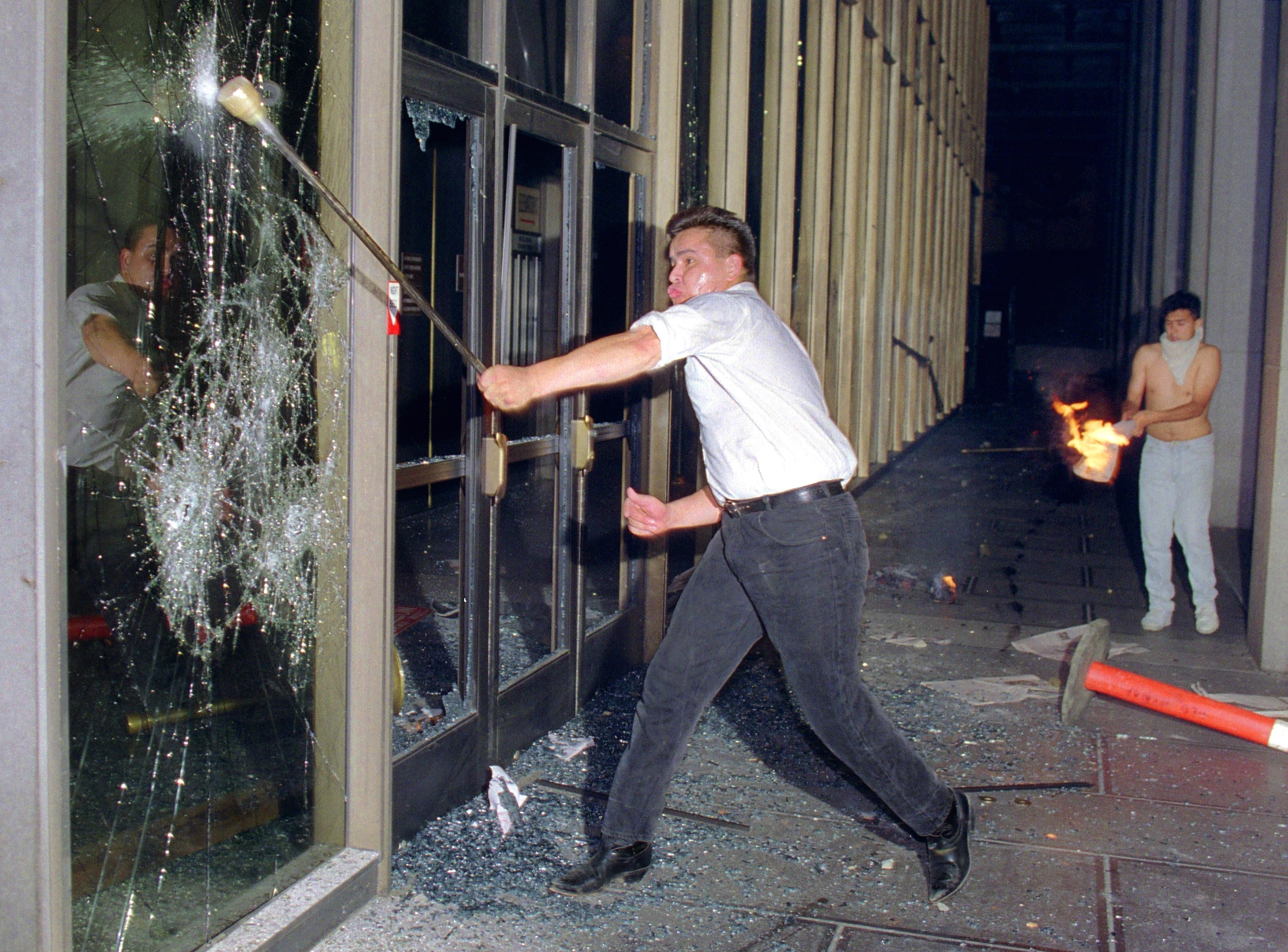
25 Years after the April 1992 Los Angeles Riots

The riots were a consequence of the Rodney King police beating and a frustration of Blacks in South Central Los Angeles over their lack of opportunities for decent education, decent jobs, and decent housing.

We were living in the West San Fernando Valley when the riot occurred.  Neither I nor my neighbors were impacted by what happened.

I was shocked by the verdict as many others were shocked.

Los Angeles Mayor Tom Bradley went on television with an inflammatory condemnation of the verdict: “I was stunned. I was shocked. | was outraged when I heard that verdict,” he exclaimed with vehemence. “No, our eyes did not deceive us. We saw what we saw. What we saw was a crime. No, we will not tolerate the savage beating of our citizens by a few renegade cops …. The jury’s verdict will never outlive the images of the savage beating seared forever into our minds and our souls.”

I saw that comment made by Tom Bradley and immediately said that his statement was an invitation to Blacks to riot.  Of course the following day he denied that his words inspired the rioters.  The words “No, we will not tolerate the savage beating of our citizens” sent the message that it is OK to riot.

LOS ANGELES, CA – APRIL 29: A rioter breaks a glass door of the Criminal Courts building, downtown Los Angeles, 29 April 1992, after a jury acquitted four police officers accused of beating a black youth, Rodney King, in 1991. Riots broke out throughout Los Angeles hours after the verdict was announced. (Photo credit should read HAL GARB/AFP/Getty Images)

Today’s Black Lives Matter movement is an outgrowth of the continuing mistreatment of Black Americans.

The Trump 100 Day Legislative Disaster

Mexico is not paying for the wall. The Trump travel ban has twice been blocked by the courts. Trump has failed to mobilize a Republican monopoly on power in Washington and his big legislative goal — repealing Obamacare — crashed.

Not one single major piece of legislation has been passed by congress and signed into law.

Most of what Trump has accomplished has been through executive order.

Donald Trump’s Contract with the American Voter was his 100 day action plan.  The plan was announced on October 26, 2016.

How did he do?

Six measures to clean up the corruption and special interest collusion in Washington, DC:

★ FIRST, propose a constitutional amendment to impose term limits on all members of Congress.  NOT DONE.

★ SECOND, a hiring freeze on all federal employees to reduce the federal workforce through attrition (exempting military, public safety, and public health). THE FEDERAL HIRING FREEZE WAS IMPOSED IN JANUARY.  IT WAS LIFTED ON APRIL 14.

★ THIRD, a requirement that for every new federal regulation, two existing regulations must be eliminated. DONE.

★ FOURTH, a five-year ban on White House and Congressional officials becoming lobbyists after they leave government service. DONE.

★ FIFTH, a lifetime ban on White House officials lobbying on behalf of a foreign government. DONE.

★ SIXTH, a complete ban on foreign lobbyists raising money for American elections. DONE.


Seven actions to protect American workers:

★ FIRST, I will announce my intention to renegotiate NAFTA or withdraw from the deal under Article 2205. DONE. HE WILL RENEGOTIATE.

★ SECOND, I will announce our withdrawal from the Trans-Pacific Partnership. DONE.  

★ THIRD, I will direct the Secretary of the Treasury to label China a currency manipulator. NOT DONE. REVERSED OPINION.

★ FOURTH, I will direct the Secretary of Commerce and U.S. Trade Representative to identify all foreign trading abuses that unfairly impact American workers and direct them to use every tool under American and international law to end those abuses immediately. NOT DONE.

★ FIFTH, I will lift the restrictions on the production of $50 trillion dollars’ worth of job-producing American energy reserves, including shale, oil, natural gas and clean coal. DONE.

★ SIXTH, lift the Obama-Clinton roadblocks and allow vital energy infrastructure projects, like the Keystone Pipeline, to move forward. DONE.

★ SEVENTH, cancel billions in payments to U.N. climate change programs and use the money to fix America’s water and environmental infrastructure. DONE. EXCEPT NO WATER AND INFRASTRUCTURE PROJECTS HAVE BEEN BUDGETED.


Five actions to restore security and the constitutional rule of law:

★ FIRST, cancel every unconstitutional executive action, memorandum and order issued by President Obama. NOT DONE.

★ SECOND, begin the process of selecting a replacement for Justice Scalia from one of the 20 judges on my list, who will uphold and defend the U.S. Constitution. DONE. MAJOR ACCOMPLISHMENT.

★ THIRD, cancel all federal funding to sanctuary cities. NOT DONE.

★ FOURTH, begin removing the more than two million criminal illegal immigrants from the country and cancel visas to foreign countries that won’t take them back. DONE.

★ FIFTH, suspend immigration from terror-prone regions where vetting cannot safely occur. All vetting of people coming into our country will be considered “extreme vetting.” NOT DONE.

Here’s How This Will End for Trump

While Keith Olbermann has been “over the top” in giving us all the reasons for his left wing view of the world, his description of how the Trump presidency could end is a reasonable theory.  I have been saying that Trump’s presidency will end with either impeachment or resignation within four years.  I prefer the latter because impeachment is a very messy process.

California powered the nation

In March, California produced about 20% of the job growth in the entire country, which added 98,000 jobs last month. The state is huge, but it only accounts for about 11.5% of the country’s employees, which means that it is punching above its weight.

“We get beaten up for being a high-cost and high-tax state … but we have been outperforming many states,” said Robert Kleinhenz, an economist at Beacon Economics, a Los Angeles consulting firm.

California alone was responsible for 16% of the country’s growth from 2014 to 2016, according to Kleinhenz’s analysis.

California piled on 19,300 jobs in March and its unemployment rate dropped to 4.9%, according to figures released Friday by the state’s Employment Development Department. That’s the first time since December 2006 that the jobless rate has fallen below 5%.

It was another month of solid but not breathtaking job gains in a state that has slowed a bit after years of unbridled growth.

Still, California grew faster than the rest of the country in March, expanding at a rate of 2.1% year over year, compared with 1.5% nationwide. Californians were still slightly more likely to be unemployed; the U.S. jobless rate hit 4.5% in March.

The standout sector in March was construction, which increased payrolls by 18,900. The information sector — which includes tech businesses in Silicon Valley and moviemakers in Hollywood — faltered last month, cutting head count by 9,400.

Los Angeles County gained a net 16,000 jobs in March. The county’s unemployment rate fell to 4.6%, down from a revised 4.8% in February.

Source: Los Angeles Times

Trump just signed off on killing your Internet privacy protections

The article on CNN reads, “Trump signed into law a resolution that repealed protections requiring Internet service providers to get your permission before collecting and sharing data. These protections — which had not yet gone into effect — were approved by the Federal Communications Commission in the final days of the Obama administration.”

It is panic over absolutely nothing.

This resolution changes nothing. It only reinforces an existing reality. Here is the reality.

– I apply for life insurance and the carrier does an investigation of my past life. I am not qualified for their lowest quotation because they learn something about my life that they consider to be concerning. Where did they get that information?

– I do a search on-line for information about the 2017 Chevrolet Cruze and immediately every car maker offering competitive models has advertising in the header of my screen.

– The internet constantly bombards me with advertising that an algorithm has concluded will interest me.

– My bank has studied my buying habits and concluded I should have a new credit or debit card. They send the card to me without my request.

You think this resolution will change anything? No it won’t because almost every company knows almost everything about you now.

No Mr. Trump you are not all powerful. This is a democratic republic.

   The failure of Trumpcare was good news for some.  Doctors didn’t like it.  Nurses didn’t like it.  The AARP was one of the biggest critics.

If nothing else Mr. Trump has learned that being president of the United States is nothing like owning your own company.  You cannot make demands of the people and expect they will follow your orders merely because you are president.  As the owner of your own company you can give directions to your employees and know they will be carried out.

So promising to repeal and replace Obamacare was a winning promise on the campaign trail.  As president Trump has learned that making promises is easy but fulfilling them takes another set of capabilities.  Donald Trump has not yet learned that he is confronted with a set of circumstances that are entirely different than those he faced as the head of his company.

It’s not just his health care proposal that did not pass the House of Representatives that has been a challenge.  He has seen his immigration executive orders stopped by the courts, faced questions about his proposal to defund domestic programs in order to raise defense spending, and learned that foreign affairs are far more complicated than he imagined.

It seems that when things don’t go his way he finds someone else to blame.  The Democrats are to blame for the health care defeat. “So called judges” are to blame for the hold on his immigration ban.  There are leakers who are to blame for information going to the press who only deal in fake news.

As Charles Krauthammer pointed out in his latest column the country’s checks and balances really do work.  This is a feature of government that Donald Trump either does not understand or hopes will go away.  It won’t go away.

Mr. Krauthammer listed these checks on the usurping of power.

1.     The courts.

2.     The states.

3.     Congress.

4.    The media.

Discrimination in America

Despite the erection of the Statue of Liberty in New York harbor the United States has had a streak of discrimination against minorities that dates back to colonial times.  Those of you non-Americans reading this blog may find this recitation disappointing.  Americans have read all this before but not in this concise summary.

The First Group to face discrimination were Native Americans, who most Americans now call Indians or American Indians.

Europeans believed the original inhabitants of America were heathens and savages who needed to be civilized through Christianity and European culture. This led to genocide, mass murder, stolen land, attempts to wipe out Native American traditions, as well as forced assimilation through institutions like residential schools and the establishment of “Indian reservations”.  To this day the term “redskin” is used to describe Native American.

Historians call the Bear River Massacre of 1863 the deadliest reported attack on Native Americans by the U.S. military—worse than Sand Creek in 1864, the Marias in 1870 and Wounded Knee in 1890.  This link to a Wikipedia List of Indian Massacres will make most people sick.

Searching for cheap labor, early American colonists brought slavery to this continent by kidnapping Africans and bringing them to North America to work in their fields.

Many of the Africans brought to America starting in the 17th century arrived as slaves, kidnapped from their homelands in various parts of Africa. A number of them were known to be royalty and literate. African men, women, and children were stripped of their names and identities, forced to “Christianize”, whipped, beaten, tortured, and in many cases, lynched or hanged at the whims of their white masters, for whom slavery was key to maintaining their vast properties and land. Families were separated through the process of buying and selling slaves. While not all Africans in America were slaves, a large number were, particularly in the southern states. For those Africans in America who were free, discriminatory laws that barred them from owning property and voting, for example, as well as the belief in the intrinsic inferiority of dark-skinned peoples by the dominant white majority, held them back from full equality in the United States.

The Union victory in the Civil War may have freed African Americans but their lives were no picnic. Southern state legislatures passed restrictive “black codes” to control the labor and behavior of former slaves and other African Americans. Outrage in the North over these codes eroded support for the approach known as Presidential Reconstruction and led to the triumph of the more radical wing of the Republican Party. During Radical Reconstruction, which began in 1867, newly enfranchised blacks gained a voice in government for the first time in American history, winning election to southern state legislatures and even to the U.S. Congress. In less than a decade, however, reactionary forces–including the Ku Klux Klan–would reverse the changes wrought by Radical Reconstruction in a violent backlash that restored white supremacy in the South.

Disenfranchisement after the Reconstruction Era in the United States of America was based on a series of laws, new state constitutions, and practices in the South that were deliberately used to prevent black citizens from registering to vote and voting. These measures were enacted by former Confederate states at the turn of the 20th century. Their actions defied the intent of the Fifteenth Amendment to the United States Constitution, ratified in 1870, which was intended to protect the suffrage of freedmen after the American Civil War.

The sharp and sweeping rise of racial segregation in 20th century America is now subsiding but is still a reality for African Americans in many communities throughout the United States.  Police stopping and harassing Black car operators has been well documented in recent years.  The most obvious segregation were separate but equal schools (they weren’t equal), separate drinking fountains and toilet facilities, and housing segregation.  Black Americans were denied employment and housing just because they were dark skinned.

The first significant Chinese immigration to North America began with the California Gold Rush of 1848–1855 and it continued with subsequent large labor projects, such as the building of the First Transcontinental Railroad. During the early stages of the gold rush, when surface gold was plentiful, the Chinese were tolerated, if not well received.  As gold became harder to find and competition increased, animosity toward the Chinese and other foreigners increased. After being forcibly driven from the mines, most Chinese settled in enclaves in cities, mainly San Francisco, and took up low-wage labor, such as restaurant and laundry work. With the post-Civil War economy in decline by the 1870s, anti-Chinese animosity became politicized by labor leader Denis Kearney and his Workingman’s Party as well as by California Governor John Bigler, both of whom blamed Chinese “coolies” for depressed wage levels.

The Chinese Exclusion Act was a United States federal law signed by President Chester A. Arthur on May 6, 1882, prohibiting all immigration of Chinese laborers. The act followed the Angell Treaty of 1880, a set of revisions to the US–China Burlingame Treaty of 1868 that allowed the US to suspend Chinese immigration. The act was initially intended to last for 10 years, but was renewed in 1892 with the Geary Act and made permanent in 1902. The Chinese Exclusion Act was the first law implemented to prevent a specific ethnic group from immigrating to the United States. It was repealed by the Magnuson Act on December 17, 1943.

The Irish people faced much prejudice, racism and discrimination after their immigration to the United States because they were poor, uneducated, less skilled, considered disruptive and were Catholics in a land of Protestant dominance.  The common perception was that the Irish were drunkards. From 1820 to 1860, 1,956,557 Irish arrived, 75% of these after the Great Irish Famine of 1845–1852 struck.

With Japan’s December 1941 bombing of Pearl Harbor in Hawaii, racism against Japanese-Americans intensified. Like Muslims after the 9/11 attacks, Japanese-Americans were targets of harassment, discrimination, and government surveillance. Members of the community lost homes, jobs, and businesses. But the worst blow was the February 1942 Executive Order signed by President Franklin D. Roosevelt that authorized the internment of Japanese-Americans. They were now deemed enemies of the state. Over half of the 120,000 Japanese-Americans sent to the camps were born and raised in the U.S. and had never set foot in Japan. Half of those sent to the camps were children.

Although Jews first arrived in America over 300 years ago and enjoyed a certain level of religious freedom, anti-Semitism was acceptable and common socially, as well as legally in some cases. For example, some states in the late 18th century barred those who were not Christian from voting or holding public office.

Job and housing discrimination were common throughout the 20th century.  Examples are Father Charles Coughlin’s anti-Semitic radio rants in the 1930’s and Charles Lindbergh’s isolationist speeches accusing the Jews of pushing America into World War II. Henry Ford’s “The International Jew,” was published in his newspaper, The Dearborn Independent, which excerpted the infamous anti-Semitic forgery, “The Protocols of the Learned Elders of Zion.”

Henry Ford asserted that there was a Jewish conspiracy to control the world. He blamed Jewish financiers for fomenting World War I so that they could profit from supplying both sides. He accused Jewish automobile dealers of conspiring to undermine Ford Company sales policies. In 1919, he purchased a newspaper, the Dearborn Independent. He installed Charles Pipp as editor and hired a journalist, William J. Cameron, to listen to his ideas and write a weekly column, “Mr. Ford’s Page,” to expound his views. For a year, editor Pipp resisted running anti-Jewish articles, and resigned rather than publish them. Ford closed the Independent in December 1927.  Ford died in 1947, apparently unrepentant.

Islamophobia is the term that has been coined to describe the current hostility toward Islam and Muslims in the United States, manifested in prejudice, harassment and discrimination.  There is an anti-Muslim hate crime epidemic. Attacks on Muslim Americans have come in four waves since 9/11, said Corey Saylor, director of CAIR’s department to monitor and combat Islamophobia. According to the FBI, in 2001 anti-Islamic hate crimes spiked by 1,600 percent with 481 incidents.  At least six mosque projects across the U.S., not just in New York, have faced bitter opposition in 2010.  Now President Trump has stopped the entry of anyone from seven predominately Muslim nations.  The president denies that his focus is on Muslims.  He says it is an effort to deny terrorists entry into the United States.  No terrorists have been identified from those seven nations.

Trump First Act is Against New Home Buyers

trump-fha-halts-fee-cuts

Just to prove that he is really for those wanting to buy their first home, Donald Trump has reversed an Obama administration effort to reduce the monthly cost for those new home owners.

The Trump administration has suspended a cut in fees on FHA-insured mortgages that had been set to take effect this month.

A reduction in the Federal Housing Administration’s annual mortgage insurance premium had been scheduled to take place Jan. 27. In one of the first acts of the Trump administration, the cut in premiums has been suspended indefinitely.

Ben Carson, the housing secretary nominee, had hinted at this move last week, during his confirmation hearing. He said that the Obama administration’s announcement of the premium cut had been “done on the way out the door” and that the cut would cost $5 billion next fiscal year. “That’s not chump change,” he said, “so certainly, if confirmed I’m going to work with the FHA administrator and other financial experts to really examine that policy.”

For most borrowers buying homes with down payments of less than 5 percent, the monthly mortgage insurance payments will remain $141.67 a month for a $200,000 loan. It would have fallen to $100 a month.

This action is the absolute opposite of what Trump promised if elected.

Interesting American Population Statistics

Massachusetts, home to one of the nation’s wealthiest and most highly educated population, leads the nation in quality of life. Mississippi, the poorest state in the country, trails the other 49 states according to 24/7 Wall St. that reviewed three statewide social and economic measures — poverty rate, educational attainment, and life expectancy at birth — to rank each state’s living conditions. Socioeconomic outcomes vary greatly between states.

West Virginia came in at 49th place.  That is no surprise.  Here is a link to the rest of 24/7 Wall St. ratings.  Nine of the ten with the poorest quality of life are in the South.  That too is no surprise.  What is a surprise is that Florida came in at number 30.

California at number 15 is the result of the high cost of housing.  The median home value in California is $449,100, more than double the value of the typical home nationwide. If you can handle that then it is a great place to live as there is no snow in San Francisco, Los Angeles, and San Diego.  Life expectancy is the third highest in the nation.

New York state is dominated by NYC is at 13th place.  If you love the really big city that never sleeps it might be the place to live.

I would have thought that Hawaii might be in 2nd place but it’s at a mere 10th place. High incomes do not go as far in Hawaii as they would in other states.  Goods and services cost about 17% more across the state than they do on average nationwide, the highest cost of living of any state.

Connecticut in second place and appears to be a great place to live.

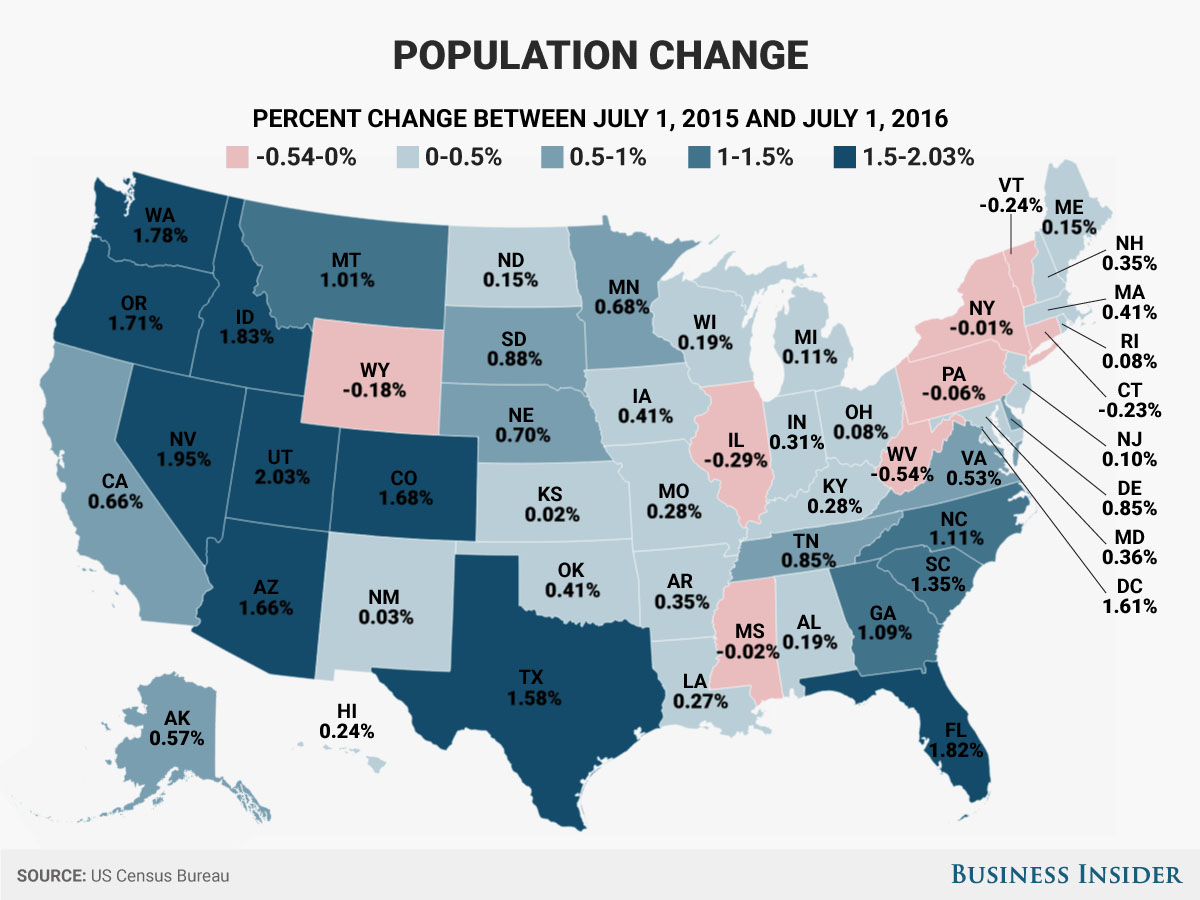
Interestingly the people of America are not entirely in tune with the above opinions.  Below is a U.S. Census map showing the change in population from July 1, 2015 to July 1, 2016.  California’s low percentage growth is a consequence of being the most populated state. With 10 year growth of 11% it now has a population of over 39 million people.  As there are over 324 million people in the USA, that means that 12% of the all Americans live in California.

population-change-7-1-2015-to-7-1-2016