Consequence of the Pulse Nightclub Terrorist Attack

There are two obvious consequences of the Pulse night club terrorist attack combined with the terrorist attack in San Bernardino California.

  • There will be more invasion of privacy.
  • The fight against terrorism will be a major issue in the presidential election.

One day after the Boston Marathon bombing the FBI released pictures of the Tsarnaev brothers. That was thanks to the battery of cameras that were mounted to buildings and light poles in the area.

We may relish our freedom but the fear of more terrorist attacks will, I believe, cause many Americans to willingly surrender that desire to prevent attacks in the future.

The NRA’s contention that more guns will stop terrorist attacks has proven worthless. Florida, where this latest attack occurred, did not stop the attack simply because most people do not carry weapons. Concealed guns are permitted in Florida.

Donald Trump will be tempted to call for more surveillance of Muslims in the United States. If he does propose that surveillance, American’s fear might prevail.

I anticipate that no matter who wins the general election we will see more loss of personal freedom.

President Barack Obama offered this statement today. “We Have To Decide If This Is The Kind Of Country We Want To Be.  …To actively do nothing is a decision as well.”

The Domino Effect of Outsourcing

From coast to coast, middle-class communities are shrinking

Fully 1 in 3 Americans who work in the manufacturing sector are receiving some form of public assistance, according to a study released this week by the UC Berkeley Center for Labor Research and Education. Of those who came to their positions through temp agencies half are on some type of safety net program. This was reported by CNBC.

I took a drive up to the Griffith Park Observatory here in Los Angeles last month. It wasn’t for going inside the building. It was a windy day and I anticipated a beautiful view from the parking lot. I was not disappointed. I obtained a photo that included a view of Catalina Island on the horizon. The distance is about 35 miles from the observatory.

I chose an alternate route back home and drove by Los Angeles City College. To my shock the sidewalk across the boulevard was lined with the tents and shelters of the homeless packed closely together. According to the Los Angeles Times there are now an estimated 44,000 homeless people in Los Angeles County. How did the numbers get so big?

Sports Chalet (more than 50 locations primarily in California) and Sports Authority (463 stores) are closing all of their stores. They started those closings last month. Kohl’s is closing 18 stores and laying off more than 1,500 employees. Where will the laid off workers go?

Back in November 2015 Macy’s Department stores reported a sharp drop in quarterly sales and lowered their forecast for 2016. Macy’s reported unsold goods piling up in their stores. Today they reported another quarter of sinking sales and once again slashed its financial targets for the rest of the year.

Meanwhile where are the jobs of the past here in Los Angeles and elsewhere in the United States? Those were the thousands of aerospace engineering jobs that were a major contributor to the strong California middle class that are mostly gone. The falloff in manufacturing jobs during the past 14-year period has caused factories to shed about 5 million workers from their payrolls nationally. Factories from all over the nation have moved to other countries. In their place are low paying service jobs that offer pay rates as low as $7.25, $15, and $25 an hour. Those jobs do not support a middle class family. They certainly do not support a Macy’s or Sports Authority price line.

Discount chains like T.J. Maxx and fast-fashion retailers such as H&M offering jeans as cheap as $17 and polo shirts for $10 are succeeding because that’s all today’s workers can afford.

So businesses keep outsourcing your work to low cost countries because you see it as a way to higher profits. Just remember that those of us left with those low paid jobs will be shopping at Walmart, Target, and the other afore-mentioned discount stores.  The vicious cycle continues to drive people from the middle class to poor and homeless.

Don’t tell me you do not know what happened to the middle class.

The Nominees

The Nominees

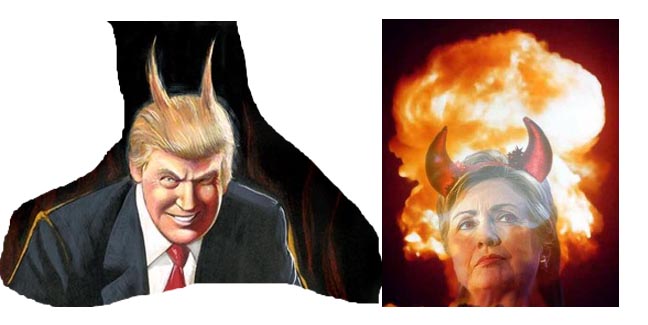
Neither of these candidates are good for America. I see two Twilight Zone Devils.

In other words they appear reasonable until the until the last moment when they will do their nasty acts.  Of course we won’t know that until it has happened.

Hillary Clinton is an insider who has too many donors that will have the final say on her actions as president. She is most likely to follow the philosophy of her husband (former President Bill Clinton). Recall that he signed the law revoking the Glass-Steagall act of 1933 that prohibited commercial banks from engaging in the investment business. He also signed into law NAFTA, a law proposed by Republicans and pushed by President George H.W. Bush that resulted in numerous companies relocating to Mexico.

Donald Trump has no experience in public office and does not appear to understand the workings of the federal government. He clearly does not understand the total significance of the Bill of Rights. “One of the things I’m going to do if I win… I’m going to open up our libel laws so when they write purposely negative and horrible and false articles, we can sue them and win lots of money,” Trump said during a rally in Fort Worth, Texas. He has limited understanding of the relations the United States has with other countries and like most of us does not know a great deal about our military capabilities. He is a scholar of business.

Let’s start with Hillary Clinton.

  1. There is no explanation to be found where she tells where she was and what she was doing when Benghazi, Libya was attacked.
  2. The use of her private e-mail server does not appear to have compromised anything. However, her use of that device calls into question her judgement.
  3. There is no theme to her campaign for president. Her entire theme seems to be she will continue the Obama administration and the banners saying “She’s with Us” and “Fighting for us.” The number one reason Hillary should be our next president according to her web site is “As a former secretary of state, U.S. senator, first lady, and a lifelong advocate for women and families, no one is more qualified to be president than Hillary.”

Let’s look at Donald Trump.

  1. He has never held any elected office.
  2. People might ask “How is Donald Trump able to file for bankruptcy so many times?” The answer is “He didn’t.” Trump himself has never filed for bankruptcy. His corporations have filed for Chapter 11 bankruptcy four times. This information from http://thelawdictionary.org/.
  3. Is he a buffoon? A genius? An exploration of the man, his brand, and his chronic bluster at The Atlantic offers a perspective.
  4. Foreign trade is a big part of the Trump campaign. Donald Trump’s trade war could kill millions of U.S. jobs contends Jim Tankersley in The Washington Post.

Go ahead and choose your devil. Just understand that in four years you will be ready for another unacceptable president. Ugh!!

$15 Minimum Wage: Booby Prize for American Workers

By Joel Kotkin

(Joel Kotkin is R.C. Hobbs Presidential Fellow in Urban Studies at Chapman University. He is executive editor of New Geography … where this piece originated and executive director of the Center for Opportunity Urbanism.)

Almost everything that Mr. Kotkin has written is accurate. It is something those who pushed the $15 minimum wage law in Sacramento knows. The question Mr. Kotkin and everyone objecting to the new minimum wage fails to answer is: How does this society contend with a population that “has seen a rapid decline in traditional blue-collar jobs?” Those blue-collar citizens are the driving force behind the crowds drawn by Donald Trump and Bernie Sanders. They may not have the answers but they understand that the masses are in dire straits. Or perhaps there is no solution and Mr. Kotkin is correct in concluding that we are going to return to a feudal society.

This article has been abridged.

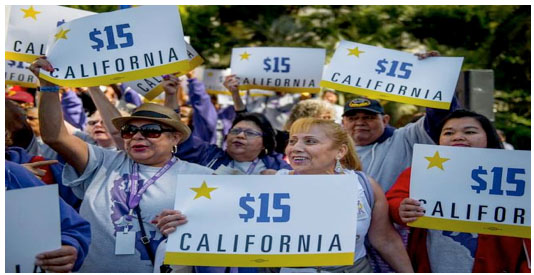
$15 California

NEW GEOGRAPHY–In principle, there is solid moral ground for the recent drive to boost the minimum wage to $15, with California and New York State taking dramatic steps Monday toward that goal. Low-wage workers have been losing ground for decades, as stagnant incomes have been eroded by higher living costs.

Yet if the campaign to boost the minimum wage reflects progressive ideals, the underlying rationale also exposes the failure of these high-priced cities to serve as launching pads for upward mobility for the vast majority of their residents. In effect, the fight for $15 is a by-product of giving up – capitulating on the idea that better opportunities can be created than the menial service jobs that increasingly are the only opportunities for the urban poor. Higher wages will make these jobs moderately more tolerable, while further cementing the wide gulf between the haves and have knots.

New York, San Francisco, LA and Seattle are at the forefront of a new urban economy, based on industries such as finance, technology and media, that generally creates jobs for the highly educated only. Virtually every region at the cutting edge of the minimum wage movement has seen a rapid decline in traditional blue-collar jobs — notably in manufacturing — which often paid well above the minimum wage, and offered potential for further individual advancement.

In these and other core cities, we are seeing something reminiscent of the Victorian era, where a larger proportion of workers are earning their living serving the wealthy and their needs as nannies, restaurant workers, dog-walkers and the like. In New York City, as of 2012, over a third of workers were employed in low-wage service jobs, a percentage that rose through the recovery from the Great Recession, according to a study by the Center for an Urban Future.

Given shrinking opportunities for middle and working class people, it’s not surprising that many seek a more direct redress from the government.

Essentially the minimum wage campaign rests on the notion that traditional middle class uplift cannot be achieved. The problem is, a $15 an hour income represents hardly enough to pay the rent for a small apartment anywhere near the blue cities where the new minimum will hit first.

The  impact in California will, if anything be larger, as the wage hike will be imposed in a wider fashion on a hugely diverse state.

To be sure, higher wages could be a blip in wealthy and thoroughly de-industrialized places like San Francisco – if higher labor costs boost the price of beet-filled ravioli, it doesn’t undermine the market in a place where hipsters and elite workers still have dollars to spend.

Perhaps the greatest beneficiaries of the minimum wage hike will not be the bulk of lower wage workers in blue states, but the people who increasingly dominate their economies.

And as the American Interest recently predicted, those most likely to benefit down the line from the higher wages will be the tech companies that will come up with the software and automated systems that replace the service jobs now made less economically competitive by the wage hikes. It’s not a loony fringe concept: the President’s Council of Economic Advisers recently estimated that lower-wage service jobs have an 80% probability of being automated.

So in the end, a $15 minimum wage, set in the low growth economy of our times, may end up boosting the very class-based hierarchies that are already increasingly evident. Ultimately it may represent a case of a well-intentioned measure that, while sounding radical, only accelerates our road back to feudalism: a society dominated by the few where many depend on the generosity of their betters and the middle class, already shrinking, fades into the dustbin of history.

Americans Are Struggling with Behavior that Contradict with their Beliefs

Ted Cruz and Donald Trump understand Americans real beliefs and hatreds and are playing on those viewpoints.

Strictly religious Christians and Jews have very rigid laws about human behavior. They really do not want any behavior by anyone that conflict with their beliefs

Thus we see laws proposed (and some signed into law) in Arkansas, Georgia, and Indiana that would protect the rights of people who choose to discriminate. Specifically these laws give people the right to discriminate against homosexuals and gay marriage. Similarly many states have created laws that limit the right to an abortion.

All of these laws are a response to evangelical Christians, orthodox Catholics and Jews.

However, Muslim beliefs are not to be tolerated by those religious Christians and Jews.

It now appears that money may impact their willingness to tolerate those that are different. The Walt Disney Co. would stop film production in Georgia if they sign into law their right to discriminate law. It is estimated that $106 million is spent in Georgia by Disney. Other companies are contemplating similar action in the three states I have identified. So far, lawmakers in Georgia haven’t heeded those concerns. Legislators in Indiana and Arkansas passed similar bills last year.

What does this situation tell us about Americans? The answer is sadly obvious.

March 28, 2016

Good news!  Under increasing pressure from major corporations that do business in Georgia, Gov. Nathan Deal announced Monday he will veto a bill that critics say would have curtailed the rights of Georgia’s LGBT community.

Donald Trump, the Great Betrayer

The Washington Post Masthead

Now, at long last, the big guns are being brought to bear. Now, at long last, some major Republicans like Mitt Romney are speaking up to lay waste to Donald Trump.

For months Trump’s rivals and other Republicans have either retreated in silence or tentatively and ineptly criticized him for exactly those traits that voters like about him: for being a slapdash, politically incorrect money-hungry bully.

But now finally — at long last — major Republicans are raising their heads and highlighting Trump’s actual vulnerability: his inability to think for an extended time about anybody but himself.

He seduces people with his confidence and his promises. People invest time, love and money in him. But in the end he cares only about himself. He betrays those who trust him and leaves them high and dry.

It’s unpleasant to have to play politics on this personal level. But this is a message that can sway potential Trump supporters, many of whom have only the barest information on what Trump’s life and career have actually been like.

This is a message that can work in a sour and cynical time among voters who already feel betrayed. This is a message that can work because it’s a personality type everyone understands. This is a time when it is not in fact too late, when it may still be possible to prevent his nomination.

The campaign against Trump has to be specific and relentless: a series of clear examples, rolled out day upon day with the same message. Donald Trump betrays.

It can start with Trump University, where Trump betrayed schoolteachers and others who dreamed of building a better life for themselves.

Trump billed his university as a place people could go to learn everything necessary about real estate investing. According to a 2013 lawsuit filed by New York’s attorney general, Eric Schneiderman, more than 5,000 people paid $40 million, a quarter of which went to Trump himself.

Internal Trump University documents suggest that the university wasn’t really oriented around teaching, but rather around luring customers into buying more and more courses.

According to the New York lawsuit, instructors filled out course evaluations themselves or had students fill out the non-anonymous forms in front of them, pressuring them into giving positive reviews. During breaks students were told to call their credit card companies to increase their credit limits. They were given a script encouraging them to exaggerate their incomes. The Better Business Bureau gave the school a D- rating in 2010.

“They lure you in with false promises,” one student, Patricia Murphy, told The Times in 2011. Murphy said she had spent about $12,000 on Trump University classes, much of it racked up on her credit cards. “I was scammed,” she said.

The barrage can continue with Trump Mortgage. On the campaign trail, Trump tells people he saw the mortgage crisis coming. “I told a lot of people,” he has said, “and I was right. You know, I’m pretty good at that stuff.”

Trump’s biggest lies are the ones he tells himself. The reality is that Trump opened his mortgage company in 2006. Others smelled a bubble, but not Trump. “I think it’s a great time to start a mortgage company,” he told CNBC. “The real estate market is going to be very strong for a long time to come.”

Part of the operation was a boiler room where people cold-called clients, sometimes pushing subprime loans and offering easy approval.

Jennifer McGovern had trusted Trump and went to work for him. But she got stiffed in the end. In 2008 a New York State Supreme Court judge ordered Trump Mortgage to pay her the $298,274 she was owed. The bill wasn’t paid. “The company was set up in a way that we could never recover what we were owed,” she told The Washington Post.

The stories can go on and on. The betrayal of investors when his casino businesses went bankrupt. The betrayal of his first wife with his flagrant public affair with Marla Maples. The betrayal of American workers when he decided to hire illegals. The people left in the wake of other debacles: Trump Air, Trump Vodka, Trump Financial, etc.

These weren’t just risks that went bad. They were shams, built like his campaign around empty promises and on Trump’s fragile and overweening pride.

The burden of responsibility now falls on Republican officials, elected and nonelected, at all levels. For years they have built relationships in their communities, earned the right to be heard. If they now feel that Donald Trump would be a reckless and dangerous president, then they have a responsibility to their country to tell those people the truth, to rally all their energies against this man.

Since the start of his campaign Trump has had more energy and more courage than his opponents. Maybe that’s now changing.

Who does Donald Trump remind you of?

Is Donald Trump the new Hitler or a reincarnation of William Jennings Bryan?  In a piece on U.S, News and World Report web site Daniel Klinghard, on March 4, 2016, thinks Trump is reminiscent of Bryan.  Following is a slightly abridged version of the article.


Pundits and academics toyed for a while with branding Donald Trump with the scarlet H – warning of his rise as a replay of the fall of Weimar Germany and the emergence of Adolf Hitler. Trump’s suggestions that the government surveil mosques, deport undocumented Mexicans and prevent Muslims from entering the U.S. was originally hailed as more Nazi than American, until we reflected on the pervasiveness of NSA surveillance, the treatment of Japanese-Americans during World War II and the mass deportations of Operation Wetback in 1954. Indeed, there are enough examples of such Trumpisms in the American tradition for comparisons of demagoguery without having to conjure up Hitler.

Consider William Jennings Bryan, who captured the Democratic presidential nomination 120 years ago in 1896. He made a name for himself as a journalist (both before and after serving as a member of the House of Representatives) and importantly as an orator who toured the country to speak to populist groups and agitate for the abandonment of the gold standard and the adoption of a silver-based currency. In his appeal to lowbrow tastes, his ability to turn politics into popular entertainment and his willingness to play to prejudice against judgment, Bryan was closer to a modern-day reality TV star than Trump is to Hitler.

To secure the nomination, Bryan applied the same rhetorical style that he had honed in prairie schoolhouses and southern convention halls – a popular forum that had been all but ignored by party elites, but through which he generated a “silent majority” that struck the establishment by surprise in 1896.

Among the most popular tools of the Bryan campaign were a series of ill-informed and wildly popular pamphlets featuring a young boy who lectured bankers on the intricacies of global finance. Witty, anti-Semitic and grossly simplistic, they reassured voters that there were solutions to America’s economic woes – solutions so clear that a child could see them. Like Trump, Bryan appealed to what he deemed to be common sense and warned his listeners that anyone preaching moderation only intended to keep the common man in the dark.

Fifteen Democratic candidates received votes for the nomination at the 1896 convention, including six governors, five senators and the sitting vice president of the United States. They never overcame their interpersonal opposition to present a united front against Bryan, a former two-term representative and newspaper editor. Indeed, they hardly considered Bryan a serious contender until the convention met and he delivered his famous “Cross of Gold” speech decrying the gold standard and calling Democrats to an apocalyptic battle against the “Eastern Elites” who dominated both parties.

The elevation of Bryan had long-term implications for his party. His predecessor as Democratic nominee, President Grover Cleveland, had made his career following a formula of running on reform principles and governing pragmatically. After 1896, Cleveland was a man without a party. He refused to support Bryan and retired in despair when Republican nominee William McKinley trounced Bryan and set up the GOP for a thirty-year period of dominance.

Bryan remained the master of what was left of the Democratic Party, despite the clear flaws in his candidacy and his isolation from the party’s establishment – particularly from its traditional major donors, nearly all of whom abandoned the party after 1896.

It is easy to imagine the emergence of an analogous situation under a Republican collapse today, even if it is one with different policy objectives. In fact, if you look at a map of the 1896 electoral college results demonstrating Bryan’s loss, you’re looking at the basic parameters of a Trump loss (with some give and take around the edges, particularly Washington, Virginia and Florida).

If the Republicans of 2016 go the direction Democrats went with Bryan in 1896, it could mean years of wandering in the wilderness. We might look toward such a proposition with hope that the polarized politics of the past fifteen years would at last be broken. But we should also be warned of a democratic deficit, in which the incentives to mobilize in support of Democratic politics would wither along with the possibility of real party competition.

The moment of truth: We must stop Trump

February 28, 2016

Trump won’t disavow support from KKK, David Duke.  His own words on CNN’s State of the Union program.

The Washington Post Masthead

By Danielle Allen February 21, 2016

Danielle Allen is a political theorist at Harvard University and a contributing columnist for The Washington Post.

Like any number of us raised in the late 20th century, I have spent my life perplexed about exactly how Hitler could have come to power in Germany. Watching Donald Trump’s rise, I now understand. Leave aside whether a direct comparison of Trump to Hitler is accurate. That is not my point. My point rather is about how a demagogic opportunist can exploit a divided country.

To understand the rise of Hitler and the spread of Nazism, I have generally relied on the German-Jewish émigré philosopher Hannah Arendt and her arguments about the banality of evil. Somehow people can understand themselves as “just doing their job,” yet act as cogs in the wheel of a murderous machine. Arendt also offered a second answer in a small but powerful book called “Men in Dark Times.” In this book, she described all those who thought that Hitler’s rise was a terrible thing but chose “internal exile,” or staying invisible and out of the way as their strategy for coping with the situation. They knew evil was evil, but they too facilitated it, by departing from the battlefield out of a sense of hopelessness.

One can see both of these phenomena unfolding now. The first shows itself, for instance, when journalists cover every crude and cruel thing that comes out of Trump’s mouth and thereby help acculturate all of us to what we are hearing. Are they not just doing their jobs, they will ask, in covering the Republican front-runner? Have we not already been acculturated by 30 years of popular culture to offensive and inciting comments? Yes, both of these things are true. But that doesn’t mean journalists ought to be Trump’s megaphone. Perhaps we should just shut the lights out on offensiveness; turn off the mic when someone tries to shout down others; reestablish standards for what counts as a worthwhile contribution to the public debate. That will seem counter to journalistic norms, yes, but why not let Trump pay for his own ads when he wants to broadcast foul and incendiary ideas? He’ll still have plenty of access to freedom of expression. It is time to draw a bright line.

One spots the second experience in any number of water-cooler conversations or dinner-party dialogues. “Yes, yes, it is terrible. Can you believe it? Have you seen anything like it? Has America come to this?” “Agreed, agreed.” But when someone asks what is to be done, silence falls. Very many of us, too many of us, are starting to contemplate accepting internal exile. Or we joke about moving to Canada more seriously than usually.

But over the course of the past few months, I’ve learned something else that goes beyond Arendt’s ideas about the banality of evil and feelings of impotence in the face of danger.

Trump is rising by taking advantage of a divided country. The truth is that the vast majority of voting Americans think that Trump is unacceptable as a presidential candidate, but we are split by strong partisan ideologies and cannot coordinate a solution to stop him. Similarly, a significant part of voting Republicans think that Trump is unacceptable, but they too, thus far, have been unable to coordinate a solution. Trump is exploiting the fact that we cannot unite across our ideological divides.

The only way to stop him, then, is to achieve just that kind of coordination across party lines and across divisions within parties. We have reached that moment of truth.

Republicans, you cannot count on the Democrats to stop Trump. I believe that Hillary Clinton will win the Democratic nomination, and I intend to vote for her, but it is also the case that she is a candidate with significant weaknesses, as your party knows quite well. The result of a head-to-head contest between Clinton and Trump would be unpredictable. Trump has to be blocked in your primary.

Jeb Bush has done the right thing by dropping out, just as he did the right thing by being the first, alongside Rand Paul, to challenge Trump. The time has come, John Kasich and Ben Carson, to leave the race as well. You both express a powerful commitment to the good of your country and to its founding ideals. If you care about the future of this republic, it is time to endorse Marco Rubio. Kasich, there’s a little wind in your sails, but it’s not enough. Your country is calling you. Do the right thing.

Ted Cruz is, I believe, pulling votes away from Trump, and for that reason is useful in the race. But, Mr. Cruz, you are drawing too close to Trump’s politics. You too should change course.

Democrats, your leading candidate is too weak to count on as a firewall. She might be able to pull off a general election victory against Trump, but then again she might not. Too much is uncertain this year. You, too, need to help the Republicans beat Trump; this is no moment for standing by passively. If your deadline for changing your party affiliation has not yet come, re-register and vote for Rubio, even if, like me, you cannot stomach his opposition to marriage equality. I too would prefer Kasich as the Republican nominee, but pursuing that goal will only make it more likely that Trump takes the nomination. The republic cannot afford that.

Finally, to all of you Republicans who have already dropped out, one more, great act of public service awaits you. As candidates, you pledged to support whomever the Republican party nominated. It’s time to revoke your pledge. Be bold, stand up and shout that you will not support Trump if he is your party’s nominee. Do it together. Hold one big mother of a news conference. Endorse Rubio, together. It is time to draw a bright line, and you are the ones on whom this burden falls. No one else can do it.

Marco Rubio, this is also your moment to draw a bright line. You too ought to rescind your pledge to support the party’s nominee if it is Trump.

Donald Trump has no respect for the basic rights that are the foundation of constitutional democracy, nor for the requirements of decency necessary to sustain democratic citizenship. Nor can any democracy survive without an expectation that the people require reasonable arguments that bring the truth to light, and Trump has nothing but contempt for our intelligence.

We, the people, need to find somewhere, buried in the recesses of our fading memories, the capacity to make common cause against this formidable threat to our equally shared liberties. The time is now.


Who Cares?

Events effecting local communities rarely receive national attention. Hurricane Sandy and Hurricane Katrina are two that really received massive media coverage. The BP oil spill on the Gulf coast was another attention getter.

The greater concern ought to be government attention when the impacted communities are those of the wealthy versus those of the poor.

In Los Angeles the Southern California Gas Company had a huge natural gas leak, reported to be the largest such leak in American history, near the Porter Ranch neighborhood may cause vomiting, nosebleeds and other short-term symptoms, they say, but they have assured residents that it does not pose long-term health risks. The leak was first reported Oct. 23, 2015. The leak was stopped last week and permanently capped yesterday.

Porter Ranch has a $121,428 median household income (2008 dollars), high for the city of Los Angeles and high for the county according to the Los Angeles Times. Since the leak thousands of residence have been relocated by the gas company at their expense. The area has been blanketed with law firms offering to process suits against the gas company. The real Erin Brokovich visited the area representing a law firm.

Meanwhile the Exide battery factory in Vernon, an industrial community 15 miles southeast of downtown Los Angeles has been operating since 1922. That factory has been spilling lead, arsenic, cadmium and other toxic metals on the ground and contaminating homes and yards in surrounding communities as well a ground water in the surrounding area these past 90 years. The people living in the nearby residential communities are all low income residents estimated to total 110,000 people.

Now the Exide company has agreed to close the facility. But where has the government been since 1922? Where was Erin Brokovich all these past years?

Will anyone in Michigan see jail time for the Flint, Michigan contaminated water system? Not only will there be no jail time it is unlikely anyone will lose their job.

Unless there is money to be made no one cares.