America Has Not Been and is Not Now Friendly to Immigrants

The reality is that the United States has not been the welcoming nation that is portrayed by many of America’s leaders. The verse on the Statue of Liberty was more likely a wish than a fact.

The reality is immigrants have been welcomed in the United States when there has been a labor need. The outstanding situations were building the railroads that brought thousands of Chinese in the 1800s, the flourishing factories of the early 20th century, and today the need for farm workers, gardeners, hotel workers, and restaurant workers-the jobs Americans don’t want to do.

Look at America’s history starting with the second administration of the United States. John Adams, our second president signed four bills into law referred to as The Alien and Sedition Acts. The Alien Friends Act allowed the president to imprison or deport aliens considered “dangerous to the peace and safety of the United States” at any time, while the Alien Enemies Act authorized the president to do the same to any male citizen of a hostile nation, above the age of 14, during times of war. Clearly, the Federalists saw foreigners as a deep threat to American security. As one Federalist in Congress declared, there was no need to “invite hordes of Wild Irishmen, nor the turbulent and disorderly of all the world, to come here with a basic view to distract our tranquillity.” Not coincidentally, non-English ethnic groups had been among the core supporters of the Democratic-Republicans in 1796. Those Democratic-Republicans were the party opposing the Federalists.

Then in 1875 came the Page Act. The law was named after its sponsor, Representative Horace F. Page, a Republican who introduced it to “end the danger of cheap Chinese labor and immoral Chinese women.” It was the first federal immigration law and prohibited the entry of immigrants considered as “undesirable.” The law classified as “undesirable” any individual from Asia who was coming to America to be a contract laborer.

In 1882 the Chinese Exclusion Act restricted immigration of Chinese laborers for 10 years and prohibited Chinese naturalization.

Then in 1891 the First comprehensive immigration laws for the US. The Immigration Bureau, created by the law, was directed to deport unlawful aliens.

The 1898 the Supreme Court case United States v. Wong Kim Ark, the decision resulted in the recognition of the 14th amendment as taking priority and the ruling that all Chinese children born in the United States are citizens of the United States.

The Emergency Quota Act of 1921 limited the number of immigrants from any country to 3% of those already in the US from that country as per the 1910 census.

The 1924 Immigration Act imposed first permanent numerical limit on immigration and thus began a national-origin quota system.

In 1954 under the direction of President Eisenhower, Operation Wet Back sent about 1 million Mexicans back to Mexico. Many of the deportations probably included many legal residents of the United States.

I have not covered all of the history of immigration into the United States but you certainly get the message that this country has not been friendly to immigrants. They have been used when there was a labor shortage of people willing to do the work that most Americans won’t do.

So why would the United States be willing to grant entry to Syrians, Iraqis, and other Middle Easterners? It’s not likely. There is no current need for more people in the United States. There is little evidence of sympathy. Read this article in the Washington Post on American opinion about permitting the migration of Jews in the late 1930s. The article shows a Gallup poll that indicated 61% of Americans at that time opposed allowing 10,000 Jewish refugee children into the United States.

Unless you bring a technical skill or money that will create jobs we really don’t want you to immigrate to our country. Those people from the Middle East don’t follow our religion, don’t understand our culture, and don’t speak our language. We really don’t want you!

David Bancroft
What Makes America Great?


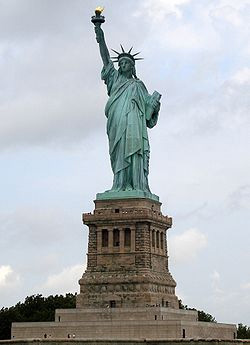
  Statue of Liberty

  First read this.

Give me your tired, your poor,
Your huddled masses, yearning to breath free,
The wretched refuse of your teeming shore,
Send these, the homeless, tempest tost to me,
I lift my lamp beside the golden door.

That is the inscription on the Statue of Liberty written by Emma Lazarus.

It’s been there since 1903. The statue itself was erected in 1886. It was a prefect poem (sonnet) to place on Lady Liberty.

We all take it seriously in America until we are confronted with people trying to obtain entry into this country. Some GOP candidates for president need to read that poem and remember their roots. Ted Cruz and Marco Rubio are the outstanding leaders of the group that do not want to devise a path to citizenship for the people who prepare their meals, wash their dishes, make their beds, and cut their lawns.

By late Monday, states refusing Syrian refugees included Alabama, Arkansas, Arizona, Florida, Georgia, Idaho, Illinois, Indiana, Iowa, Kansas, Louisiana, Maine, Massachusetts, Michigan, Mississippi, Nebraska, New Hampshire, New Mexico, North Carolina, Ohio, Oklahoma, South Carolina, Tennessee, Texas and Wisconsin.

Have we lost our collective mind? America was built on refugees. They are the people who made this country great. Jamie Dimon, Chairman and CEO of JP Morgan Chase is the grandson of a Greek immigrant. Similarly millions of Americans are the children or grandchildren of immigrants.

So your next door neighbors and the people you see on the streets don’t look like you and maybe they have different religious beliefs but they all – we all – have one thing in common – our families all agree the United States is a country where everyone can work and live at our full potential. Somehow we seem to have forgotten that idea.

It’s time we all started acting like Americans.

Why Ben Carson has no business near the Oval Office

by Los Angeles Times commentator Doyle McManus, on line and in print November 11, 2015

Ben Carson #2

I don’t really mind that Ben Carson thinks the pyramids in Egypt were used to store grain; that’s a folk belief that’s been around since the Middle Ages. At least he dismisses the theory that the pyramids were built by space aliens.

And I don’t really mind that Carson’s autobiography, by his own admission, isn’t precisely accurate on every detail. He still insists that he tried to kill a classmate with a knife, an unusual claim for a presidential candidate. But even if that story was an exaggeration, it’s harmless myth-making — a dramatization of how low the teenage Carson had sunk before God intervened to shape him up. Barack Obama’s autobiography used creative license to make him sound like a juvenile delinquent, too.

Here’s what I do mind: Even though Carson considers himself brilliant, he doesn’t seem to care much about the actual duties of a president. His speeches, interviews and books betray a shaky grasp of economic and foreign policy, to put it kindly. And when a candidate is tied for first place for the Republican nomination in most polls, that’s no laughing matter.

Case in point: His comments about the federal budget.

Carson has proposed turning the income tax into a 15% flat tax on rich and poor alike — a massive tax cut for the wealthy (and tax increase for the poor) that would reduce federal revenue by more than half a trillion dollars, according to most estimates.

But more than a year after he began running for president, the good doctor still hasn’t explained how he would fill the yawning budget gap his tax cut would produce.

Indeed, this week he appeared to make the problem worse. Previously, Carson said he would cut federal spending by 3% to 4% across the board (except for the military, which he would grow). Now he says the cuts would amount to only 2% or 3% — a more realistic target, but one that would only widen the deficit.

Where are the details? There aren’t any available; none of these plans has been reduced to paper. A Carson spokesman told me that the campaign hopes to release specific proposals by the end of the year.

I don’t envy Carson’s aides; the candidate often sounds confused.

“The lion’s share of the gross domestic output is consumed by the federal government,” he complains in his latest book, “A More Perfect Union.” Actually, no: Federal spending consumes about 20% of GDP while consumer spending takes the true lion’s share: almost 70%.

On the public radio show “Marketplace” last month, Carson was asked whether he would block an increase in the federal debt ceiling. “I would not sign an increased budget,” he replied. No, his interviewer clarified, the question was about debts already incurred, not future spending. Carson still seemed to think they were the same thing. “We’re not raising any spending limits, period,” he said.

His vagueness and apparent lack of understanding on those counts isn’t comical; it’s troubling. Next to Carson, Ronald Reagan was a detail-oriented policy wonk.

Economics isn’t his only blind spot.

In his book, Carson argues that federal judges shouldn’t be allowed to rule on the constitutionality of state ballot initiatives like California’s Proposition 8, which the Supreme Court overturned in 2013.

“Having a ballot referendum on an important issue is a farce if a federal judge can throw out the results,” he writes. He suggests, as a remedy to this problem, that Congress simply impeach any judge who “ignores the will of the people.” So much for the Constitution.

Carson thinks the U.S. military should be taking the lead in ground combat against Islamic State in Syria and Iraq. “I would commit everything to eliminating them [Islamic State] right now,” he said. That’s a controversial position, but a defensible one. Here’s where Carson goes off course: He argues that U.S. forces shouldn’t be bound by the laws of war.

“There is no such thing as a politically correct war,” he told Fox News. “If you’re going to have rules for war, you should just have a rule that says ‘no war.’ Other than that, we have to win.”

Carson is, by all accounts, a brilliant surgeon. He’s a splendid motivational speaker and an admirable philanthropist. But he’s not ready to be chief executive of the United States.

In his books, he often mentions incidents in which God intervened in his life. When he neglected to study at Yale, God showed him the answers on a chemistry exam. When he fell asleep while driving home one night, God spared his life. When he used new surgical techniques on children’s brains, God saved some of his patients. And when he was on a safari in Africa, God answered his prayer for plenty of photogenic wildlife.

Now that he’s running for president, Carson sounds as if he’s counting on divine intervention to pull him through again. There can be no doubt about the sincerity of Carson’s Christian faith or his belief in the power of prayer. But voters — even the most devout — deserve more earthly evidence that he’s up to the job.

doyle.mcmanus@latimes.com

Buy-Outs, Forced Retirement and Age Discrimination

Your employer is in financial difficulty and needs to find a way of saving cash until there is a recovery.

If you work for a newspaper or magazine you are in an industry that is in serious decline then recovery is in doubt. The Washington Post seems to have recovered thanks to a purchase by Jeff Bezos, founder of Amazon. BusinessWeek magazine was bought by Michael Bloomberg and is thriving. Newsweek and U.S. News and World Report are gone. Tribune Publishing Company that owns the Chicago Tribune, the Los Angeles Times and other newspapers is in dire straits.  The Los Angeles Times is currently attempting to offer buy-outs to their staff.  Sports writer Bill Dwyre, a gray-haired man with years of experience and probably high pay just announced his retirement.  Other outstanding columnists with that paper are probably also going to take their leave.

General Motors and Ford Motor Company both went through some very difficult economic times as have   many other companies.

In every instance they all followed the same path. Cut the high cost employees and reduce the pay to the remaining employees. I know people who were part of the buy-out, those who faced the reduced pay, and those who were simply laid-off. I was party to that situation more than once.

The issue for those losing their jobs is their age. Once you are older, 55 or older, obtaining another job at the same pay as was previously received is difficult and in most cases impossible.

Age discrimination is rampant and impossible to prove. “Age discrimination involves treating someone (an applicant or employee) less favorably because of his or her age. The Age Discrimination in Employment Act (ADEA) only forbids age discrimination against people who are age 40 or older.” That is the statement posted on the EEOC on their web site.

From Forbes magazine dated January 31, 2014

The Ugly Truth About Age Discrimination (abridged)

“So then the headhunter said something that took my breath away,” said my caller, Philip.

“He told me that his client looked at my resume and said it looked great, but then he found my LinkedIn profile and decided I’m a little long in the tooth for the job.”

I was silent. That took my breath away, too.

“Long in the tooth?” I asked. “As in old?”

“Exactly,” said Philip. “The headhunter actually told me that the client said I was too old for the job. I asked him if that was illegal – I’m pretty sure it is – and he said that the client’s view is that if they don’t interview me, I’m not a candidate, so it’s not discrimination.”

“That’s false,” I said, but even as I said it, I knew that it doesn’t make any difference.

What is Philip going to do – sue the employer he never met because a third-party recruiter told him that one hiring manager made an inappropriate comment? So-called Failure to Hire cases are notoriously hard to bring and even harder to prove. As long as the organization ends up hiring someone who is qualified for the job, how could Phil ever prove that he was rejected because of his age? It’s not as though the organization is going to publish the new hire’s age for all the other candidates to see.

Age discrimination is everywhere. I hear more examples of age discrimination than I hear about sex discrimination, racial discrimination and every other kind put together. I expect that’s because some employers believe that older workers aren’t as nimble or perhaps aren’t as easy to train. Some of them undoubtedly worry that an older person is necessarily overqualified, and thus likely to bolt the minute a better job comes along.

I was there too. At the age of 60 in an interview the president of the company, he asked me if I was a grandfather. My answer was no and that was accurate. The thought running through my head was I would not be obtaining this job. To my surprise I did receive the job offer. I went on to two promotions proving that older employees can thrive.  Could I have brought a successful suit against that employer? There was no proof that the question was asked.

I know of no solution. Businesses thrive, businesses shrivel, life goes on. As the population ages the issue of age discrimination will fade away.

How Big Business Continues to Take More from Everyday Americans

Walgreens Drug company, officially named Walgreens Boots Alliance Inc., on Tuesday agreed to buy Rite Aid Corp. for about $9.4 billion, combining two of the nation’s largest drugstore chains as they bulk up to increase their profits. The claim is that they are doing this to better compete in the rapidly changing health care industry.

The two companies didn’t say whether they would shutter stores or lay off workers after the deal closes. But they did say that “decisions will be made over time regarding the integration of the two companies” and that Walgreens “plans to further transform Rite Aid’s stores to better meet consumer needs.”  A Rite Aid is about 3/4 mile from my house and a Walgreens is about one mile from my house.  Do you think both will remain open after this consolidation?

Soon when you say “I am going to the drug store” no one will ask which one because there will be only one. That is also likely to happen in the retail food market business as Kroger continues its march to own all the general purpose food stores no matter what the brand name is on the front of the building. In Los Angeles both Ralphs and Food 4 Less are owned by Kroger.

The dismaying part of this march to consolidation is the reduced competition and the ensuing price hikes. No matter what those companies say, when there is reduced competition there are price increases.

The saddest part of this situation is that our congress sits on its hands and does nothing to stop the consolidations. This is the reason that Donald Trump, Ben Carson, and Bernie Sanders are all doing well in the presidential polling. They say that they will stop the control of our society by the wealthy.

Can we believe those outsiders? The insiders certainly have not done the job.

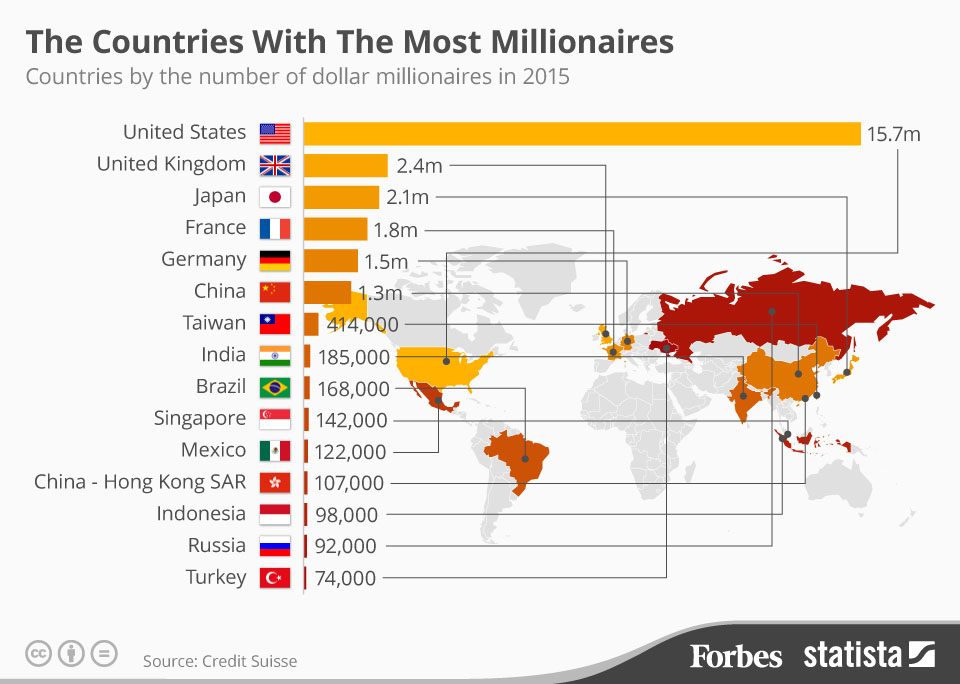
The Countries with the Most Millionaires

Senator Bernie Sanders is correct when he says that 1% of our citizens control more wealth than the bottom 90%. A new report posted on cnn.com references an English company named Oxfam estimates that the richest 1% will have as much wealth as the other 99% combined by next year. Just Google these words: “does 1% of Americans own 90% of the wealth” and you will find numerous web sites that confirm the Sanders contention. The United States is the overwhelming home of millionaires.

From Forbes Magazine date October 15, 2015

“The United States has the world’s biggest millionaires club by a huge distance. No other country comes even close to matching it. According to Credit Suisse Global Wealth Report, the U.S. was home was home to 41% of the world’s millionaires in 2014, and its share grew by 46% in 2015.”

“Wealth has risen has risen in the U.S. for the seventh year in succession and the U.S. millionaire population now stands at 15/7 million, according to the report. The United Kingdom comes a distant second at 2.4 million, while Japan rounds of top three countries with a population of 2.1 million.”

Countries with the most millionaires

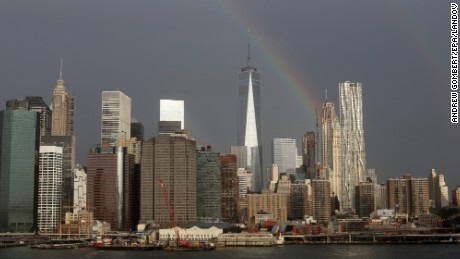
This situation probably explains the ever higher costs of living in NYC, San Francisco, and Los Angeles.

So should we vote for Mr. Sanders based upon these facts? My response: 1) what would he do to change this reality? 2) Is this situation a bad thing?

Jeb Bush and Multiculturalism

Most nations in the world reject multiculturalism.  Even in Canada they have decided to define Quebec as the French speaking, French oriented province while the rest of the country speaks English and is oriented towards the UK.

CNN reported that Jeb Bush argued today that the United States is “creeping toward multiculturalism” and described it as “the wrong approach.”

But Bush, who’s fluent in Spanish and lives in Miami, has made cultural diversity a key staple in his campaign. He routinely talks about his wife, who’s from Mexico, and the “bicultural” children that they’ve raised together. On Monday, while addressing the Hispanic Chamber of Commerce in Houston, Bush lauded the country’s mixture of cultural backgrounds, saying the immigrant experience adds a “vitality that is different and unique and extraordinary for our country.”

So what is Jeb Bush’s real opinion? At this point in the race to win the GOP nomination I am guessing that his words today, Tuesday, are meant to win the Conservative vote in Iowa.

His real problem is that his desire to win the nomination has made him turn and twist as Mitt Romney did in 2012. We all know how that worked out. No one believed him in the race against Obama and the loss that year was overwhelming.

No matter who the Democratic nominee is; Jeb as the GOP candidate, will face the argument that he does not have a clear reliable opinion and cannot be trusted on any issue.   The Democrats are collecting the words of every GOP candidate and will be using them after the conventions in 2016. Hillary couldn’t be happier.

Presidential Debates where the Candidates Tell Us Nothing About Real Issues

A bizarre three hours.

After listening to the second GOP debate you would think that the choice for president is all about who would have his/her finger on the nuclear button and who has been the smartest CEO.  Trump says the leaders of other countries are destroying American jobs but offers no solutions (at least he has identified the loss of jobs as an issue).

Or is the real threat to America the Muslim world.

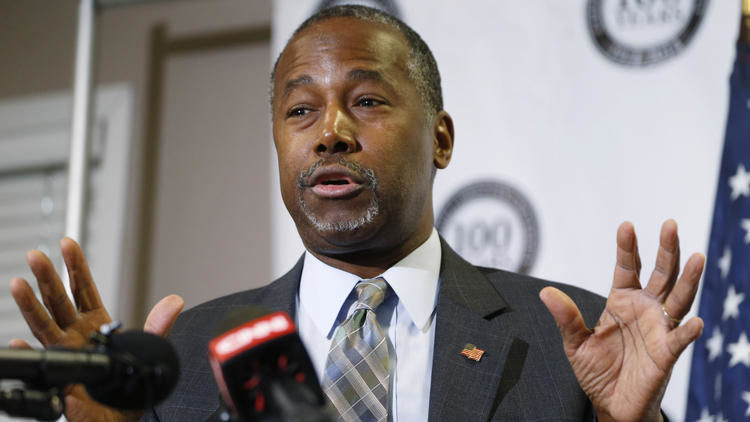
Republican presidential candidate Dr. Ben Carson said he would not support a Muslim as President of the United States.  Responding to a question on “Meet the Press” today, the retired neurosurgeon said, “I would not advocate that we put a Muslim in charge of this nation. I absolutely would not agree with that.”  He also said that Islam, as a religion, is incompatible with the Constitution.

On that Meet the Press program commentator guest Hugh Hewitt, who is also a constitutional scholar, pointed out that the sixth article of the Constitution specifically says that religion shall not be a criteria to hold any office.  The end of the last sentence in that article reads, “but no religious test shall ever be required as a qualification to any office or public trust under the United States.”

The problem is that the voting public can decide they do not want anyone to hold office that is not a Christian.  This is not a new issue.

We have a spotty history of bias against those who hold beliefs that are not held us (that personal us).  Laws aside, the first Catholic to run for President was campaigned against because of his religion.  Al Smith was the first Roman Catholic presidential nominee, and lost the 1928 election in a landslide to Republican Herbert Hoover.  Influential Lutherans and Southern Baptist ministers believed the Catholic Church and the Pope would dictate Smith’s policies.

Source: Boundless. “Al Smith and the Election of 1928.” Boundless U.S. History. Boundless, 21 Jul. 2015. Retrieved 20 Sep. 2015 from https://www.boundless.com/u-s-history/textbooks/boundless-u-s-history-textbook/from-the-new-era-to-the-great-depression-1920-1933-24/resistance-to-change-188/al-smith-and-the-election-of-1928-1045-2231/

Much of those very same arguments against Al Smith were again used when John F. Kennedy ran for president.  Americans were not dissuaded by the anti-Catholic arguments and Kennedy won.  The 1960 presidential race was one of the closest elections in U.S. history.  The popular vote was 49.72% for Kennedy against 49.55% for Richard Nixon.  303 electoral votes for Kennedy of the 537 total electors.

Anjem Choudary, a famous Muslim cleric in the U.K., in 2013 said, “Inevitably, I’m convinced, I’m 100% certain that the sharia will be implemented in America and in Britain one day. If we have enough authority and power, we are obliged as Muslims to take the power away from the people who have it, and implement sharia law.”

Chris Christy accurately pointed out in that last debate that the public wants to hear specifics about what candidates would do to help Americans obtain decent middle class jobs.  Did any of the other candidates hear his message?  I doubt it.

In my opinion no candidate in either party are worth voting for.  None have proposed any specific actions they would take on any issue.

Bernie Sanders’ Labor Day Index

This is an OP-ED article in today’s Los Angeles Times. It is posted under Senator Bernie Sanders name. The data is not news to me but might be news to you.

Bernie Sanders


Amount a full-time worker must earn per hour to afford the average two-bedroom apartment in Los Angeles:

$27.38

Factor by which this exceeds the city’s current $9-an-hour minimum wage

3.04

______


Number of manufacturing jobs in the United States on Jan. 1, 2000

17.3 million


Number last year:

12.1 million

______


Percentage change in annual worker compensation from 1978 to 2013:

+10.2

Percentage change in annual CEO compensation from 1978 to 2013:

+937

______


Average CEO pay in the S&P 500:

$13.8 million

Amount of the top-compensated CEO,

David Zaslav of Discovery Communications,

was paid in 2014:

$156 million

Median salary at Discovery Communications in 2014:

$80,000

______


Median weekly earnings for full-time workers in 2015:

$801

For female full-time workers:

$726

______


Real national unemployment rate:

10.3%

(This is from the BLS Table A15, U6 data, 8-31-15)


For young White high school graduates:

33.8%


For young African American high school graduates:

51.3%

______


Percentage of the entire wealth of the United States owned by the top 1%

41


Percentage owned by the bottom 60%:

2

______


Percentage of Americans without health insurance for at least part of the year 2013:

11.7

Percentage of Canadians:

0

Percentage of Israelis:

0

______


Number of countries in the Organization for Economic Cooperation and Development (OECD) that mandate some form of paid family leave:

33

Number of OECD countries that do not:

1


Percentage of U.S. workers without access to paid family leave:

87

______


Number of American children living below the poverty line is 2012:

24.2 million

______


Percentage of Americans who still believe in the American dream:

64