An Eradic Behavior

“Trump’s ‘will he, won’t he’ tariff chaos is just one more con on working people.”

That’s what Melinda St. Louis, Global Trade Watch director at the watchdog group Public Citizen, said in a Wednesday statement after U.S. President Donald Trump announced a 90-pause for what he has called “reciprocal” tariffs, excluding China.

It seems Donald Trump wants a recession. Why? A recession will drive down the price of real estate, companies, and shares of stock. Trump and his fellow billionaires want o buy everything on the cheap and then enjoy the ride upward-no matter the cost to working people.

“OUR PLAN IS WORKING PERFECTLY AND IS JUST A NEGOTIATING TACTIC BUT IT IS ALSO GOING TO BE PERMANENT AND WE WILL BE THE WORLD LEADER IN TEXTILES AND NOW THERE IS A PAUSE AND EVERYONE NEEDS TO CHILL BUT ALSO WE WILL NEVER BACK DOWN AAAAAAHHHHHH.”

US stocks tumbled today after the White House clarified that its tariff on all Chinese goods was at least 145% — even higher than previously believed. This comes a day after US stocks skyrocketed following President Donald Trump’s announcement of a 90-day pause on all “reciprocal” tariffs, except for China. Beijing, meanwhile, implemented its own retaliatory tariffs of 84% on US goods.

• Trade negotiations: Trump just defended his tariff policy in a Cabinet meeting, saying his administration is “working on deals” with multiple countries. Earlier today, the EU announced it would pause its retaliatory US tariffs for negotiations. Even after Trump’s U-turn, economists say the damage is done.

DOW down 1,835.94, S&P 500 down 281.5 5.5% mid-day April 10,2025

A majority of Americans voted for Donald Trump!

Trump consistently frames policy around ‘fairness,’ trading on American frustration

A long article worth reading.

By Kevin Rector, Staff Writer for the Los Angeles Times

In a sit-down interview with Fox News last month, President Trump and his billionaire “efficiency” advisor Elon Musk framed new tariffs on foreign trading partners as a simple matter of fairness.

“I said, ‘Here’s what we’re going to do: reciprocal. Whatever you charge, I’m charging,’” Trump said of a conversation he’d had with Indian Prime Minister Narendra Modi. “I’m doing that with every country.”

“It seems fair,” Musk said.

Trump laughed. “It does,” he said.

“It’s like, fair is fair,” said Musk, the world’s richest person.

The moment was one of many in recent months in which Trump and his allies have framed his policy agenda around the concept of fairness — which experts say is a potent political message at a time when many Americans feel thwarted by inflation, high housing costs and other systemic barriers to getting ahead.

“Trump has a good sense for what will resonate with folks, and I think we all have a deep sense of morality — and so we all recognize the importance of fairness,” said Kurt Gray, a psychology professor at University of North Carolina at Chapel Hill and author of the book “Outraged: Why We Fight About Morality and Politics and How to Find Common Ground.”

“At the end of the day,” Gray said, “we’re always worried about not getting what we deserve.”

In addition to his “Fair and Reciprocal Plan” for tariffs, Trump has cited fairness in his decisions to pull out of the Paris climate agreement, ban transgender athletes from competing in sports, scale back American aid to embattled Ukraine and pardon his supporters who stormed the U.S. Capitol on Jan. 6, 2021.

Trump has invoked fairness in meetings with a host of world leaders, including Japanese Prime Minister Shigeru Ishiba and British Prime Minister Keir Starmer. He has suggested that his crusade to end “diversity, equity and inclusion” programs is all about fairness, couched foreign aid and assistance to undocumented immigrants as unfair to struggling American taxpayers, and attacked the Justice Department, the media and federal judges who have ruled against his administration as harboring unfair biases against him.

Trump and Musk — through his “Department of Government Efficiency,” which is not a U.S. agency — have orchestrated a sweeping attack on the federal workforce largely by framing it as a liberal “deep state” that either works in unfair ways against the best interests of conservative Americans, or doesn’t work at all thanks to lopsided work-from-home allowances.

“It’s unfair to the millions of people in the United States who are, in fact, working hard from job sites and not from their home,” Trump said.

In a Justice Department speech this month, Trump repeatedly complained about the courts treating him and his allies unfairly, and reiterated baseless claims that recent elections have been unfair to him, too.

“We want fairness in the courts. The courts are a big factor. The elections, which were totally rigged, are a big factor,” Trump said. “We have to have honest elections. We have to have borders and we have to have courts and law that’s fair, or we’re not going to have a country.”

Before a meeting with NATO Secretary-General Mark Rutte this month, Trump complained — not for the first time — about European countries not paying their “fair share” to defend Ukraine against Russian aggression, and the U.S. paying too much.

“We were treated very unfairly, as we always are by every country,” Trump said.

Almost exclusively, Trump’s invocations of fairness cast him, his supporters or the U.S. as victims, and his critics and political opponents as the architects and defenders of a decidedly unfair status quo that has persisted for generations. And he has repeatedly used that framework to justify actions that he says are aimed at tearing down that status quo — even if it means breaching norms or bucking the law.

Trump has suggested that unfavorable media coverage of him is unfair and therefore “illegal,” and that judges who rule against him are unfair liberal activists who should be impeached.

The politics of feeling heard

Of course, grievance politics are not new — nor is the importance of “fairness” in democratic governance. In 2006, the late Harvard scholar of political behavior Sidney Verba wrote of fairness being important in various political regimes but “especially central in a democracy.”

Verba noted that fairness comes in different forms — including equal rights under the law, equal voice in the political sphere, and policies that result in equal outcomes for people. But the perception of fairness in a political system, he wrote, often comes down to whether people feel heard.

“Democracies are sounder when the reason why some lose does not rest on the fact that they are invisible to those who make decisions,” Verba wrote. “Equal treatment may be unattainable, but equal consideration is a goal worth striving for.”

According to several experts, Trump’s appeal is in part based on his ability to make average people feel heard, regardless of whether his policies actually speak to their needs.

Gray said there is “distributive fairness,” which asks, “Are you getting as much as you deserve?” and “procedural fairness,” which asks, “Are things being decided in a fair way? Did you get voice? Did you get input?”

One of Trump’s skills, Gray said, is using people’s inherent sense that there is a lack of distributive fairness in the country to justify policies that have little to do with such inequities, and to undermine processes that are in place to ensure procedural fairness, such as judicial review, but aren’t producing the outcomes he personally desires.

“What Trump does a good job at is blurring the line between rules you can follow or shouldn’t follow,” he said. “When he disobeys the rules and gets called out, he goes, ‘Well those moral rules are unjust.’”

People who voted for Trump and have legitimate feelings that things are unfair then give him the benefit of the doubt, Gray said, because he appears to be speaking their language — and on their behalf.

“He’s not just saying that it’s him. He’s saying it’s on behalf of the people he’s representing, and the people he’s representing do think things are unfair,” Gray said. “They’re not getting enough in their life, and they’re not getting their due.”

Lawrence Rosenthal, chair of the Center for Right-Wing Studies at UC Berkeley and author of “Empire of Resentment: Populism’s Toxic Embrace of Nationalism,” said Trump and his supporters have built him up as a leader “interested in fixing the unfairness to the working class.”

But that idea is premised on another notion, even more central to Trump’s persona, that there are “enemies” out there — Democrats, coastal elites, immigrants — who are the cause of that unfairness, Rosenthal said.

“He names enemies, and he’s very good at that — as all right-wing authoritarians are,” Rosenthal said.

Such politics are based on a concept known as “replacement theory,” which tells people to fear others because there are only so many resources to go around, Rosenthal said. The theory dovetails with the argument Trump often makes, that undocumented immigrants receiving jobs or benefits is an inherent threat to his MAGA base.

“The sense of dispossession is absolutely fundamental and has been for some time,” Rosenthal said.

John T. Woolley, co-director of the American Presidency Project at UC Santa Barbara, said Trump has “a remarkable capacity for constructing the world in a way that favors him” — even if that’s as the victim — and appears to be an “outlier” among presidents in terms of how often he focuses on fairness as a political motif.

“Certainly since his first term with impeachment, ‘the Russia hoax,’ ‘dishonest media,’ ‘fake news’ and then ‘weaponizing’ of justice — he’s constructed a kind of victim persona, in battle with the deep state, that is now really basic to his interaction with his core MAGA constituency,” Woolley said.

An idea for Democrats

In coming to terms with Trump’s win in November, Democrats have increasingly acknowledged his ability to speak to Americans who feel left behind — and started to pick up on fairness as a motif of their own, in part by zeroing in on mega-billionaire Musk.

In an interview with NPR last month, Rep. Alexandria Ocasio-Cortez (D-N.Y.) evoked the idea of unfairness in the system by saying American government is working for rich people like Musk, but not for everyone else. “Everything feels increasingly like a scam,” she said.

She and Sen. Bernie Sanders (I-Vt.) have since embarked on a nationwide “Fighting Oligarchy” tour, where they have blasted Musk’s role in government and questioned how his actions, or those of Trump, have helped average Americans in the slightest.

“At the end of the day, the top 1% may have enormous wealth and power, but they are just 1%,” Sanders wrote Friday on X. “When the 99% stand together, we can transform our country.”

US green card holders, student visa holders can be deported

Can a green card holder be deported from the United States? The recent arrest of Mahmoud Khalil, a Palestinian activist involved in organising campus protests over the Israel-Hamas conflict at Columbia University in New York City, has raised questions about the protections foreign students and green card holders have against deportation from the US.

A green holder and student visa holders have been given a privilege. They have no rights

A green card holder has lawful permanent resident status, allowing them to live and work in the US indefinitely. However, this status is not absolute, and deportation remains a possibility under certain circumstances. 

Rights and responsibilities of green card holders 

According to US Citizenship and Immigration Services (USCIS), green card holders have the right to:

< Work in any legal job they qualify for, except some roles restricted to US citizens for security reasons

< Be protected by all US laws, including state and local regulations 

They are also subject to specific responsibilities: 

< Obey all US and local laws

< File income tax returns and report income to the Internal Revenue Service and state tax authorities

< Support the democratic form of government (without voting in elections)

< Register with the Selective Service if they are male and between 18 and 25 years old

< Work in any legal job they qualify for, except some roles restricted to US citizens for security reasons

< Be protected by all US laws, including state and local regulations 

 Can green card holders be deported? 

Yes, they can. 

“Generally, green card holders have the same First Amendment rights as US citizens. Constitutionally protected speech, including peaceful protest, would not normally be grounds for cancelling a green card. Green cards are typically revoked for serious crimes or other obvious violations,” Russell A Stamets, partner at Circle of Counsels told Business Standard. 

“While they have strong legal protections, such as the right to a hearing before an immigration judge and the ability to appeal deportation orders, they can still be removed for reasons like aggravated felonies, fraud, national security threats, or abandoning their residency by staying outside the US for too long,” Aurelia Menezes, partner at King Stubb & Kasiva, Advocates and Attorneys, explained to Business Standard.

As protests over the Gaza conflict ignited rancor and division at Columbia University last year, one student stood out for his role as a negotiator representing activists in talks with the school officials who were desperate to achieve peace on campus.

Mahmoud Khalil, 30, emerged as a public face of students opposed to the war, leading demonstrations and granting interviews. He delivered a message that his side viewed as measured and responsible but that has been branded by some, including the Trump administration, as antisemitic.

Mr. Khalil has been involved in demonstrations as recently as January, when four masked demonstrators entered a class on the history of Israel taught by an Israeli professor at Columbia to accuse the school of “normalizing genocide.” Videos of an unmasked Mr. Khalil at a related sit-in were soon circulated on social media among critics of Columbia’s protest movement, with some calling for him to be deported.

Over the weekend, Mr. Khalil was at the center of the news again. He was arrested by federal immigration officials in a drastic escalation of President Trump’s crackdown against what he has called antisemitic campus activity. Mr. Khalil, a permanent resident of the United States, had been living in Columbia’s student housing when he was detained and then transferred to the Central Louisiana ICE Processing Center in Jena, La.

A green card holder and student visa holders have been given a privilege. They have no rights. Deportation for bad behavior by ICE is a consequence of that behavior. Deporting Mr. Khalil and others who are guests in this country is the right thing to do.

Destruction of the Free Press in America

Amid all the noise, an eerie hush is spreading across America. Companies, scientific researchers and Trump critics are clamming up as the MAGA movement ushers in a new era of government censorship.

On Day 1, President Donald Trump signed an executive order titled “Restoring Freedom of Speech and Ending Federal Censorship.” This might have sounded like banal lip service, reaffirming commitment to the First Amendment. In reality, it was the start of an Orwellian effort to root out wrongthink from government ranks and the private sector.

CBS says it will turn over an unedited transcript of its October interview with Kamala Harris to the Federal Communications Commission, part of President Donald Trump’s ongoing fight with the network over how it handled a story about his opponent.

President Donald Trump’s newly appointed chairman of the Federal Communications Commission has ordered an investigation into NPR and PBS over their alleged “airing of commercials,” and suggested that the public broadcasters could be at risk of losing their federal funding.

Last week, the administration ordered a blackout on public communications from government health agencies — in the middle of flu season.

For the first time since 1952, the Centers for Disease Control and Prevention withheld its weekly report on morbidity and mortality data updates.

Other federal departments, such as the Energy Department, were also ordered to cease public communications unless they had explicit approval of the acting secretary.

The president and his allies have also leaned on private firms to disavow politically incorrect values. For example, a group of 19 Republican state attorneys general sent a letter to Costco demanding the retailer drop its diversity commitments, citing a Trump executive order. 

Other Trump allies have engaged in speech- and thought-policing, the kinds of actions for which they once condemned progressives (sometimes rightfully!). Last week, for instance, Rep. Dan Crenshaw (R-Texas) obliquely threatened Apple’s CEO for not yet renaming the Gulf of Mexico as the Trump-blessed “Gulf of America” in Apple Maps. (Google Maps has caved, however.)

Washington Post’s “Democracy Dies in Darkness” is heading for the trash can.

George Orwell ‘s Nineteen Eighty-Four (also published as 1984) is a dystopian novel and cautionary tale by English writer George Orwell. It was published on 8 June 1949 by Secker & Warburg as Orwell’s ninth and final book completed in his lifetime. Thematically, it centres on the consequences of totalitarianismmass surveillance, and repressive regimentation of people and behaviours within society. Orwell, a staunch believer in democratic socialism and member of the anti-Stalinist Left, modelled the Britain under authoritarian socialism in the novel on the Soviet Union in the era of Stalinism and on the very similar practices of both censorship and propaganda in Nazi Germany. More broadly, the novel examines the role of truth and facts within societies and the ways in which they can be manipulated.

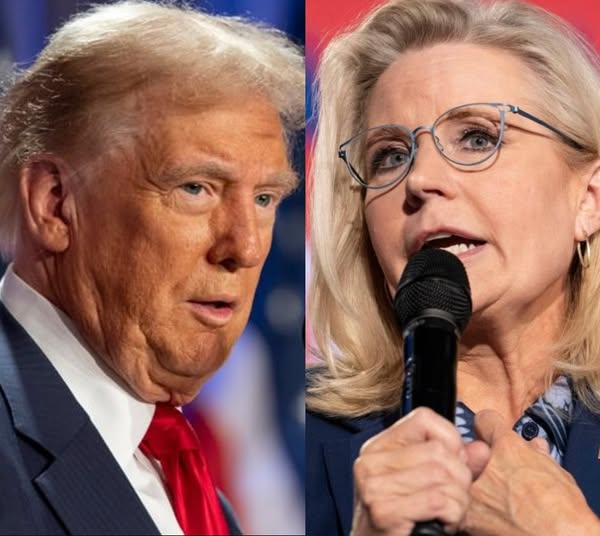
Republican Liz Cheney hits back Hard at Donald Trump

BREAKING: Republican Liz Cheney hits back hard at Donald Trump for his “assault on the rule of law” after he threatens to imprison those like her who served on the House January 6th committee.

And she wasn’t done there…

“Here is the truth: Donald Trump attempted to overturn the 2020 presidential election and seize power,” Cheney said in a statement provided to several outlets.

“He mobilized an angry mob and sent them to the United States Capitol, where they attacked police officers, invaded the building and halted the official counting of electoral votes,” she went on.

“Trump watched on television as police officers were brutally beaten and the Capitol was assaulted, refusing for hours to tell the mob to leave,” Cheney continued.

“This was the worst breach of our Constitution by any president in our nation’s history,” she stated. “Donald Trump’s suggestion that members of Congress who later investigated his illegal and unconstitutional actions should be jailed is a continuation of his assault on the rule of law and the foundations of our republic.”

Over the weekend, Trump told Meet the Press that Cheney’s actions were “inexcusable” and said “honestly, they should go to jail” of the members of the January 6th committee.

The fact that these people have done nothing wrong and were simply trying to protect our democracy matters not to Trump. He’s beginning his revenge tour.