Recalling the George W. Bush Presidency

Remembering one of America’s worst presidents!

It appears that the folks in South Carolina have forgotten some major events that occurred when George W. Bush was president. Not all were his direct fault but he and his administration, in my opinion, did not take sufficient precautions.  I did not have to refer to any publication or website for these occurrences. They are all clearly in my mind.  They should be in yours too. 

  1. September 11, 2001 attack on the World Trade Center in New York City did occur eight months after he was inaugurated into office. The prior administration had warned of a possible terrorist attack.
  2.   Hurricane Katrina occurred on the morning on August 29, 2005. When the storm made landfall, it had a Category 3 rating on the Saffir-Simpson Hurricane Scale–it brought sustained winds of 100–140 miles per hour–and stretched some 400 miles across the Gulf coast. The History Channel says “Officials, even including President George W. Bush, seemed unaware of just how bad things were in New Orleans and elsewhere: how many people were stranded or missing; how many homes and businesses had been damaged; how much food, water and aid was needed. Katrina had left in her wake what one reporter called a “total disaster zone” where people were “getting absolutely desperate.” The Bush administration was widely criticized for its slow response to the disaster.
  3. The invasion of Iraq occurred in the spring of 2003, the United States invaded Iraq in order to overthrow leader Sadaam Hussein (1937-2006), whose regime was accused of supporting international terrorist groups and possessing large caches of weapons of mass destruction (WMD). No WMD were found. 4,486 U.S. soldiers died in Iraq.
  4. He began his presidency with a federal budget surplus; however, factors such as the enormous cost of fighting two wars (Afghanistan and Iraq) and the broad tax cuts led to annual budget deficits starting in 2002.
  5. The 2008 financial crisis was the worst economic disaster since the Great Depression. The president was mostly absent from the efforts to save the economy. Instead it was his Treasury Secretary, Henry Paulson, who made requests to congress for funds to support the banking industry.

Perhaps the above listing of George W. Bush’s major administration failures would be a reason to suspect another Bush would not be welcomed to the White House.
Goodbye to America’s Middle Class

Forget about the poor and the rich for just a few minutes. Think about the middle class. The range of the middle class varies by state. According to Pew Research Center in the middle class shrunk in every state between 2000 and 2013. The highest median income for that group was $72,483 in Maryland and at the low end in Mississippi it was $37,963.

Here is the real shocker. Household median income reached $48,474 in 2012 but in adjusted for inflation dollars Americans reached an income of $48,655 in 1978. The median income in 1978 was $13,234.

Pew Research writes: “The hollowing of the American middle class has proceeded steadily for more than four decades. Since 1971, each decade has ended with a smaller share of adults living in middle-income households than at the beginning of the decade, and no single decade stands out as having triggered or hastened the decline in the middle.

Based on the definition used in their report, the share of American adults living in middle-income households has fallen from 61% in 1971 to 50% in 2015.”

Which presidential candidate is likely to change this situation? The answer is no one. While Bernie Sanders rails against big business he has not offered any solutions.

America’s 20 richest people have more money than these 152 million people

This article appeared on End Of The American Dream and MarketWatch.

“America’s 20 wealthiest people — a group that could fit in one Gulfstream G650 jet — are now worth $732 billion, which means they have more wealth than the 152 million people who make up the least wealthy 50% of U.S. households, according to a report released Wednesday by the Institute for Policy Studies. What’s more, the “Forbes 400” wealthiest individuals in the U.S. now have a net worth of $2.34 trillion.”

So when Bernie Sanders says almost the very same thing you think “Well he is running for president and this is his hook.”

I ask you now what do you think?

Just yesterday the Los Angeles Times posted the following:

“The nation’s income gap increased 10% over the past 20 years, and roughly twice that rate for people in their prime earning years, according to a new study.

The income gap swelled 21% for those between the ages of 35 to 44, and 17.6% for people aged 45 to 54, according to the analysis by financial website Bankrate.com. The study analyzed the period from 1992 to 2012.

The study is the latest to highlight rising income inequality, and is troubling because it shows the dichotomy worsening for people in their key earnings years.

“The prime earning years for most people — when they’re in their 30s and 40s — are also the most important when it comes to setting up a future position on the wealth spectrum,” according to the study. “While some are quickly advancing toward becoming rich, others are just as quickly falling behind.”

According to the study, the income gap is widest among people 65 and older, although it grew only 3%, the slowest rate for any age group over the last 20 years.

Citing data from the Census Bureau, the bottom fifth of U.S. households earn an annual average of $11,490, the study said.

The next fifth take in $29,696. The middle tier earns $51,179 and the next group takes home $82,098. The top fifth earns $181,905, and the top 5% earns $318,052.”

The problem is that neither Hillary Clinton nor any of the GOP presidential candidates have even opened a dialog on this issue.

Thus even though there is more than enough data, none of the leading candidates want to face the unpleasant reality that the average American family is growing poorer.

Why should you vote in a presidential race when your needs are not even part of the discussion? Wait, there is one candidate who has brought this topic to the forefront.

What’s Wrong with the TPP?

What is wrong with NAFTA, TPP, and other free trade agreements that lower tariffs?

The United States is the dream country for capitalists. The limits on corporations are minimal. Very big companies buy each other out (called a merger) with few government efforts to control the likely outcome of near monopoly. The latest example in Walgreens drug company’s plan to buy Rite-Aid drug company.

Those same companies are now referred to as multi-nationals. General Electric is a creation of Thomas Edison but consider that the company now has facilities in 130 countries. GE has invested over $200 million in a flexible new “brilliant factory” in Pune, India. This information is from GE websites.

Heinz Ketchup sits on the tables of restaurants in Paris. It is not packaged in the United States.

The United States currently imposes low tariffs on most of the goods imported into this country. The TPP will eliminate those tariffs on the other 11 countries. That probably won’t impact the amount of goods being imported. The agreement also lowers the tariffs that other countries impose on imported American goods and that appears to be a good thing.

However when those goods are shipped overseas that are in limited supply in the United States that will drive up the prices in America. An example is chicken. Tyson Foods processes 41 million chickens a year. If they can sell some of those chickens in other countries that will reduce the number of chickens available for sale in America. Less supply translates to higher prices. That means higher profits for Tyson.

If you manufacture something in the United States where $15 to $25 per hour is a common pay rate, why not manufacture your goods in Vietnam, Peru or Malaysia where pay rates are significantly lower and import the products to America?

John Deere and Caterpillar are two companies that will benefit from lower tariffs in other countries. The problem is there are too few companies that are in the category of big machines.

The United States has lost millions of jobs to lower pay rate countries. The benefit to company shareholders is obvious.   The loss of jobs in America is obvious. The rich typically get their way. I predict capitalism will prevail. I also predict the end of the middle class in America.

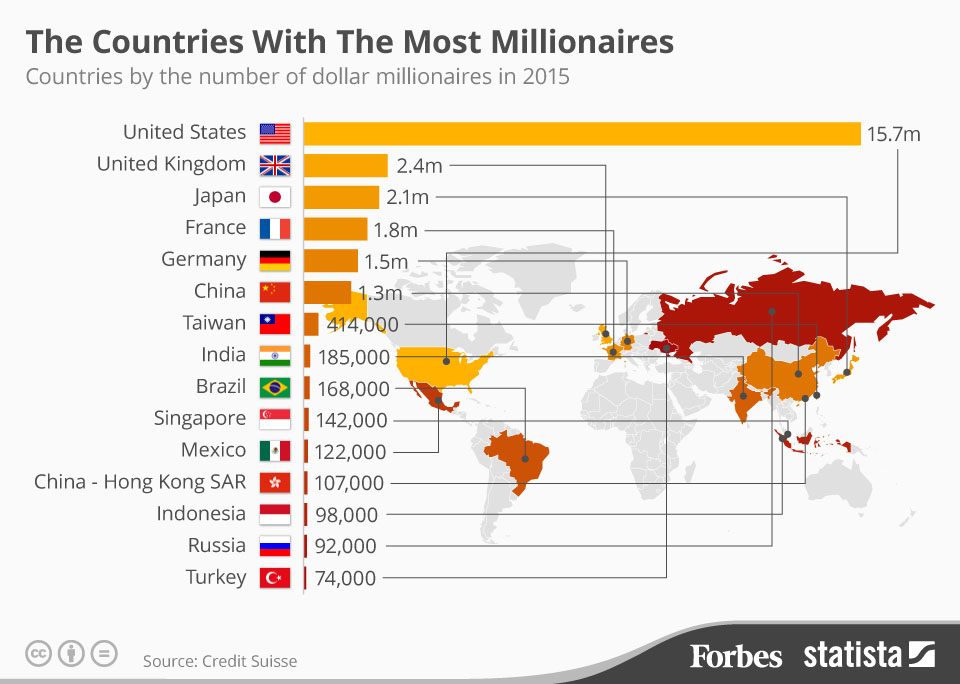
The Countries with the Most Millionaires

Senator Bernie Sanders is correct when he says that 1% of our citizens control more wealth than the bottom 90%. A new report posted on cnn.com references an English company named Oxfam estimates that the richest 1% will have as much wealth as the other 99% combined by next year. Just Google these words: “does 1% of Americans own 90% of the wealth” and you will find numerous web sites that confirm the Sanders contention. The United States is the overwhelming home of millionaires.

From Forbes Magazine date October 15, 2015

“The United States has the world’s biggest millionaires club by a huge distance. No other country comes even close to matching it. According to Credit Suisse Global Wealth Report, the U.S. was home was home to 41% of the world’s millionaires in 2014, and its share grew by 46% in 2015.”

“Wealth has risen has risen in the U.S. for the seventh year in succession and the U.S. millionaire population now stands at 15/7 million, according to the report. The United Kingdom comes a distant second at 2.4 million, while Japan rounds of top three countries with a population of 2.1 million.”

Countries with the most millionaires

This situation probably explains the ever higher costs of living in NYC, San Francisco, and Los Angeles.

So should we vote for Mr. Sanders based upon these facts? My response: 1) what would he do to change this reality? 2) Is this situation a bad thing?

Costco Goes for the Wealthy

Costco’s basic idea was opening low cost warehouse stores, not located in higher cost shopping centers, and offering a no frills limited selection of goods that could be had in bulk at significantly lower prices.

Old Costco #2My nearby Costco was an abandoned warehouse next to a Home Depot and across a boulevard from a Salvation Army facility that includes housing for some very poor people. Adjoining that property is apartment complexes for a struggling working class community.

There were people always sitting on the curb hoping to obtain day jobs. That is probably the consequence of the Home Depot. Some shoppers were uncomfortable with the environment and would not shop at that Costco.

Despite my description of that Costco it was a very busy place. Weekends were always packed with shoppers to the extent that a very large parking lot was near capacity and lines in the store checkout were long.

Just 2½ miles away Westfield (the Australian shopping center developer) owns the Westfield Topanga Mall that houses high end stores including a Neiman Marcus department store.   That mall is on the perimeter of Warner Center and just 3 miles from Kim Kardashian and Jay z’s home in Hidden Hills and about 4½ miles from Calabasas which is the home of many entertainment and sports stars.

First Day Opening #2So Costco, understanding that wealthy people have more money to spend than the rest of us, closed their 20 year old warehouse and moved the 2½ miles into a new building that still has warehouse racking inside but offers the things that only the very wealthy can afford.

What could they offer that is not at your usual Costco?

Louis Vuitton and Chanel Handbags for $1500 (no picture).

Louis XIII Liquor$6500 bottles of Louis XIII Cognac.

$23K Wedding Ring

$23,000 wedding ring.

 Patek Philippe Watch

 A $19,000 Patek Phillipe watch.

 $150K Round Diamond Solitare Pendant

A $150,000 5.34 carat Round solitaire pendant on what must be a diamond studded necklace. Click the picture to confirm that price. 

There are no words that I can write to portray my astonishment.

Ben Carson Continues to Prove He is not Ready for the Presidency

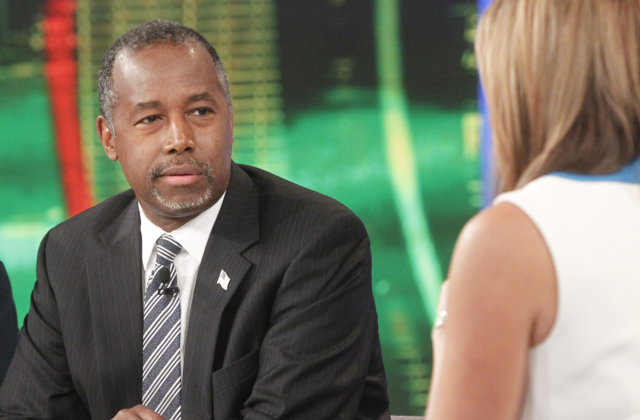
Ben CarsonGiven that Doctor Ben Carson is a retired neurosurgeon it is difficult to understand how lacking he is in basic knowledge about how the Federal government operates and how little he knows about American treaties.

Number 1:

When asked about what Eastern European nations should do about the fear of Russia he said they should join NATO.

Hugh Hewitt, talk radio host, asked if NATO should be willing to go to war if Russian leader Vladimir Putin attempts to do in the Baltic states (Estonia, Latvia or Lithuania) what he’s already done in Ukraine.

“I think they would be willing to go to war if they knew that they were backed up by us,” Carson said. “We need to convince them to get involved in NATO and strengthen NATO.”

“Well, the Baltics, they are in NATO,” Hewitt responded. [In fact, they’ve been member states since 2004.]

After a commercial break, Carson explained that he was confused. “Well, when you were saying Baltic state, I thought you were continuing our conversation about the former components of the Soviet Union,” he said.

Carson’s views on the current Middle East turmoil are similarly confused. Read the entire Hewitt interview here:

Read more: http://www.politico.com/story/2015/03/ben-carson-trips-up-on-nato-knowledge-dates-islamist-rage-to-bc-era-116208#ixzz3o0G0kdKR

Number 2:

In an awkward back-and-forth on NPR’s “Marketplace,” the top-tier GOP presidential candidate baffled host Kai Ryssdal by apparently conflating the debt limit with broader budgetary issues.

Ryssdal asked Carson if the US should raise the debt limit, a hot-button issue that has repeatedly generated congressional brinkmanship in recent years.

Here is the transcript:

Ryssdal: All right, so let’s talk about debt then and the budget. As you know, Treasury Secretary Lew has come out in the last couple of days and said, “We’re going to run out of money, we’re going to run out of borrowing authority, on the fifth of November.” Should the Congress then and the president not raise the debt limit? Should we default on our debt?

Carson: Let me put it this way: If I were the president, I would not sign an increased budget. Absolutely would not do it. They would have to find a place to cut.

Ryssdal: To be clear, it’s increasing the debt limit, not the budget, but I want to make sure I understand you. You’d let the United States default rather than raise the debt limit?

Carson: No, I would provide the kind of leadership that says, “Get on the stick guys, and stop messing around, and cut where you need to cut, because we’re not raising any spending limits, period.”

Ryssdal: I’m going try one more time, sir. This is debt that’s already obligated. Would you not favor increasing the debt limit to pay the debts already incurred?

Carson: What I’m saying is what we have to do is restructure the way that we create debt. I mean if we continue along this, where does it stop? It never stops. You’re always going ask the same question every year. And we’re just gonna keep going down that pathway. That’s one of the things I think that the people are tired of.

Ryssdal: I’m really trying not to be circular here, Dr. Carson, but if you’re not going to raise the debt limit and you’re not going to give specifics on what you’re gonna cut, then how are we going to know what you are going to do as president of the United States?

Number 3:

Ben Carson told Meet the Press that no Muslim should ever be president. “I would not advocate that we put a Muslim in charge of this nation.” The constitution specifically says that there is no religious qualification to be president. Carson doubles down by telling Wolf Blitzer on CNN he is not sure that President Obama is a Christian – and that really doesn’t matter but being a Christian seems to matter to Ben Carson. 

GE says it may move up to 500 jobs overseas

When Donald Trump said “we-are-led-by-veryverystupidpeople” you probably thought he was exaggerating.  The GOP lead congress refused to re-authorize the U.S. Export Import Bank on the grounds that it was helping companies that don’t need any help.  This is the consequence of that very stupid decision.

By ASSOCIATED PRESS

General Electric LogoGeneral Electric Co. may move about 500 American jobs overseas because Congress did not renew a government program that allows foreign companies to borrow money to buy U.S. products, the industrial conglomerate said Tuesday.

Authorization for the U.S. Export Import Bank was not approved by Congress, forcing it to stop lending July 1. Foreign companies use the agency to buy expensive U.S. products when bank loans are not possible.

As a result, GE says 100 jobs from a Houston plant that makes gas turbines will move to Hungary and China in 2016. The Fairfield, Connecticut, company says those countries have lending options in place for customers.

“We do not make today’s announcements lightly and in fact, have done everything in our power to avoid making these moves at all, but Congress left us no choice when it failed to reauthorize the Ex-Im Bank this summer,” said John Rice, GE’s vice chairman.

Another 400 jobs could be created in France instead of factories in South Carolina, Maine and New York if the company wins projects it is bidding on. The projects require financing, and the export credit agency in France has agreed to provide it.

GE said it’s bidding on projects valued at $11 billion that require export financing. It said it has reached agreement with the French export credit agency to provide a line of credit for global power projects. GE said the line of credit will initially support potential orders in international markets that include Indonesia.

To access the required export credit for its customers of its aeroderivatives turbines, GE will move its final assembly from the U.S. to Hungary and China. As related projects are bid and won in these two product lines, GE said it will move approximately 500 jobs from Texas, South Carolina, Maine and New York to France, Hungary and China.

The embattled and little-known banking agency has been at the center of a fight between tea party Republicans who say it’s not needed and Democrats and some Republicans — backed by manufacturers and large businesses — who say it promotes trade and helps create jobs.

The Ex-Im Bank’s principal role is to guarantee commercial bank loans to foreign businesses and governments to buy U.S. products. U.S. taxpayers would be responsible for a loan if a company operating overseas defaults on a bank loan used to buy a product made by a U.S. company.

Copyright © 2015, Los Angeles Times

Raising the Minimum Wage Rate

If we lived in a world where everyone has the right to pay whatever low rate they could manage then the least able would be paid a starvation salary. Wait, this is almost exactly the situation today. American society has established a minimum hourly pay rate that will not provide enough money to pay for housing, food, and other basic necessities.

The consequence is that those with limited ability and the resulting minimum pay must share housing and pool their low income to sustain their lives.

On the other end of the scale there are those businesses who need those low paid workers to sustain their low priced products. McDonald’s and it competitors are those businesses that come to mind. If the cost to make a burger goes up then the cost of those low priced burgers goes up. That could impact the very existence of many small enterprises.

We are faced with a conundrum!

I find myself sympathetic to both the poor and low pay employers.

Thus society must decide what is best for everyone in the long run. We see the consequence of not providing support for the poor when we look at nations like Bangladesh, India, and other southeastern Asian nations. The poor live in hovels and eat rice, beans, and anything else they can grow in a small garden. Is that the society we want in the United States?

Since we are a free enterprise society there are those who say “tough” and “it’s not my problem.”

The majority of our elected officials will make the decisions. As it stand today there are many cities and states who have decided it is in their best interest to continue raising the minimum wage. The current target seems to be $15.00 an hour. That is not a living wage but will help those who cannot obtain a higher level of education.

McDonald’s burgers at $5.00 won’t break us but just might help a little.

Cities Grow or Die

Updated May 22, 2015 because of data reported in the Los Angeles Daily News.

Chicago, Detroit, Philadelphia, and Baltimore are examples of large cities that are dying.  They all have one common issue. A lack of jobs.  Cities that are thriving are growing and they all have one common reason.  New jobs.  Los Angeles grew in population by 136,243 people since the last census says the U.S. Census Bureau.  That is a growth of just the city and does not include surrounding towns such as Long Beach which have all seen similar or greater population increases.

I live near the very end of the northwest part of Los Angeles. The nearby boulevard ends about 2 miles west of my home. Despite that fact the traffic is busy all of the time. It is obviously crowded during rush hours. Simply put, we have run out of space. The land beyond the end of the city has been set aside as protected land to preserve open space with the idea of establishing a wildlife park to protect both animals and native habitat.

The question is how do we provide housing for the growing population? The answer is more apartments and condominiums. With that conclusion in mind the city has decided to permit that kind of construction. Cities do not remain static. They either grow or shrink. The growth is into the suburbs, more high rise buildings, or a combination. Spread of the Los Angeles area is a fact and is probably known throughout the world. The travel times has become nightmares for some people driving as long as two hours to get to work. Finally the city has become wiser and now has started permitting the dreaded high rise housing. Many in our city are continuing to fight this kind of construction.

Thus we have arrived at a time when many new proposals are being submitted to neighborhood councils and the city council for approval. In my area:

  •  Two part with phase 1 for the construction of a 7-story, 193,000 sqft building to house 170 apartments including 13 live-work units and 5,700 sqft restaurant. There will also be parking for 258 cars and 196 bikes.  The 2nd phase is for the construction of 166,000 sqft commercial office building with 10,000 sqft for restaurant and retail space. There will also be parking for 490 cars and 254 bikes. The office buildings being replaced are modern two story structures.
  •  A 707 unit apartment complex that was the home of Panavision manufacturing consisting of a one story building and parking lot.
  •  A 300 unit apartment complex most likely replacing one or two story office buildings.
  •  A 4,000 multifamily unit development on the former Rocketdyne facility that is expected take 10 years to complete. That project is in the design phase and has not been released for public scrutiny. The information released to date says that the buildings will vary in height from 6 to 18 stories high.
  • The former Catalina Yachts manufacturing site will be converted into 600 units.

That is a total of 5,777 housing units which more than likely means an additional 11,000 people and their cars added to already congested boulevards. To make the additional housing more palatable new nearby shopping centers and business offices will provide jobs.

Westfield Village #3

You don’t like it? Some alternative places to live are Fresno, California and Medford, Oregon. Those are two nice communities that are not faced with large growth but do offer a pleasant climate and many of the benefits of larger cities.