(Bloomberg) — March 12, 2015 / Household wealth in the U.S. increased from October through December by the most in a year as stock prices advanced to an all-time high at the end of 2014. Net worth for households and non-profit groups rose by $1.5 trillion in the fourth quarter 1.9 percent from the previous three months, to $82.9 trillion, the Federal Reserve said Thursday from Washington in its financial accounts report, previously known as the flow of funds survey.
A report like that would make you believe that Americans are all richer and feeling quite confident about the future. The rest of that Bloomberg article was just as upbeat. It proves how numbers can give a distorted view of the world. Those numbers were provided by the Federal Reserve.
Wait this really isn’t what it appears to be. USA Today offered this additional piece of information: But the wealth gains are flowing mainly to affluent Americans. Broad stock market averages have jumped more than 150% from their trough in the spring of 2009. But roughly 10% of households own about 80% of stocks.
The reality is that millions of families live paycheck to paycheck. The majority do not have significant savings for their retirement. The Median Value of Assets for Households in 2011 was $68,828.00. Married couples over 65 years had the highest wealth at a Median Value of $284,790.00. Take away the value of their home and you realize that many senior citizens are primarily relying on their Social Security income. The source for this data is the U.S. Census Bureau.
This data says two things to me. 1) You cannot rely on the reporting from just one publication for complete information. 2) There is a great economic divide in this nation.
Greed: a selfish and excessive desire for more of something (as money) than is needed. That is the Merriam-Webster definition.
When I was a boy reading comic books there was a character in the Donald Duck series named Scrooge McDuck. He loved money and the cartoon showed him rolling in dollar bills and dancing on the money. That was a characterization of some people in this world. Was that greed?
The stock market continues to hit new highs every several months. The S&P 500 reached another new high on Friday, February 13, 2015. Apple Computer shares are at or near their highest level ever. Most people do not own enough stocks to feel a significant impact. The wealthy, whose source of income is the stock market, are the beneficiaries of this situation.
Meanwhile BBC.com and Fareed Zakaria GPS reports the findings of Oxfam, an anti-poverty group, that the combined wealth of the world’s richest 1% will overtake that of the other 99% of the world’s population by 2016. Furthermore the richest 80 people in the world have collected the same amount of wealth as the bottom 3.5 million people-$1.9 Trillion.
There are two facts that are slowly destroying the middle class and causing even greater harm to blue collar laboring classes.
Without government involvement jobs are performed at the lowest pay rate which moves jobs to the poorest countries.
Technology enables employers to replace workers performing repetitive work with a machine.
These are not new facts. Queen Elizabeth I (queen of England 1558–1603) denied a patent for the first knitting machine in 1589. It was denied because of her concern for the security of the kingdom’s many hand knitters.
Robots install rivets on a 2015 Ford F-150
Paul Wiseman of the Associated Press posted an article titled “Robots replacing workers at a faster pace”. The report was replicated by many news media outlets including ABC, Fox Business, etc. The article said “A new report says that cheaper, better robots will replace human workers in the world’s factories at a faster pace over the next decade, pushing labor costs down 16 percent.” The mechanization has impacted only 10% of the possible uses for robots. 90% of the changeover is still in the future.
Recently two public parking lots I had occasion to use had no pay clerk at the exit. The system was automated. Soon there will be no one to take your order at McDonald’s.
I could go on with more examples of lost jobs thanks to technology or replacing middle income workers with low paid workers but you already understand the point I am making.
The question to candidates for the next president of the United States is what will you do to change the obvious decline in the income of the majority of Americans? You ought to ask your congressional representative and senators that same question.
The working masses of America don’t think of themselves as peasants. Oh no, wisely America’s wealthy came up with a much more palatable description. They are part of the middle class. Everyone is part of the middle class. I know wealthy people who tell me they are part of the middle class. The wealthy in Bel-Aire and Calabasas call themselves upper middle class. It seems that the middle class is everyone.
So explain the following to me.
Sixteen million children were on food stamps as of the end of last year, the highest number since the nation’s economy tumbled in 2008. That is 1 in 5 of all children in America. 46.5 million people in the United States are on food stamps. That means more than 14% of our 320 million people are too poor to afford food. These fact are reported by the Associated Press.
A new study released by Morgan Stanley revealed income inequality ranked fourth among concerns of the high-net-worth individuals nationally, behind the 86% citing increasing foreign conflicts, the 81% pointing to fears of terrorism in the U.S., and the 80% noting the U.S. government budget deficit.
The same Morgan Stanley study indicated that those with $100,000 or more to invest made up 21% of U.S. households. In other words 79% of all American households have less than $100,000 to put in a bank or invest in stocks and bonds. That translates into millions of retired people who live almost totally on Social Security and millions of younger people wondering what their retirement will look like.
Can those families with college age children send their children to college? The answer is obvious. Children must qualify for a student loan or their education comes to an end. California’s famous community colleges now cost $46 per unit or $736 per semester. I recall when those schools were free to every high school graduate.
Another part of this story is the wealthy who earn millions of dollars a year and pay the lowest tax rate with thousands of dollars earned that are not taxed at all. One example is tax free municipal bonds. If you own $1 million of those bonds the interest earned is not taxed. If you decide to sells those bonds to earn a profit after owning them for more than one year, your profits will be taxed at 15%. Since 2003, certain dividends known as qualified dividends (Qualified dividends are generally dividends from shares in domestic corporations) have been subject to the same tax rates as long-term capital gains, which are currently taxed at 15%.
In other words if I work for a living, 40 hours a week every week of the year and earn $50,000 a year my joint income tax is about $4,700. However if I am lucky enough to earn my $50,000 in municipal bond interest my income tax is NOTHING.
The problem for the middle class who work for a living is that there is no one who speaks for them in Washington. Oh, the Democrats claim they do but that is a lie. They had control of both the House and the Senate for the first two years of the Obama administration and no relief or help was provided. Meanwhile the wealthy who say they are concerned with income inequality have happily accepted the ever growing divide between the rich and poor. Corporate managers now earn 200 to 300 times the income of the rest of us.
The middle class? What middle class is there? It’s primarily older people who managed to save for their retirement. One day there will be an uprising by the masses who will finally recognize that they are the victims of a system that milks them. It won’t come too soon for me.
This presentation is worth watching or read the transcript below the Youtube video. I support her points. Unfortunately many do not. It is a mystery to me why so many people do not want a growing middle class. This does tie in to my commentary The Great economic Divide.
WASHINGTON, D.C. –(ENEWSPF)—January 7, 2015. Today, United States Senator Elizabeth Warren spoke at the AFL-CIO National Summit on Raising Wages. The text of Senator Warren’s remarks as prepared for delivery follows, and a PDF copy of her remarks is available here:
Good morning, and thank you MaryBe for the introduction, and for your work with the North Carolina AFL-CIO. Your efforts make a real difference for our families.
I want to start by thanking Rich Trumka and Damon Silvers for your leadership on economic issues, for your good counsel, and, for a long time now, your friendship. I also want to give special thanks to my good friends from the Massachusetts AFL-CIO who are here today, Steve Tolman and Lou Mandarini.
I love being with my labor friends, and I’m especially glad to join you today for the AFL’s first-ever National Summit on Wages. You follow in the best tradition of the American labor movement for more than a century-always fighting for working people, both union and non-union. Today you’ve spotlighted an economic issue that is central to understanding what’s happening to people all over this country.
I recently read an article in Politico called “Everything is Awesome.” The article detailed the good news about the economy: 5% GDP growth in the third quarter of 2014, unemployment under 6%, a new all-time high for the Dow, low inflation.(i)
Despite the headline, the author recognized that not everything is awesome, but his point has been repeated several times: On many different statistical measures, the economy has improved and is continuing to improve. I think the President and his team deserve credit for the steps they’ve taken to get us here. In particular, job growth is a big deal, and we celebrate it.
I’ve spent most of my career studying what’s happening to America’s middle class, and I know that these four widely-cited statistics give an important snapshot of the success of the overall economy. But the overall picture doesn’t tell us much about what’s happening at ground level to tens of millions of Americans. Despite these cheery numbers, America’s middle class is in deep trouble.
Think about it this way: The stock market is soaring, and that’s great if you have a pension or money in a mutual fund. But if you and your husband or wife are both working full time, with kids in school, and you are among the half or so of all Americans who don’t have any money in stocks,(ii) how does a booming stock market help you?
Corporate profits(iii) and GDP are up. But if you work at Walmart, and you are paid so little that you still need food stamps to put groceries on the table, what does more money in stockholders’ pockets and an uptick in GDP do for you?
Unemployment numbers are dropping. But if you’ve got a part-time job and still can’t find full-time work — or if you’ve just given up because you can’t find a good job to replace the one you had — you are counted as part of that drop in unemployment,(iv) but how much is your economic situation improving?
Inflation rates are still low. But if you are young and starting out life with tens of thousands of dollars in student loan debt locked into high interest rates by Congress, unable to find a good job or save to buy a house, how are you benefiting from low inflation?
A lot of broad national economic statistics say our economy is getting better, and it is true that the economy overall is recovering from the terrible crash of 2008. But there have been deep structural changes in this economy, changes that have gone on for more than thirty years, changes that have cut out hard-working, middle class families from sharing in this overall growth.
It wasn’t always this way.
Coming out of the Great Depression, America built a middle class unlike anything seen on earth. From the 1930s to the late 1970s, as GDP went up, wages went up pretty much across the board. In fact, 90% of all workers-everyone outside the top 10%-got about 70% of all the new income growth.(v) Sure, the richest 10% gobbled up more than their share-they got 30%. But overall, as the economic pie got bigger, pretty much everyone was getting a little more. In other words, as our country got richer, our families got richer. And as our families got richer, our country got richer. That was how this country built a great middle class.
But then things changed.
By 1980, wages had flattened out, while expenses kept going up. The squeeze was terrible. In the early 2000s, families were spending twice as much, adjusted for inflation, on mortgages as they had a generation earlier. They spent more on health insurance, and more to send their kids to college. Mom and dad both went to work, but that meant new expenses like childcare, higher taxes, and the costs of a second car. All over the country, people tightened their belts where they could, but it still hasn’t been enough to save them. Families have gone deep into debt to pay for college, to cover serious medical problems, or just to stay afloat a while longer.(vi) And today’s young adults may be the first generation in American history to end up, as a group, with less than their parents.(vii)
Remember how up until 1980, 90% of all people-middle class, working people, poor people-got about 70% of all the new income that was created in the economy and the top 10% took the rest? Since 1980, guess how much of the growth in income the 90% got? Nothing. None. Zero. In fact, it’s worse than that. The average family not in the top 10% makes less money than a generation ago.(viii) So who got the increase in income over the last 32 years? 100% of it went to the top ten percent. All of the new money earned in this economy over the past generation-all that growth in the GDP-went to the top.(ix) All of it.
That is a huge structural change. When I look at the data here – and this includes years of research I conducted myself – I see evidence everywhere about the pounding that working people are taking. Instead of building an economy for all Americans, for the past generation this country has grown an economy that works for some Americans. For tens of millions of working families who are the backbone of this country, this economy isn’t working. These families are working harder than ever, but they can’t get ahead. Opportunity is slipping away. Many feel like the game is rigged against them – and they are right. The game is rigged against them.
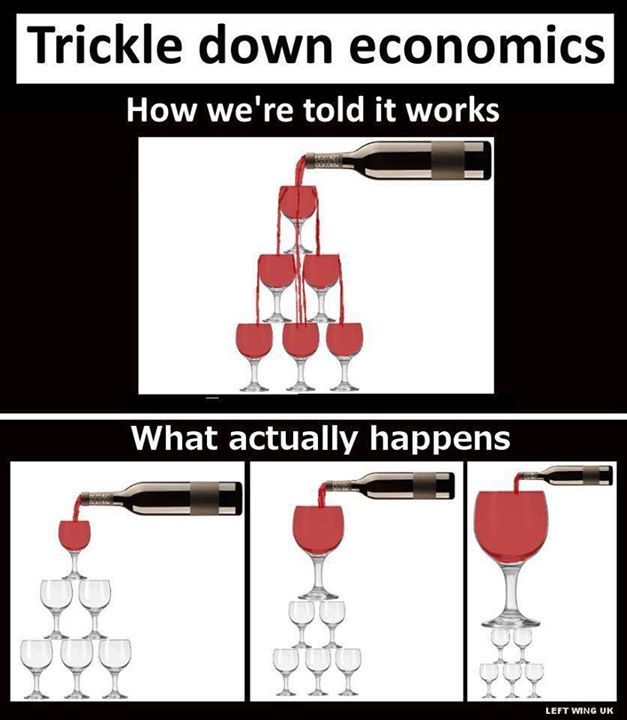
Since the 1980s, too many of the people running this country have followed one form or another of supply side – or trickle down – economic theory. Many in Washington still support it. When all the varnish is removed, trickle-down just means helping the biggest corporations and the richest people in this country, and claiming that those big corporations and rich people could be counted to create an economy that would work for everyone else.
Trickle-down was popular with big corporations and their lobbyists, but it never really made much sense. George Bush Sr. called it voodoo economics.(x) He was right, and let’s call it out for what it is: Trickle-down was nothing more than the politics of helping the rich-and-powerful get richer and more powerful, and it cut the legs out from under America’s middle class.
Trickle-down policies are pretty simple. First, fire the cops-not the cops on Main Street, but the cops on Wall Street. Pretty much the whole Republican Party – and, if we’re going to be honest, too many Democrats – talked about the evils of “big government” and called for deregulation. It sounded good, but it was really about tying the hands of regulators and turning loose big banks and giant international corporations to do whatever they wanted to do-turning them loose to rig the markets and reduce competition, to outsource more jobs, to load up on more risks and hide behind taxpayer guarantees, to sell more mortgages and credit cards that cheated people. In short, to do whatever juiced short term profits even if it came at the expense of working families.
Trickle down was also about cutting taxes for those at the top. Cut them when times are good, cut them when times are bad. And when that meant there was less money for road repairs, less money for medical research, and less money for schools and that our government would need to squeeze kids on student loans, then so be it. And look at the results: The top 10% got ALL the growth in income over the past 30 years-ALL of it-and the economy stopped working for everyone else.
The trickle-down experiment that began in the Reagan years failed America’s middle class. Sure, the rich are doing great. Giant corporations are doing great. Lobbyists are doing great. But we need an economy where everyone else who works hard gets a shot at doing great!
The world has changed beneath the feet of America’s working families. Powerful forces like globalization and technology are creating seismic shifts that are disrupting our economy, altering employment patterns, and putting new stresses on old structures. Those changes could create new opportunities-or they could sweep away the last vestiges of economic security for 90% of American workers. Those changes demand new and different economic policies from our federal government. But too many politicians have looked the other way. Instead of running government to expand opportunity for 90% of Americans and to shore up security in an increasingly uncertain world, instead of re-thinking economic policy to deal with tough new realities, for more than 30 years, Washington has far too often advanced policies that hammer America’s middle class even harder.
Look at the choices Washington has made, the choices that have left America’s middle class in a deep hole:
the choice to leash up the financial cops,
the choice in a recession to bail out the biggest banks with no strings attached while families suffered,
the choice to starve our schools and burden our kids with billions of dollars of student loan debt while cutting taxes for billionaires,
the choice to spend your tax dollars to subsidize Big Oil instead of putting that money into rebuilding our roads and bridges and power grids,
the choice to look the other way when employers quit paying overtime, reclassified workers as independent contractors and just plain old stole people’s wages,
the choice to sign trade pacts and tax deals that let subsidized manufacturers around the globe sell here in America while good American jobs get shipped overseas.
For more than thirty years, too many politicians in Washington have made deliberate choices that favored those with money and power. And the consequence is that instead of an economy that works well for everyone, America now has an economy that works well for about 10% of the people.
It wasn’t always this way, and it doesn’t have to be this way. We can make new choices – different choices – choices that put working people first, choices that aim toward a better future for our children, choices that reflect our deepest values as Americans.
One way to make change is to talk honestly and directly about work, about how we value the work that people do every day. We need to talk about what we believe:
We believe that no one should work full time and still live in poverty – and that means raising the minimum wage.
We believe workers have a right to come together, to bargain together and to rebuild America’s middle class.
We believe in enforcing labor laws, so that workers get overtime pay and pensions that are fully funded.
We believe in equal pay for equal work.
We believe that after a lifetime of work, people are entitled to retire with dignity, and that means protecting Social Security, Medicare, and pensions.
We also need a hard conversation about how we create jobs here in America. We need to talk about how to build a future. So let’s say what we believe:
We believe in making investments – in roads and bridges and power grids, in education, in research – investments that create good jobs in the short run and help us build new opportunities over the long run.
And we believe in paying for them-not with magical accounting scams that pretend to cut taxes and raise revenue, but with real, honest-to-goodness changes that make sure that we pay-and corporations pay-a fair share to build a future for all of us.
We believe in trade policies and tax codes that will strengthen our economy, raise our living standards, and create American jobs – and we will never give up on those three words: Made in America.
And one more point. If we’re ever going to un-rig the system, then we need to make some important political changes. And here’s where we start:
We know that democracy doesn’t work when congressmen and regulators bow down to Wall Street’s political power – and that means it’s time to break up the Wall Street banks and remind politicians that they don’t work for the big banks, they work for US!
Changes like this aren’t easy. But we know they are possible. We know they are possible because we have seen David beat Goliath before. We have seen lobbyists lose. We’ve seen it all through our history. We saw it when we created the new Consumer Financial Protection Bureau, when we passed health care reform. We saw it when President Obama took important steps to try and reform our immigration system through executive order just weeks ago. Change is difficult, but it is possible.
This is personal for me. When I was 12, my big brothers were all off in the military. My mother was 50 years old, a stay at home mom. My daddy had a heart attack, and it turned our little family upside down. The bills piled up. We lost the family station wagon, and we nearly lost our home. I remember the day my mother, scared to death and crying the whole time, pulled her best dress out of the closet, put on her high heels and walked to the Sears to get a minimum wage job. Unlike today, a minimum wage job back then paid enough to support a family of three. That minimum wage job saved our home-and saved our family.
My daddy ended up as a maintenance man, and my mom kept working at Sears. I made it through a commuter college that cost $50 a semester and I ended up in the United States Senate. Sure, I worked hard, but I grew up in an America that invested in kids like me, an America that built opportunities for kids to compete in a changing world, an America where a janitor’s kid could become a United States Senator. I believe in that America.
I believe in an America that builds opportunities. An America that ensures that all hardworking men and women earn good wages. An America that once again grows a strong, vibrant middle class.
I believe in that America, and I will fight for that America! And if we fight-side-by-side-I know we will build that America again.
Let’s not beat around. Barack Obama was wrong. There are two Americas. Not red states and blue states or racial divides of Black and White. The two Americas are 1) the rich and 2) everyone else.
This is the subject that should be discussed and debated in the next presidential election. Even before that date the subject of the declining size of the middle class and the growing numbers of poor should be discussed by every candidate in both political parties.
Mario Cuomo, the just deceased former governor of New York State, speaking at the 1984 Democratic convention in San Francisco told us the truth about America. Unfortunately the things he said are even truer today.
“While the press and politicos would thrill to the speech’s metaphors about the ‘Tale of Two Cities’ and wagon trains heading west, Cuomo himself would note years later that the part of the speech that ordinary people mentioned to him more than any other by far was the moving description of his family’s immigrant experience” 1 which matches a story that many immigrants to America can tell.
So here we sit at the beginning of 2015 with 30% of the unemployed still looking for work for more than half a year. Many people have been unemployed for years rather than months. Considering those that are “marginally attached to the work force” the unemployment rate is over 11%. These are numbers from the last (November 2014) Labor Department report.
Some are whining that half of the population pay no income taxes. Are they upset that their pay is so low or that the burden is too high for the nation’s wealthy population? That there is a population that receives special treatment for their dividend and interest earnings? The wealthy aretaxed at a lower rate than the family that works for their income. There are wealthy that pay no income tax because they own nothing but municipal bonds.
Will Jeb Bush, Hillary Clinton, or any of the other candidates discuss the great economic divide that haunts this nation? My guess is that this is a subject that won’t be discussed. The reason is quite simple. No one wants to alienate their backers who are mostly the very rich.
So what will they discuss and debate? Iran, Iraq, ISIS, Cuba, immigration, taxes, education and everything else you can imagine. There won’t be one word spoken about America’s economic divide.
1 Andrei Cherny, “The legacy of Mario Cuomo’s 1984 ‘Tale of Two Cities’ speech”, Yahoo News
The New Year could be one of the best for Americans. There are many indicators to support this forecast. That would not include Nouriel Roubini. He has a history of negative forecasts so I wouldn’t pay attention to him.
Beaconomics forecasts Incomes, Consumer Spending on the Rise: As job growth continues, worker incomes are expected to expand in 2015, something that will keep consumer spending growing and encourage those who have dropped out of the workforce to re-enter.
The GDP for the third quarter of 2014 initially reported growth of 3.5% and subsequently has raised that number to 5%. Unemployment is now reported at 5.8% which is not great but is definitely going in the right direction. The stock market has set new records this year and is now at a new high that won’t help everyone but will motivate people to spend and perhaps hire more people. Gasoline is at unbelieveably low prices.
Goldman Sachs’s chief economist Jan Hatzius just published answers to what he believes are the eight top questions for next year.
Here’s a list of the questions asked by Business Insider and a quick summaries of his thoughts:
Will the US economy continue to grow above trend? Yes. Domestic strength should offset weakness from other economies.
Will the dollar appreciation weigh on growth? Yes, but it’s manageable in the short term because of lower oil prices.
Will the housing recovery accelerate? Yes, especially in the single-family sector. Household formation should improve as young adults move out of their parents’ homes.
Will consumer spending growth accelerate? Yes, as real disposable income increases because of lower oil prices.
Will capital spending growth accelerate further? No. Business capital spending does not look depressed relative to the long-term fundamentals and the decline in oil prices is likely to take a toll on energy sector.
Will wage growth move into the 3%-4% range identified by Chair Yellen as “normal”? No. There’s still slack in the labor market as measured by the U6 underemployment rate.
Will core inflation rise toward the Fed’s 2% target?No. The dollar is strong, wage growth is low, and depressed oil prices should have a negative impact.
Will the Fed hike rates by the June FOMC meeting? No, because inflation probably won’t hit the 2% target. “Based on our below-consensus forecasts for wage and price inflation we expect the first funds rate hike to occur after June 2015; our base case is September,” Hatzius said.
So in summary, the US economy will grow together with the dollar, faster than its global peers. But inflation below the Fed’s target will push its rate hike back to at least September, and the impact of lower oil prices will continue to be felt throughout the economy.
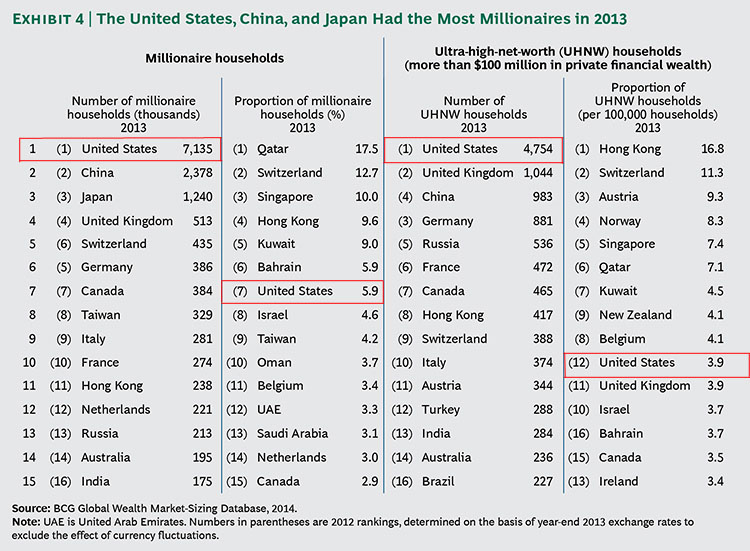
This is one topic that will not be discussed in the campaign for president in 2016. The U.S.A. is a home for millionaires. There are more in this country than any other nation in the world. The opportunity to become a millionaire is the reason so many people look for every way to enter this nation.
The Boston Consulting Group (BCG) posted this interesting article about wealth in the world this past June titled “Global Wealth 2014: Riding a Wave of Growth.”
Even as the income discrepancy between the average American and the top income earners has become more extreme the number of millionaires around the world has risen to new heights the numbers of millionaires in the United States has grown even more. BCG states: “As the debate over the global polarization of wealth rages on, one thing is certain: more people are becoming wealthy. The total number of millionaire households (in U.S. dollar terms) reached 16.3 million in 2013, up strongly from 13.7 million in 2012 and representing 1.1 percent of all households globally.”
The number of millionaires in the United States exceeds the total of the next 13 nations combined with 7,135. Among the ultra-rich (families with $100 million in wealth) shown in the third column above, once again the United States has more than four times as many as the next nation (United Kingdom).
The inflow of immigrants to the United States isn’t just the poor. The wealthy are doing their very best to grab a piece of the American pie. Businessweek had an article in the October 20-26 issue about Arcadia, California – a suburban community of Los Angeles that has been inundated with wealthy Chinese buying homes and building mansions there.
There is a possibility that you can be a millionaire in the United States. It’s easier than almost any other country in the world. So that’s why we won’t be changing the laws pertaining to millionaires. We won’t penalize you for becoming one too! It is what makes America great. It’s everyone’s goal. You don’t have to know anyone to make it happen. Anyone can be the next Steve Jobs, Bill Gates, or Sara Blakley.
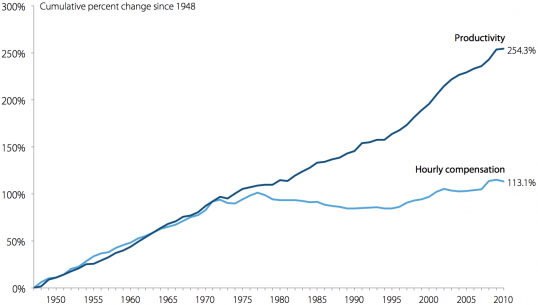
The political parties have missed the primary message of the November 4 election. There was a poor turnout because neither party addressed the issue that most Americans care about. My opinion: A growing economy ought to be the primary target for both parties. The graph below developed by the Economic Policy Institute shows increased productivity without increased remuneration but the EPI discussion does not offer any evaluation as to cause. They leave the evaluation to others. Those others are the commentators and economists who just might have a political agenda.
My take: Higher productivity is not the outcome of employees working harder or smarter. It is the result of new technologies. Those technologies are the consequence of new tools and new software. Those technologies lower the needed manpower. A good example is the elimination of ticket takers/payment clerks as you leave a parking structure. They are now being replaced with automated systems. Those same systems will eliminate order takers at McDonald’s, etc. Those technologies enable machine shops to complete projects faster with less scrap and higher quality.
What will we do with all the people who no longer have jobs? That is the question that politicians can’t answer. Those illegal aliens? Their jobs are on the line too. Capitalism in a free enterprise society translates to hiring the least expensive labor. Of course politicians don’t want to talk to the electorate about this issue.
Is the solution more subsidies and aid for the “middle class”? That appears to be the only solution today. Neither political party wants to admit we have a problem with no apparent solution.
Do not expect anyone running for president in 2016 to say anything about this issue. You will hear discussion on illegal immigration, Russian threats to Eastern Europe, the challenges in Middle Eastern Islamic nations (no boots on the ground), and of course Obama Care. No one will be talking about the gap between the wealthy and the middle class. I hope I am wrong.
The biggest issue for me in the next presidential election is the economy. I do not expect the results of the November 4 election to change the course of the country during the next two years.
The middle class is shrinking thanks to technology and foreign competition. From the 2000 to the 2012, real U.S. median household income decreased 6.6 percent. That is a decrease from $55,030 in 2000 to $51,371 in 2012 according to The U.S. Census Bureau. In the meantime the wealthiest in our country became even richer. It is, by now, well-known that income inequality has increased in the United States. The top 10 percent of earners took more than half of the country’s overall income in 2012, the highest proportion recorded in a century of government record keeping.
Where are the ideas that will enable this country, the United States, to thrive in this century? By 2016 we will already be well into the 21st century. Things happening on the other side of the world do effect what happens here. Our economy is struggling to find a new direction. Our leaders are silent on their ideas about where we as a nation should be going.
Others may say it is too early to expect any ideas from the 2016 candidates but I do not agree with that view. I want to hear new ideas. I want to hear what the candidates will do to lead this country.
Obama’s 2008 campaign used the slogan “Change we can believe in” and the chant “Yes We Can”. John McCain’s 2008 campaign used the slogan “Country First.” Can anyone explain the meaning of those slogans? Neither told us what those candidates would do as president. We all know how that turned out. We chose change but obtained grid lock and a lack of leadership skills.
I am not interested in their political party as much as I am interested in their plans. Candidates should fill in the remainder of this statement. “If I am elected president I will ______.”
It is unlikely there will be a candidate that will make this statement. We will be inundated with new slogans and words telling us how bad the opponent is for the country.
How many of us will ride above the political party line and vote for the best man? Or is it the best woman? Hmm. The gender, sexual orientation, or religion of the candidates might be the big issue. And once again we won’t be focusing on the real question. Where will you take this country?



 Coast Contact