The Stock Market is thrilled – You should not be …

Happy Face

In case you were hoping that America’s three-decade-long trend toward extreme wealth inequality was starting to reverse itself, Pew has some bad news for you.

Nothing has changed.

The rich are still getting richer… and everyone else is still getting hosed.

Today’s monthly job report reinforces that fact.

Out of the marvelous 204,000 new jobs “Leisure and hospitality employment rose by 53,000 in October.  Within the industry, employment in food services and drinking places increased by 29,000, the same as its average monthly gain over the prior 12 months.

Employment in retail trade increased by 44,000 in October, compared with an average monthly gain of 31,000 over the prior 12 months.”

In other words of the 204,000 new jobs 97,000 were in low  paying positions.  Most of these jobs pay less than $15.00 an hour.  At $600 per week (15 x 40 hours) their total annual income is $31,200.  That number is below middle class.  Those in the $10 to $12 hourly pay rate are clearly part of the poor.

So celebrate the number of new jobs if you must.  Just realize that this society is creating a nation of poor people.

Wal-mart is making money and so are the owners of corporate stocks.

More Than Half of Wal-Mart’s Hourly Workers Make Less Than $25,000

I have written about the low pay that is received by retail is destroying the middle class.  Here is a confirmation posted on businessweek.com.

Walmart

By  October 23, 2013

Wal-Mart Stores (WMT) is the country’s biggest private employer. Its low wages have incited labor protests and congressional criticism, and have created a cottage industry of public policy research. The company has responded with facts and figures that sometimes raise as many questions as they answer.

Now Wal-Mart has provided some new and useful information: More than 475,000 of its 1 million hourly store employees earn at least $25,000 a year for full-time work. This figure comes from Bill Simon, the president and chief executive officer of Walmart U.S., who presented (PDF) it at Goldman Sachs’s (GS) Global Retailing Conference last month. The statistic, which was listed under the heading “Great job opportunities,” means as many as 525,000 full-time hourly employees earn less than $25,000 a year.

OUR Walmart, the union-backed workers’ group that’s been staging protests and asking for higher wages, pointed this out during a press conference in Washington, D.C., on Wednesday. (The company’s presentation is also on its website.) Three store associates, as well as three Democratic members of the House of Representatives, called on the retail giant to pay all of its full-time workers at least $25,000 a year.

“A decent wage is their demand—a livable wage, of all things,” said Representative George Miller (D-Calif.). The problem with companies like Wal-Mart is their “unwillingness, not their inability, to pay that wage,” he said. “They hand off the difference to taxpayers.” Miller was referring to a congressional report (PDF) released in May that calculated how much Walmart workers rely on public assistance. The study found that the 300 employees at one Supercenter in Wisconsin required some $900,000 worth of public assistance a year. Catherine Ruetschlin, an analyst at Demos, the progressive policy center, noted during the press conference that raising wages can be good for the overall economy. “Putting money into workers’ wallets puts cash in the registers of retailers, and with it the need for new employees,” she said. “We estimate that a raise to $25,000 a year would lead to at least $11 billion of new GDP and generate 100,000 new jobs.”

“We have hundreds of thousands of associates who are making $25,000 a year or more,” says Kory Lundberg, a Wal-Mart spokesman. “And the opportunity exists for those who aren’t to grow into the career they want. We promote 160,000 people a year.” Lundberg also explained how to parse some of Wal-Mart’s figures. The company has 1.3 million hourly workers, which led OUR Walmart to claim at the press conference that 825,000 of them made less than $25,000 a year. Lundberg points out that Simon’s presentation was referring to the 1 million who work in the stores. (The rest work as truck drivers and at the Bentonville (Ark.) headquarters, among other places.) So about 52 percent of its associates make less than $25,000 a year—not 63 percent.

Then Lundberg led me deep into the company’s website to find where Wal-Mart states its average full-time hourly wage: $12.83. How many employees work full-time? Wal-Mart will only say that it’s the majority.

There will be No Middle Class

In September, the number of long-term unemployed (those jobless for 27 weeks or more)was little changed at 4.1 million. These individuals accounted for 36.9 percent of the unemployed. The number of long-term unemployed has declined by 725,000 over the past year.

Both the civilian labor force participation rate, at 63.2 percent, and the employment-population ratio at 58.6 percent, were unchanged in September. Over the year, the labor force participation rate has declined by 0.4 percentage point, while the employment-population ratio has changed little.

These are not my words. They are copied from yesterday’s BLS report for the month of September.

Sadly today’s Los Angeles Times commentator, Doyle McManus wrote the following article that points out the real wealth trend in America.  The future looks even bleaker, according to libertarian economist Tyler Cowen.

Cowen is quoted as writing, “Our future will bring more wealthy people than ever before, but also more poor people. Rather than balancing our budget with higher taxes or lower benefits, we will allow the real wages of many workers to fall — and thus we will allow the creation of a new underclass.”


Poof goes the middle class

Imagine a future in which real wages for most workers decline year after year; a future in which middle-class jobs that disappeared in the Great…  The rest of this Los Angeles Times opinion here

McManus ends his column with the question, New ideas, anyone?  Even if someone has any new ideas how can they be implemented when our political system is broken?  

The Richest 1% Own Nearly Half of all Global Wealth

By David Lazarus, Los Angeles Times, October 11, 2013

David Lazarus, Los Angeles Times

The richest 1% own nearly half of all global wealth.

Let’s get our heads around that. Only a tiny fraction of the roughly 7 billion people in the world accounts for 46% of the estimated $241 trillion in money, prop­erty and other material resources available.

The richest 10%, mean­while, can claim 86% of global wealth, leaving 90% of the world’s population to divvy up whatever’s left.

These extraordinary figures were included in a report this week from Credit Suisse Research Institute. It found that the gravy train is chugging along, but with relatively few passengers.

Former Labor Secretary Robert Reich has been sounding the alarm over wealth inequality for years. He’s at the center of a recent documentary, “Inequality for All,” which explains the problem in frightening detail.

“When so much of the purchasing power, so much of the economic gain, goes to the very top,” Reich told me, “there’s simply not enough purchasing power in the rest of the economy.”

That has profound impli­cations. In the United States, consumer spending accounts for about 70% of all economic activity. If most consumers are getting by with less, the inevitable outcome is that they’ll have fewer dollars to pump into the economy.

Reich noted that wealth inequality was greatest in this country in 1928 and 2007. In both years, the top 1% represented about a quarter of total income.

And shortly thereafter, in 1929 and again in 2008, the U.S. economy tanked, drag­ging down the rest of the world with it.

Other nations, Reich said, have taken steps to address wealth inequality. They’ve invested more in infrastructure and educa­tion in an effort to create more economic opportuni­ties throughout the social spectrum.

The United States, for its part, has been content to let the problem grow.

“We are far more unequal than any other advanced society in the world, and we are surging toward greater and greater inequality,” Reich said.

The Credit Suisse report bears that out. Average adult wealth in Switzerland is $513,000, the world’s high­est, followed by Australia ($403,000), Norway ($380,000) and Luxembourg ($315,000).
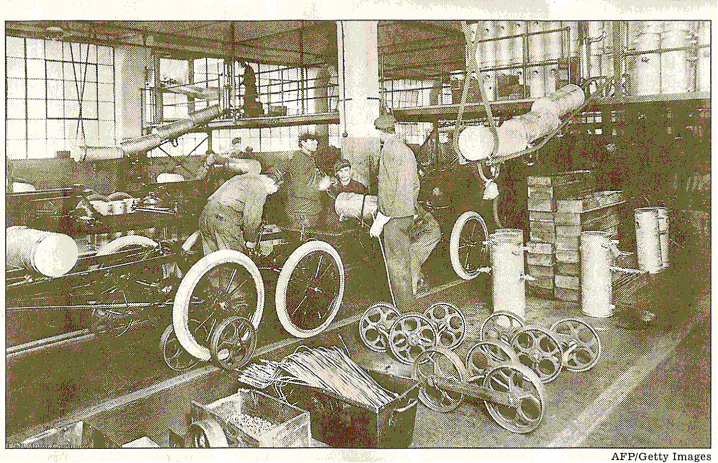
Ford Factory - 1913

IN 1914, HENRY FORD more than doubled factory workers’ minimum pay so they could afford to buy Ford cars. Above is the Highland   Park plant in 1913.

——————————————————————————————————

Average adult wealth in the United States is $301,000, but that number is heavily skewed by the fact that this country has, by far, the greatest number of “ultra-high net worth” indi­viduals, with personal as­sets exceeding $50 million.

According to the report, the United States accounts for 46% of all such super­wealthy people worldwide. Coming in a distant second is China, which boasts 6% of the world’s super rich.

Being successful, obvi­ously’ isn’t a bad thing. There’s much to be said for the whole land-of-opportu­nity idea, in which people are rewarded for a job well done.

But that’s not what’s actually happening. The rich are gaming the system so they can accumulate a greater share of wealth to the detriment of others.

They do this by using their financial (and hence political) clout to reduce their share of taxes, thus placing a greater burden on the rest of society to fund government programs and the public sector’s investment in economic growth.

The top marginal tax rate for much of the 1920s was 25%. It was 35% in 2007. At both times, wealth in­equality was at record levels.

Compare that with the 1950s when, under then­ President Dwight Eisen­hower, a Republican, the top marginal tax rate was 91%. Were the upper classes barely scraping by with such an onerous tax load?

Hardly. This period was one of the most prosperous in American history. Not coincidentally, wealth in­equality was at a low as almost everyone shared in the economy’s and the country’s good fortune.

In contemporary terms, job creators were paying much higher taxes than working stiffs, and – guess what? – there were still plenty of jobs being created.

“I’m sure the rich in the 1950s would have preferred a 10% tax rate,” said Gregory Clark, an economist at UC Davis. “But there’s no em­pirical evidence that taxing the rich slows down eco­nomic growth.”

Just the opposite. Since consumer spending is re­quired for growth, placing more money in the hands of consumers would seem crucial to fueling economic expansion, which, it goes without saying, has the ancillary benefit of helping the rich get richer.

Henry Ford recognized this. In 1914, he more than doubled factory workers’ minimum pay to $5 a day ($1l7 in today’s dollars). In part, this was to halt costly employee turnover. But it was also to provide workers with enough cash to buy the cars they were making.

“It is our belief that social justice begins at home,” said James Couzens, Ford’s treasurer at the time. “We want those who have helped us to produce this great institution and are helping to maintain it to share our prosperity.

“We want them to have present profits and future prospects,” he said. “Believ­ing as we do that a division of our earnings between capital and labor is unequal, we have sought a plan of relief suitable for our busi­ness.”

U. S. chief executives made an average of$12.3 million last year, or 354 times what the average rank-and-fIle worker pulled down, according to the AFL-CIO. Thirty years ago, the average CEO was paid 42 times what ordinary workers received.

The Credit Suisse report shows that the number of millionaires worldwide has risen by almost 2 million since the middle of last year. There are now about 99,000 individuals worth more than $50 million apiece.

Yet two-thirds of all other adults have assets worth less than $10,000. Put another way, two-thirds of all adults worldwide repre­sent no more than 3% of global wealth.

Credit Suisse forecasts that global wealth will rise almost 40% over the next five years. That’s the good news.

The bad news is that you, and billions of other hard­working people, will see little if any of those gains.

Attempted Suicide

The G.O.P., America’s conservative pro-business political party, has decided it wants to stop the president’s health care program at any cost.  Thus throwing 800,000 government employees of out of work is not too high a price to pay, in their view, if their goal is reached.

Here is a list of some of the departments and programs that will be affected.

  • Internal Revenue Service call centers will close
  • 90 percent of Environmental Protection Agency
  • National parks and museums will be shuttered
  • Equal Employment Opportunity Commission
  • Export-Import Bank of the United States
  • Federal Communications Commission
  • Federal Trade Commission
  • National Science Foundation
  • National Labor Relations Board
  • US Postal Service Inspector General
  • USDA – Rural Development
  • Civilian military workers (Department of Defense) – 400,000 people or ½ of staff
  • Department of Interior – 58,000 people
  • Department of Justice – 17,000 people
  • Department of Labor – 13,000 people
  • Department of Commerce – 40,000 people

CNN provided their detailed list.

The U.S. debt ceiling will be reached on October 17.  If the Republicans tie that limit to funding of the government I predict an impact on stock markets around the world.

While the United States will survive this self-inflicted wound, the country will be significantly diminished in the eyes of the world.

Saying Goodbye to the Middle Class

In 1914, Henry Ford started an industrial revolution by more than doubling wages to $5 a day—a move that helped build the U.S. middle class and the modern economy. After World War II the return of the GIs and the benefits they received prompted an educated society that wanted homes and cars.   Union jobs with good benefits along with little competition from other nations made the United States into an industrial power house that lasted for decades.

Then big business realized that there was an opportunity to save money by outsourcing the manufacture of the things we buy.  The government accommodated those businesses by negotiating free trade agreements with many nations.  Communications with the entire world became easier and cheaper.

People in the poorest nations of the world could be trained to operate the machines that made things Americans want to buy.  They would work for one fourth the rate of pay or less than American workers.

Today my computer, television, home theater, camera, and my clothes are all made in another country.  The people who used to make those things are now either unemployed or working in low paid service jobs (tourism, retail, fast food, and other jobs that pay less than $15 an hour).  The middle management jobs are now part of those outsourced functions.  Call the help line for Earthlink or Hewlett-Packard and you will be speaking to someone in India or the Philippines.

“A middle-age middle manager who was laid off is not going to be miraculously rehired in that position or anything like it. Same with the factory worker and the receptionist and the copy editor. They’re finished. Many of the people who held those positions have already pulled out of the workforce and others are moving into different jobs (often at lower pay levels)” writes Mark Lacter on LA Observed.

Do not look for Congress or any government agency to solve this problem.  They have no solutions.

Those desperate people who have taken jobs that pay half of what they previously earned are no longer part of the middle class.  Those that have not obtained any job at this point are living on their accumulated wealth.  Neither of those groups will be spending money as they had in the past.  Thus the bifurcated economy of the wealthy and the poor.  This means the end of the middle class in America.  That is the big picture.

Objections to Keystone XL Pipeline

11-18-2014: The number one issue in America is a growing economy. That means more good jobs. The president is WRONG on this issue. Perhaps today’s vote in the Senate will change his opinion.

Oil Pipeline GraphicA quick review.  This is the proposed oil pipeline from Hardisty, Alberta, Canada to Houston, Texas and Port Arthur, Texas.

It now appears that the U.S. State Department sees no objection to approving the project.  However, the U.S. Interior Department warns of possible harm to wildlife.  Activists are primarily concerned with the possibility of oil spills.

Interestingly there is already a pipeline from Hardisty, Alberta to Cushing, Oklahoma.  While the reports of oil spills from that pipeline are rare there has been little in the news that confirms that fact.

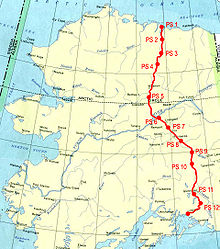
Furthermore the Trans-Alaska oil pipeline, 800 miles long, had its largest oil spill involving the main pipeline on February 15, 1978, when an unknown individual blew a 1-inch (2.54-centimeter) hole in it at Steele Creek, just east of Fairbanks.  Approximately 16,000 barrels of oil leaked out of the hole before the pipeline was shut down.  Criminal mischief has been the primary cause of leaks.  There are no reports of impact on wildlife.

Trans_alaska_pipelineThe oil companies injected billions of dollars into the Alaska economy during the construction effort and the years afterward.

Of course environmentalists don’t want to hear the facts.

The Value of Blockerbuster Mergers

There is a value to mergers.  They make companies larger and more powerful.  The likely outcome is more revenue and higher net income.  It is a share holders dream.

Historically the United States has taken the position that large mega companies that control an industry are not in the best interest of America.  The Sherman Antitrust Act was passed into law July 2, 1890.  The purpose was to prohibit monopolies.  The most infamous of the trusts was the Standard Oil Trust, which was formed in January, 1882. At that time, Standard Oil and its affiliates controlled more than 90 percent of the oil refining capacity and most of the oil marketing facilities in the U.S.  The trusts came to dominate a number of major industries, and were, in effect, monopolies.

This ground breaking piece of legislation was the result of intense public opposition to the concentration of economic power in large corporations and in combinations of business concerns (i.e., trusts) that had been taking place in the U.S. in the decades following the Civil War. Opposition to the trusts was particularly strong among farmers, who protested the high charges for transporting their products to the cities by railroad.

American Airlines & US Airways planes at Washington's Ronald Reagan National Airport
american airlines-us-airways-planes-at-washington’s-ronald-reagan-national-airport

So what do you suppose would happen if most of the airlines were consolidated into one carrier?  There would be no reason to control the charges that the airline could impose.  Even now the number of airlines has declined in the United States. There were nine major national airlines as recently as 2005, but only five remain today. American Airlines has acquired four other air carriers since 1971.  The largest was TWA in 2001.

Continental Airlines merged with United Airlines 2010 to 2012.  They retained the United Airlines name.

Between 2008 and 2010 Delta Airlines absorbed Northwest Airlines.

See a more complete list here.

What has happened to the cost of flying?  The airlines have added numerous fees to hide the increased cost of air travel.  Now there is a fee to check a bag.  A fee for food (even chips or soft drink).  Want to watch a movie?  There is a fee.  Some airlines are even charging extra for aisle seats.

 So what do you expect the fares to be once this merger is completed? The average cost of a roundtrip domestic ticket — including baggage and reservation change fees — grew to $378.62 last year, up from $351.48 in 2008, when adjusted for inflation according to a report from the Associated Press.

Just imagine the cost of other items if there was little or no competition.  Bank fees have increased simply because there is less competition.  AT&T and Verizon dominate the telecommunications industry just as Time Warner and Comcast dominate the television service industry.

The justice department is finally stepping forward to protect consumers.  Let’s hope this is the first of many more actions to protect consumer interests.

Proletariat

It’s a French word meaning “The class of industrial wage earners who, possessing neither capital nor production means, must earn their living by selling their labor.”  In Marxist theory they are the class of wage-earners, especially industrial workers, in a capitalist society, whose only possession of significant material value is their labour.

The Congressional Budget Office has issued a report saying that the lowest earning 20% of Americans have seen their income increase by 18% since 1980.  The highest earning 1% saw their earnings increase by 275% in the same period.  At the same time the number of middle class families declined.  Those middle class families have become even poorer.

From the CBO report:

The share of income going to higher-income households rose, while the share going to lower-income households fell.

  • The top fifth of the population saw a  10-percentage-point increase in their share of after-tax income.
  • Most of that growth went to the top 1 percent of  the population.
  • All other groups saw their shares decline by 2 to 3 percentage points.

In other words the proletariat has increased in numbers even as the richest became even more wealthy.  The reason?  The outsourcing of manufacturing, along with increases in technology, has reduced labor requirements.  America just does not need as many middle management workers.

The social issue is the question, how will we feed and support a society that offers declining opportunity for those who lack technical skills? Most people recognize the question but neither private enterprise nor government is prepared to discuss the issue.

Monopoly Man

Perhaps the majority, by their behavior, are saying, “Who cares?  The stock market is up, my house value is up and cars are selling well.  So what’s the problem?”

U.S. students trail global leaders

Just what business wants – Cheap Low Paid Labor

In response to concerns raised by federal regulators, Los   Angeles Unified School   District and eight other school districts have filed an amended application for a waiver from a federal law requiring that all students be proficient in English and math by 2014.  This was reported on May 29, 2013 in the Los Angeles Daily News.  The article went on to say that Rather than using No Child criteria to gauge a school’s achievement, CORE has proposed its own accountability system, called the School Quality Improvement Index. Sixty percent of a school’s score would be based on standardized tests and graduation rates, 20 percent on absenteeism and suspension rates, and another 20 percent on campus “culture and climate.”

Yes, “culture and climate” has a 20% value, what ever that means, should be considered rather than the ability to communicate in English.

Meanwhile Scores from the 2009 Programme for International Student Assessment (PISA), 15-year-old students in the U.S. performing about average in reading and science, and below average in math. Out of 34 countries, the U.S. ranked 14th in reading, 17th in science and 25th in math.

Between 1995 and 2008, for example, the United   States slipped from ranking second in college graduation rates to 13th, according to the Organisation for Economic Co-operation and Development, the Paris based organization that develops and administers the PISA exam.  Of 34 OECD countries, only eight have a lower graduation rate than the United States.

Our next door neighbor, Canada, ranked 4th in Math and 6th in Science.

Meanwhile the LAUSD and other school districts representing over 1 million students want a waiver on proficiency in English and math.  If granted, the United   States is on its way to a two class society.  Those with English and math skills and everyone else.  Everyone else will be working at McDonald’s, Target, making beds in hotels, or other low paid blue collar jobs.