How much more brutal can it be when the U.S. Bureau of Labor Statistics monthly jobs report starts with these horrible words? “Nonfarm payroll employment was unchanged (0) in August, and the unemployment rate held at 9.1 percent, the U.S. Bureau of Labor Statistics reported today. Employment in most major industries changed little over the month.”
Looking down through the detail only makes you feel even worse. Comments by the White House and the Speaker of the House did nothing to make anyone feel good about the jobs situation.
Rather than actually doing something constructive our national government is tied in knots because the political parties are more interested in dueling than accomplishing anything. Would voting out the incumbents make a difference? Unlikely because the new office holders would simply comply with their party line.
While we may be dangerously close to a double dip recession that probably won’t happen because enough Americans are working and shopping to sustain the business community.
We have the kind of economy that Bill Gross of PIMCO calls “the new normal” and others call “the great reset.” Whatever you want to call this situation there does not appear to be a path back to “the good old days.”
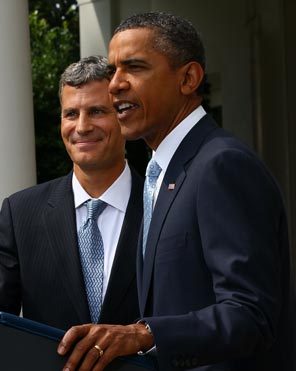
President Barack Obama has chosen Princeton University’s Alan Krueger to be chairman of the White House Council of Economic Advisers.
“As one of this country’s leading economists, Alan has been a key voice on a vast array of economic issues for more than two decades,” Mr. Obama said Monday in a statement. He continued, “Alan understands the difficult challenges our country faces, and I have confidence that he will help us meet those challenges as one of the leaders on my economic team.”
Mr. Krueger served as assistant Treasury secretary for economic policy during the first two years of the Obama administration—which means he has recently cleared the sometimes treacherous Senate confirmation process.
What we have here is a re-cycling of the same people between government and the elitist economists that dominate the Ivy League universities. Larry Summers rotates between Washington D.C. and Harvard University. Christina Romer and Robert Reich are now at UC Berkeley. Austan Goolsbee returns to the University of Chicago.
Alan Krueger brings the same thoughts and ideas that are just a re-tread of the previous advisers. It’s the “yes men” who provide nothing new and simply provide support to the president’s views. This situation is nothing new. Every president that I can remember has done exactly the same thing. Those who are not “yes men” do not last long.
Remember Paul O’Neill under George W. Bush. He held the position of Secretary of the Treasury from January 20, 2001 to December 31, 2002. O’Neill was chairman and CEO of the Pittsburgh industrial giant Alcoa from 1987 to 1999, and retired as chairman at the end of 2000. He was fired for opposing the invasion of Iraq. It was his reward for not being a “yes” man.
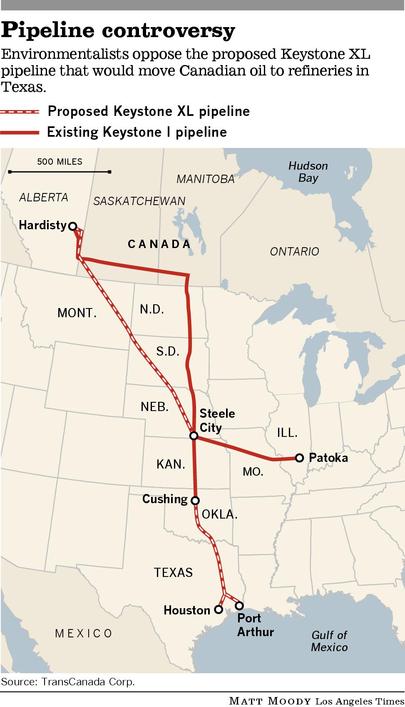
The proposed Keystone XL oil pipeline from Canada to the Texas Gulf Coast would not have “significant impacts” on the environment, the State Department has concluded, removing a major barrier to construction of the $7-billion project.
The problem is that environmentalists and others oppose the idea on the grounds that tar sand extraction (usually called fracking) because water tables will be impacted in the mining area. There have been reports on American television of enough gas in water pipes to ignite them at their outlets. This is obviously a serious issue.
The question of a new pipeline from Alberta to Texas should be what will the Canadians do if the United States says no to the project? It appears Canadian are determined to extract oil from their soil in Alberta despite the opposition. The answer is they will sell the crude oil to another country. That would most likely be South Korea, China, or Japan. There are already plans to build the Northern Gateway pipeline from Alberta through to British Columbia’s northern coast. Some say this is a fake play by the Canadian government. No matter, a greater reliance on oil from Canada will benefit the United States with more jobs and a dependable source of supply.
President Obama may be caught in this controversy because if his decision is a “no,” Republicans will say the decision is anti-business and is a job killer. They would be correct.
A free falling object is an object that is falling under the sole influence of gravity. No one knows where the object will land. A free falling economy is undefined but appears to be an economy that is collapsing. No one knows where it will end. Jobs are disappearing, businesses are closing, and the only purchasing is for necessities of life. Those necessities are water, food, and power for cooking and heat.
Happily most of us are not in that stage now but we seem to be going that way. The government is functioning poorly at best, jobs are difficult to find, and businesses are closing. These are all the facts that brought us the Great Depression.
Of course no one in our government and no one in the media want to use the word “depression.” The mere suggestion of “depression” might start the population to believe it can happen again.
“Double dip, here we come,” said Colin Barr in Fortune.com.
The private sector should be the engine of hiring, but it’s holding back because of “scant demand,” said Phil Izzo in The Wall Street Journal.
“Let’s face it”, said David Leonhardt in The New York Times: The “old consumer economy is gone, and it’s not coming back.”
One big difference this time is the lack of government hiring, which tends to “blunt the bleeding of the private sector” during downturns, said Morgan Housel in TheMotleyFool.com. Since 2010, the public sector has cut nearly half a million jobs, particularly at the state and local levels, because of “plunging tax receipts.” Add those job losses to the steep declines in manufacturing, construction, and retail, and you can see why “most respected economists don’t see employment hitting pre-recession levels until 2014 at the earliest.”
The Federal Open Market Committee of the Federal Reserve issued a statement yesterday that read in part:
To promote the ongoing economic recovery and to help ensure that inflation, over time, is at levels consistent with its mandate, the Committee decided today to keep the target range for the federal funds rate at 0 to 1/4 percent. The Committee currently anticipates that economic conditions–including low rates of resource utilization and a subdued outlook for inflation over the medium run–are likely to warrant exceptionally low levels for the federal funds rate at least through mid-2013.
I never shopped in Tourneau in Westfield Topanga but it was a very large store.
Does anyone believe this economy will recover before 2013? Write your explanation here.

 Coast Contact