Jobless claims reached the lowest level in more than 50 years. This is the lowest level for initial claims since November 15, 1969 when it was 197,000. The 71,000 slide marks the eighth straight week of declines, a reflection of a tight labor market that has companies scrambling to retain and expand their workforces.
Unemployment is still higher than it was before the pandemic, resignations are soaring, and employers are struggling to keep their workers. Workers are demanding higher pay and walking away from jobs that don’t provide a living wage or are just plain boring and don’t offer an opportunity for more satisfying work.
Inflation may be up but the economy is growing. Most businesses are seeing higher profits.
President Joe Biden is in serious trouble despite the fact that his infrastructure bill has been passed. His social infrastructure bill of $3 Trillion has been striped down to a mere $1.75 Trillion and is looking to be stripped to an even smaller size. Inflation reports by the Bureau of Labor Statistics (BLS) just reported that inflation rose 6.2% in the past year. Add to that the supply chain issues that are causing shortages in the things we want, the sloppy withdrawal from Afghanistan, the unconquered COVID-19 pandemic, the likely control of Congress passing to the Republicans next November and you have the formula for a one term president.
The infrastructure bill that will be signed on Monday November 15 will deliver $550 billion of new federal investments in America’s infrastructure over five years, including money for roads, bridges, mass transit, rail, airports, ports and waterways. The package includes a $65 billion investment in improving the nation’s broadband infrastructure, and invests tens of billions of dollars in improving the electric grid and water systems. Another $7.5 billion would go to building a nationwide network of plug-in electric vehicle chargers, according to the bill text. The public is not impressed.
In a new WaPo-ABC poll In a new WaPo-ABC poll
63% of respondents said Biden has accomplished “not very much” or “little or nothing” so far in his presidency. A full 45% said he’s done “little or nothing” — that’s worse than the numbers for then-Presidents DONALD TRUMP, BARACK OBAMA or BILL CLINTON at comparable points in their presidencies.
Just 31% said he’s kept most of his major campaign promises — also a worse figure than Trump, Obama or Clinton received.
70% rated the economy as “not so good” or “poor.”
While the 2024 presidential election is three years away likely candidates are laying their plans now. The winner will not be President Joe Biden nor past president Donald Trump. We want a unifier but politics will be getting in the way.
The latest jobs report from the federal government provided some shocking information. The total number of new jobs rose by only 194,000. The economic experts had predicted about 500,000. What happened?
Many people are not willing to return to their old jobs. It’s not just one reason. The obvious reason is fear of contracting COVID-19. The less obvious is many people thinking they never did like their old job because the pay was lousy, the hours were too long, and the chances for advancement were limited. Even the poorly educated are thinking they want a more rewarding occupation so maybe I can find something else to do.
That feeling that “I’ve had enough” according to the BLS report resulted in 4.3 million workers, or 2.9% of the labor force, quitting their jobs in August. That’s the highest rate since the BLS began tracking the data in December 2000.
After all who wants to drive a truck and who wants to deal with difficult patrons? Who in the hell wants these jobs?
To lure those workers back to those mind numbing jobs it is going to take higher pay and that will mean higher prices for everything. After all businesses still want the same profits they have had in the past.
Now it appears certain that many of these strains, both economic and viral, will continue well into 2022, and perhaps beyond. “There’s just no road map to opening a global economy in a pandemic, and people keep forgetting we’re still in a pandemic,” said Diane Swonk, chief economist at Grant Thornton. Now the recovery not only has to fix what was lost, but also the “scars and wounds have to heal” after hard-hit workers and industries reevaluated their futures,” Swonk said.
The world has been dislocated by the COVID-19 pandemic in ways most of us cannot comprehend. Shortages, higher prices, and few of us are willing to work in low paying jobs with no future are outcomes of this world wide catastrophe.
When fewer items are available, consumers are willing to pay more to obtain the item—as outlined in the economic principle of supply and demand. The result is higher prices due to demand-pull inflation.
Employers have faced a number of challenges throughout the COVID-19 pandemic — most recently, a labor shortage. In order to protect profitability, companies will have to pass on the additional costs to the consumer, adding to inflationary pressures.
cargo ships awaiting a birth at Los Angeles harbor
There is a cargo ship bottleneck trying to get into ports along the California coast. The supply chain is backed up and affecting businesses all the way down to the consumer. Another in inflationary pressure.
Add social behavior caused by the COVID-19 pandemic and the world is confronted with an inflationary period with no ending in sight.
Government solution of aid in the form of unemployment benefits, regulations protecting tenants against evictions, and other programs to protect the unemployed causes many to believe the United States is becoming a socialist society.
Those “experts” writing their opinion pieces and appearing on news media outlets don’t really know where this situation is going. Your opinion an my opinion is just as valid.
‘It takes just “one extra snowflake to start an avalanche — and boom!” Indeed, according to Harry S. Dent Jr., aka The Contrarian’s Contrarian, flurries could come in July: The ever-building market bubble is likely to “blow at the end of this month, if not September,” predicts Dent in an interview with ThinkAdvisor.’
The Conference Board opinion: Looking further ahead, we forecast that the US economy will grow by 3.8 percent (year-over-year) in 2022 and 3.0 percent (year-over-year) in 2023.
My opinion: The sky is not falling. Despite politics we will muddle through despite our lack of a strong leader. Ignore the noise.
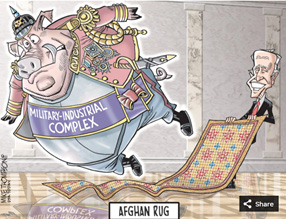
The military–industrial complex describes the relationship between a nation’s military and the defense industry that supplies it, seen together as a vested interest which influences public policy.
Dwight Eisenhower, 34th president of the United States
President Eisenhower’s farewell speech to the nation the retiring president warned of the dangers of allowing a Military-Industrial Complex to take control of the United States. The Military-Industrial Complex is a term that denotes a symbiotic relationship between a nation’s military, economy, and politics.
The U.S. sent to Afghanistan nearly 600,000 small arms, 76,000 vehicles and 208 airplanes to Afghanistan’s military and police from 2003 to 2016, according to a 2017 Government Accountability Office report, one of the few such compilations. The U.S.-led military coalition documented deliveries of 174 Humvees, nearly three million rounds of ammunition, and nearly 100,000 2.75-inch rockets during the period, night-vision goggles and even small drones for intelligence gathering.
The Department of Defense has a handful of arms manufacturers. You may recognize some or the names: Colt, Daniel Defense, Remington Arms Company, and FN America. FN is also working to help develop new guns featuring revolutionary technology. Lockheed Martin Corp. is the largest arms manufacturer in the world. Boeing, Northrup Grumman, and Raytheon rely on the U.S. military for anywhere from 44% of their revenue (Boeing) to 89% of their revenue (Lockeheed).
“FN America was recently down-selected and contracted to produce two prototypes for the U.S. Army’s Next Generation Squad Automatic Rifle program,” says Greg Livermore, FN’s vice president for product management.
All of those arms manufacturers are now trying to negotiate a situation that will result in fewer arms sales. Don’t you know they will be promoting another war? They don’t care where it is and how many lives are lost or how many injuries are sustained?
It was WWII followed by the Cold War that created jobs for Americans in those arms manufacturing companies. Many have said that wars are what keeps America out of depressions.
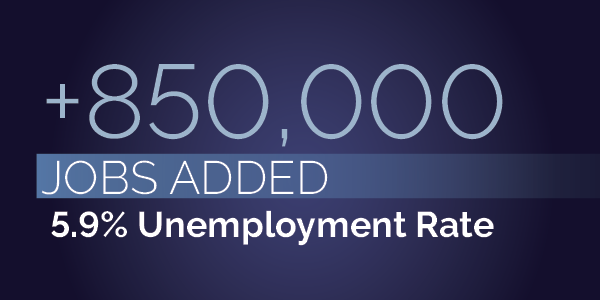
The Labor Department’s Job Opening and Labor Turnover Survey (JOLTS) shows that by May, the economy had more than 9 million unfilled job openings, the highest number since the survey began in 2000, and double the number available as recently as 2014. The unemployment rate in July was 5.4 percent and presumably would have been lower if job seekers had taken some of the many available positions. Explain what is the reason for a rental eviction moratorium?
I feel badly for those who lack the skills to obtain nothing more than a minimum wage job but life isn’t fair. I cannot be a lawyer or doctor because I lack the ability to pass the bar or meet the standards to be a doctor. That is simply a fact.
Many people are receiving more unemployment benefit aid than the money they would earn in their previous job. Millions will lose pandemic unemployment in September—many have already been cut off. … The programs, which support people who’d normally fall through the cracks of the unemployment system, were established in the March 2020 CARES Act and extended until Labor Day 2021 through the American Rescue Plan.
Roughly 7.5 million workers who’ve relied on pandemic-era unemployment benefits will be cut off from jobless aid altogether when they are set to expire on September 6, according to estimates from The Century Foundation, a left-leaning think tank. Rising Covid cases due to the contagious delta variant make finding a job difficult but how difficult when retail and hospitality businesses are clamoring for workers?
A consequence of low paying jobs means a lack of affordable housing. This is not a Covid-19 issue. The poor have been confronted with this issue all of their lives. It begs the question: Is it the government’s responsibility to provide housing for everyone? I believe the answer is yes. Many cities do provide public housing. Most Democrats say the answer is YES and most Republicans say NO. But it’s not that simple. There are unfilled jobs available now. I won’t be surprised if many of those unwanted openings are filled after September 6.
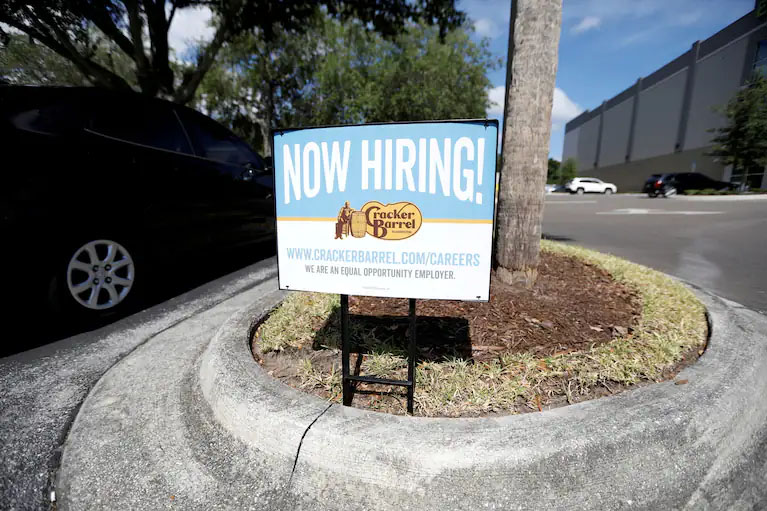
Average pay just topped $15 an hour at U.S. restaurants, one of many sectors forced to raise wages to lure back millions of workers. Now hiring signs are everywhere. My nearby IHOP has signs saying now hiring cooks and servers. But no one wants those jobs because the pay is low and there is limited chances for promotion.
Employees in the hospitality industry are quick to point out that pay is still paltry compared with that in other fields. The work is grueling, including standing all day and dealing with customers who can be unfriendly or outright irate. But workers are noticing — and responding to — the higher pay. More than 40 percent of the better-than-expected hiring in June was in the hospitality sector.
What is clear from the June jobs report is that firms that are raising pay are largely seeing the benefits. Businesses advertising $15 or more an hour are luring more applicants, and the pay hikes in the hospitality sector appear to be forcing other industries to increase wages as well, to stay above retail and restaurants. After companies like Chipotle said they would go to $15 an hour and Bank of America said it would go to $25 an hour by 2025, searches for jobs at those firms jumped, according to Indeed.com.
For a limited time workers taking jobs that are a drudgery are now being called heroes. So let’s celebrate!
This is a shocking reality reported in the April-May AARP magazine. The median retirement nest egg among retired people in the United States is $50,000 reports the Federal Reserve. Just to review median is not average. In statistics the median is the mid-point separating the higher half from the lower half of a data sample. In other words half the retired population has less than is $50,000 in their retirement account. This data goes along with the frequently reported fact that many people do not have enough money to pay a $400 unexpected expense tells me how poor most Americans are. In the AARP article titled “Protecting Your Nest Egg” the author goes on to offer suggestions on how to save money.
Meanwhile Jeff Bezos’ wealth grew by $99 billion from 2014 to 2018. Bezos is not the only super wealthy citizen of the United States. Michael Bloomberg, Mark Zukerberg, and Elon Musk have wealth in the billions.
This is not the first Guilded Age. The industrialists of the later 19th century and early 20th century Gilded Age lived high on the hog, but most of the working class lived below poverty level. As time went on, the income inequality between wealthy and poor became more and more glaring. Cornelius Vanderbilt, John D. Rockefeller, Andrew Carnegiewere all part of that early 1900s world of super wealthy and 12 hour starvation wage working class.
It was that glaring difference between the super wealthy and the rest of us that gave rise to communism.
What is “middle class?” Former Secretary of Labor Robert Reich suggests that the middle class should be defined ashouseholds making between 50% below and 50% above the median. Pew Research Center, a non-political organization,on line posting says “About half of U.S. adults (52%) lived in middle-income households in 2018, according to a new Pew Research Center analysis of government data. Roughly three-in-ten (29%) were in lower-income households and 19% were in upper-income households.”
My own opinion is that the idea of the words “middle class” are the wealthy’s definition of everyone who is isn’t part of the super wealthy. No one is poor. Peasant in an unacceptable word. Too demeaning. We are all part of the upper middle class or the lower middle class. So the janitors and house cleaning people are lower middle class. In other words there are no “poor people” in America.
The 2021 federal poverty level (FPL) for a single person residing in the 48 contiguous states or Washington, D.C. is $12,880. Today’s $7.25 an hour minimum wage is below poverty level and low pay for the so called middle class of today is the motivation that results in revolutions.
Republicans who voted to grow the national debt under former president Donald Trump are trumpeting fiscal conservatism again during a Democratic presidency.
The national debt under former president Donald Trump grew from $19.9 trillion in January 2017 to a new high of $27 trillion In October 2020. That’s an increase of almost 36% in less than four years.
Today the debt is over $28 trillion.
Joe Biden’s spending plans will obviously increase the national debt to an even higher number.
The problem is that the political party that is out of power invariably voicing concerns of the growing debt.
Doyle McManus in the Los Angeles Times pointed out in his latest column that more than $600 billion in taxes on 2020 income will go uncollected because the IRS lacks the manpower to audit the most tax returns. Unreported income of the wealthy is the issue. “The total shortfall over the coming decade could reach $7.5 trillion — more than enough to pay for all of President Biden’s ambitious spending plans.”
“Collecting the taxes people are required to pay isn’t soaking the rich; it’s stopping the deadbeats and freeloaders from shirking a burden the rest of us are carrying.”
The president knows that his best opportunity to see laws passed that are on his agenda have to be completed during his first two years in office. Why? Because control of congress usually is won by the opposition party in the second two years.
The control of the House of Representatives during Trump’s second two years went to the Democrats. That very thing happened during Barack Obama presidency. In fact both houses were controlled by the GOP during the last two years of his presidency. It’s not a given since George W. Bush managed to have a GOP congress for four years but Eisenhower, who was president for two terms, saw both houses in Democratic control for six of his eight years in office. The Democratic Party has a very narrow control of both houses. Just the loss of one seat in the Senate and the GOP will again be in control. Doyle McManus in the Los Angeles Times reports that most prognosticators predict the GOP will gain control of the House of Representatives in the 2022 election.
Incidentally, I started writing this piece before the McManus column.
A reservoir in Florida that holds nearly 400 million gallons of wastewater from a former phosphate mine was leaking on Saturday, prompting hundreds of evacuations, the authorities said.



 Coast Contact