Stimulus and the Impact of Shortages

President Joe Biden may have led the congress into an inflation that has been brewing for a long time.

Treasury Secretary Janet Yellen said she didn’t think inflation posed a significant risk now that the Biden administration’s covid relief is signed and on its way to implementation. Federal Reserve Chair Jerome Powell has made it very clear that unlike some investors, he’s not stressed out about a potential rise in inflation later this year. And there’s good reason for that: he’s busy worrying about jobs.

Low interest rates and easy access to money has resulted in a buying flurry in southern California where I live. This did not start with the stimulus money sent to most families. Long before the COVID-19 pandemic new car sales and home buying was very obvious here.

My middle class neighborhood (median family income is $70,505) is now the home for high priced Lexus, Jaguar and other expensive car brands. This past October my nearby Honda dealer told me that they were not expecting any new shipments until after the new year. That means they have no motivation to sell cars at less than the sticker price. Real Estate brokers have been crying because the supply of new listings was too low for the past two or three years. It wasn’t. Most people do not keep moving from house to house. Homes have seen selling easily with bidding wars that drove the final selling price up by tens of thousands of dollars.

As of March 1, 2021 the Consumer Price Index data for the month of January found that the cost of food eaten at home rose 3.7 percent from a year ago — more than double the 1.4 percent year-over-year increase in the prices of all goods included in the C.P.I.

Even as a non-economist I can see trouble on the horizon.

‘$4 isn’t much’

The Kroger company is the biggest retail grocery company in the United States. As the largest pure grocer in the United States (trailing only Walmart in overall grocery sales and at approximately double the revenue of number-two Albertsons.

Kroger owns many chains other than Kroger stores. Food 4 Less and Ralphs in metropolitan Los Angeles are two of its chains. When you shop in Ralphs, as I do, you see the Kroger name on many of its private label products.

The company has decided to close its stores in Long Beach (one Ralphs and one Food 4 Less) because the city council has ordered food markets to pay a $4-an-hour increase for grocery workers during the pandemic. The city called it hazards pay. This is not a permanent increase.

Kroger, which has enjoyed a big jump in profits during the pandemic, is pushing back. Customers and workers say that’s unfair. Kroger’s decision is most likely based on the fear that once the pay rate is increased it will never go back to the previous level and it will set precedent for the city and county of Los Angeles. That then could spread across the nation.  

Ronald Fong, president of the California Grocers Association trade group, which filed a lawsuit over the Long Beach ordinance, said the group tried to warn the city about “unintended consequences” of the measure.

This is the best example of workers versus employers that we have seen since the last strike of grocery workers. The 2003-04 Southland grocery strike dragged on for 141 days. That work stoppage was estimated by some analysts to have cost the supermarket chains as much as $2 billion, with locked-out workers losing $300 million in wages.

One shopper at the Ralphs store told an LA Times reporter she supports the hero pay, in part because her son works in the retail grocery business. “It’s hard work for him!” she said. “$4 isn’t much.”

With a 2020 Net Income of $1.64 billion it seems the company needs to become a responsible member of a society that is struggling with a pandemic.

Folly of the Buy American Program

President Joe Biden’s Buy American program is a mistake.  It is an assault on our allies.  It is anti-competitive.

iPhones are made in China because the cost of making them in America would make them too expensive for most people.  Actually the newest iPhones are too expensive for most people now.

More than 40 million American jobs depend on trade, and trade is critical to the success of many sectors of the U.S. economy.

98% of the roughly 300,000 U.S. companies that export are small and medium-sized businesses, and they account for one-third of U.S. merchandise exports, according to the U.S. Department of Commerce

American imports totaled $2.614 trillion in goods in 2019.

Here are the top ten items imported items into the United States.  My source in the U.S. Chamber of Commerce.

1. Machinery (including computers and hardware) – $386.4 billion

2. Electrical machinery – $367.1 billion

3. Vehicles and automobiles – $306.7 billion

4. Minerals, fuels, and oil – $241.4 billion

5. Pharmaceuticals – $116.3 billion

6. Medical equipment and supplies – $93.4 billion

7. Furniture, Lighting, and Signs – $72.1 billion

8. Plastics – $61.9 billion

9. Gems and precious metals – $60.8 billion

10. Organic chemicals – $54.6 billion

The total dollar value of every U.S. import translates to about $9,457 for every resident in the country.

The United States’ greatest trading partners are also those who provide the most of the country’s imports. Based solely on the strength of goods (not services), the most powerful nation in the world receives the most imports from China (18.2%), Mexico (14.4%), and Canada (12.7%). Rounding out the list of the top 10 United States imports are Japan, Germany, South Korea, Vietnam, the United Kingdom, Ireland, and France, accounting for approximately 23.9% of the rest of U.S.-bound imports.

Canada, Mexico, the European Union, Chile, and Brazil are also the largest importers of American-made food products, including horticultural goods, sugar, and tropical products unique the North American climate. Nearly $14 billion in food goods go to these countries each year.

The raw material to make those imported items costs the same whether they are purchased in the United State or elsewhere. It is the cost of labor that makes products manufactured in the United States more expensive.  There is no way Americans will work for the low wages that are common so many countries around the world.  Things are going to get even tougher as President Biden pushes for a $15 per hour minimum wage.

Vast productivity gains relating to increased use of automation and information technologies have helped U.S. manufacturers retain and in many areas enhance their global competitiveness in recent years, even as the number of Americans employed in manufacturing has declined since its peak in 1979.

The U.S. Department of Commerce estimates that exports of manufactured goods directly support more than 6 million U.S. manufacturing jobs—roughly half of all manufacturing employment.

Perhaps Biden’s efforts in his Buy American program is not a serious effort but is just saying the right thing politically.  After all we should do everything we can to encourage companies to make their products in the United States.

In the end, we cannot turn our back on international trade. It is an inevitable part of the world in the 21st century. We simply need our elected leaders to prioritize initiatives to open foreign markets so that U.S. companies can sell more of our goods and services overseas. Trade can provide a path to jobs and prosperity if we have the courage to seize it.

Trade can provide a path to jobs and prosperity if we have the courage to seize it.

Companies and People Are Leaving California

Over the past several years, a disturbing trend has been developing in California. Once known as the bastion of commerce, manufacturing, and business growth. The Golden State is saying goodbye to dozens of businesses every year, and the numbers seem to be increasing as companies are leaving California.

California has lost huge players like Toyota, Comcast, and many others is cause for the state to sit up and take note. The exodus is especially dramatic in 15 California counties, with Los Angeles being the worst.

It’s not just businesses. It’s the many rich who are exhausted by the ever higher taxes and the ever increasing cost of living. Elon Musk has decided to move to Austin, Texas. He is the second richest person in the world. His two major companies are still in California but the message is clear. It’s too expensive to live in in this state. I agree.

I know many of the people personally and through social media sites who have moved not only to other states but to other countries.

What I find most disturbing is the shrugs of our elected leaders when they learn of the departure of those big businesses and wealthy people. It seems they have raised taxes to discourage businesses from remaining here.

One can only wonder why our elected leaders are so quiet.

Re-elect Me or Your Finances will go down the Drain

Like this ostrich, Donald Trump prefers to hide from reality.

The selloff  of the stock market today follows Monday’s sharp decline as the president tries to make a closing argument with voters that rings hollow.

Trump’s argument for his re-election makes no sense. 40% of Americans don’t have $400 in the bank for emergency expense says the Federal Reserve.

But for discussion:
Closing words of Donald Trump at the second presidential debate. “We are on the road to success. But I’m cutting taxes and he wants to raise everybody’s taxes. And he wants to put new regulations on everything. He will kill it. If he gets in, you will have a depression, the likes of which you’ve never seen. Your 401K’s will go to hell and it’ll be a very, very sad day for this country.”

For perspective the average 401(k) balance is $92,148, according to a 2019 Vanguard analysis of over 5 million 401(k) plans issued by the company. But most people don’t have that amount of retirement savings. The median 401(k) balance is $22,217, a better indicator of what the majority of Americans have saved for retirement. That is not enough to buy a car.

The S&P 500 reached a peak of 3544.71 on October 12 but today it has dropped to 3295. The Dow slides more than 800 points today. My 401K investment is in a fund based on those averages. How about Apple shares? Down 10%.

Donald Trump is out of touch with most Americans. Most of us are concerned with sufficient income to put food on the table, pay the rent, the car payment, and affordable health care.

Americans are more Cautious Then You Thought

2000 Chevrolet Montecarlo

According to CNBC, a cable finance news channel, 25% of cars in the U.S. are at least sixteen years old as vehicle age hits record high.

On average, 1 in 4 cars and trucks you pass are at least 16 years old, according to new analysis of what Americans are driving. With the economy struggling due to Covid-19, prompting companies to lay off millions of Americans, the age of vehicles in the U.S. is likely to rise. It may even climb at a faster rate, according to IHS Markit the highly respected survey company that provided the data.

As someone who believes in driving a car until it is ready for the junk yard I was delighted to learn that I am not alone.

Of course we all want a new car.  We might even shop for a new car.  Then we hear what the monthly payment will be and that stops us from proceeding with the purchase.

It is the same thing when it comes to the purchase of any high priced item.  The picture on the old TV is still good so unless the new television has some new features we can’t live without, we turn to our family members and say “What we have does the job.  Let’s wait until black Friday and we’ll make it a family Christmas gift.”

Despite all of these efforts to keep our expenses under control and avoid using our credit card, the Average US Credit Card Debt is at $15,983.

Sadly many of us have been laid off as a result of the virus epidemic and are now using our credit card(s) to buy our everyday needs.

Is personal bankruptcies going to grow?  Putting food on the table is a priority.

Donald Trump is Livid

Living in his own world Donald Trump believes everything is wonderful. Poll numbers are all up. The coronavirus is going away (On Wednesday Trump said “It’s dying out.”) The economy is in a rapid recovery.  

Unfortunately none of that is true. A new Fox News poll shows that Biden is ahead of Trump by a 12 point margin, as racism, coronavirus, and unemployment are top-of-mind for 2020 voters. New virus cases have been trending upward reaching almost 28,000 cases today. John Bolton, his former very conservative adviser, has joined a group of highly respected former members of the Trump cabinet condemning him as a moron and unfit to serve in the roll of president. Another 1.5 million people filed for unemployment benefits this past week. To add to his dismay he has lost two cases in the Supreme Court (LGBTQ protection against employer discrimination and preserving DACA).

To make himself feel better he is having a campaign rally in an enclosed arena in Tulsa Oklahoma where no masks will be required and social distancing will not be enforced.

If you are concerned about Trump’s health check the bunker.

First Day of Reopening – Westfield Topanga Mall

I was surprised to see so many cars parked in the northside Owensmouth garage.  It was a hot day.  I took a walk around the lower level.  At least one half of all the stores were closed.  Target and Macy’s was open but Nordstrom’s was closed.  H&M had all the mannequins undressed and there were stacked boxes of merchandise so I guess they will not be re-opening.  Jimmy Choo’s had no merchandise on the shelves which probably means they too are closing.  Some stores had notification of their planned openings and others posted on the doors they would be opening soon. Of course all the eateries and cholatiers were closed.    

This is not my video but definitely tells the story.

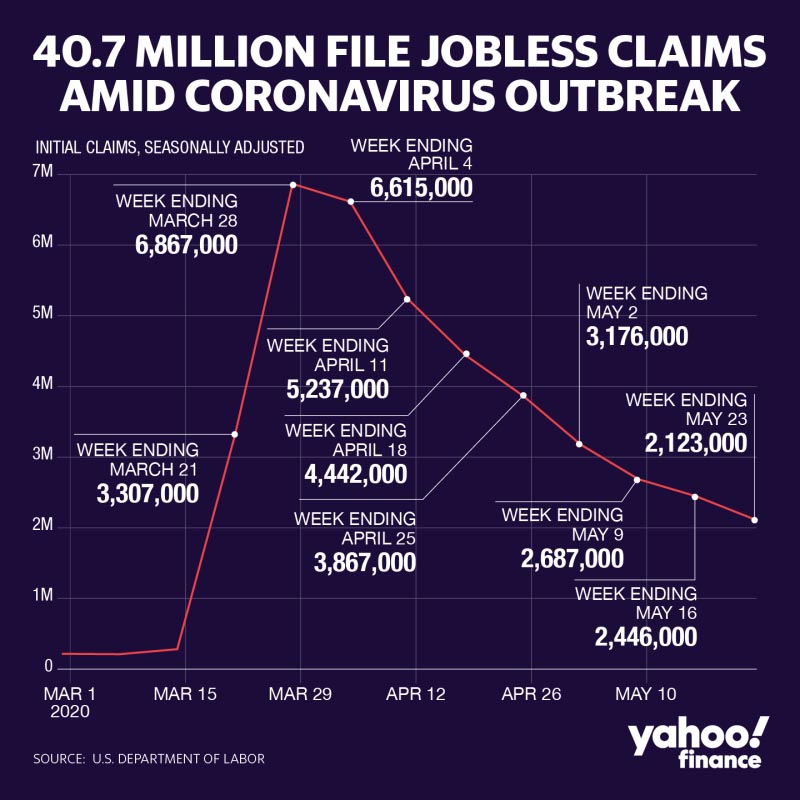
40.7 Million Filed for Jobless Claims Since Start of Coronavirus Outbreak

Donald Trump’s primary argument for his re-election has been the low unemployment rate. Another 2.1 million people applied for unemployment insurance benefits this past week. Trump loves to take credit for the booming economy but doesn’t that make him responsible for a failed economy?

This graph shows the weekly new jobless claims.  Prior to the Coronavirus Outbreak weekly claims were about 212,000 and the unemployment rate was 3.5%.