U.S. Job Openings Exceed Number of Unemployed

U.S. job openings unexpectedly rose to a fresh record in April, with vacancies increasingly exceeding the number of unemployed workers amid a robust labor market, Labor Department data showed Tuesday.

 March’s upward revision made it the first time in data back to 2000 that vacancies exceeded the number of unemployed, a gap of 48,000. That difference grew to 352,000 in April and is poised to keep widening, as the number of unemployed dropped further in May, to 6.07 million.

 I believe most Americans are primarily concerned with their economic situation over any other issue.  If collusion with Russia, attacks on the Justice Department, immigration policy, health care, equal opportunity, the environment and other issues are far less important than the economy the Republicans will most likely retain both houses of Congress. 

 The November election will tell us all what Americans think is really important.

California Alone is the Fifth Largest Economy in the World

It is accurate to say that California is a challenging place to live if you are not a millionaire. It is very difficult for median income families.  Median household income for California was $67,739 in 2016. Housing costs are among the highest in the nation. Gasoline is currently averaging $3.63 a gallon for regular. That gasoline price is matched only by Hawaii.

Despite those challenges California’s gross domestic product is only surpassed by the entire United States, China, Japan, and Germany.

The reason for this situation is the multiple economic engines.

-Silicon Valley: the area south of San Francisco is the home of Facebook, Alphabet previously known as Google, Hewlett-Packard, Oracle, Intel, Cisco Systems, Nvidia, Netflix, Tesla, and many less known tech companies.

-Hollywood: Really all of Los Angeles is the television and movie entertainment capital of the world. CBS, NBC Universal, Disney, Paramount, Sony, and Warner Brothers are all in metropolitan Los Angeles.

-Tourism: According to the Los Angeles Tourism & Convention Board, 48.3 million tourists visited L.A. in 2017, an increase of more than 2 percent over 2016 and the seventh consecutive year of record-breaking results. The total number of visitors to San Francisco last year rose 2.3 percent to 16.9 million.

-Import and Distribution: The two largest ports in the United States are Long Beach and Los Angeles. 40% of all goods imported enter through those two ports. They are then moved to distribution warehouses in Los Angeles, Riverside, and San Bernardino.

-Agriculture: California produces a sizable majority of many American fruits, vegetables, and nuts: 99 percent of artichokes, 99 percent of walnuts, 97 percent of kiwis, 97 percent of plums, 95 percent of celery, 95 percent of garlic, 89 percent of cauliflower, 71 percent of spinach, and 69 percent of carrots (and the list goes on. California is the leading US state for cash farm receipts. I have seen California strawberries in Toronto Canada.

-Manufacturing: Manufacturers help to drive California’s economy, with $142.39 billion in manufactured goods exports in 2016.

These are the reasons that nearly 40 million people see the state as the heart of economic opportunity.

The Largest U.S. Trade Deficit Is With China

Why is President Donald Trump imposing tariffs on China?

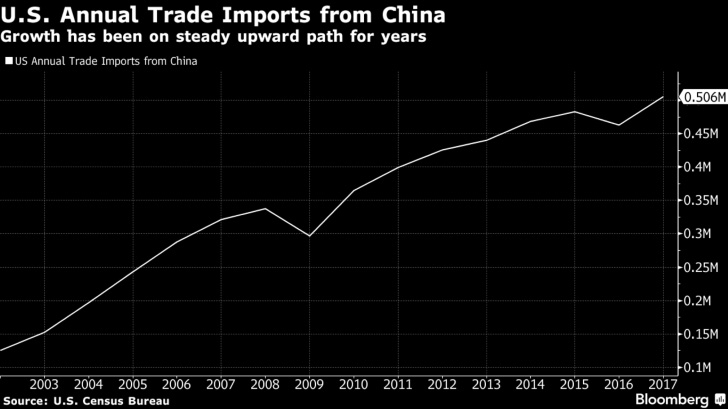
More than 65 percent of the U.S. trade deficit in goods was with China. The $375 billion deficit with China was created by $506 billion in imports. The main Chinese imports are consumer electronics, clothing, and machinery.

America only exported $130 billion in goods to China.

As this graph indicates this is not a new phenomenon. It goes back to the late 1900s.

China currently assembles the majority of Apple’s iPhones in its Shenzen, China, location by Foxconn. That company maintains factories in countries across the world, including Thailand, Malaysia, the Czech Republic, South Korea, Singapore, and the Philippines. A second company, Pegatron, is a relatively recent addition to the iPhone assembly process also in China.

High End clothing brands we all lust after really have to work hard to minimize the production costs while keeping their products “luxurious” and “high end”. China is their go to manufacturing location. Who are they?
1. PRADA
2. COACH
3. ARMANI
4. BURBERRY
5. MULBERRY
6. MARC JACOBS
7. D&G

Chinese factories manufacture winter coats, gloves, mittens and hats for consumers around the world. These factories also produce maternity clothes and infant clothes as well as wedding dresses and tuxedos. Underwear, T-shirts and slips are among the items exported from China to consumers around the world. Sports caps are also produced in China as are belts and bras.

Luggage, machinery, and furniture are also made in China.

The consequence of the outsourcing of all that manufacturing has resulted in a major loss of good paying blue collar jobs in America.

Trump is correct when he points out that both political parties stood by and did nothing as the jobs left the country.

We couldn’t stop the outsourcing but our government did nothing to train people in new jobs that are needed in the 21st century.

While Trump has accurately identified the problem he does not appear to understand the needed solution. His solution of applying tariffs will only harm the American economy by raising the cost of consumer goods.

Article I of the US Constitution vests the power to set tariffs in Congress. The president has the power to impose tariffs at his discretion only because Congress has passed laws granting him that power. If Republicans in Congress think Trump has a bunch of dumb, destructive ideas about trade, they could pass new laws that strip him of that power.

Congress is in total grid lock. They won’t do anything to counter the new tariffs.

We are headed for a trade war. The last time that happened was 1930. Smoot-Hawley Tariff Act, formally United States Tariff Act of 1930, also called Hawley-Smoot Tariff Act, U.S. legislation (June 17, 1930) that raised import duties to protect American businesses and farmers, adding considerable strain to the international economic climate of the Great Depression.

Wall Street bankers are not given to grovelling. But in June 1930 Thomas Lamont, a partner at J.P. Morgan, came close. “I almost went down on my knees to beg Herbert Hoover to veto the asinine Hawley-Smoot Tariff,” he recalled. “That Act intensified nationalism all over the world.”

America’s Economy is Booming

Now that Donald Trump has been president for over a year he gets the credit for what happens to the United States economy. Good or bad he will be blamed or honored. 

As it stands today that makes his presidency a success.  Despite a recent decline the stock market has reached new highs, car sales are high, and job growth has gone from quite good to very good.  Tax cuts have put more money in everyone’s pocket.

313,000 jobs were created in the month of February 2018. This is not fake news.  This is a report from the Bureau of Labor Statistics that was released today.

Trump’s primary reason for giving him your vote was that he would bring back jobs.  He appears to be on track to fulfill that campaign promise.

Democrats may believe they have a chance of winning control of the House of Representatives in November but that has to be based on Trump’s personal behavior, his continued support of the NRA, and his support of White nationalist groups.  While those are upsetting issues, “It’s the economy, stupid” coined by Bill Clinton strategist James Carville still is the primary issue.  It still holds true today.

The Democratic Party has not been the friend of labor.   They talked a good game as the United States was overwhelmed with low cost imports that drove out car manufacturing to garment manufacturing to electronics manufacturing.  Your iPhone is made in China and Bangladesh and China probably made most of the clothes you wear.  

If the GOP holds both houses of Congress in this fall’s election be prepared for even more changes to American life.

Unintended Consequences

The lower income tax rates passed into law this past December seemed like a wonderful idea.  Who can object to bonuses and higher take home pay?

The U.S. stock market indexes fell sharply today (Friday, February 2, 2018) as investors digested a stronger-than-expected jobs report that stoked inflation fears.  “The details of this jobs report, especially the numbers behind the wage growth suggest that companies are competing for workers and the shortage of skilled workers is pushing up wages. The trend in inflation is ticking higher and the big question is whether the incoming Fed, which is more hawkish, will allow the economy run hotter in the short term or tighten aggressively,” said Quincy Krosby, chief market strategist, at Prudential Financial.


Investopedia: A government or economy often defines full employment as any rate of unemployment below a defined number. If, for example, a country sets full employment at a 5% unemployment rate, any level of unemployment below 5% is considered acceptable. Full employment, once attained, often results in an inflationary period. The inflation is a result of workers having more disposable income, which would drive prices upward.


The short term benefit of lower income tax rates are obvious.  It results in a bigger paycheck for almost all workers.  However, with America’s unemployment rate at 4.1% for the past four months and below 5% since November 2016 the shortage of workers along with lower corporate taxes could easily result in a horrible surge in inflation.

Many of us saw the consequences of high inflation.  In 1974 and again 1979 to 1981 we experienced inflation as high as 14.7% in a single month.  We spent using a credit card knowing that the repayment would be in cheap dollars.  Buying a home meant paying an inflated interest rate on the mortgage.  We refinanced when the rate fell.

 I have read nothing about economist’s concerns of higher inflation.  The Federal Reserve Board did not raise rates at last Wednesday’s meeting. They left its benchmark interest rate unchanged in a range of 1.25 percent to 1.5 percent, a relatively low level that the Fed said would help support continued job growth and stronger inflation.


Wow! Is the Fed correct or are stock market investors correct?  When you are working you can demand a pay raise to compensate for inflation but if you are retired inflation can destroy your retirement plans.  Roaring inflation will also destroy the party in power in Washington.

The Never Ending Hike to the United States National Debt

Now that the Republicans have control of both houses of Congress and the presidency they have forgotten their “no new debt” crusade. It was just six years ago that Grover Norquist transformed a single issue – preventing tax hikes – into one of the key platforms of the Republican Party. Norquist’s biggest coup was getting more than 270 members of Congress, and nearly all of the 2012 Republican presidential primary candidates, to sign a pledge promising never to vote to raise taxes. Norquist may be happy that there will be a reduction in taxes but the price will be a new higher national debt.

President Barack Obama’s oversight of the deficit was leaving “America’s future in the balance,” the Republican National Committee said in 2011. A year later, Senator Mitch McConnell said the federal debt was “the nation’s most serious long-term problem.” The debt was “killing our economy.” 

How can today’s GOP vote for a new tax law that will raise the national debt over the coming decade? The answer is they are more interested in helping the rich get richer. The proof is the rise of the stock market since Donald Trump’s election.

Look at the history of our national debt since 1981.

Ronald Reagan, a member of the Republican Party, took office as the 40th President of the United States on January 20, 1981. After serving two terms the national debt had grown from just short of $998 billion to over $2.6 trillion. That was after his promise that the debt would shrink due to his plan that would encourage more spending that would more than make up for lower taxes.

George Herbert Walker Bush was left to explain the giant tax cuts passed into law under Reagan. Remember his “No new taxes” campaign? He did raised taxes and the debt continued to soar. It was almost $4.4 trillion when Bush left office in just four years.  HIs loss for a second term was the result of raising income taxes and a recession.

During the Clinton presidency of eight years the debt had grown to over $5.7 trillion. That was a relatively small expansion of the national debt.

Between 2001 and 2008 the debt climbed from $5.7 trillion to $10 trillion. Those were the years of the George W. Bush administration. That was after a tax cut and the cost of war in Afghanistan and Iraq.

Obama did even worse than his predecessor leaving office with a $20.5 trillion debt. For eight years, Republicans warned the American public that we were hurtling toward certain fiscal doom. In 2012 Senator Mitch McConnell said the federal debt was “the nation’s most serious long-term problem.” John Boehner, when he was the House speaker, in 2013: The debt was “killing our economy.”

There is nothing in the current plan to cut taxes that will change the trend of more national debt. The party out of power seems to always cry over the growing debt. Republicans have a history of opposing any thing that will increase the debt as long as they are not in the majority.

Corporate America Must Prove Tax Reform is Good for Average Americans

Lowering the tax rate from the current 35% to the planned 20% will be a dramatic change for corporations. The GOP controlled congress contends that their planned corporate income tax cuts will result in more investment in new business and higher wages for American workers. Will it actually happen? We will have to wait until next year.

Read this report from CNBC.
A meeting of CEOs might seem to be a friendly gathering place for President Donald Trump’s chief economic adviser Gary Cohn, former president of Goldman Sachs. But at a gathering of chief executives hosted by the Wall Street Journal on Tuesday November 14, business leaders called into question one of Cohn’s top arguments for slashing the corporate tax rate to 20 percent.

When one of the Journal’s editors asked the crowd if they planned to up their capital expenditure if the GOP’s tax plan went through, only a smattering raised their hands.

There’s little evidence to support the claim that tax breaks boost employment numbers.

A National Bureau of Economic Research study published in 2014 found “little evidence that corporate tax cuts boost economic activity” unless implemented in a recession.

Far from being short on cash, corporations are sitting on record amounts.

The informal poll was not the only disappointment for Cohn on Tuesday. Another non-scientific poll conducted at the gathering found that more than half of the CEOs present didn’t believe that Congress would pass a major tax bill by the end of the year.

Cohn had previously told reporters that tax legislation would be advanced by the end of the year, calling it a “once in a lifetime opportunity.”

Is this an opportunity to improve America’s middle class or an opportunity for higher dividend payments to shareholders?

We will know after the tax cut is put into effect. If the result of this tax cut does not provide higher incomes for the middle class the Republicans will lose in the next election.

Poverty in California

It’s hard to believe that there is significant poverty in California. The Los Angeles Homeless Services Authority say there are over 57,000 homeless in this county alone. That reality is made obvious by the growing number of homeless encampments that have sprung up all over the city.

More than a third of California households have virtually no savings and are at risk of financial ruin. That data was compiled by Prosperity Now, a Washington, D.C.-based organization seeking to help people — particularly people of color and those with limited income — achieve financial security and prosperity. Even if the data is half as bad as reported it would still mean that about 15% of the population is in serious trouble.

The report says that more than 37 percent of California households have so little cash saved that they couldn’t live at the poverty level for even three months if they lost a job or suffered another significant loss of income.

No emergency fund
The scorecard also shows that 46 percent of households in the Golden State didn’t set aside any savings for emergencies over the past year, a higher percentage than the national rate of 43.7 percent.

It doesn’t help that 21.1 percent of California jobs are in low-wage occupations. The scorecard found that 21.4 percent of Californians experienced income volatility over the past year, a situation that most often results from irregular job schedules.

Households of color
It gets worse for households of color. They are nearly twice as likely to live below the poverty line as white households — 18.2 percent compared to 9.7 percent — and they are much less likely to own a home or other assets that could help boost their long-term financial stability.


Less than half of California’s households of color (43.9 percent) own homes, compared to 62.5 percent of white, non-Hispanic households. Moreover, 60.7 percent of Latino households and 56.7 percent of black households have virtually no savings and are considered “liquid asset poor,” compared to 28.2 percent of white households fitting that category.

“Beyond providing a cushion to get families through emergencies, increased savings and wealth allow families to invest in their futures and gain ground for future generations,” Prosperity Now President Andrea Levere said in a statement. “It’s clear that far too many people are stuck in economic limbo.”

High housing costs
Lars Perner, an assistant professor of clinical marketing at the USC Marshall School of Business, said California’s high housing costs have put many households on shaky financial ground.

“The cost of housing in California is exorbitant,” he said. “That’s a big part of the problem. People pay a disproportionate amount of their income toward housing.”

The report finds that nearly 20 million U.S. households (16.9 percent of the total) have zero or negative net worth. That means they owe more than they own.

Getting on track
The scorecard suggests several policies that could help get struggling households on track, including adopting policies that encourage saving, increasing the minimum wage, providing better access to home ownership and boosting retirement security.

Workable solutions are lacking. Meetings by various community groups might be interesting to attend but none of our elected government officials have any worthwhile ideas.

Saber Rattling Will Not Deter Kim Jong-un

Saber rattling will not deter Kim Jong-un in his obsession to obtain an ICBM that can strike the United States.

First, the United States and South Korea conducted joint missile exercises off the east coast of the South Korean peninsula. Then, on July 8, American B-1 bombers flew over the Korean Peninsula, where they were joined by South Korean and American fighter jets. Now it is reported that the THAAD missile defense system will be tested.

All of this is saber rattling. The United States is unlikely to start a war with North Korea. The loss of life, likely hundreds of thousands of people, would be too high.

There are many things the United States can do to force North Korea to take the action it wants including telling China that exports to the U.S. will be limited unless there is clear evidence that North Korea has begun dismantling its nuclear and missile technology.  If I were president of the United States I would give China 60 days to produce verifiable results. 

Businesses in the United States will suffer if we limit imports from China but this is national security taking priority over American business interests. What President Trump needs to do is obvious but does he have the courage to take the needed action?

What’s Wrong with California?

To answer the title question: Nothing!

The talk at some discussion groups that I attend revolves around the argument that California and especially Los Angeles is on the verge of collapse due to high taxes, high public debt, and a significant loss of private enterprises moving to other states. That perception is not in keeping with reality.

For the most part Californians accept the multi-ethnic makeup of the society. Thus we find large populations of Asians and Hispanics throughout the state. The Los Angeles LGBT Center is one of the largest and most experienced providers of LGBT health and mental healthcare, supported by a research team working to advance the care and treatment of lesbian, gay, bisexual, and transgender people.

California alone as a nation would economically be the 6th largest economy in the world. The five ahead of us are the U.S., China, Japan, Germany and the United Kingdom. The U.S. Bureau of Economic Analysis reported that California’s GDP was $2.5 trillion in 2015, up 4.1 percent from a year earlier.

California is the largest producer of Pima cotton in the United States. The California cotton industry provides more than 20,000 jobs in the state and generates revenues in excess of $3.5 billion annually.

California is largest producer of fresh vegetables in the United States says the US Department of Agriculture. California strawberries are found in the markets of Toronto Canada.

Industry Week lists the 500 largest U.S. companies each year. Last year California surged ahead of Texas, 64 companies to 55. By revenue, the biggest manufacturers in California together contributed $881 billion to the state’s coffers, while the biggest in Texas contributed $847 billion. There is not one other state that employs over 1 million people in manufacturing. Texas at 750,000 is in second place. This is US Census data.

40% of all imports and exports of the U.S.A. are moved through the Los Angeles/Long Beach harbor facilities. This figure does not include goods that are shipped by air cargo.

Speaking of air traffic, Los Angeles International Airport (LAX) is the third busiest in the United States.  That makes Los Angeles a major tourist destination. Santa Monica, Beverly Hills, Hollywood, and the amusement parks draw millions of people and that means thousands of jobs.

San Francisco and San Diego are major tourist destinations for the entire world.  Last year we stayed at the Fisherman’s Wharf Sheraton Hotel.  The desk informed me that their primary of guests comes from other countries.   

Los Angeles is a world leader in architecture. The Los Angeles Times this past Sunday (May 21, 2017) published a catalogue of 186 pages showing the works of major architect in this city. Titled DesignLA, it pictured the work of those talented people who include Frank Gehry.

As to education, California has some of the most highly regarded universities in the world. UCLA, USC, UC Berkley, Stanford, and CSUN are just the top of an outstanding educational system that draw thousands of students from around the world.

Silicon Valley and San Francisco are the heart of high tech for the entire world.  Facebook, Google, Apple, Tesla are the four most famous of those companies but there are many others as well.

Los Angeles is still home to important aerospace companies including JPL, Rocketdyne, and Space X. 

Los Angeles is the entertainment capital of the world. All the major movie studios are based in metropolitan Los Angeles. All television networks have large studios in Los Angeles.

New Jersey has the highest effective property tax rate at 2.38% and is followed closely by Illinois (2.32%), New Hampshire (2.15%), and Connecticut (1.98%). California is happily in 34th place with an effective rate of .81%. My source: https://taxfoundation.org/

California gasoline tax will be the highest in the nation thanks to the latest increase in that tax that will take effect November 1, 2017. This is clearly a serious mistake.

California state government bonds are rated AA- by both Fitch and Standard and Poor’s, Aa3 by Moody’s.

I have not even discussed the weather that is the most obvious reason there was a mass migration to California after WW2 and is still a major drawing point for so many in the rest of the United States. We moved from Philadelphia where you can rely on rain if you plan a picnic in the park and that is in the summer. Winters can best be described as miserable at best.