California powered the nation

In March, California produced about 20% of the job growth in the entire country, which added 98,000 jobs last month. The state is huge, but it only accounts for about 11.5% of the country’s employees, which means that it is punching above its weight.

“We get beaten up for being a high-cost and high-tax state … but we have been outperforming many states,” said Robert Kleinhenz, an economist at Beacon Economics, a Los Angeles consulting firm.

California alone was responsible for 16% of the country’s growth from 2014 to 2016, according to Kleinhenz’s analysis.

California piled on 19,300 jobs in March and its unemployment rate dropped to 4.9%, according to figures released Friday by the state’s Employment Development Department. That’s the first time since December 2006 that the jobless rate has fallen below 5%.

It was another month of solid but not breathtaking job gains in a state that has slowed a bit after years of unbridled growth.

Still, California grew faster than the rest of the country in March, expanding at a rate of 2.1% year over year, compared with 1.5% nationwide. Californians were still slightly more likely to be unemployed; the U.S. jobless rate hit 4.5% in March.

The standout sector in March was construction, which increased payrolls by 18,900. The information sector — which includes tech businesses in Silicon Valley and moviemakers in Hollywood — faltered last month, cutting head count by 9,400.

Los Angeles County gained a net 16,000 jobs in March. The county’s unemployment rate fell to 4.6%, down from a revised 4.8% in February.

Source: Los Angeles Times

Evolution of American Industry

Valued at nearly $20 trillion, the U.S. economy is the largest in the world. Maintaining a competitive edge necessitates remaining diversified and dynamic. While this means that some U.S. industries thrive, others inevitably decline or are rendered obsolete.

As certain industries fade, so do hundreds of thousands of American jobs. 24/7 Wall St. analyzed employment figures from 2006 to 2015 from the Bureau of Labor Statistics to determine the 25 fastest dying industries. Employment in each industry on this list declined by at least 43%, and in the top two by at least 80%.

At least one of three broad factors is behind the decline in each of the fastest dying industries. The first factor is cost reduction. Cheaper labor abroad has caused many American companies to outsource manufacturing operations. In China, for example, the minimum monthly wage in the garment industry is less than $150 a month. Perhaps not surprisingly, the bulk of clothing Americans import was made in China.

Click here to see America’s 25 dying industries.

Click here to see America’s 25 thriving industries.

In addition to outsourcing, robotic automation in U.S. factories have hurt employment in manufacturing. The sector has shed nearly 2 million jobs in the past decade, a 12.8% decline. Of the 25 fastest dying industries, 10 are in the manufacturing sector, and seven of those are related to clothing and other textiles.

The second cause for massive employment declines in certain industries is the wide adoption and exponential growth of new technologies. Online streaming services and on-demand programming are largely responsible for the 61% employment decline in DVD and video tape manufacturing and the 89% decline in the video rental industry. Similarly, the proliferation of cellphones and smartphones has greatly reduced employment in both telephone manufacturing and photofinishing, industries where employment has declined by 51% and 60%, respectively.

Finally, broad macroeconomic conditions have also contributed to lower employment in many industries. Most notably, within the last 10 years, the subprime mortgage crisis and resulting recession have contributed to a considerable drag on construction. Since 2006, new home construction has declined by 51%. Over the same time period, the broad construction sector has shed over a million jobs, or 15.3% of total employment. The land subdivision and framing industries were hit especially hard, with employment declining by 57% and 55%, respectively.

To identify the dying industries, 24/7 Wall St. reviewed employment growth from 2006 through last year for 704 U.S. industries in the fourth level of detail in The North American Industry Classification System (NAICS) by the U.S. Census Bureau. All data, including the number of establishments within each industry, average weekly and annual wages, as well as breakouts of these data over government, private, and local levels were retrieved from the U.S. Bureau of Labor Statistics’ (BLS) Quarterly Census of Employment and Wages (QCEW). The BLS tracks industry employment by tallying the number of workers in establishments whose primary sources of revenue fall within a given industry. As a result, a given establishment along with all of its employees may be reclassified depending on business decisions and market performance. For the finance and insurance industry, where the primary source of revenue for a fund, trust, or financial vehicle can change from a single trading decision, industry employee counts may not be comparable from one year to the next. To help ensure that 10-year employment changes reflected natural growth, all industries related to the management of funds, trusts, and other financial vehicles were excluded.

This is not the kind of data Donald Trump wants to see.  He, along with millions of people who have lost their jobs, does not want to face the realities of a world economy.  Instead of working to retain outdated technologies the US government should be spending its time training the population in technologies of the 21st century.  We have the money to change but we lack the will.
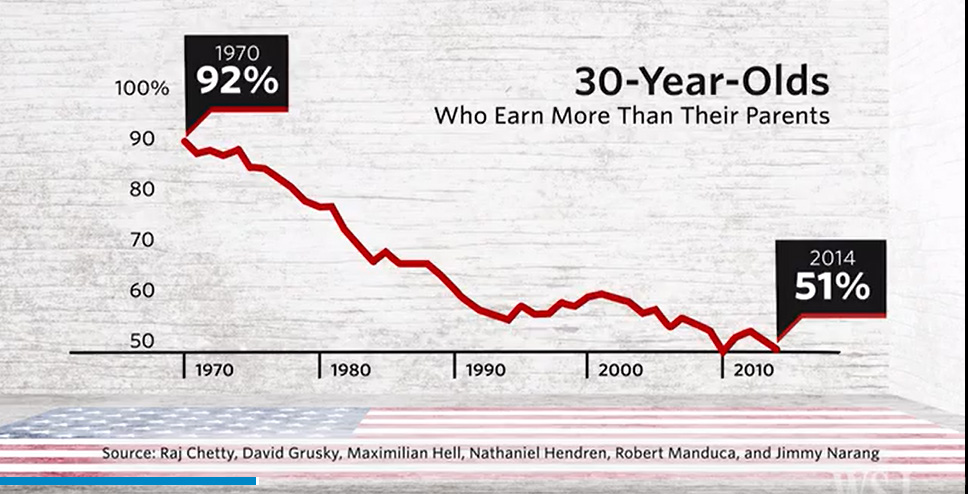
Barely Half of 30-Year-Olds Earn More Than Their Parents

Sorry, Young People: You Probably Won’t Make as Much Your Parents Did

As wages stagnate in the middle class, it becomes hard to reverse this trend

From a report in the Wall Street Journal dated December 8, 2016.   Barely half of 30-year-olds earn more than their parents did at a similar age, a research team found, an enormous decline from the early 1970s when the incomes of nearly all offspring outpaced their parents. Even rapid economic growth won’t do much to reverse the trend.

30-year-olds-earning-less-than-their-parents

Wage stagnation has taken heavy toll since 1970s

“My parents thought that one thing about America is that their kids could do better than they were able to do,” said Raj Chetty, a prominent Stanford University economist who emigrated from India at age 9 and is part of the research team. “That was important in my parents’ decision to come here.”

What’s more, even if President-elect Donald Trump fulfills his promises of rapid economic growth, the trend won’t be reversed significantly. Even if income levels grew 3.8%, the percentage of 30-year-olds who out-earn their parents would bump up to just 62%, the Wall Street Journal reports.

The study was conducted by economists and sociologists at Stanford, Harvard and the University of California. They used tax and census data to compare the earnings of 30-year-olds starting in 1970 to that of their parents.

What the report does not do is explain why wages are stagnant. I will give you my take on this horrible reality. I did earn more than my parents but only because of inflation.

When I married in 1969 my salary was $10,000 per year. According to the United States bureau of Labor Statistics your income today, based upon the CPI Inflation Calculator, that salary equates to $65,866.  My father never earned that inflation adjusted salary.

There have been many reasons for the stagnant salaries.  Three come to mind almost immediately. 

First management earned ten to twenty times the average income of most employees in the earlier parts of the 20th century.  Today management earns 200 to 300 times the average income of most employees.

Second many jobs have been outsourced other countries.  That has resulted in more potential employees seeking the remaining jobs.  Thus with more people looking for work employers can push down the pay they have to offer.

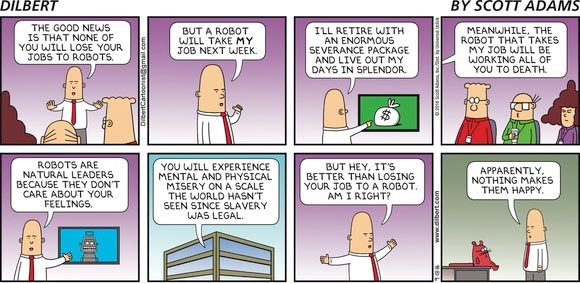
Third, many jobs have been automated thanks to artificial intelligence (AI), and computerization.   Have you seen the inside of an auto manufacturing facility?  Automation has eliminated many jobs from welding to painting.  Warehouses are now so automated that less material handlers are needed.  Office workers, I am one of them, now have computers that perform many of the manually performed functions that were done using typewriters and spreadsheets. That too reduced manpower needs. Less manpower translates to an oversupply of workers and that translates to lower pay. It is all about supply and demand.

It is unlikely that any government of any political party will change this trend.  I hope I am wrong.

Buyer Beware

Caveat emptor is a Latin term that means “let the buyer beware.”

I was in a J.C. Penny store just few days ago buying two shirts and pair of pajamas.  The items were all on counters that informed me they were on sale.  When I took the items to the check-out counter I was given another 5% discount.  That of course made the purchase an even better deal.  There were sale signs everywhere.  Almost everything in that store seemed to be on sale.

A strategic mistake made in 2011 at JC Penney, regarding its pricing strategy –replacement of sales through coupons with everyday low prices. The Ron Johnson plan was implemented when he took the helm of the company, modeling the company’s stores after those of Apple.  Sales declined disastrously during his tenure.  People like to buy things that are “on sale.”

Here in metropolitan Los Angeles there are at least 20 Macy’s department stores.  Advertising is almost daily in the newspapers.  There is always a sale.  30% off, 40% off, 50% off along with One Day Sales are part of the usual pitch.  I have never believed any of the advertising.  My wife and daughter do believe the advertising.  They are probably part of the larger group than doubters like me.

Los Angeles City Attorney Mike Feuer apparently agreed with my suspicions.  Feuer’s office has filed lawsuits against four big retailers for deceptive advertising that allegedly misled shoppers into believing that thousands of products were on sale at a hefty discount.

The attorney’s office provided examples of misleading ads by Macy’s, Sears, J.C. Penny and Kohl’s.  One example is the April, 2016, Sears online ad for Kenmore washing machine with a “regular” price of $1,179.99 and a “sale” price of $999.99. However, the purported “regular” price was a false reference price.  The argument is that the washer was never advertised at the regular price.

California law bans retailers from advertising a higher original price unless a product was actually available at that price within three months of the ad running. Feuer said the evidence his office collected focused on thousands of online transactions, but that he had reason to believe the practices also were underway at stores.

Should there be such a California law?  After all shouldn’t the words “buyer beware” apply to the purchase of any item at any price?

Not a Member of a Political Party

I am not registered as a member of any political party. Given my interest in politics it may seem an unlikely scenario. Let me tell you my reasoning.

The Republican Party historically in the 20th century was the party supporting business. They fought for lower taxes and less regulation. Who can be opposed to those objectives? Then the conservative religious groups evolved inside the G.O.P. Instead of being the business party they became the party of Evangelical Christians and other orthodox religious groups that put their religious beliefs ahead of business and the rights of non-believers. Today, thanks to Donald Trump, the G.O.P. has become the party concerned with helping the working classes of the country and the party of the extreme right wing (alt-right/neo-Nazi) hate groups. This is not a pretty picture.

Sadly the Democratic Party is no longer the party of the working class and middle class America. Extreme left wing socialists have become the driving force within the party. Senator Bernie Sanders has become a leader of this socialist perspective. America does have some socialist services but not to the level that the left wing aspires to bring to America. Social Security, Medicare, Medicaid, and welfare for the needy are all socialist programs but I do not support government ownership of businesses that should be operated privately (car manufacturing companies, aircraft manufacturers, etc.).

Third parties have had an inconsequential impact on American politics.

I am left with selecting candidates that have said or done something that catches my attention. I voted for both Democrats and Republicans in November. Some races were left unmarked for any candidate.

Donald Trump appears to be a thin skinned man who takes every slight as a major insult to him. How will he conduct himself as president? His behavior as a candidate has not changed since he won the election. The only thing that might stop him from starting a nuclear war might be the decisions of a wiser military.

How did America get itself into such a predicament?

America’s Free Enterprise System Is Coming to an End!

attSo the wealthy have the power to do as they wish. These are oligarchs. They are only interested in accumulating unbelievable wealth that will provide their family generations of luxurious living without ever having to work a day in their lives. As our society evolves into a nation controlled by those very wealthy, the vast majority of Americans are becoming ever poorer. Donald Trump talks about the shrinking middle class and the 45 million people either in poverty or near poverty. He is correct in pointing out the discrepancy but he really doesn’t have a solution. He is one of those oligarchs. Those oligarch just don’t care no matter what they say.

Thus we see AT&T buying Time Warner. In what way will this benefit society? It won’t. What it will do is put more power in the hands of a few. It will be a more controlled society.

Wells Fargo may pay a fine but its power remains. The rest of the banking industry is just happy they have not been caught in some other manipulation.  The former Wells Fargo CEO John Stumpf “retires” with a $100 Million plus retirement package.

This is a sad collapse of the free enterprise system where individuals can open small businesses and make a living. Privately owned drug stores, food markets, and hardware stores were part of the American well of life. Now its Walgreens, Walmart, Kroger, and Home Depot that control the price we pay and the jobs we have.

How Rich do you have to be?

Wells Fargo CEO Stumpf retires but won’t receive severance pay. That headline reads nicely but it does not reveal all the facts. He will receive more than $100 Million in vested stock and a 401(k) exceeding $24 Million. Forbes magazine reports that “Even though he left on a low, John Stumpf, former CEO of Wells Fargo, will take about $133.1 million into retirement. ’’

What does a man do with $100 Million? I understand that as CEO of Wells Fargo he headed the second largest banking company in the United States but does that entitle him to earn so much money that his family will live in luxury for generations?

Take a look at the board of Directors of Wells Fargo or any other giant corporation and you will see that those directors are almost always part of a very wealthy economic club that sustains their way of life and works to keep their average employees at the same low pay that is 1/20 to 1/30 of theirs.

Stock holders don’t care as long as their shares continue to appreciate and they receive their dividend checks.

Our free enterprise society was built on the right to earn as much money as you can regardless of who remains in poverty and who does not have the money to provide their children with a good college education.

 Forbes Billionaires: Full List Of The 500 Richest People In The World 2016 tells me that we have a world where the rich get richer and the poor get poorer. Neither Donald Trump nor Hillary Clinton will change that reality.

Manufacturers returning to America means jobs for robots, not people

Another article in the Los Angeles Times re-states what I have been writing about for a few years. https://coastcontact.wordpress.com/2013/02/08/impact-of-technology-on-the-u-s-economy/

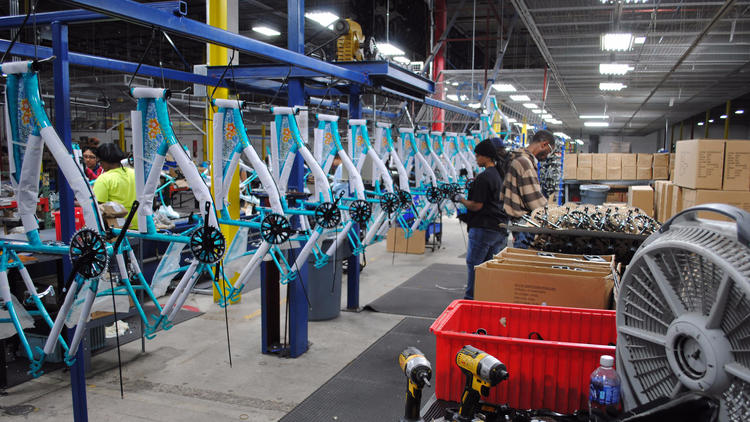
Workers at Bicycle Corporation of America assemble bikes - LA Times 8-14-2016

Workers at Bicycle Corporation of America assemble bikes for Wal-Mart, Target and other retailers. (Bicycle Corporation of America)

Here’s a little reality check on the current presidential campaign and promises by both Donald Trump and Hillary Clinton to bring back jobs from overseas.

It’s about a private Michigan company called Ranir, which makes, among other things, the business end of electric toothbrushes. After spending two years and millions of dollars to reengineer its toothbrush heads, Ranir brought back fully one-fifth of that production from China to its facility in Grand Rapids.

There’s just one catch: Thanks to the new robotic manufacturing process that Ranir adopted, it takes only four workers at the American plant to do the same job that almost certainly required dozens more in China.

The story goes that William Lee, an English minister, grew tired of hearing the incessant clicking of his wife’s knitting needles. Alternate versions of the story say that Lee was trying to win the affections of a lady who was more interested in her knitting than she was in him. In 1589, he modified the looms that were used to create rugs with hooks that would form loops that would be released during each pass of the thread, thereby knitting a whole row at once. Lee left his church work and went to secure the blessing of the queen (Elizabeth I) to ensure that no one else could create such a device and allowing him to make a healthy profit. Elizabeth denied his request and Lee went to France to try the same thing. Henri IV granted Lee the rights that he asked for, but was soon assassinated leaving Lee to die poor in 1610. Lee’s brother, James, took the idea back to England and was assisted by a man named Ashton in Nottingham in creating the first knitting factory. It wasn’t long before it was so cheap to create machine knitted clothing that many local hand-knitters were petitioning the government for limits of the business. (Sound familiar?) Lee’s design remained virtually unchanged until the 1700s when it was modified to include the kitting frame and later to accept other materials like lace and silk or create ribbed materials that could stretch.

Just as hand knitters in 1600 could not stop progress, today American factory workers are asking the United States government to stop progress. They might delay progress but in the end things will not be as they were during the industrial revolution.

Yes! It does hurt!


Goodbye to Chain Department Stores

Macy's North Hollywood Closing 8-4-2016The Sears near my home was in a shopping center that includes many of the major department store chains including Macy’s, Nordstrom’s, Target, and Neiman Marcus. The store is now sealed off with metal siding and block walls.

The impact of Amazon and other on-line sales companies is really starting to take its toll.   Amazon, Wal-Mart Lead Top 25 E-commerce Retail List. Total annual retail e-commerce sales are $201 billion, according to the 180 companies tracked by eMarketer. For the top 25 retailers, total annual e-commerce sales come in at $159 billion, with Amazon Inc., Wal-Mart Stores Inc. and Apple Inc. taking the top three spots. According to eMarketer, Amazon’s e-commerce sales are $79.3 billion while Wal-Mart has $13.5 billion and Apple totals $12 billion. After Walmart is Apple, Staples, and Macy’s.   More than 50% of Williams-Sonoma’s sales are done on-line.

So while Macy’s may be seeing an increase in-line sales they are closing or have closed at least 40 stores this year. Four in the Los Angeles area include their Century City store (that is next to Beverly Hills). This list does not include all of the targeted stores as they just today announced the closing of a North Hollywood store that was opened 61 years ago by May Company.

Fortune magazine reports that 78 Sears and Kmart stores are also closing.

There are many other chains of specialty stores from women’s fashions to sporting goods and sportswear that are also facing declining sales.

What will happen to all the malls that have been built across the nation? One high end mall in Woodland Hills California, called the Promenade, is now mostly deserted and rumor has it that the buildings will be torn down and apartment houses will replace the shopping. Westfield is the owner and has not revealed its plans.

Does this also means more lost jobs? Well, no.  New distribution centers are being erected by the on-line retailers.

Nothing is forever!