Some Good News

The news is all about what bad things have happened during the day or all the way to yesterday. It’s time to write about some good things that have happened.

-Surge of new jobs. The Bureau of Labor Statistics reported that 287,000 new jobs were created last month (June). New jobs have been created every month starting March of 2010. The unemployment rate I 4.9%. All those new jobs were not high paying but that is a record worth advertising.

-The S&P 500 has almost reached it record set May 20, 2015 when the index reached 2134.72. Friday it was almost there again closing at 2129.90.

-JCPenney is adding 350 jobs in LA and Orange counties in California. That is a company that many expected to go out of business this year.

-When Sharay Santora and her two children first arrived in downtown Dallas on Thursday to join the Black Lives Matter protest, she said the interaction between marchers and officers was peaceful, loving. Officers lined the streets as a massive crowd marched past.

“They gave us high-fives, hugs, were taking selfies,” Santora, 37, told The Washington Post. “It was such an instance of love and understanding, that ‘I’m here for you.’  You could feel it. There was no animosity in the air. That was the feeling throughout.”

Santora said marchers noted “these people who came out to protect us, we’re going to be out there for them.”

She plans to take her children to memorials for the fallen officers, for the same reason she has taken her children to Black Lives Matter demonstrations: “You’re either part of the solution, or you’re part of the problem. Even if you don’t know what to do, you can do something, even if it’s showing love.”

Maybe, just may be, the tragedy in Dallas can bring all of us to our senses.

The United States is the Greatest Nation in the World Today

Donald Trump, What are you talking about?

The United States is the Greatest Nation in the World Today.

U.S. Flag

The proof is everywhere. People from every country are trying to find a way to migrate to the United States. They know that this is the land of opportunity. Immigrants in the United States and their U.S.-born children now number approximately 81 million people, or 26 percent of the overall U.S. population according to the U.S. Census Bureau’s 2014 American Community Survey (ACS).

The United States is the greatest innovator of any nation in history. Bloomberg.com recently examined more than 200 countries and sovereign regions to determine their innovation quotient. The final universe was narrowed down to 96. Innovation was measured by seven factors, including R&D intensity, productivity, high-tech density, researcher concentration, manufacturing capability, education levels and patent activity. The United States is Number 1.

2.South Korea

3.Germany

4.Finland

5.Sweden

6.Japan

10.France

14.Russia

17.Canada

18.United Kingdom

29.China

32.Israel

The names Amazon, General Electric, UPS, Fed Ex, Microsoft, IBM, Apple, Walmart and Google stand out as just a few of the American successes. What other country has so many world famous companies?

Students from around the world come to American universities. One of the most common items in the news is criticism that our universities are favoring foreign student admissions over admission of American students.

So I am not buying the “Make America Great Again” theme.

America is great today!

Trump Killing NAFTA Could Mean Big Unintended Consequences for the U.S.

Donald Trump intends to renegotiate NAFTA.  In a speech given today he laid out a seven-point plan to change U.S. ‘failed trade policies’, including withdrawing from the Trans-Pacific Partnership (TPP) and renegotiating NAFTA.

Following is an article that appeared on Bloomberg.com on October 1, 2015.  This article points out the benefits of NAFTA.

by Eric Martin

Ending the deal would hurt American manufacturers. For consumers, backing out might mean price increases on everything from cars to fruits and vegetables.

Donald Trump has pledged to renegotiate or terminate the North American Free Trade Agreement, saying that it’s been a disaster for the U.S.

And the billionaire front-runner for the Republican nomination isn’t the first presidential candidate to bash the deal: Since its inception (Ross Perot warned of a “giant sucking sound” pulling jobs to Mexico), Nafta has been a popular punching bag for politicians. Despite the idea’s popularity, pulling out of Nafta could have all sorts of unintended consequences for U.S. businesses and the economy.


1. America’s biggest export market would be jeopardized

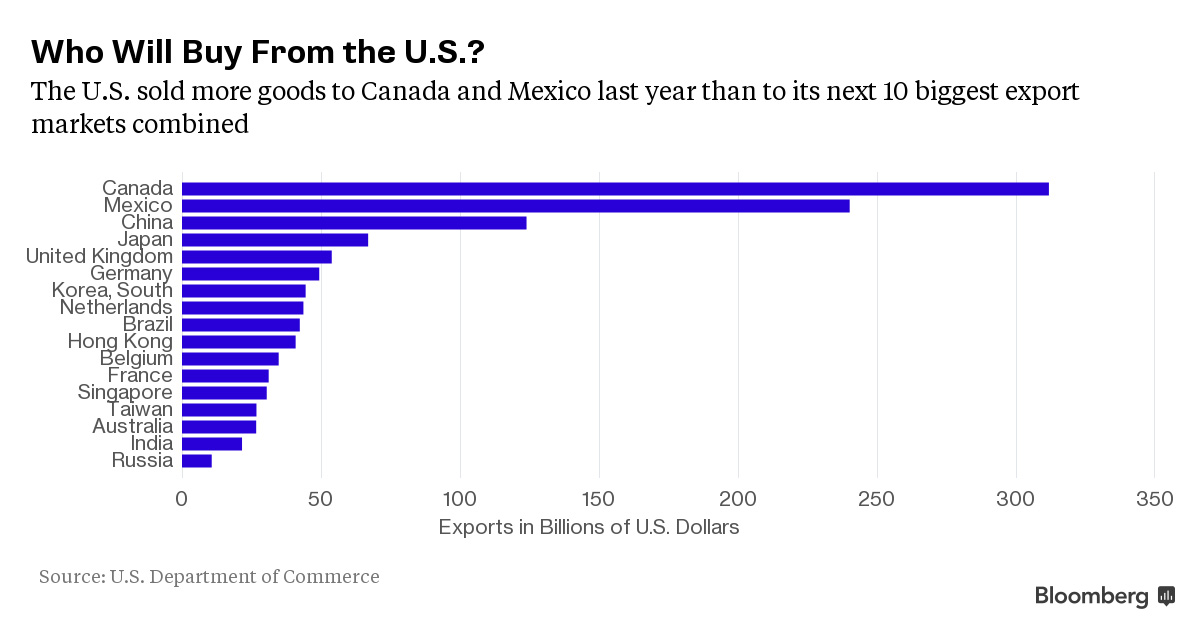
U.S. goods exports to Canada and Mexico have quadrupled since Nafta took effect in 1994, rising to about $550 billion last year. That’s more than sales to China, Japan, the U.K., Germany, South Korea, Brazil, India, Russia and Hong Kong combined.
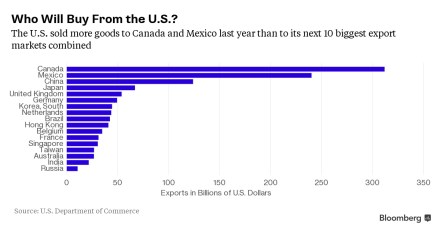
  Exports in Billlions of Dollars While critics have decried Nafta and other free-trade agreements for opening U.S. markets to foreign products, the deal actually lowered tariffs in Canada and Mexico even more than in the U.S. The American government applied an average tariff of just 4.3 percent to imports from Mexico and 5.1 percent to those from Canada before Nafta, while Canada had a 9.7 percent tax on imports from the U.S. and Mexico’s tax was 12.4 percent, according to a study last year led by Gary Hufbauer, an analyst at the Peterson Institute for International Economics.

A return to the tariffs pre-Nafta would mean “our exporters have more to lose in the immediate shock” than Canada and Mexico, Hufbauer said in an interview.


2. Jobs already gone wouldn’t return

As with any trade agreement, jobs were both created and destroyed after Nafta took effect as the workforce in each nation was realigned based on comparative advantage. In their search for lower costs for production chains, U.S. companies have moved jobs abroad—some to countries that have free trade with the U.S. and others to nations that don’t.

“If we didn’t have Nafta, would things like clothing and automobiles that are produced in Mexico be produced in the United States? No,” said David Gantz, who teaches trade law at the University of Arizona. “They’d be produced in China or somewhere that the labor costs are a lot lower. One needs to look at what the alternatives would be.”


3. The American economy overall would lose

Thanks to Nafta, U.S. consumers have enjoyed the benefits of cheaper imports from goods manufactured in Mexico. Scrapping the trade agreement might force Americans to stomach higher costs, from flat-screen TVs to Nissans to guacamole: Mexico is the world’s top producer of avocados.

Hufbauer estimates that Nafta trade growth makes the U.S. $127 billion richer each year, not only because of the boost to American exporters but also because of these benefits to U.S. consumers. That’s about $400 per person.

“It’s not always visible to people because much of the benefit is at the checkout counter,” Hufbauer said.


4. American drivers could pay more for gasoline

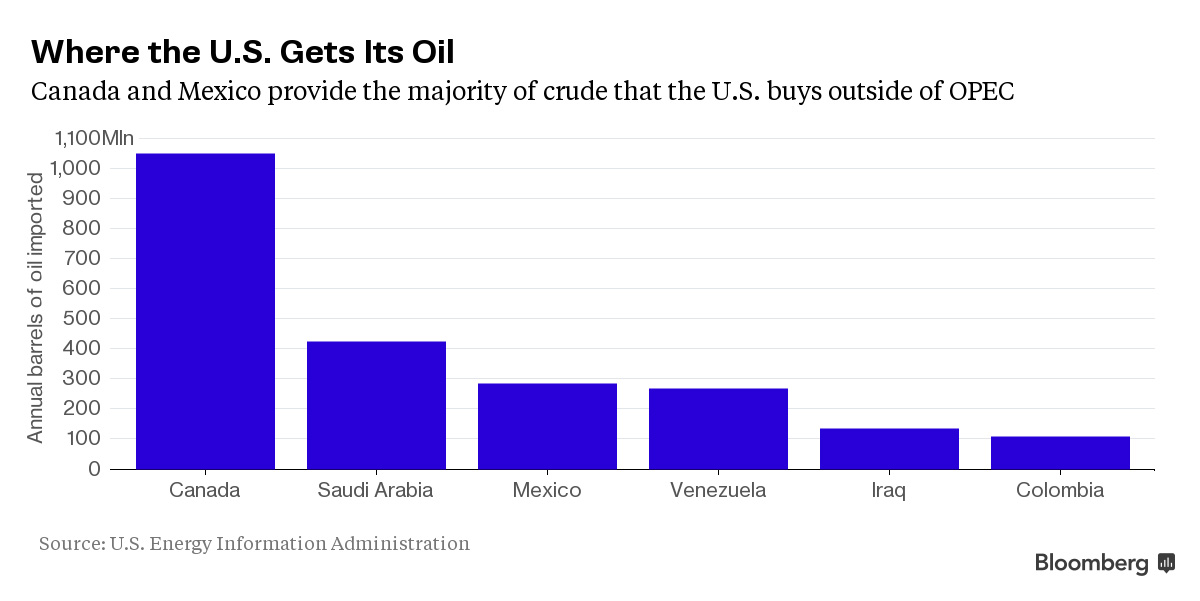
Canada and Mexico accounted for about half of U.S. oil imports in 2014, more than all the nations in OPEC combined and 84 percent of the oil the U.S. bought from outside the cartel.
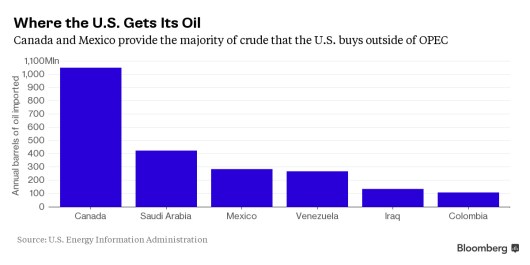
Where the U.S

While a supply glut has driven oil prices to near a six-year low, there’s no guarantee things will stay that way.  Ending Nafta could make the U.S. more reliant on imports from Saudi Arabia, Venezuela and other OPEC members when global demand rebounds down the road.

Nafta gives the U.S. preferential access to oil, limiting the scenarios in which Canada can restrict energy exports to the U.S. If the U.S. didn’t import oil from its Nafta partners, it could do so at higher cost from other countries, some of which aren’t as friendly to the U.S. as Mexico or Canada.

The Domino Effect of Outsourcing

From coast to coast, middle-class communities are shrinking

Fully 1 in 3 Americans who work in the manufacturing sector are receiving some form of public assistance, according to a study released this week by the UC Berkeley Center for Labor Research and Education. Of those who came to their positions through temp agencies half are on some type of safety net program. This was reported by CNBC.

I took a drive up to the Griffith Park Observatory here in Los Angeles last month. It wasn’t for going inside the building. It was a windy day and I anticipated a beautiful view from the parking lot. I was not disappointed. I obtained a photo that included a view of Catalina Island on the horizon. The distance is about 35 miles from the observatory.

I chose an alternate route back home and drove by Los Angeles City College. To my shock the sidewalk across the boulevard was lined with the tents and shelters of the homeless packed closely together. According to the Los Angeles Times there are now an estimated 44,000 homeless people in Los Angeles County. How did the numbers get so big?

Sports Chalet (more than 50 locations primarily in California) and Sports Authority (463 stores) are closing all of their stores. They started those closings last month. Kohl’s is closing 18 stores and laying off more than 1,500 employees. Where will the laid off workers go?

Back in November 2015 Macy’s Department stores reported a sharp drop in quarterly sales and lowered their forecast for 2016. Macy’s reported unsold goods piling up in their stores. Today they reported another quarter of sinking sales and once again slashed its financial targets for the rest of the year.

Meanwhile where are the jobs of the past here in Los Angeles and elsewhere in the United States? Those were the thousands of aerospace engineering jobs that were a major contributor to the strong California middle class that are mostly gone. The falloff in manufacturing jobs during the past 14-year period has caused factories to shed about 5 million workers from their payrolls nationally. Factories from all over the nation have moved to other countries. In their place are low paying service jobs that offer pay rates as low as $7.25, $15, and $25 an hour. Those jobs do not support a middle class family. They certainly do not support a Macy’s or Sports Authority price line.

Discount chains like T.J. Maxx and fast-fashion retailers such as H&M offering jeans as cheap as $17 and polo shirts for $10 are succeeding because that’s all today’s workers can afford.

So businesses keep outsourcing your work to low cost countries because you see it as a way to higher profits. Just remember that those of us left with those low paid jobs will be shopping at Walmart, Target, and the other afore-mentioned discount stores.  The vicious cycle continues to drive people from the middle class to poor and homeless.

Don’t tell me you do not know what happened to the middle class.

The Nominees

The Nominees

Neither of these candidates are good for America. I see two Twilight Zone Devils.

In other words they appear reasonable until the until the last moment when they will do their nasty acts.  Of course we won’t know that until it has happened.

Hillary Clinton is an insider who has too many donors that will have the final say on her actions as president. She is most likely to follow the philosophy of her husband (former President Bill Clinton). Recall that he signed the law revoking the Glass-Steagall act of 1933 that prohibited commercial banks from engaging in the investment business. He also signed into law NAFTA, a law proposed by Republicans and pushed by President George H.W. Bush that resulted in numerous companies relocating to Mexico.

Donald Trump has no experience in public office and does not appear to understand the workings of the federal government. He clearly does not understand the total significance of the Bill of Rights. “One of the things I’m going to do if I win… I’m going to open up our libel laws so when they write purposely negative and horrible and false articles, we can sue them and win lots of money,” Trump said during a rally in Fort Worth, Texas. He has limited understanding of the relations the United States has with other countries and like most of us does not know a great deal about our military capabilities. He is a scholar of business.

Let’s start with Hillary Clinton.

  1. There is no explanation to be found where she tells where she was and what she was doing when Benghazi, Libya was attacked.
  2. The use of her private e-mail server does not appear to have compromised anything. However, her use of that device calls into question her judgement.
  3. There is no theme to her campaign for president. Her entire theme seems to be she will continue the Obama administration and the banners saying “She’s with Us” and “Fighting for us.” The number one reason Hillary should be our next president according to her web site is “As a former secretary of state, U.S. senator, first lady, and a lifelong advocate for women and families, no one is more qualified to be president than Hillary.”

Let’s look at Donald Trump.

  1. He has never held any elected office.
  2. People might ask “How is Donald Trump able to file for bankruptcy so many times?” The answer is “He didn’t.” Trump himself has never filed for bankruptcy. His corporations have filed for Chapter 11 bankruptcy four times. This information from http://thelawdictionary.org/.
  3. Is he a buffoon? A genius? An exploration of the man, his brand, and his chronic bluster at The Atlantic offers a perspective.
  4. Foreign trade is a big part of the Trump campaign. Donald Trump’s trade war could kill millions of U.S. jobs contends Jim Tankersley in The Washington Post.

Go ahead and choose your devil. Just understand that in four years you will be ready for another unacceptable president. Ugh!!

Manufacturing and Minimum Wage Jobs in the 21st Century

Lower taxes might help domestic manufacturers but when the cost of labor in other countries is one-tenth the cost in the United States lost jobs will not be returned to this country.

Individuals assembling Apple’s iPhones in China allegedly work long hours for low pay. They work 11-hour shifts at a rate of $1.50 per hour. During each shift they are docked 20 minutes of pay (I assume for a lunch break). There earnings are $268 per month before overtime. This information is from a report in Business Insider.

GM, Ford Boost Mexico Output With $26-a-Day Workers.  Mexico’s share of North American auto production may rise at a quicker pace as General Motors Co., Ford Motor Co. and Chrysler Group LLC seek out workers making less than 10 percent of what their U.S. counterparts earn. This information is from a report in Bloomberg Businessweek.

For example crib maker Stanley Furniture Co. misjudged the willingness of Americans to pay more for domestically produced goods when cheaper imports are available. Meanwhile, the husband-and-wife entrepreneurs who founded 20-year-old Chesapeake Bay Candle have struggled to find workers who can do basic math. This information is from a report in The Wall Street Journal.

 Los Angeles, once the epicenter of apparel manufacturing has seen the outsourcing of jobs to China and Southeast Asia due to lower labor costs.

Do you really believe that Donald Trump will bring those assembly jobs back to the United States? Donald Trump does not agree with the idea of a $15 per hour minimum wage. I heard him say that. Los Angeles was once the epicenter of apparel manufacturing Los Angeles was once the epicenter of apparel manufacturing, attracting buyers from across the world to its clothing factories, sample rooms and design studios. But over the years, cheap overseas labor lured many apparel makers to outsource to foreign competitors in far-flung places such as China Los Angeles was once the epicenter of apparel manufacturing, attracting buyers from across the world to its clothing factories, sample rooms and design studios. But over the years, cheap overseas labor lured many apparel makers to outsource to foreign competitors in far-flung places such as China

Just to add to the difficulty in keeping jobs in America paid family leave regulations have been passed in New York and California.

Most web sites contend that government regulations are a significant cost to business in the USA. The problem is that every regulation has its supporters.

Unless Donald Trump intends to drive up the cost of clothing, cars, and electronic devices there is no way he can bring those jobs back to the United States. His ideas will spark a trade war.

The solution is retraining in areas short of workers. CNN posted an article listing 30 jobs needing most workers in next decade. How many people will take the opportunity by at least investigating the opportunities?

Technological Unemployment

From Wikipedia: “Perhaps the earliest example of a scholar discussing the phenomena of technological unemployment occurs with Aristotle, who speculated in Book One of Politics that if machines could become sufficiently advanced, there would be no more need for human labour.”

It has been reported repeatedly that Queen Elizabeth I of England refused to grant a patent for a weaving machine because it would put the hand weavers out of work. She was correct. It did.

I was talking with an acquaintance about the effects of AI (artificial intelligence) and IT (information technology) on the work environment and the elimination of many jobs. A touch plate at a fast food ordering counter could replace an order taker. So could many other jobs.

One job I held for 7½ years was a scheduling supervisor in a factory. I had decided to quit after about four years. The work was tedious and very stressful. It took me the next 3½ years to find work that would pay more and appeared to offer a chance of advancement. I was responsible for all the production schedules and work orders in the factory. If something went wrong in the middle of the night, the night foreman called me. Today that job would be done more accurately by a computer generated program that could accomplish my 40 plus hour weekly job in minutes.

My father was a structural engineer. He retired just as computers were beginning to be used to calculate stress analysis. His calculation tool was a slide rule. He was a mathematical genius. Today those calculations can be more accurately accomplished using a computer that would provide the results in minutes not hours. The drafting of the structure can now be provided by a computer driven drafting machine rather than a draftsman.

Perhaps the order taker at the fast food counter will still have a job preparing the order. Perhaps the mathematical genius will be working on a program in Silicon Valley. One thing is certain. All jobs that can be mechanized and/or computer driven will result in fewer jobs.

I rarely take my car to a repair garage because they too have been fitted with longer lasting components. Thanks to a well-made furnace and plumbing in my house the need for service maintenance is reduced. That means there is no growing need for service industry workers.

I have yet to hear anyone, neither politician, corporate leader, nor social engineer, explain how even the brightest people will care for their families when the number of jobs is in decline.

We have a serious societal challenge and no answers. Joel Kotkin and other commentators have observed the issue. Now what?

$15 Minimum Wage: Booby Prize for American Workers

By Joel Kotkin

(Joel Kotkin is R.C. Hobbs Presidential Fellow in Urban Studies at Chapman University. He is executive editor of New Geography … where this piece originated and executive director of the Center for Opportunity Urbanism.)

Almost everything that Mr. Kotkin has written is accurate. It is something those who pushed the $15 minimum wage law in Sacramento knows. The question Mr. Kotkin and everyone objecting to the new minimum wage fails to answer is: How does this society contend with a population that “has seen a rapid decline in traditional blue-collar jobs?” Those blue-collar citizens are the driving force behind the crowds drawn by Donald Trump and Bernie Sanders. They may not have the answers but they understand that the masses are in dire straits. Or perhaps there is no solution and Mr. Kotkin is correct in concluding that we are going to return to a feudal society.

This article has been abridged.

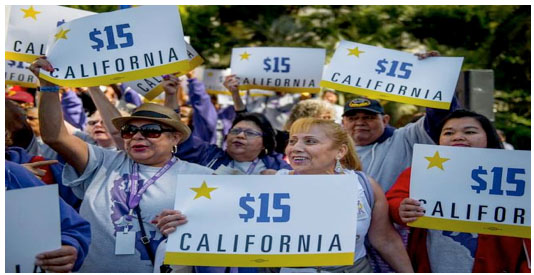
$15 California

NEW GEOGRAPHY–In principle, there is solid moral ground for the recent drive to boost the minimum wage to $15, with California and New York State taking dramatic steps Monday toward that goal. Low-wage workers have been losing ground for decades, as stagnant incomes have been eroded by higher living costs.

Yet if the campaign to boost the minimum wage reflects progressive ideals, the underlying rationale also exposes the failure of these high-priced cities to serve as launching pads for upward mobility for the vast majority of their residents. In effect, the fight for $15 is a by-product of giving up – capitulating on the idea that better opportunities can be created than the menial service jobs that increasingly are the only opportunities for the urban poor. Higher wages will make these jobs moderately more tolerable, while further cementing the wide gulf between the haves and have knots.

New York, San Francisco, LA and Seattle are at the forefront of a new urban economy, based on industries such as finance, technology and media, that generally creates jobs for the highly educated only. Virtually every region at the cutting edge of the minimum wage movement has seen a rapid decline in traditional blue-collar jobs — notably in manufacturing — which often paid well above the minimum wage, and offered potential for further individual advancement.

In these and other core cities, we are seeing something reminiscent of the Victorian era, where a larger proportion of workers are earning their living serving the wealthy and their needs as nannies, restaurant workers, dog-walkers and the like. In New York City, as of 2012, over a third of workers were employed in low-wage service jobs, a percentage that rose through the recovery from the Great Recession, according to a study by the Center for an Urban Future.

Given shrinking opportunities for middle and working class people, it’s not surprising that many seek a more direct redress from the government.

Essentially the minimum wage campaign rests on the notion that traditional middle class uplift cannot be achieved. The problem is, a $15 an hour income represents hardly enough to pay the rent for a small apartment anywhere near the blue cities where the new minimum will hit first.

The  impact in California will, if anything be larger, as the wage hike will be imposed in a wider fashion on a hugely diverse state.

To be sure, higher wages could be a blip in wealthy and thoroughly de-industrialized places like San Francisco – if higher labor costs boost the price of beet-filled ravioli, it doesn’t undermine the market in a place where hipsters and elite workers still have dollars to spend.

Perhaps the greatest beneficiaries of the minimum wage hike will not be the bulk of lower wage workers in blue states, but the people who increasingly dominate their economies.

And as the American Interest recently predicted, those most likely to benefit down the line from the higher wages will be the tech companies that will come up with the software and automated systems that replace the service jobs now made less economically competitive by the wage hikes. It’s not a loony fringe concept: the President’s Council of Economic Advisers recently estimated that lower-wage service jobs have an 80% probability of being automated.

So in the end, a $15 minimum wage, set in the low growth economy of our times, may end up boosting the very class-based hierarchies that are already increasingly evident. Ultimately it may represent a case of a well-intentioned measure that, while sounding radical, only accelerates our road back to feudalism: a society dominated by the few where many depend on the generosity of their betters and the middle class, already shrinking, fades into the dustbin of history.

Robots Are Coming For Our Jobs

This is not an April Fool’s Joke!

Donald Trump and Bernie Sanders may say that they want to help the blue collar, working class, and middle class income Americans but neither has a solution for the oncoming displacement of most laboring and office jobs as wells as many technical jobs.

Japan is number one in the world in operational robots with 310,508 units. There’s even a hotel staffed almost entirely by robots that opened last year in Nagasaki, Japan, according to BAML (Bank of America Merrill Lynch). The United States is in second place (168,623) with Germany in a close third place. This was reported just today on Business Insider.

Coincidentally the Los Angeles Times had an opinion piece in today’s paper that starts with the words “A viral video released in February showed Boston Dynamics’ new bipedal robot, Atlas, performing human-like tasks: opening doors, tromping about in the snow, lifting and stacking boxes.” That article refers to a White House report that says “Most occupations that pay less than $20 an hour are likely to be automated into obsolescence.” Powerhouse consultancies like McKinsey & Co. forecast that 45% of today’s workplace activities could be done by robots, AI or some other already demonstrated technology. Truck drivers and baristas will be replaced too. Some professors argue that we could see 50% unemployment in 30 years.

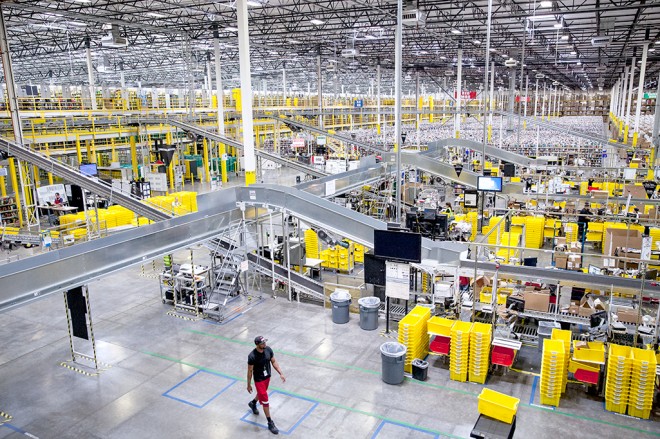
AMAZON-PHOENIX-WAREHOUSE

A rare peak inside Amazon’s massive wish-fulfilling machine

We think we have problems now but a coming so-called Fourth Industrial Revolution will bring changes to society that most of us have yet to imagine.

Americans Are Struggling with Behavior that Contradict with their Beliefs

Ted Cruz and Donald Trump understand Americans real beliefs and hatreds and are playing on those viewpoints.

Strictly religious Christians and Jews have very rigid laws about human behavior. They really do not want any behavior by anyone that conflict with their beliefs

Thus we see laws proposed (and some signed into law) in Arkansas, Georgia, and Indiana that would protect the rights of people who choose to discriminate. Specifically these laws give people the right to discriminate against homosexuals and gay marriage. Similarly many states have created laws that limit the right to an abortion.

All of these laws are a response to evangelical Christians, orthodox Catholics and Jews.

However, Muslim beliefs are not to be tolerated by those religious Christians and Jews.

It now appears that money may impact their willingness to tolerate those that are different. The Walt Disney Co. would stop film production in Georgia if they sign into law their right to discriminate law. It is estimated that $106 million is spent in Georgia by Disney. Other companies are contemplating similar action in the three states I have identified. So far, lawmakers in Georgia haven’t heeded those concerns. Legislators in Indiana and Arkansas passed similar bills last year.

What does this situation tell us about Americans? The answer is sadly obvious.

March 28, 2016

Good news!  Under increasing pressure from major corporations that do business in Georgia, Gov. Nathan Deal announced Monday he will veto a bill that critics say would have curtailed the rights of Georgia’s LGBT community.