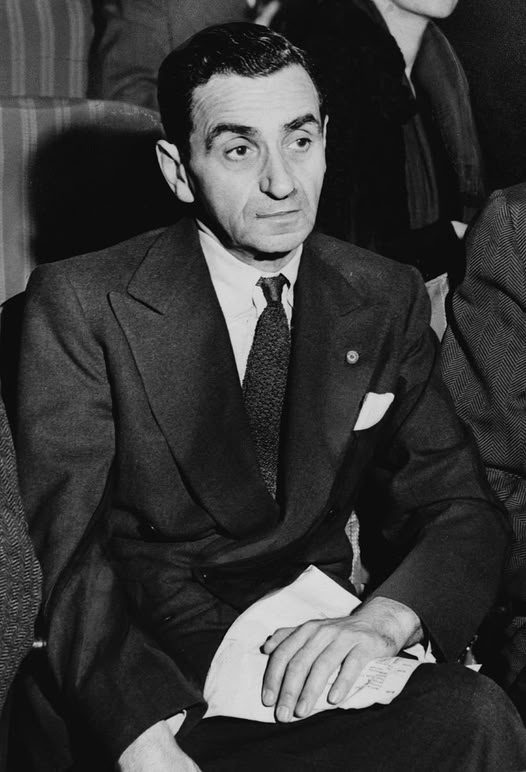
On this day in 1989, September 22, the world bid farewell to Irving Berlin, the self-taught musical titan born Israel Isidore Baline on May 11, 1888, in the Siberian town of Tyumen, Russia. As the youngest of eight children in a poor Jewish family, Berlin’s early life was upended by pogroms. At age 4, his family fled to New York City in 1893, seeking refuge in the tenements of the Lower East Side. Tragedy struck young. His mother died soon after arrival, and by 13, after his father, a cantor, passed away, Berlin dropped out of school to sing on street corners and hustle as a singing waiter in Chinatown dives. He never learned to read or write music, composing instead on a custom piano that transposed keys to fit his ear, but that didn’t stop him from penning over 1,500 songs, revolutionizing American popular music for more than seven decades.
Berlin’s genius lay in his uncanny ability to capture the American spirit: the grit of ragtime in “Alexander’s Ragtime Band” (1911), the romance of the Jazz Age in “Blue Skies” (1926), the showbiz dazzle of “There’s No Business Like Show Business” (1946 from Annie Get Your Gun), and the unyielding patriotism that defined his era. During World War I, he served in the Army and wrote the cheeky hit “Oh! How I Hate to Get Up in the Morning.” In the lead-up to World War II, he crafted “God Bless America” (1938) as a peace prayer, donating all royalties forever to the Boy and Girl Scouts, a gesture that continues to pour millions into youth programs today. His Broadway triumphs included Top Hat (1935 with Fred Astaire’s “Cheek to Cheek”), Call Me Madam (1950), and the Easter Parade film score. By his death at 101 in his Manhattan townhouse, Berlin had earned four Oscars, a Grammy Lifetime Achievement Award, and the Congressional Gold Medal, yet he remained humble, once quipping, “I’m a simple man. The only thing I know how to do is write songs.”
Perhaps Berlin’s most enduring gift is “White Christmas,” the wistful 1942 ballad from the film Holiday Inn that Bing Crosby made the best-selling single of all time, over 50 million copies. Inspired by his homesick troops during a 1942 USO tour and his own longing for the snowy holidays of his adopted home, Berlin stipulated it couldn’t be performed in color films to preserve its black-and-white nostalgia. It’s a song that tugs at the heartstrings of longing amid joy, profoundly American and profoundly ironic given its creator’s Jewish roots and aversion to schmaltz.
In a delicious twist of cultural assimilation, Jewish songwriters like Berlin dominated Tin Pan Alley’s holiday output, crafting the soundtrack to a Christian celebration they observed from afar. Of the top 25 most-performed Christmas songs tracked by ASCAP, at least 18 were penned by Jews, a testament to their outsized role in shaping American pop during the mid-20th century’s “Great American Songbook” era. Berlin kicked it off with “White Christmas,” but join him on the list: Johnny Marks gave us “Rudolph the Red-Nosed Reindeer” (1949) and “Rockin’ Around the Christmas Tree” (1958); Mel Tormé and Robert Wells dreamed up “The Christmas Song (Chestnuts Roasting on an Open Fire)” (1945); Sammy Cahn and Jule Styne delivered “Let It Snow! Let It Snow! Let It Snow!” (1945) and “The Christmas Waltz” (1954); Jay Livingston and Ray Evans teamed for “Silver Bells” (1951); and don’t forget “Santa Baby” (1953) by Joan Javits and Philip Springer or Felix Bernard’s music for “Winter Wonderland” (1934). These weren’t just tunes, they were bridges, born from immigrants’ ingenuity, turning December’s chill into evergreen warmth for everyone.
Berlin lived to 101, outlasting two world wars, the Depression, and his own hits. As he once said, “The song is ended, but the melody lingers on.” What’s your favorite Irving Berlin gem or Jewish-penned holiday banger that sneaks onto your playlist? Drop it below.
#IrvingBerlin#JewishSongwriters#WhiteChristmas#AmericanSongbook#OnThisDay#HolidayMusic#MusicHistory#TinPanAlley





 Coast Contact