O Canada, you sensible land!

You may already know that the U.S. dollar and Canadian dollar are almost identical in value . Currently the US dollar will buy about $1.10 Canadian. Just a few months ago the situation was reversed. Toronto and Vancouver homes are as expensive or more expensive than the same property in Los Angeles. Their housing boom tracked the U.S. boom before 2008. The exception is they did not experience the melt down. The price of homes has continued to rise throughout Canada. To quote the Financial Post: “Home ownership a passion for Canadians. It is a passion for ownership that has put Canada in the elite company of countries with estimates that more than 70% of households now own their own home.”

O Canada, you sensible land!

By Jay MacDonald · Bankrate.com
Monday, May 9, 2011
Posted: 9 am ET


What’s the best way out of our bubble-bust-bubble mortgage muddle that has resulted in a record 2.87 million  American foreclosures last year alone? The answer may lie due north.

O Canada, you have no doubt watched our housing-driven Great Recession with  the stern if sympathetic eye of a schoolmaster who well knows the fate of all  undisciplined schoolboys.

During our financial meltdown, not a single Canadian bank failed. Less  than 1 percent of Canadian mortgages are in arrears. And this in a land that  doesn’t even afford its homeowners the courtesy of a tax break on their mortgage  interest!

I was gob-smacked by a recent McClatchy report out of Toronto with the  headline, “Canada’s mortgage system works.” Of course, compared to our system,  falling as it does somewhere between a faulty pachinko game and three-card  Monte, most of the developed world could make the same claim.

Canada owes its housing stability in large part to a conservative regulatory  environment that holds its 71 federally regulated lenders to stricter  underwriting standards and larger reserve requirements for potential losses than  does its U.S. counterpart.

There is no Canadian equivalent of Fannie Mae and Freddy Mac, which purchase  mortgages from banks and bundle them into bonds. Did I mention that Fannie and  Freddy have been in government conservatorship since mid-2008?

As far as tax incentives go, Canadian homeowners are allowed an exemption on  capital gain from the sale of their primary residence, period. Yet their  homeownership rate is equal to or greater than ours here in Sud Moosejaw.

Stuart Gabriel, a finance professor at UCLA, sees it this way:

“They’ve insisted all along on the more rigorous mortgage underwriting, and  because of that never found themselves originating subprime and no-doc mortgages … some very basic items such as stringency of underwriting seem to go a long  way.”

Indeed. Now I’ll grant you, corralling a total of 71 lenders for 34 million  citizens may be a tad easier than wrangling 8,000-plus FDIC-insured lenders  serving 310 million. But it’s still ironic that Canada’s conservative mortgage  system is unfazed while our “free market” version – and I use those quotation  marks intentionally – has resulted in the largest financial meltdown since the  big one.

O Canada, please send some of your common sense our way as we attempt to  dismantle our house of cards and start over. Hopefully with  two-by-fours.

Read more:  http://www.bankrate.com/financing/mortgages/o-canada-you-sensible-land/#ixzz2vnqaMrGJ Follow us: @Bankrate on Twitter | Bankrate on Facebook
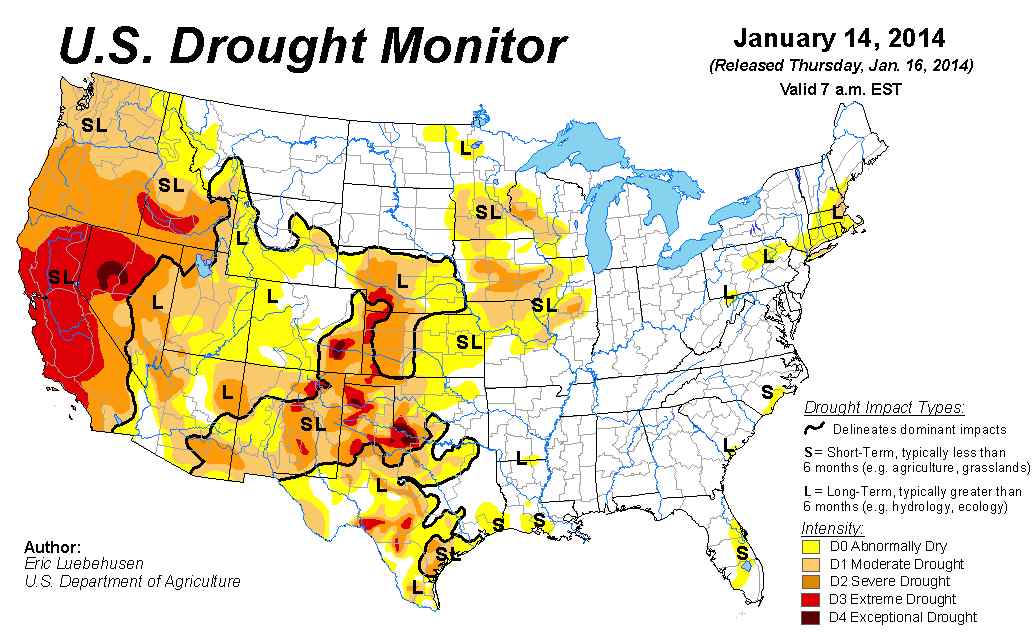
The Drought of 2014

Drought MonitorMost Californians already knew that there is a drought covering most of the state. California Governor Jerry Brown has named this rainless winter an official drought. The real purpose of the declaration is to obtain federal aid, reduce enforcement of some environmental regulations, and most importantly convince voters to approve an $11.1 Billion water bond proposal.

More than $13 Billion has been spent on California water projects since the year 2000. The newest bond proposal is not new. It has been bandied around for at least four years. The only reason there has not been a proposal on the ballot has been the serious economic conditions of this state.

This ballot measure, if it does appear, will not add one additional drop of water to the state’s water supply. There will be no more water for urban areas and no additional water for farming or live stock. This proposal will provide profits for construction companies.

Sacramento Bee reporter and columnist Dan Walters says this bond issue doesn’t address the issues. Traci Sheehan on the California Progress Report web site has identified all the newspapers that oppose this waste of money.

Fear of water rationing will be the tool of choice to convince passage of this boondoggle.

Objections to Keystone XL Pipeline

11-18-2014: The number one issue in America is a growing economy. That means more good jobs. The president is WRONG on this issue. Perhaps today’s vote in the Senate will change his opinion.

Oil Pipeline GraphicA quick review.  This is the proposed oil pipeline from Hardisty, Alberta, Canada to Houston, Texas and Port Arthur, Texas.

It now appears that the U.S. State Department sees no objection to approving the project.  However, the U.S. Interior Department warns of possible harm to wildlife.  Activists are primarily concerned with the possibility of oil spills.

Interestingly there is already a pipeline from Hardisty, Alberta to Cushing, Oklahoma.  While the reports of oil spills from that pipeline are rare there has been little in the news that confirms that fact.

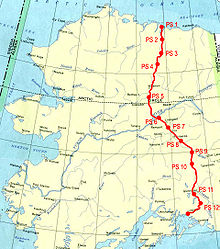
Furthermore the Trans-Alaska oil pipeline, 800 miles long, had its largest oil spill involving the main pipeline on February 15, 1978, when an unknown individual blew a 1-inch (2.54-centimeter) hole in it at Steele Creek, just east of Fairbanks.  Approximately 16,000 barrels of oil leaked out of the hole before the pipeline was shut down.  Criminal mischief has been the primary cause of leaks.  There are no reports of impact on wildlife.

Trans_alaska_pipelineThe oil companies injected billions of dollars into the Alaska economy during the construction effort and the years afterward.

Of course environmentalists don’t want to hear the facts.

Environmentalists Gone Wild

Environmentalists have the desire to return the earth to its native state EVERYWHERE.  Thus their idea is to limit national park access to hikers only.  No cars or other vehicles should be permitted to enter.  Entering Yosemite Valley would only be available for the hardy who can hike there from the park entrance.  Riding in an inflatable raft in the Merced River would be banned.  Grocery stores and gift shops would be closed.

The Environmentalists would also remove the concrete walls of the Los Angeles River.  It is really a wash that only holds rain water during the winter months.  There are no streams or creeks that feed into this wash.  There are no springs from surrounding hills that trickle in.

Despite the fact that the concrete walls protect the city from flooding that was prevalent in the first half of the 20th century and all times earlier the Environmentalists want the concrete walls removed to restore the natural appearance of the wash.  They have done such a good job of promoting their vision that a group called L.A. River Revitalization Corp. have convinced the Army Corp of Engineers to consider proposals costing at least $444 million for making the banks of the wash more environmentally pleasing.  At the high end the cost would be $1.06 billion.

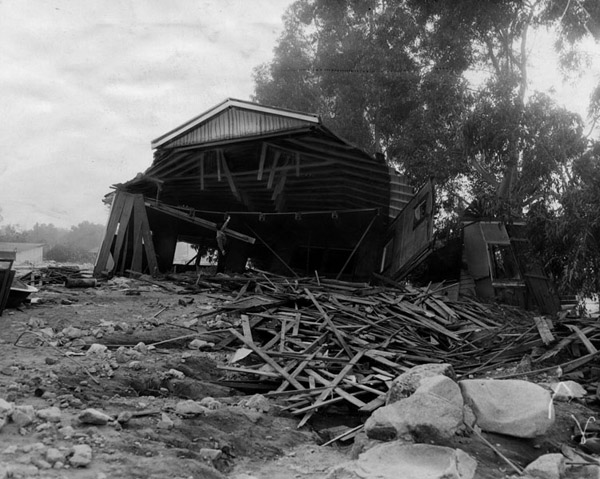
1934 flooding before the LA River was controlled

A house that was washed a block away from the river, 1934

 Amnesia seems to have affected both our government officials and the general public.  As reported in the Los Angeles Times on February 12, 1992 “City emergency workers in helicopters and rubber boats rescued 48 people stranded in cars and other vehicles as floodwaters rose rapidly on Burbank Boulevard and other streets that run around and through the basin.”

kayaking-the-los-angeles-river

The concrete Los Angeles River was built to protect the city from massive flooding.  Sepulveda Dam, which was constructed in 1941, protected downstream neighborhoods (and allowed others to be built); the postwar concretization of the upstream riverbed allowed the development of the San Fernando Valley.  All of the homes and businesses from Canoga Park going downstream could be seriously impacted if those concrete walls were removed.  Kayaking down the Los Angeles River is not a necessity.  Protection from flooding is a necessity.

LA Observed

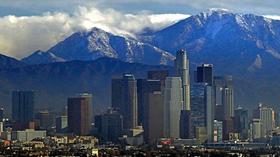
Los Angeles, California #2Los Angeles is a busy city.  Not only does 40 % of all imports to the USA enter the country through the Los Angeles-Long Beach ports but this is the city that brings entertainment to the world.  This is the place where all the stars shine.  LA Observed offers links and information in a concise package.  The link is on the right.  For now just click here.

10 states most at risk for major disasters

Oklahoma tornado

Surprisingly Oklahoma is not the number one state for disasters according to the Federal Emergency Management Agency (FEMA).  Oklahoma came in at number 3.

10. Missouri

The Show-Me State has been shown disastrous weather in every month of the year: severe snow and ice storms in winter, tornadoes during the spring, summer and fall, and flooding at virtually any time.

Major disaster declarations since 1953: 53

9. Arkansas

Arkansas has been walloped by heavy rain, snow, ice, tornadoes and flooding over the years and has even taken poundings from tropical storm systems, though it’s not a coastal state. In 2008, storms and tornadoes associated with Hurricane Gustav littered streets with debris, damaged buildings, roads and bridges, and knocked out electric cooperatives.

Major disaster declarations since 1953: 54

8. Kentucky

The disaster roster in Kentucky has included landslides, mudslides and rockslides, along with flooding and tornadoes. The state was ripped up in 2008 by the remnants of Hurricane Ike. Another major disaster declaration involved a record snowfall in late 2004, and yet another stemmed from a 1981 series of chemical explosions in the Louisville sewers.

Major disaster declarations since 1953: 56

7. Alabama

This Gulf Coast state has been battered by hurricanes, including Isaac in 2012, Gustav in 2008, Katrina and Dennis in 2005, and Ivan in 2004. But tornadoes in April 2011 rivaled the hurricanes for destructive power, lashing the state with winds that exceeded 210 mph and leaving about 250 people dead and an estimated $1.5 billion in damage.

Major disaster declarations since 1953: 57

6. Louisiana

It has taken Louisiana years to recover from Hurricane Katrina, the now-legendary 2005 storm that government officials say killed nearly 1,000 residents and caused tens of billions of dollars in damage. The Gulf state has been visited by numerous hurricanes including 1969’s Camille, a Category 5 storm that came ashore with 190 mph winds. By comparison, Katrina was “only” a Category 3 on the wind scale.

Major disaster declarations since 1953: 60

5. Florida

The Sunshine State has been pummeled by dozens of tropical storm systems since the 1950s — none worse than Hurricane Andrew in 1992. The Category 5 hurricane with gusts of more than 200 mph held the title as the most expensive natural disaster in U.S. history until Hurricane Katrina in 2005. Severe freezes have been disastrous for Florida farming on multiple occasions.

Major disaster declarations since 1953: 65

4. New York

Across its empire that stretches from the Great Lakes to the Atlantic coast, New York has been lashed by everything from blizzards to tropical storms. In 2012, Superstorm Sandy killed nearly 50 in the state and caused more than $40 billion in damage. New York also received disaster declarations for the Sept. 11, 2001, terrorist attacks that destroyed the World Trade Center and an earlier bombing in the complex’s garage.

Major disaster declarations since 1953: 67

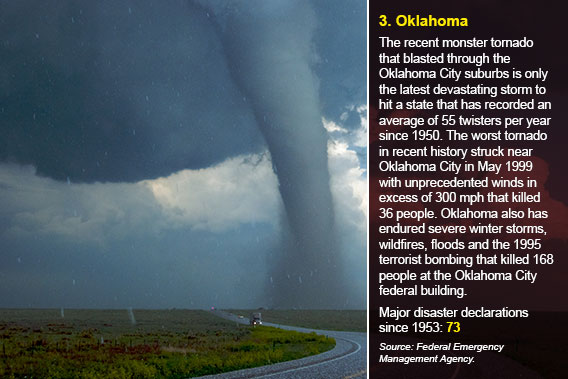
3. Oklahoma

The recent monster tornado that blasted through the Oklahoma City suburbs is only the latest devastating storm to hit a state that recorded an average of 55 twisters per year since 1950. The worst tornado in recent history struck near Oklahoma City in May 1999 with unprecedented winds in excess of 300 mph that killed 36 people. Oklahoma also has endured severe winter storms, wildfires, floods and the 1995 terrorist bombing that killed 168 people at the Oklahoma City federal building.

Major disaster declarations since 1953: 73

2. California

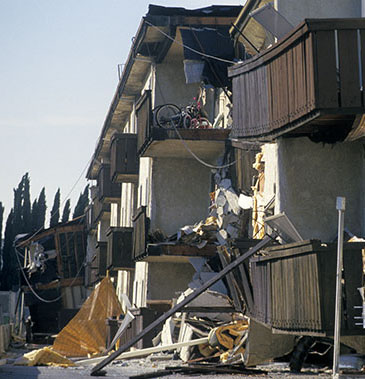
Northridge Earthquake Apartment Building

Apartment house damage from 1994 Northridge Earthquake

The nation’s most populous state also is one of the most disaster-prone thanks to wildfires, landslides, flooding, winter storms, severe freeze and even tsunami waves. But earthquakes are the disaster perhaps most closely associated with California. The worst in recent years have included a magnitude-6.9 quake near San Francisco in 1989 that killed 63 and a magnitude-6.7 quake in Southern California in 1994 that killed 61.

Major disaster declarations since 1953: 78

1. Texas

Within Texas’ nearly 267,000 square miles (second only to Alaska in size), at least one major disaster is declared nearly every calendar year. The Lone Star State has dealt with tornadoes, floods, wildfires and fairly frequent coastal hurricanes. One of the deadliest and costliest in recent decades was Hurricane Celia, which tore up Corpus Christi in 1970. The storm left 13 dead and destroyed millions of dollars’ worth of property.

Major disaster declarations since 1953: 86

Well, the Empire was finished after the war.

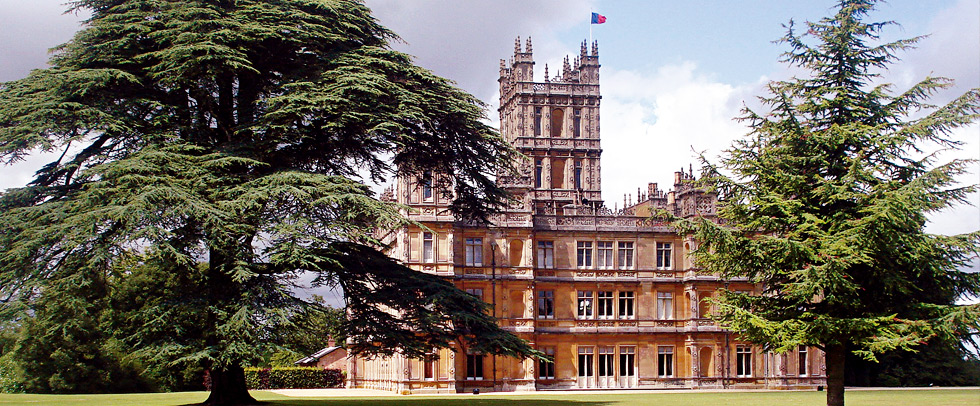
Downton Abbey

UpStairs – Downstairs, Gosford Park, and Downton Abbey all have the common theme of the “distinct behavior produced by the British class system.”  They reflected a time that was basic to the British Empire. The title above was a line from Gosford Park. Not only was the Empire finished after World War One, the British class system was finished too.  It’s just been a slow deterioration.

On our visit last summer to London, the fascination with Great Britain’s past was everywhere.  I did not hear anyone say “keep a stiff upper lip” but it was apparent.

How do you march into the 21st century with your past clinging to your every decision?  That is the challenge for the prime ministers of England.

Their Heathrow Airport, Tube subway system (it‘s really old), and high speed rail to Paris are good starts.  Britain needs to look at motivators from the past. Queen Victoria’s husband, Prince Albert was the promoter of The Great Exhibition of 1851 in London.  Prime Minister Margaret Thatcher promoted free enterprise.

This is not to imply that everything in Britain’s past was bad.  To survive in this century the British class system is no longer appropriate.  Today we reach new highs based upon our capabilities.  Race, religion, national origin, sexual orientation are of no consequence.  Finally, most of us have come to our senses. 

Global Warming is Happening

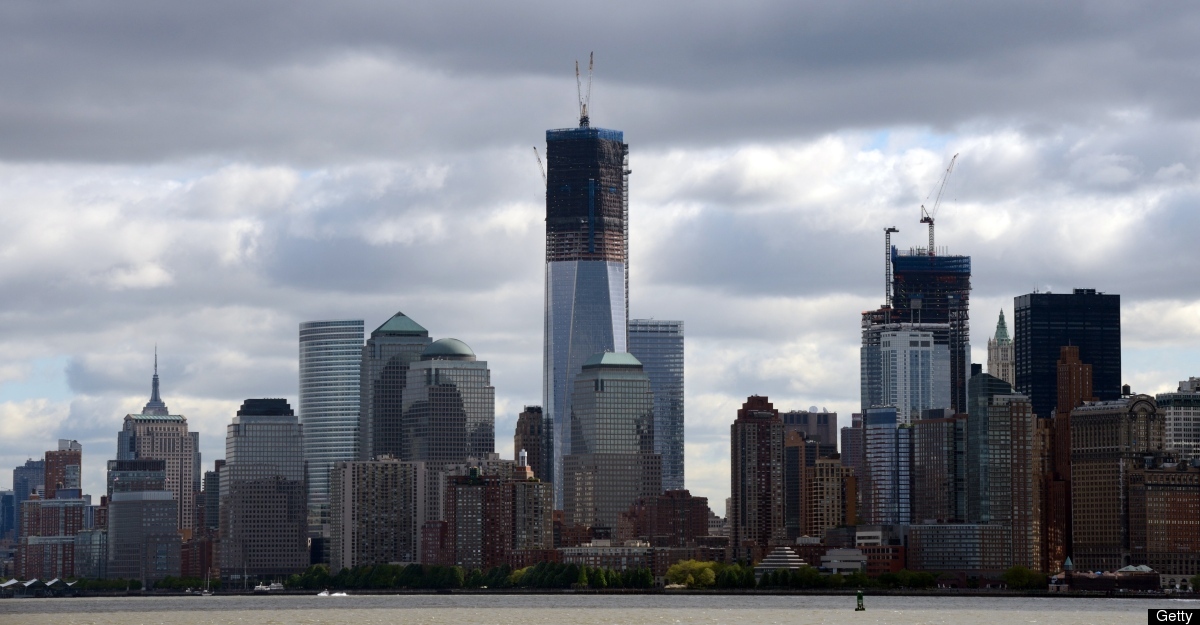
The elevation of Manhattan ranges from 1 to 80 meters (3.3 to 265.5 feet). The highest Natural Point of Elevation on the island of Manhattan – 265.5 feet according to USGS.

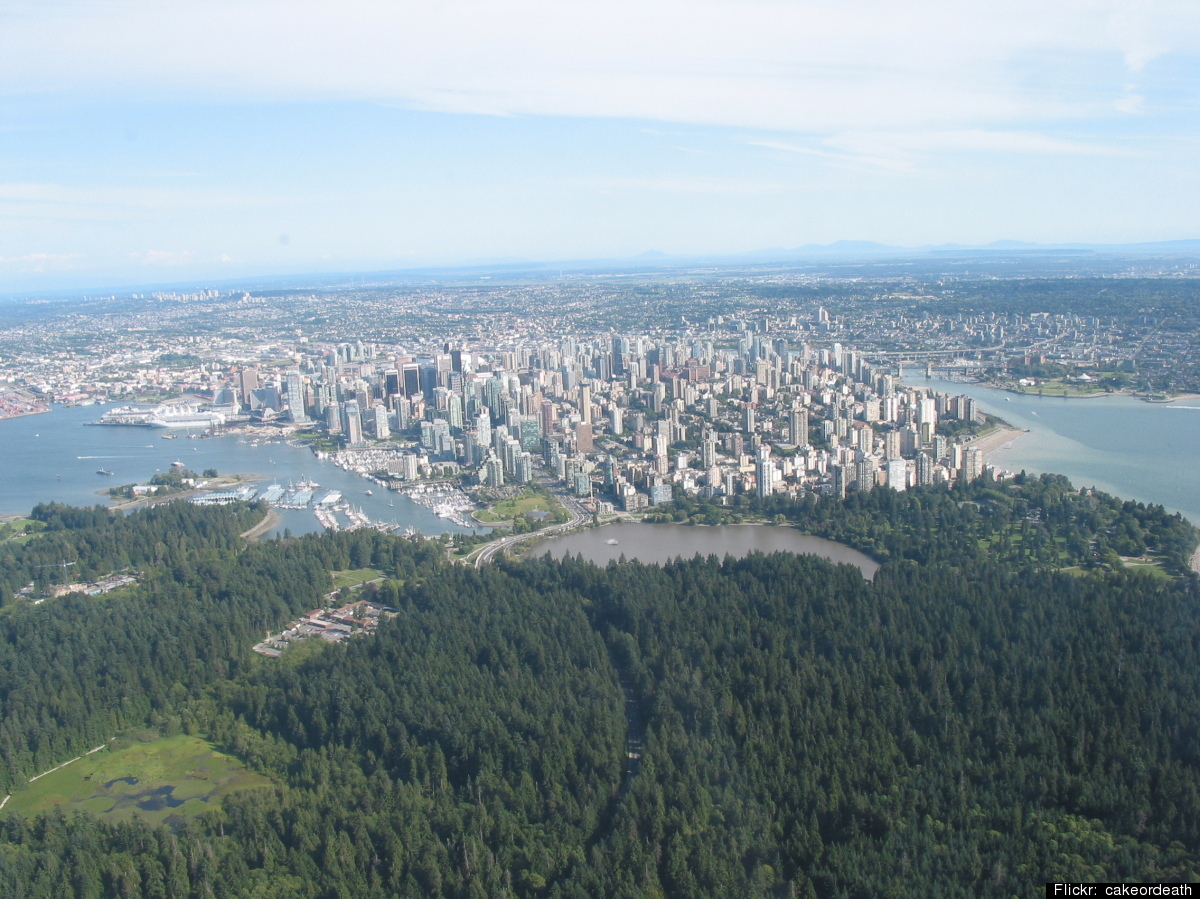
An urban planner recently told the Vancouver Sun that the city will need to take steps to protect many of its landmarks. Andrew Yan “estimates the city will have to spend upwards of $510 million to build and upgrade the dikes and seawalls – plus billions more to buy the land to put them on – over the next century.

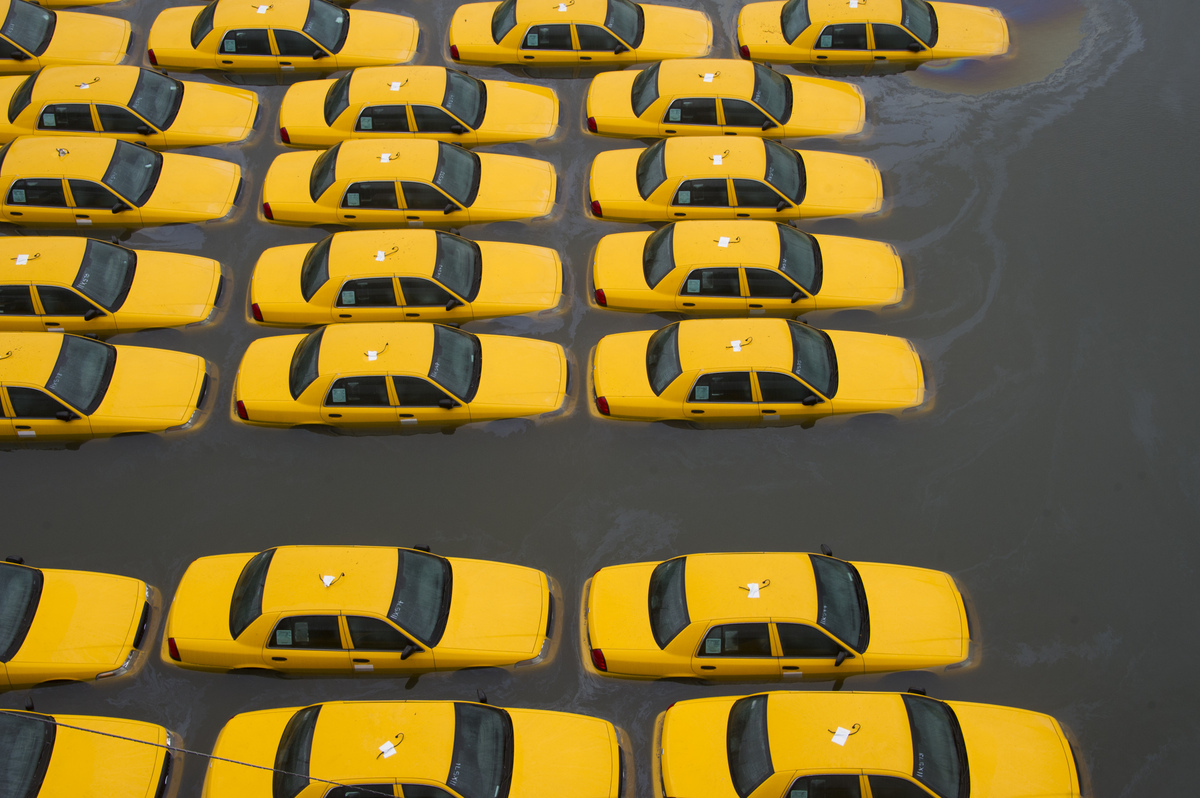
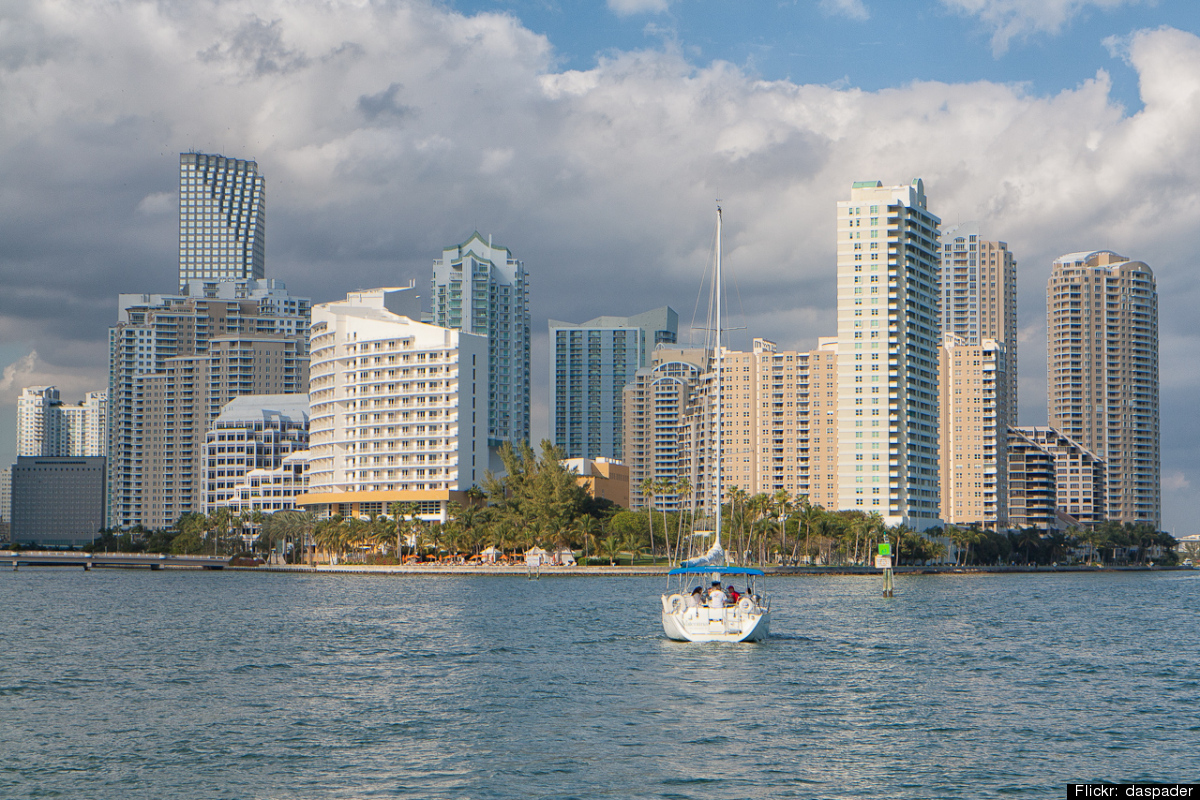
Look at these pictures of Miami and New York.  With such low elevations it should be obvious that any serious storm will mean devastation.

We can all argue about man causing global warming but we cannot argue that it is not happening.  CBC, the Canadian Broadcasting Company, posted “Arctic thaw heats up Northwest Passage dreams” on its web site.  Polar Cruises is now offering tours into the Northwest passage.

Based on  projections that sea levels will rise about 1 meter by the end of the century,  the analysis suggests the southern Atlantic and Gulf coasts could be particularly hard hit…

Miami, New Orleans, Tampa, Fla., and Virginia Beach, Va. could lose more than 10 percent of their land area by 2100.

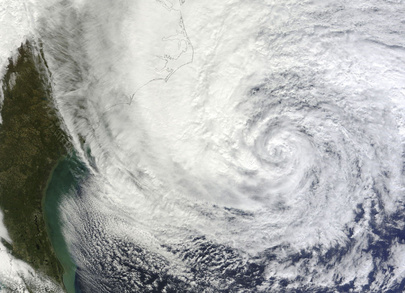
The impact of this global warming has been predicted to be unusual weather conditions throughout the world.  Is Sandy and Irene just the beginning?  I am not a scientist but the frequency of these kinds of storms would support that contention.

Americans Can Come Together

Can Americans come together when there is a major tragedy?  The answer is yes!  Whether it was the Oklahoma Federal Building bombing or the 9-11 terrorist attack we did come together.

On January 17, 1994 Los Angeles was hit with a 6.7 magnitude earthquake.  Unfortunately there are no warnings to help prepare for the event.  The National Weather Service did an excellent job of warning the East Coast of the Sandy Hurricane and ensuing storm.

In both instances the Federal government came to the aid of the people who were impacted.  Houston did open its doors to those who lost their homes in Louisiana after the devastating floods caused by Hurricane Katrina. These events prove that Americans can come together to support those in need.

My problem with Americans is that they want to put politics ahead of logic and reason in so many instances.  So we have these two political parties that behave like mad dogs.  One party suggests a solution to a problem and the other will reject it even if it is worthwhile.  Proof? Richard Nixon proposed a health care plan similar to Obamacare but the Democrats rejected the idea.  Forty years later the GOP staunchly opposes that very same plan.

We need new behavior from our politicians.  My forecast; Unfortunately it’s not coming any time soon.

Moving Into the City

For the first time in a century, most of America’s largest cities are growing at a faster rate than their surrounding suburbs.  Just Google “relocating from the suburbs to the inner city” and you will find multiple articles including this Hartford Courant news item with the headline:  Great Reversion: Boomers and millennials are coming back to urban America. There is this headline on nbc.com: Cities grow more than suburbs, first time in 100 years.

 What is going on is a realization by people of all ages that central areas of cities have more things to do and see (art galleries, theaters, shopping), easier cheaper transportation, faster access to health care, educational opportunities, and some intriguing homes.  On top all this there are no more hour long commutes.

Even Los Angeles has seen a resurgence in central city population growth.  Old and mostly abandoned department stores in the Downtown and Hollywood area still have the same exteriors but have been remodeled into apartments and lofts.  Apartment house developments are along major boulevards and adjoining streets throughout the west side all the way to Venice Beach and Santa   Monica.  Central Long Beach has become a major redevelopment area on the southern perimeter of the city.

San Diego Montage
San Diego Montage

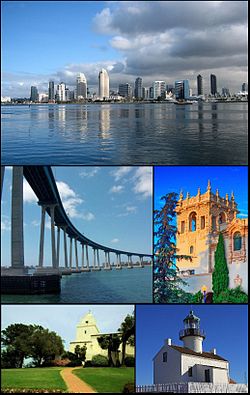
San Diego, my favorite city, has seen a rebuilt central city dominated by high rise condo and apartment developments.  Plenty of night life in the Gas Lamp district, a world class zoo, sports stadiums, and museums that are second to none.  Their light rail and bus system is outstanding.  Don’t send your children to their universities – they won’t return home; even back to Los Angeles.

Businessweek.com evaluated 100 of the country’s largest cities based on 16 criteria, which include: the number of restaurants, bars, and museums per capita; the number of colleges, libraries, and professional sports teams.  Those are some of the reasons living in major metropolitan areas outweighs the congestion and noise that is prevalent.  While you may not agree with their rankings (I don’t) the descriptions tell you the reasons that the suburbs are no longer the place to live.