
This photo was taken by Daniel Sonkin in Sausalito, California. He posted it on the DPReview forum website. He used a Panasonic DMC-FZ50 camera with an infrared filter + TCON. I have no idea what a TCON is but that is part of his posted information.
This photo was taken by Daniel Sonkin in Sausalito, California. He posted it on the DPReview forum website. He used a Panasonic DMC-FZ50 camera with an infrared filter + TCON. I have no idea what a TCON is but that is part of his posted information.
If you grew up in a poor neighborhood that is the environment you understand. Likewise if you grew up in a neighborhood of the well to do that is also the world you understand. I grew up in a very middle class neighborhood and my perceptions are based upon that environment. I never missed meal and I never went without shoes in that 1250 square foot three bedroom home.
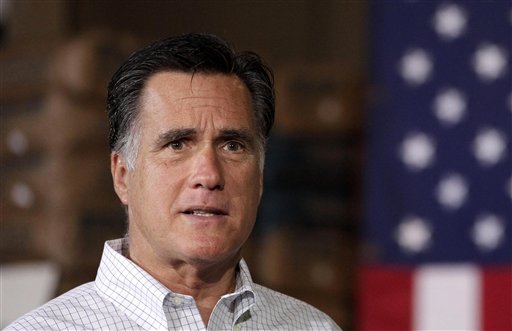 The Associated Press reports: “Mitt Romney says he learns about what it’s like to struggle in a difficult economy by sitting down to chat with regular people. But the Republican presidential candidate doesn’t want anybody to see it — and his campaign won’t say who he meets with or when the meetings occur.”
“Before I begin an event like this, I typically am able to sit down with a few people on an off-the-record kinda basis,” Romney said as he delivered his standard campaign speech Friday in Pittsburgh.
Mitt Romney’s annual yearly income is over $20 million. He has off shore accounts to minimize his income tax. I doubt anyone reading this column has any accounts outside the United States(Unless you live outside the United States). The Census Bureau says the median household income in the USA from 2006-2010 was $51,914. Arithmetic Median Definition: Median is the middle value of the given numbers or distribution in their ascending order.
Mitt Romney can hear about the issues of the average American for the rest of his life but he has never had to say “we can’t afford that” or heard your spouse asking if there is enough in the budget to pay for some new curtains or new shoes this month.
Yesterday’s issue for me was getting the lights turned on after an electrical malfunction. The initial price to do the job right was over $4,000. The final cost just to get the lights working was $352. Mr. Romney would have done the $4,000 job.
Mr. Romney’s problem is that he really doesn’t have to face the life of a typical American citizen. There is no way he can understand. Isn’t he lucky?
Checking out at the store, the young cashier suggested to the older woman, that she should bring her own grocery bags because plastic bags weren’t good for the environment.
The woman apologized and explained, “We didn’t have this green thing back in my earlier days.”
The young clerk responded, “That’s our problem today. Your generation did not care enough to save our environment for future generations.”
She was right — our generation didn’t have the green thing in its day.
Back then, we returned milk bottles, soda bottles and beer bottles to the store. The store sent them back to the plant to be washed and sterilized and refilled, so it could use the same bottles over and over. So they really were recycled.
But we didn’t have the green thing back in our day.
Grocery stores bagged our groceries in brown paper bags, that we reused for numerous things, most memorable besides household garbage bags, was the use of brown paper bags as book covers for our schoolbooks. This was to ensure that public property, (the books provided for our use by the school) was not defaced by our scribblings. Then we were able to personalize our books on the brown paper bags.
But too bad we didn’t do the green thing back then.
We walked up stairs, because we didn’t have an escalator in every store and office building. We walked to the grocery store and didn’t climb into a 300-horsepower machine every time we had to go two blocks.
But she was right. We didn’t have the green thing in our day.
Back then, we washed the baby’s diapers because we didn’t have the throwaway kind. We dried clothes on a line, not in an energy-gobbling machine burning up 220 volts — wind and solar power really did dry our clothes back in our early days. Kids got hand-me-down clothes from their brothers or sisters, not always brand-new clothing.
But that young lady is right; we didn’t have the green thing back in our day.
Back then, we had one TV, or radio, in the house — not a TV in every room. And the TV had a small screen the size of a handkerchief (remember them?), not a screen the size of the state of Montana . In the kitchen, we blended and stirred by hand because we didn’t have electric machines to do everything for us. When we packaged a fragile item to send in the mail, we used wadded up old newspapers to cushion it, not Styrofoam or plastic bubble wrap. Back then, we didn’t fire up an engine and burn gasoline just to cut the lawn. We used a push mower that ran on human power. We exercised by working so we didn’t need to go to a health club to run on treadmills that operate on electricity.
But she’s right; we didn’t have the green thing back then.
We drank from a fountain when we were thirsty instead of using a cup or a plastic bottle every time we had a drink of water. We refilled writing pens with ink instead of buying a new pen, and we replaced the razor blades in a razor instead of throwing away the whole razor just because the blade got dull.
But we didn’t have the green thing back then.
Back then, people took the streetcar or a bus and kids rode their bikes to school or walked instead of turning their moms into a 24-hour taxi service. We had one electrical outlet in a room, not an entire bank of sockets to power a dozen appliances. And we didn’t need a computerized gadget to receive a signal beamed from satellites 23,000 miles out in space in order to find the nearest burger joint.
But isn’t it sad the current generation laments how wasteful we old folks were just because we didn’t have the green thing back then?
News reports this evening are about the major earthquake in Mexico. It occurred in a favorite tourist area. CNN had a report on their web site. Mexico is part of the “Ring of Fire” that I commented about on March 11, 2011.
The Los Angeles River was encased in a concrete channel to protect lives and property. Councilman Dennis Zine’s idea of “bike paths, walkways and restaurants” will work out well as long as there is no flooding. We weren’t here then but the river has a history of flooding adjoining land. Here are some examples provided by The City of Los Angeles, Department of Public Works web site.
1815–The original Plaza is washed away as the river overflows and changes course at Alameda and Fourth Street
1861-62–Heavy flooding. Fifty inches of rain falls during December and January. Much of San Fernando Valley is under water.
1884–Heavy flooding causes the river to change course again, turning east to Vernon and then southward to San Pedro. The Downtown section of the river is channelized.
1914–Heavy flooding. Great damage to the harbor. Public called for creation of the L.A. County Flood Control District and discussion of channelizing the river begins.
1934–Moderate flood starting January 1. Forty dead in La Canada.
1938–Great County-wide flood with 4 days of rain. Most rain on day 4. Red Cross said this was the 5th largest flood in history at that time with 113 lives lost, $40 million in damage ($360 million in 1994 dollars). Recorded as a 50 year storm. Public demands action. Army Corps of Engineers begins channelizing the river with 10,000 workers applying 3,000,000 barrels of concrete by hand.
1941 to 44–L.A.River floods five times.
1983–Flooding kills six people.
1994–Heavy flooding. Estimates range from a 15 to over a 100 year flood.
It is difficult to convince anyone that their opinion is wrong no matter what the topic. Politics and global warning are the two most controversial topics in the world. So when Richard Muller, a prominent physicist and skeptic of global warming changes his mind that is something to broadcast to everyone.
His conclusions were the result of a two year study funded by the Charles Koch Foundation, whose founder is a major supporter of skeptic groups and the conservative tea party movement. The Koch brothers, Charles and David, run a large privately held company involved in oil and other industries, producing sizable greenhouse gas emissions.
No one is saying that the earth will experience all warming and no other effects. Predictors are forecasting unusual changes in weather patterns. We have experienced some usual change this year in the United States. Some very hot humid summer weather was followed by a 10 inch snow storm before Halloween.
Of course businesses that create greenhouse gases don’t want to believe they are contributing to the problem. Perhaps Richard Muller can lead a new wave of understanding.
–
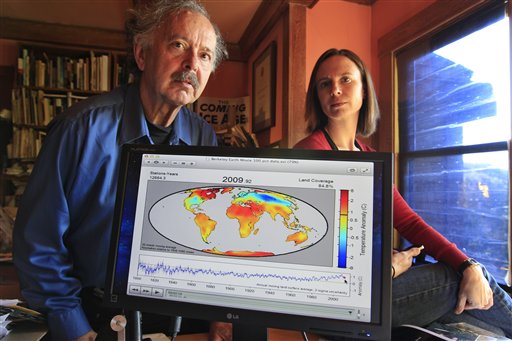
In this Friday, Oct. 28, 2011 photo, Richard Muller, left, and his daughter, Elizabeth Muller, right, pose with a map from their study on climate at their home in Berkeley, Calif. A new study of Earth’s temperatures going back more than 200 years finds the same old story: It’s gotten hotter in the last 60 years. What’s different is the scientist behind the latest study, Richard Muller. The California physicist was doubtful of what climate scientists have been saying – until he did his own research, partly funded by climate change skeptics. Elizabeth Muller, co-founder and executive director of the Berkeley Earth Surface Temperature Study, ran the study. (AP Photo – Paul Sakuma)
The proposed Keystone XL oil pipeline from Canada to the Texas Gulf Coast would not have “significant impacts” on the environment, the State Department has concluded, removing a major barrier to construction of the $7-billion project.
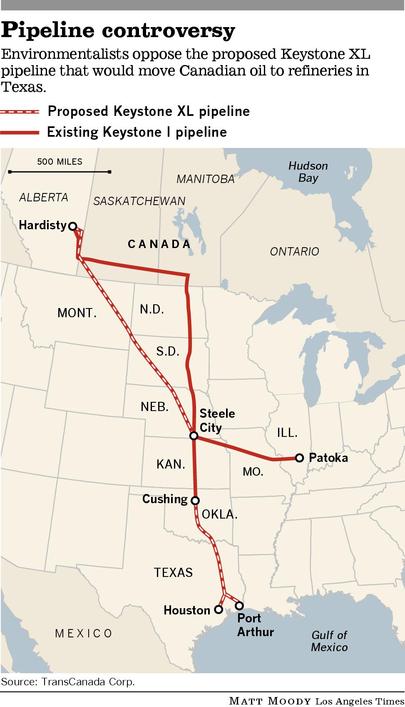
The problem is that environmentalists and others oppose the idea on the grounds that tar sand extraction (usually called fracking) because water tables will be impacted in the mining area. There have been reports on American television of enough gas in water pipes to ignite them at their outlets. This is obviously a serious issue.
The question of a new pipeline from Alberta to Texas should be what will the Canadians do if the United States says no to the project? It appears Canadian are determined to extract oil from their soil in Alberta despite the opposition. The answer is they will sell the crude oil to another country. That would most likely be South Korea, China, or Japan. There are already plans to build the Northern Gateway pipeline from Alberta through to British Columbia’s northern coast. Some say this is a fake play by the Canadian government. No matter, a greater reliance on oil from Canada will benefit the United States with more jobs and a dependable source of supply.
President Obama may be caught in this controversy because if his decision is a “no,” Republicans will say the decision is anti-business and is a job killer. They would be correct.
Source for this article is the Los Angeles Times and Scientific American.


Aerial photo of Santa Monica Freeway
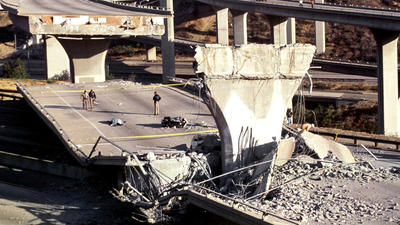
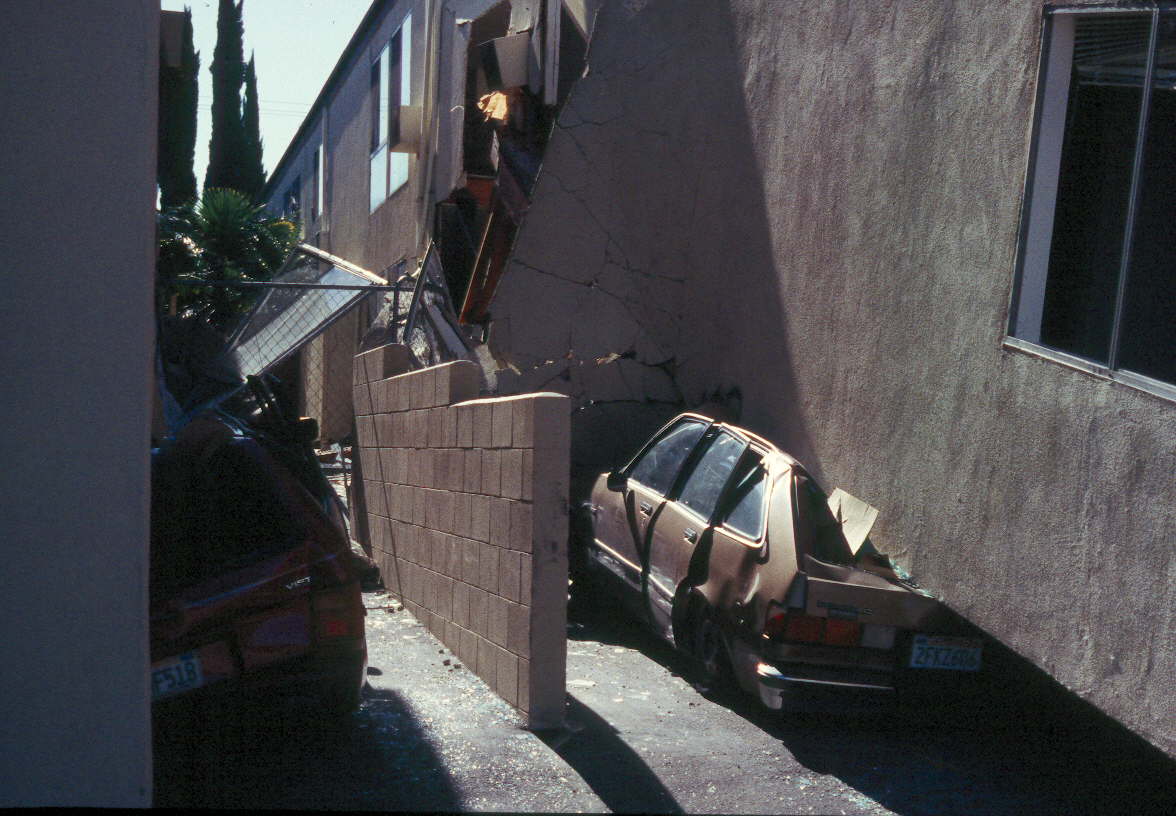
It was 4:30 a.m. on January 17, 1994 when the house rumbled and swayed. “Everybody into the hall”, I yelled. With the doors closed to the bedrooms we sat there on the floor until the swaying had stopped. Our neighbor was pounding on the front door. He yelled, “Is everybody OK?” That is when we left the hall and I opened the front door.
We were all OK and the damage was minor. I missed two days of work because the freeways had collapsed.
New York City, Washington – what you experienced was a minor shake. Here in Los Angeles we just go back to work. Around the Pacific Ocean we are not alone. Earthquakes on the San Andreas Fault are here.
President Bush and VP Cheney are sitting in a bar. A guy walks in and asks the barman, “Isn’t that Bush and Cheney sitting over there?”
The bartender says, “Yep, that’s them.”
So the guy walks over and says, “Wow, this is a real honor! What are you guys doing in here?”
Bush says, “We’re planning World War III.”
The guy says, “Really? What’s going to happen?”
Bush says, “Well, we’re going to kill 140 million Muslims and one blonde with big tits..”
The guy exclaimed, “A blonde with big tits?”
“Why kill a blonde with big tits?”
Bush turns to Cheney and says, “See, I told you, no one gives a shit about the 140 million Muslims.”
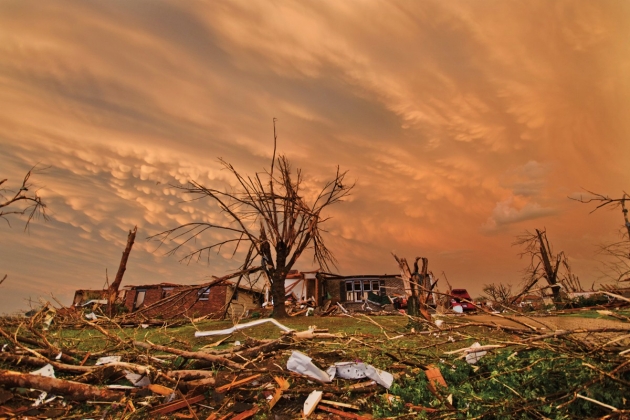
The world is experiencing climate change. There may be debate about the cause but there is no denying the reality. The facts are almost everywhere. More tornados, higher tides, and melting glaciers are just part of the data. After the NOAA (National Oceanic and Atmospheric Administration), part of the U.S. Department of Commerce, predicted a dryer than normal California winter, the opposite occurred. National television networks reported much higher than normal water falls in Yosemite National Park. According to the National Park Service website, the April 1, 2011 snow pack in the Tuolumne River drainage was 178% of average. This was reported in the Fresno Examiner (about two hours from Yosemite Valley).
Newsweek’s June 6, 2011 edition includes a dramatic two page photo from Joplin, Mo and a four page article and world map that predicts 6º to 10ºF increases in temperature by the end of the century. Even if they are extremes, one half the numbers predicted are alarming.
Next week in Vancouver, Canada, city representatives from across Canada, the United States and Britain will gather at a conference dubbed “Resilient Communities: Preparing for the Climate Challenge.”
This Blog will stay tuned.
 Coast Contact