This is a Demand Side Economy

The discussion is promoted by David Brooks column A Little Economic Realism in the July 5, 2010 New York Times.

The American economy is driven by consumer spending.  That fact has been driven home by articles, commentaries, and TV talk shows.  The United States is a consumer nation.  Our biggest trading partner is China.  That countries recent growth has been the result of America’s demand for low cost products.  Wal-Mart and Costco are filled with products that consumers want.  American credit card debt totals almost $1 Trillion.  It has been a Demand Side economy.

Need more proof that this is Demand Side economy?  I found this December 20, 2006 Think Progress report:

Today, President Bush held a news conference where he discussed the “way forward” for the economy in 2007. Renowned Morgan Stanley economist Steven Roach says the “odds of the U.S. economy tipping into recession are about 40 to 45 per cent.” New York Times columnist Paul Krugman notes that “the odds are very good — maybe 2 to 1,” that the U.S. will teeter toward a recession in 2007. Bush’s solution? “Go shopping more.” Watch it:

http://video.thinkprogress.org/2006/12/bushshopping.320.240.flv

Similarly, after the Sept. 11 attacks, Bush simply asked Americans for their “continued participation and confidence in the American economy.” From the International Herald Tribune, 1/14/03:

Bush did nothing to mobilize public opinion to accept the sacrifices that war implies — the first thing a leader would do. Tax cuts could go ahead as planned, and energy saving was dismissed out of hand. “Go shopping” was the administration’s message.

Bush added today that 2007 will “require difficult choices and additional sacrifices” from the American people.

Bush Transcript (unerlined and bold by me):

As we work with Congress in the coming year to chart a new course in Iraq and strengthen our military to meet the challenges of the 21st century, we must also work together to achieve important goals for the American people here at home. This work begins with keeping our economy growing. … And I encourage you all to go shopping more.

Of course David Brooks is a Republican and supports their belief that lower taxes are the salvation to all our economic problems.  Most American corporate interests are now multi-nationals and are more concerned with their net income than the welfare of the average American.
More Jobs is Job 1!

July 8, 2010

A Dow Jones news report issued today, July 8, started with the words “In a hopeful sign for the labor market, the number of U.S. workers filing new claims for unemployment benefits fell last week by more than analysts expected.” That is a totally misleading statement.  New claims dropped into the 400,000 to 500,000 range in the week of November 21, 2009.  The number has never dropped below 433,000 claims in any week since then.  So while the latest number is less than the previous week, what is hopeful about new claims of 454,000?

July 2, 2010

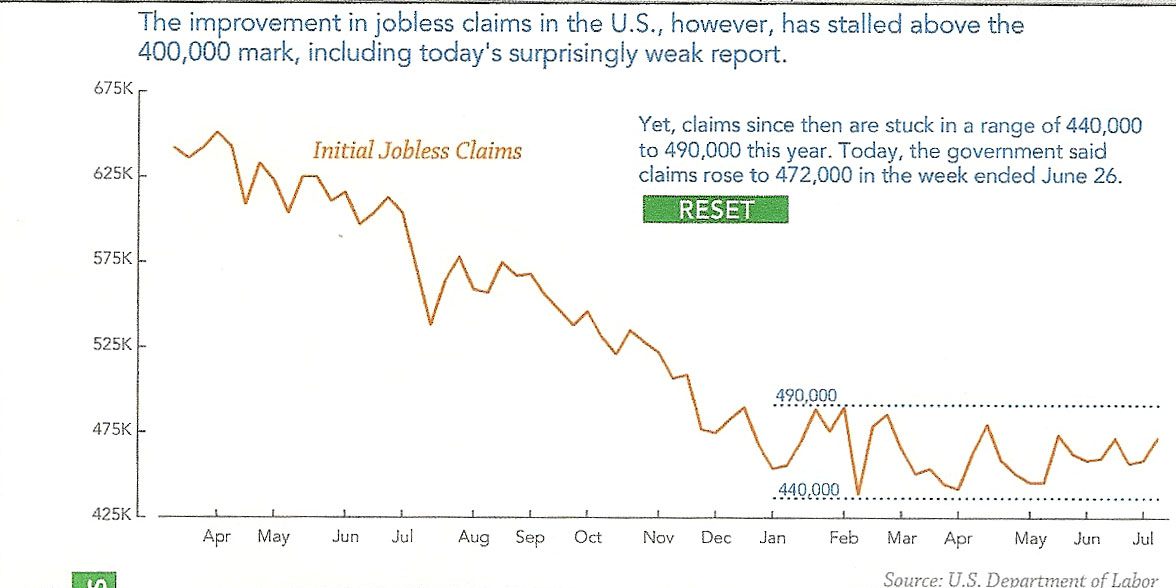
The unpleasant reality is that new job claims are continuing at a rate that will cause more people to vote for Republican representatives to the Congress and Senate. The following graph demonstrates the unending recession.  Click the graph to see a better view.  It’s not a pretty picture.

Both congressional Republicans and Democrats don’t seem to get it.  The United States is in serious economic trouble.  While the monthly unemployment report seems to be improving there really has not been an improvement in this economy.

 Look at these quotes from Businessweek magazine.                                                                      

The improvement in jobless claims in the U.S., however, has stalled above the 400,000 mark, including today’s surprisingly weak report.

Yet, claims since then are stuck in a range of 440,000 to 490,000 this year. Today, the government said claims rose to 472,000 in the week ended June 26.

“To get the unemployment rate going down you need 200,000 plus jb growth,” said Mark Zandi, chief economist with Moody’s Analytics in West Chester, Pennsylvania. “If that doesn’t happen by the end of the year, then this will go down as another jobless recovery.”

This week’s employment report may move the U.S. further away from hitting Zandi’s job growth target.

If payrolls grow an average of 100,000 a month, Bloomberg calculations show, it would take six years for the U.S. to return to the peak in employment of 138 million people set in December 2007.

From Bloomberg.com                                                                                                                                                                Almost a year ago, economic strategist Dan Greenhaus of Miller Tabak & Co. in New York told his clients the U.S. economy would recover while job growth would be scarce.

His prediction for a so-called jobless recovery, derided by some clients when he made the forecast last July, may be coming true.

From the United States BLS:                                                                                                                                                              In June, the number of long-term unemployed (those jobless for 27 weeks and over) was unchanged at 6.8 million. These individuals made up 45.5 percent of unemployed persons.

The graph shown here really speaks louder than words.  It is provided by the U.S. Department of Labor.

My question is what is congress doing?  Unless I have missed something the answer is NOTHING!

Cutting the Deficit in Half, Is It a Fairy Tale?

President Barack Obama told a news conference at the end of the G20 conference in Toronto that all nations have agreed to cut their deficits in half by 2013.  So I asked myself:

What is the difference between the public debt and the deficit?

According to treasurydirect.gov  The deficit is the difference between the money Government takes in, called receipts, and what the Government spends, called outlays, each year. Receipts include the money the Government takes in from income, excise and social insurance taxes as well as fees and other income. Outlays include all Federal spending including social security and Medicare benefits along with all other spending ranging from medical research to interest payments on the debt. When there is a deficit, Treasury must borrow the money needed for the government to pay its bills.

We borrow the money by selling Treasury securities like T-bills, notes, Treasury Inflation-Protected securities and savings bonds to the public. Additionally, the Government Trust Funds are required by law to invest accumulated surpluses in Treasury securities. The Treasury securities issued to the public and to the Government Trust Funds (intragovernmental holdings) then become part of the total debt.

The current federal debt is $13 Trillion.  The deficit for fiscal year 2009, which ended Sept. 30, 2009 came in at a record $1.42 trillion, more than triple the record set in 2008.  The administration projects a shortfall of $1.6 trillion in the fiscal year that ends in September 2010.  The president’s immediate solution is to reduce domestic discretionary spending.  CNN reports that such spending amounts to 2% of the budget.  The government is about to ask for another $33 Billion for the Afghan War.  Republican lawmakers — joined by Democrat Ben Nelson of Nebraska — maintained a unified front to sustain a filibuster of the $110-billion bill for the extension of unemployment benefits. The vote was 57 to 41; the majority was three short of the 60 needed to cut off debate and bring the bill to a final vote. Enough Republicans will probably switch their votes next week to pass this bill.

Where will the spending cuts come from?  Perhaps it will be a fairy godmother that solves this dilemma.  Perhaps they won’t happen at all except in our dreams.

It’s Not the Glass-Steagall Act

Unfortunately the new financial reform bill that will most likely be signed into law by July 4 does not bring back the stringent regulations of the Glass-Steagall Act that was revoked in 1999.  Too many lobbyists had too much influence.

From the Los Angeles Times:

…the overhaul legislation wouldn’t force big banks — the target of much public criticism during the crisis — to shrink.

In contrast, in the 1930s, the landmark Glass-Steagall Act forced banks to separate their riskier investment banking operations from their commercial banks, which predominantly take deposits and make loans. The idea was to protect commercial banks, which are backed by federal deposit insurance, from devastation during financial crises. The Glass-Steagall provision, however, was repealed in 1999.

Moving back in the direction of Glass-Steagall, the Obama administration proposed the so-called Volcker rule, developed by former Federal Reserve chief Paul Volcker. The rule was one of the most contentious elements of this week’s negotiations. The final compromise limits banks to investing no more than 3% of their capital in hedge funds, private equity funds and proprietary trading desks.

On derivatives, the banks would be forced to move some particularly risky trading into separate entities. Virtually all derivatives would have to be traded through a clearinghouse, bringing down some of the profits from the private derivatives deals in which the banks currently engage.

New York Times reporter Binyamin Appelbaum had this article:

“I don’t know that there has been a bill that has touched as many different substantive areas as this one,” said A. Patrick Doyle, a partner at Arnold & Porter who has worked on financial issues for three decades. “Clearly there’s going to be a lot of work.”

The surge in hiring has sent a joke bouncing around Washington: Congress finally passed a jobs bill — full employment for lawyers.

Continuing Lack of Job Growth

CNBC reported that weekly Initial job claims dropped by 19,000.  That is quite an improvement but it is also very misleading.  Job claims for the previous week were revised upward by 20,000.  So in fact, job claims actually increased by 1,000.  The network’s continuing misleading reporting will result in my watching and listening to Fox Business News.

Weekly Initial job claims are revised one week after the initial report when more accurate data is compiled.  The weekly revised number dropped to 433,000 in the weeks ending December 26, 2009 and January 2, 2010.  It has not been that low since those two weeks.  That low number is probably the result of delayed filing due to the holiday season.  Last week’s revised 476,000 tells me that high unemployment is likely to be around for quite awhile.

I am not alone in this opinion.  This is a quote from Businessweek magazine in the June 14, 2010 issue.  “We are not going to generate a lot of jobs. The cost of labor is too high. We are having a huge substitution of technology for people to save money and make profits.” – Allen Sinai, president, Decision Economics, and former chief economist for Lehman Brothers, speaking about the U.S. economy

Canada’s Economy is the Envy of the World

A Summary of an Associated Press article.

It should be noted that the total population of Canada is less than the population of California.

TORONTO (AP) — Canada thinks it can teach the world a thing or two about dodging financial meltdowns.

While others have floundered, Canada’s economy grew at a 6.1 percent annual rate in the first three months of this year. President Barack Obama says the U.S. should take note of Canada’s banking system, and Britain’s Treasury chief is looking to emulate the Ottawa way on cutting deficits.

“We should be proud of the performance of our financial system during the crisis,” said Finance Minister Jim Flaherty in an interview with The Associated Press.

The banks are stable because, in part, they’re more regulated. As the U.S. and Europe loosened regulations on their financial industries over the last 15 years, Canada refused to do so. The banks also aren’t as leveraged as their U.S. or European peers.

In Canada’s concentrated banking system, five major banks dominate the market and regulators know each of the top bank executives personally. [editor’s note: There are eight major banks in the United States]

Although Canada did experience the recession of 2008-2010 it is recovering from the recession faster than others, and although its deficit is currently at a record high, the International Monetary Fund expects Canada to be the only one of the seven major industrialized democracies to return to surplus by 2015.  The proof?  This month Canada became the first among them to raise interest rates since the global financial crisis began.

George Osborne, Britain’s Treasury chief, has vowed to follow Canada’s example on deficit reduction.  “They brought together the best brains both inside and outside government to carry out a fundamental reassessment of the role of the state,” Osborne said in a speech.

“The rest of the world certainly thinks we’re the model to follow,” said Martin, who was prime minister from 2003 to 2006. “I’ve been asked by a lot of countries as to how to go about it.”

Don Drummond, Martin’s budget chief at the time, “There’s a lot to learn from Canada but their starting conditions are worse,” he said. “Even though we were on the precipice of a crisis we weren’t in as bad a shape as many of them are.”

Can We Just Say No!

We are facing an unpleasant reality.  The Federal government is currently spending money at a rate 1½ times the rate of incoming money from taxes.  That is fact, not internet chatter.  Even worse is that the total national debt equals one year of GDP.  Imagine if your personal debt excluding your house mortgage (a planned long term commitment) equaled your total annual income.  The banks would increase the interest you would be required to pay on that debt because they would fear the possibility of default.  Unlike everyone else in America, the Federal government can print the money it needs.

The Congress and most people realize the situation is desperate.  The difficulty is saying “no” to the pressure for continuing the spending.  There are those in Congress who want to extend existing programs and add more for one simple reason.  It is an election year. 

Some examples of programs wanting more money:

  • There has been a subsidy to recently unemployed people that provides for 65% of the cost of COBRA for a total of 15 months.  That program expired May 31. 
  • Unemployment benefits have been extended to 99 weeks.  The House voted to extend the benefits and now the program awaits Senate approval.  
  • Medicare doctors are looking increased payments. 
  • States want more aid due to their unbalanced budgets. 
  • The SEC, FDA, Interior Department (think mineral management) and other Federal agencies want additional funds to do a better job. 
  • The State of California wants money to do a demonstration of high speed rail. 
  • Los Angeles wants the Federal government to provide aid for speeding up subway and light rail construction. 
  • President wants $50 billion in state and local aid to avoid “massive layoffs of teachers, police and firefighters” and to support the still-fragile economic recovery.
  •  

Everyone wants the projects but there just is not enough money.  Can we just say No?

Summary Of Key Provisions Of Senate Financial Overhaul Bill

I wanted restoration of the Glass-Steagall Act.  It was the most far reaching of any financial control law in American History.  The new law may be an improvement but I fear the details will provide loopholes that will not fulfill American needs.

Following is a an abridged summary found on Morningstar.

-NEW REGULATORY AUTHORITY: Gives federal regulators new authority to seize and break up large troubled financial firms without taxpayers bailouts in cases where the firm’s collapse could destabilize the financial system.

-CONSUMER AGENCY: Would create a new Consumer Financial Protection Bureau within the Federal Reserve, with rulemaking and some enforcement power over banks and non-banks that offer consumer financial products or services such as credit cards, mortgages and other loans.

-DERIVATIVES: Would require the vast majority of all derivatives trading be executed on a public exchange as opposed to between banks and their customers as many contracts are currently written.

-FINANCIAL STABILITY COUNCIL: Would establish a new, nine-member Financial Stability Oversight Council, comprising existing regulators charged with monitoring and addressing system-wide risks to the nation’s financial stability.

-OVERSIGHT CHANGES: Would eliminate the Office of Thrift Supervision, but an attempt to strip the Fed of its oversight of thousands of community banks in the bill was reversed with an amendment.

-FEDERAL RESERVE OVERSIGHT: Calls for a one-time government audit of all of the Fed’s emergency lending programs from Dec. 2007 onward, including facilities used to help deal with the collapse of Bear Stearns & Co. and the program to stabilize asset-backed securities markets.

-BANK CAPITAL STANDARDS: Under an amendment adopted unanimously with little fanfare, the bill would force banks with more than $250 billion in assets to meet higher risk- and size-based capital standards.

-CREDIT RATING AGENCIES: The bill will establish a new self-regulatory organization for credit rating agencies designed to eliminate a conflict in the current system where an institution pays for its rating and, at times, shops for the best rating it can get for the lowest price.

-INVESTMENT ADVICE: Several Democrats had hoped to tighten regulations for broker-dealers who give investment advice, but they weren’t given a floor vote on their amendment despite near constant lobbying from consumer groups.

-MORTGAGE RISK: Would require firms that securitize mortgages and other loans to hold a portion of the risk on their own balance sheets, but–under an amendment added on the floor–also would direct regulators to establish a category of less-risky mortgage products– primarily fixed-rate, fully amortizing loans–that would be exempt from the risk-retention rule.

-HEDGE FUNDS: Would require hedge funds that manage more than $100 million to register with the SEC as investment advisors and disclose to the agency information about their trades and portfolios.

-CORPORATE GOVERNANCE: Would give shareholders of public corporations a non-binding vote on executive pay, and would give the SEC the authority to grant shareholders proxy access to nominate directors.

-INSURANCE: Would create a new Office of National Insurance within Treasury to monitor the industry, recommending to the systemic risk council insurers that should be treated as systemically important, as well as coordinate international insurance issues.

Wall Street Reform Now!

The banks love fine print and loopholes. We need to make sure the loopholes are closed and taxpayers, investors and consumer are protected by Wall Street reform. The Senate is preparing to vote on oversight of the banks and Wall Street. I just sent my Senators a quick, strong message and I hope you will to. Just go to www.DefendYourDollars.org.

This is the letter that Defend Your Dollar suggests you send to your U.S. Senators.

End “too big to fail”: In 1995, the assets of the six largest banks were equivalent to 17 percent of the US economy (GDP); now they amount to 63 percent of GDP. No wonder the mega-banks can shakedown the taxpayer with threats of economic collapse! The Brown/Kaufman amendment would finally limit the size of the biggest financial institutions so we never again have to worry that if one of them fails it will bring down the economy. Vote YES for Brown/Kaufman.
 
No loopholes for auto loans: Auto dealers who make car loans should be held to the same standards of fairness and transparency as banks. When I buy a car and the dealer helps me get a loan, I should get exactly the loan I bargained for, with no unexpected “extras” or surprise conditions.
 
 Strongly protect consumers: An independent pro-consumer watchdog must be created so when new problems with deceptive financial products are spotted, they can act quickly to stop them. Vote YES for the strongest, most independent consumer watchdog you can.
 
End “keep the fee, pass the risk”: Making bad loans was good for brokers, lenders, and Wall Street because everyone got a fee on the deal while passing the risk of nonpayment on to the next person in the chain. The Senate bill requires that every entity that securitizes loans keep a material portion of the risk. That means everyone will think twice before making a bad loan–and taxpayers won’t be cleaning up the mess.
 
If it’s not a bank, it can still tank the economy: Some of the biggest firms that threatened our economy were not banks, but other kinds of financial companies held to lower standards. This bill allows a panel of bankruptcy judges to appoint the FDIC as the receiver of important non-bank financial companies or bank holding companies when they are at risk of failing.  The FDIC can fire management, and creditors and shareholders of the failed company will bear the losses not taxpayers. 
 
End the hidden gambling: Require hedge funds to register and to disclose their trading activities, bring sunshine and oversight to the largely secretive derivatives market, and stop banks from gambling on derivatives.
 
Let states protect us: States should have the right to do more than what the Federal government says to protect residents from emerging financial schemes.

How close are you to the financial edge? Take this quiz

Thanks  to the Los Angeles Times Business section writer Kathy M. Kristof.  My score is 15 so I can gloat.

How close are you to the financial edge? To help you find out, here’s a 10-question multiple-choice quiz, developed with some guidance from the National Foundation for Consumer Credit and Clearpoint Financial Solutions.

1. The amount I have socked away in savings to handle emergencies could pay all of my living expenses for up to:

A) three months;

B) six months;

C) 8 months or more;

D) about an hour and a half, if I cut back.

2. My spouse and I fight about money:

A) frequently;

B) sometimes;

C) never;

D) through court-appointed lawyers.

3. Payments on my consumer debts — auto loans, student loans, credit cards and home equity lines of credit — amount to less than:

A) about 20% of take-home pay;

B) 15% of take-home pay;

C) 10% or less of take-home pay;

D) considerably more than 20% of my monthly paychecks.

4. When it comes to saving for retirement, I’m socking away:

A) 6% or a little less of income to get the company match;

B) 10% of my income;

C) the maximum allowed by the company plan;

D) whatever’s in the couch cushions. Seriously, who can afford to save for retirement?

5. My housing costs, including property tax (when applicable) and insurance, amount to less than:

A) 30% of my take-home pay;

B) 25% of take-home pay;

C) 20% or less of take-home pay;

D) more than 30% of take-home pay.

6. I make more than the minimum required payments on my credit cards:

A) sometimes;   

B) most of the time;

C) always — I pay off the full balance each month;

D) never. If they demand $29.37, that’s what I’m paying and not a penny more.

7. I spend less than I make:

A) unless there’s a sale;

B) except in cases when I’m investing in something long-term, like education or a car that gets me to work;

C) always;

D) when I manage to work enough overtime.

8. My finances:

A) are an occasional source of concern;

B) are largely in control;

C) are never a cause of worry;

D) give me cold sweats.

9. I have enough insurance to cover medical costs:

A) as long as they’re not catastrophic;

B) for both me and my family;

C) and I have money set aside to cover co-payments and deductibles;

D) only if I never get sick.

10. I know my net worth and:

A) though it’s not what I want it to be, I’m working on it;

B) it’s good and growing;

C) I’m the typical millionaire next door;

D) it tells me I’m insolvent.

Scoring: Give yourself 5 points for each A answer; 2 points for each B; 1 point for each C; and 10 points for each D answer. Total your points and assess your score.

76-100: Danger zone: You are in the economic red zone. Get yourself to a credit counselor pronto. If you need help finding one, go to http://www.nfcc.org or http://www.aiccca.org. Both are national credit counseling associations that allow you to find a counselor in your neighborhood by hitting the “find a counselor” buttons on their home pages.

51-75: Teetering: You may be making your payments now, but you’re on the razor’s edge of trouble. It’s time to get serious about budgeting and saving. If you can’t do it alone, get help.

26-50: Healthy and happy: You’ve got adequate savings and good habits. Keep it up and you’ll be comfortably rich in no time, if you’re not already.

0-25: Go ahead and gloat: You are in an enviable spot, likely to be able to handle any economic emergency that comes your way. But you already knew that, didn’t you?

business@latimes.com