Inflation is Real

It’s the economy stupid” was a phrase coined by James Carville in 1992, when he was advising Bill Clinton in his successful run for the White House. And it is still true today.

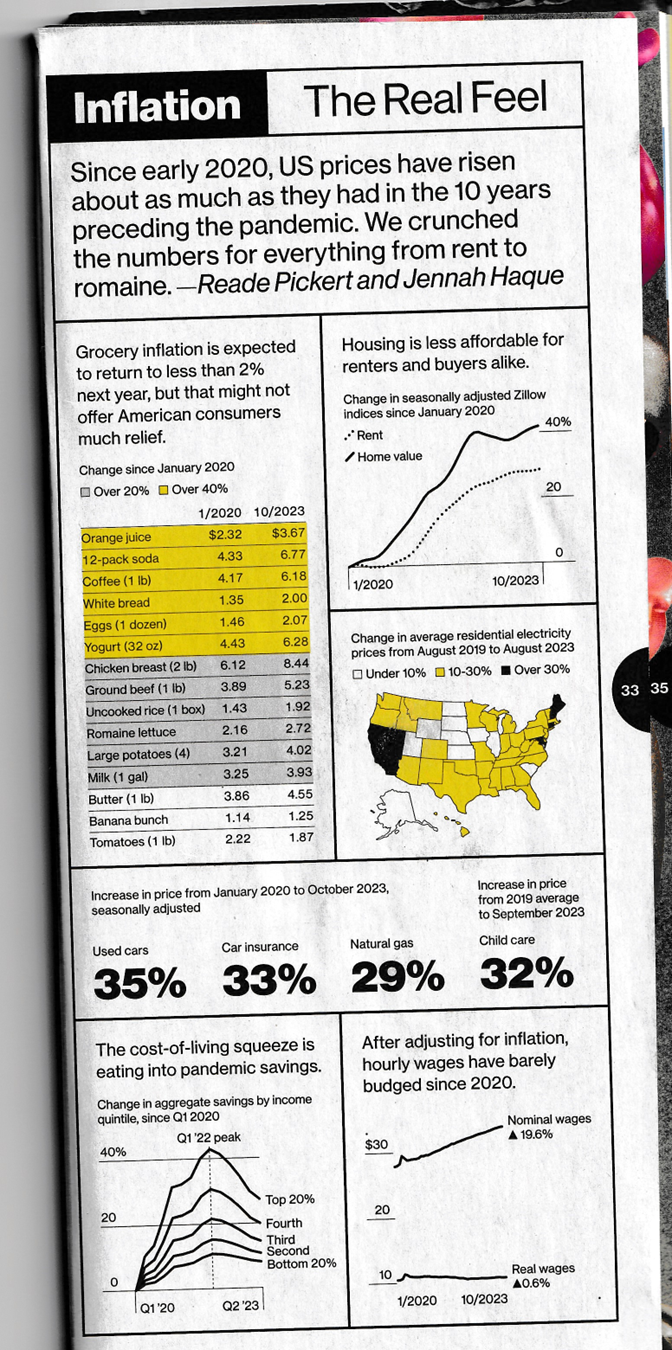
The Biden administration may want you to believe that inflation is not real but they are telling you a lie. This report from the latest Bloomberg Business Week provides the facts. In my own personal life my Quaker Oats Apple and Cinnamon now provides 8 packets down from 10 in a box. My shaving cream is now in a 7 ounce container down from 10 ounces. Next year’s inflation rate of an expected 2% won’t be bringing prices down.

Social Security and Medicare are Running out of Money

Sadly the congress of the United States delays confronting serious problems to the last minute. The debt ceiling was reached in January and there is casual discussion about adjusting it or doing major budget changes while the treasury secretary juggles the bills that are due now. We have an even big problem looming that will impact everyone.   

Social Security and Medicare are running out of money.

Medicare’s trust fund is projected to be exhausted by 2028. Social Security’s trust fund is projected to be exhausted by 2035. When that happens the money each fund will dispense will be equal to incoming receipts.  According to the Washington Post payments to doctors and health plans will likely be 90% of current reimbursements starting in 2028 and a 20 percent cut for all seniors receiving a Social Security check in 2035.

So, those are the two basic options to solve these issues: raise taxes or cut benefits. You could do similar things today. For example, to make Social Security solvent for the next 75 years, legislators could raise the tax rate from 6.2% to 8.1%. According to current actuarial projections, this would fix the problem until 2095.

Democratic lawmakers say that both Social Security and Medicare can be addressed without any cuts to the program — an approach expected to be codified in Biden’s upcoming budget, which is set to be released next month. Some liberal lawmakers have pushed for a one-line change to federal law that would require general funds from the Treasury Department to be used to pay off the shortfalls in the programs and make beneficiaries whole. Some liberal advocates, meanwhile, have pointed out that tax hikes would take care of the funding shortfall. One proposal to lift the current cap on earnings subject to Social Security payroll taxes, endorsed by Sen. Bernie Sanders (I-Vt.) Sen. Joe Manchin (D-WV) and others in the Democratic caucus, would extend funding for the program for decades. That cap is now about $160,000.

Will congress do anything before the last minute?  Not likely.

The U.S. Debt is not just a Paper Number

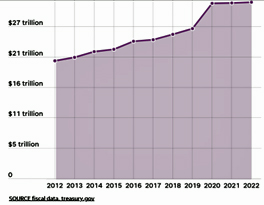
$31 trillion is the debt limit set by congress. Today the debt is at $30.93 trillion. As you can see in this U.S. treasury graph the growth has increased at a horrifying rate. That debt is bonds sold by the government. That debt exists because the government spends more than is taken in through taxes. With higher interest rates any new bonds will cost more.

If this was your household would you continue borrowing or would you say NO to more spending? What would you cut out of the federal budget?

$30.93 trillion

Even in a Down Stock Market the S&P 500 is Still the Best Bet

When competitor Money magazine ceased print publication in 2019, Kiplinger’s acquired roughly 400,000 of its monthly subscribers.

Kiplinger continues to offer investment advice in both a printed magazine and an on-line version. 

But what is the point of trying to outsmart the index low fee investments? 

When I started investing in the late 1980s every fund compared itself to the S&P 500.  Oh, I said to myself, those managed funds are trying to tell me that they have the formula to beat the index.  Why not just invest in the index?  Then I learned about a Vanguard fund that simply emulated the index.   

“Let me summarize what I’ve been saying about the stock market: I think it’s very hard to come up with a persuasive case that equities will over the next 17 years perform anything like—anything like—they’ve performed in the past 17. If I had to pick the most probable return, from appreciation and dividends combined, that investors in aggregate—repeat, aggregate—would earn in a world of constant interest rates, 2% inflation, and those ever hurtful frictional costs, it would be 6%!”

— Buffett, Fortune (1999)

Warren Buffett has been a supporter of index funds for people who are either not interested in managing their own money or don’t have the time. Buffett is skeptical that active management can outperform the market in the long run, and has advised both individual and institutional investors to move their money to low-cost index funds that track broad, diversified stock market indices. Buffett said in one of his letters to shareholders that “when trillions of dollars are managed by Wall Streeters charging high fees, it will usually be the managers who reap outsized profits, not the clients.” In 2007, Buffett made a bet with numerous managers that a simple S&P 500 index fund will outperform hedge funds that charge exorbitant fees. By 2017, the index fund was outperforming every hedge fund that made the bet against Buffett.
Republicans rediscover their concern for the national debt

Republicans who voted to grow the national debt under former president Donald Trump are trumpeting fiscal conservatism again during a Democratic presidency.

The national debt under former president Donald Trump grew from $19.9 trillion in January 2017 to a new high of $27 trillion In October 2020. That’s an increase of almost 36% in less than four years.

Today the debt is over $28 trillion.

Joe Biden’s spending plans will obviously increase the national debt to an even higher number.

The problem is that the political party that is out of power invariably voicing concerns of the growing debt.

Doyle McManus in the Los Angeles Times pointed out in his latest column  that more than $600 billion in taxes on 2020 income will go uncollected because the IRS lacks the manpower to audit the most tax returns. Unreported income of the wealthy is the issue. “The total shortfall over the coming decade could reach $7.5 trillion — more than enough to pay for all of President Biden’s ambitious spending plans.

“Collecting the taxes people are required to pay isn’t soaking the rich; it’s stopping the deadbeats and freeloaders from shirking a burden the rest of us are carrying.”

U.S. Stocks Notch Records in Final Trading Day of 2020

The Dow Jones Industrial Average and the S&P 500 ended the year set new high records on the last day of trading.  Major indexes finished 2020 solidly. The Dow was up more than 6%  for the year. The S&P 500 was up 15%, the Russell 2000 was up 19%, and the Nasdaq Composite was up 43%.

If you had put just $5,000 in a Vanguard 500 Index Fund on January 1, 2020.  Your investment would now be worth $5,748 The expense .04% or $2.  If you had your money in a Bank of America savings account  your earnings are .05%.  CDs (certificate of deposit savings accounts of rates no more than 1.5% or an account worth $5,250 at the end of the year.

I know so many people are fearful of losing their hard earned savings but the S&P 500 has a history of success.  If you had put $10,000 in that account ten years ago it would be of $42,844 today.  You just have to ignore the down swings like this year’s decline due to the corona virus.  This Morningstar graph shows that ten year growth.


I am not a broker but have learned the hard way.  It feels good selling my earnings to pay bills or take a trip but leaving my initial investment untouched to earn more money.

Re-elect Me or Your Finances will go down the Drain

Like this ostrich, Donald Trump prefers to hide from reality.

The selloff  of the stock market today follows Monday’s sharp decline as the president tries to make a closing argument with voters that rings hollow.

Trump’s argument for his re-election makes no sense. 40% of Americans don’t have $400 in the bank for emergency expense says the Federal Reserve.

But for discussion:
Closing words of Donald Trump at the second presidential debate. “We are on the road to success. But I’m cutting taxes and he wants to raise everybody’s taxes. And he wants to put new regulations on everything. He will kill it. If he gets in, you will have a depression, the likes of which you’ve never seen. Your 401K’s will go to hell and it’ll be a very, very sad day for this country.”

For perspective the average 401(k) balance is $92,148, according to a 2019 Vanguard analysis of over 5 million 401(k) plans issued by the company. But most people don’t have that amount of retirement savings. The median 401(k) balance is $22,217, a better indicator of what the majority of Americans have saved for retirement. That is not enough to buy a car.

The S&P 500 reached a peak of 3544.71 on October 12 but today it has dropped to 3295. The Dow slides more than 800 points today. My 401K investment is in a fund based on those averages. How about Apple shares? Down 10%.

Donald Trump is out of touch with most Americans. Most of us are concerned with sufficient income to put food on the table, pay the rent, the car payment, and affordable health care.

Americans are more Cautious Then You Thought

2000 Chevrolet Montecarlo

According to CNBC, a cable finance news channel, 25% of cars in the U.S. are at least sixteen years old as vehicle age hits record high.

On average, 1 in 4 cars and trucks you pass are at least 16 years old, according to new analysis of what Americans are driving. With the economy struggling due to Covid-19, prompting companies to lay off millions of Americans, the age of vehicles in the U.S. is likely to rise. It may even climb at a faster rate, according to IHS Markit the highly respected survey company that provided the data.

As someone who believes in driving a car until it is ready for the junk yard I was delighted to learn that I am not alone.

Of course we all want a new car.  We might even shop for a new car.  Then we hear what the monthly payment will be and that stops us from proceeding with the purchase.

It is the same thing when it comes to the purchase of any high priced item.  The picture on the old TV is still good so unless the new television has some new features we can’t live without, we turn to our family members and say “What we have does the job.  Let’s wait until black Friday and we’ll make it a family Christmas gift.”

Despite all of these efforts to keep our expenses under control and avoid using our credit card, the Average US Credit Card Debt is at $15,983.

Sadly many of us have been laid off as a result of the virus epidemic and are now using our credit card(s) to buy our everyday needs.

Is personal bankruptcies going to grow?  Putting food on the table is a priority.