U.S. Debt to Surge Past Wartime Record, Deficit to Quadruple

Let’s start with understanding the difference between U.S. Debt and U.S. Deficit.

In simple terms, a budget deficit is the difference between what the federal government spends (called outlays) and what it takes in (called revenue or receipts). The national debt, also known as the public debt, is the result of the federal government borrowing money to cover years and years of budget deficits.

Today this item was posted on Bloomberg News website.

U.S. Debt to Surge Past Wartime Record, Deficit to Quadruple

By Christopher Condon and Dave Merrill

April 21, 2020, 5:00 AM

The U.S. budget deficit may quadruple this year to almost $4 trillion. Projections from the Committee for a Responsible Federal Budget (CRFB) say that by 2023 U.S. debt held by the public will surpass records set in the post-World War II years. (1)

And these projections only include spending enacted so far—in a three-month-old crisis that has seen emergency Congressional appropriations top $2.3 trillion. Additional spending is almost certain as the coronavirus pandemic destroys millions of jobs and thousands of businesses while slashing tax revenues for local and state governments.

Even before the crisis, U.S. debt-to-GDP had more than doubled to 79% in 2019 from 35% in 2007. Deficit hawks, already hard to find, disappeared once the virus shut down whole swaths of the U.S. economy. The Coronavirus Aid, Relief, and Economic Security (CARES Act) legislation passed on a unanimous voice vote. Lawmakers understood that frugality made no sense in the face of impending economic collapse.

Will the candidates for president in the November election even touch this issue?  Probably not.

The Largest U.S. Trade Deficit Is With China

Why is President Donald Trump imposing tariffs on China?

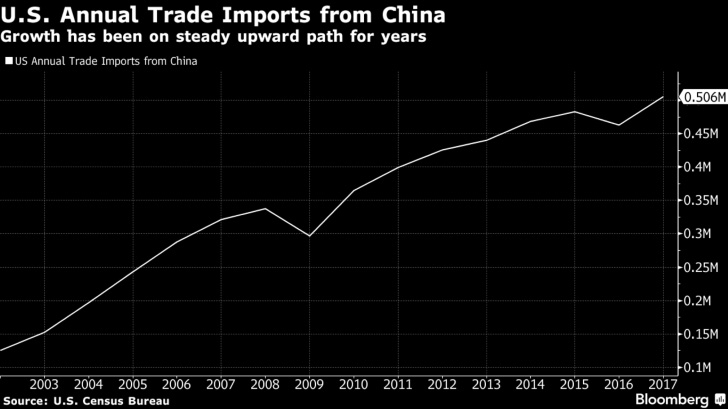
More than 65 percent of the U.S. trade deficit in goods was with China. The $375 billion deficit with China was created by $506 billion in imports. The main Chinese imports are consumer electronics, clothing, and machinery.

America only exported $130 billion in goods to China.

As this graph indicates this is not a new phenomenon. It goes back to the late 1900s.

China currently assembles the majority of Apple’s iPhones in its Shenzen, China, location by Foxconn. That company maintains factories in countries across the world, including Thailand, Malaysia, the Czech Republic, South Korea, Singapore, and the Philippines. A second company, Pegatron, is a relatively recent addition to the iPhone assembly process also in China.

High End clothing brands we all lust after really have to work hard to minimize the production costs while keeping their products “luxurious” and “high end”. China is their go to manufacturing location. Who are they?
1. PRADA
2. COACH
3. ARMANI
4. BURBERRY
5. MULBERRY
6. MARC JACOBS
7. D&G

Chinese factories manufacture winter coats, gloves, mittens and hats for consumers around the world. These factories also produce maternity clothes and infant clothes as well as wedding dresses and tuxedos. Underwear, T-shirts and slips are among the items exported from China to consumers around the world. Sports caps are also produced in China as are belts and bras.

Luggage, machinery, and furniture are also made in China.

The consequence of the outsourcing of all that manufacturing has resulted in a major loss of good paying blue collar jobs in America.

Trump is correct when he points out that both political parties stood by and did nothing as the jobs left the country.

We couldn’t stop the outsourcing but our government did nothing to train people in new jobs that are needed in the 21st century.

While Trump has accurately identified the problem he does not appear to understand the needed solution. His solution of applying tariffs will only harm the American economy by raising the cost of consumer goods.

Article I of the US Constitution vests the power to set tariffs in Congress. The president has the power to impose tariffs at his discretion only because Congress has passed laws granting him that power. If Republicans in Congress think Trump has a bunch of dumb, destructive ideas about trade, they could pass new laws that strip him of that power.

Congress is in total grid lock. They won’t do anything to counter the new tariffs.

We are headed for a trade war. The last time that happened was 1930. Smoot-Hawley Tariff Act, formally United States Tariff Act of 1930, also called Hawley-Smoot Tariff Act, U.S. legislation (June 17, 1930) that raised import duties to protect American businesses and farmers, adding considerable strain to the international economic climate of the Great Depression.

Wall Street bankers are not given to grovelling. But in June 1930 Thomas Lamont, a partner at J.P. Morgan, came close. “I almost went down on my knees to beg Herbert Hoover to veto the asinine Hawley-Smoot Tariff,” he recalled. “That Act intensified nationalism all over the world.”

Unintended Consequences

The lower income tax rates passed into law this past December seemed like a wonderful idea.  Who can object to bonuses and higher take home pay?

The U.S. stock market indexes fell sharply today (Friday, February 2, 2018) as investors digested a stronger-than-expected jobs report that stoked inflation fears.  “The details of this jobs report, especially the numbers behind the wage growth suggest that companies are competing for workers and the shortage of skilled workers is pushing up wages. The trend in inflation is ticking higher and the big question is whether the incoming Fed, which is more hawkish, will allow the economy run hotter in the short term or tighten aggressively,” said Quincy Krosby, chief market strategist, at Prudential Financial.


Investopedia: A government or economy often defines full employment as any rate of unemployment below a defined number. If, for example, a country sets full employment at a 5% unemployment rate, any level of unemployment below 5% is considered acceptable. Full employment, once attained, often results in an inflationary period. The inflation is a result of workers having more disposable income, which would drive prices upward.


The short term benefit of lower income tax rates are obvious.  It results in a bigger paycheck for almost all workers.  However, with America’s unemployment rate at 4.1% for the past four months and below 5% since November 2016 the shortage of workers along with lower corporate taxes could easily result in a horrible surge in inflation.

Many of us saw the consequences of high inflation.  In 1974 and again 1979 to 1981 we experienced inflation as high as 14.7% in a single month.  We spent using a credit card knowing that the repayment would be in cheap dollars.  Buying a home meant paying an inflated interest rate on the mortgage.  We refinanced when the rate fell.

 I have read nothing about economist’s concerns of higher inflation.  The Federal Reserve Board did not raise rates at last Wednesday’s meeting. They left its benchmark interest rate unchanged in a range of 1.25 percent to 1.5 percent, a relatively low level that the Fed said would help support continued job growth and stronger inflation.


Wow! Is the Fed correct or are stock market investors correct?  When you are working you can demand a pay raise to compensate for inflation but if you are retired inflation can destroy your retirement plans.  Roaring inflation will also destroy the party in power in Washington.

Irrational Exuberance?

The Dow Jones average broke 25,000 today.  The Dow has risen 28% in the past year and the S&P 500 has risen 21%.

“Irrational exuberance” is a phrase used by the then-Federal Reserve Board chairman, Alan Greenspan, in a speech given at the American Enterprise Institute during the dot-com bubble of the 1990s.  The stock market was on a tear.  We all know how that ended.

The dotcom bubble occurred in the late 1990s and was characterized by a rapid rise in equity markets fueled by investments in Internet-based companies. During the dotcom bubble, the value of equity markets grew exponentially, with the technology-dominated NASDAQ index rising from under 1,000 to more than 5,000 between 1995 and 2000.

What is happening in today’s stock market seems to me to be the same sort of irrational behavior.  The Dow price earnings ratio is now at 22.08 and the historical average is about 15.  But famed economist Robert Shiller indicated he was not alarmed when being interviewed on CNBC this past September.

“It’s not just a matter of low interest rates, it’s something about the American atmosphere. It’s partly the Trump atmosphere. Investors love this. I can’t exactly explain – maybe it has something to do with prospective tax cuts. But I don’t think it’s just that. It’s something deeper, and it’s pushing the American market up,” he added.

Unlike 1929, Shiller pointed out there’s not much talk about people borrowing exorbitant amounts of money to buy stocks. Plus, he noted there’s now more regulation.

I am somewhat mollified.

Black Monday Coming Soon?

October: The Month Of Market Crashes?

In finance, Black Monday refers to Monday, October 19, 1987, when stock markets around the world crashed, shedding a huge value in a very short time. The crash began in Hong Kong and spread west to Europe, hitting the United States after other markets had already declined by a significant margin. The Dow Jones Industrial Average (DJIA) fell exactly 508 points to 1,738.74 (22.61%). In Australia and New Zealand, the 1987 crash is also referred to as “Black Tuesday” because of the time zone difference.

The terms Black Monday and Black Tuesday are also respectively applied to October 28 and October 29, 1929, which occurred after Black Thursday on October 24, which started the Stock Market Crash of 1929.The events that have given October a bad name span 80 years.

They are:

  • The Panic of 1907 (October 1907)
    A financial panic threatened to engulf Wall Street, mostly owing to threats of legislative action against trusts and shrinking credit. There were multiple bank  runs and heavy panic selling at the stock exchange. All that stood between the U.S. and a serious crash was a J.P. Morgan led consortium that did the work of the Fed before the Fed existed.
  • Black Tuesday, Thursday and Monday (October 1929)
    The Crash of 1929 was bloodletting on an unprecedented scale because so many more people were involved in the market. It left several “black” days in the history books, each with their own record breaking slides.
  • Black Monday (October 1987)
    Nothing says Monday like a financial meltdown. In 1987, automatic stop-loss orders and financial contagion gave the market a thorough throttling as a domino effect echoed across the world. The Fed and other central banks intervened and the Dow recovered from the 22% drop quite rapidly.

The S&P 500 has risen from 2083.79 to 2559.47 in the past 12 months. That is a 22.83% increase. It may feel good but fast rises can also result in fast declines. Historically a significant recession has occurred about every ten years during the past 100 years. While there have been declines since the Great Recession (Dec 2007 – June 2009) none have resulted in a major impact on the economy. I suspect we are due to have another decline in the near future. My thought that could be within the next year or two.

Are you ready?

Golden Parachutes and extraordinary pay for the undeserving

Greed and incompetence are rewarded in corporate America. Just ask Robert Coury, Marissa Mayer, and John Stumpf. These are the three people I am highlighting but there are many more. A 57 cent ignition switch was not replaced in 2.6 million Chevrolet Cobalts and Saturn Ions at the price of 13 deaths.

Mylan (MYL) was already under fire for a relentless series of price hikes on a two-pack of EpiPens by 400% over seven years. The controversy badly damaged Mylan’s reputation and wiped out billions of dollars of market value. Yet Mylan still lavished former CEO Robert Coury with $98 million in pay for 2016 as he transitioned to the role of executive chairman.

Marissa Mayer leaves Yahoo with nearly $260 million. This is after she failed to make the company a success. In fact it was bought by Verizon who saved Yahoo from bankruptcy. Mayer, who will not be sticking with Verizon (VZ, Tech30) now that Yahoo and its other digital media unit AOL are being combined under one operating unit called Oath, will also receive $23 million in severance payments to walk away from Yahoo.

In 2012, John Stumpf, former CEO of Wells Fargo Bank, had total compensation of $22.87 million with a base salary of $2.8 million, $3,300,000 in cash bonuses, $12.5 million in stock granted, and $15,000 in other compensation. Stumpf retired just weeks after he was grilled by two congressional panels over the way the bank handled an alleged scam where upwards of 2 million accounts were created by employees without the knowledge of customers. The accounts were allegedly opened so thousands of employees could meet aggressive sales goals set by management. Stumpf was widely criticized for the way he handled the questioning, pushing the blame to lower-level employees and not holding upper-level executives, including himself, responsible.

Those were just three of the oligarchs that are receiving millions of dollars while the U.S. Census Bureau reported in September 2014 that: U.S. real (inflation adjusted) median household income was $51,939.

Don’t Need A Will? Think Again!


by Jane Bryant Quinn in the May 2017 AARP Bulletin

Just do it. Your heirs will thank you.

Does everybody need a Will? The straight answer is yes. That’s true even for people who think they don’t have a dime to leave to anyone. What if you were in an accident and died later of injuries, and your estate won a $l million settlement? Who gets the money?

Admittedly, that’s a little far out. You might get away without having a will if, say, you’re a renter living on Social Security with no savings. If you have savings, a pay-on-death account will pass that money to named beneficiaries when you die.
But there are hitches to any no-will scheme, says attorney Patrick Lamon of Bilzin Sumberg in Miami. To begin with, a random financ.al asset almost always turns up. Examples might be a rental deposit that’s returned or a medical reimbursement. Those checks will be made out to the deceased. How do your heirs get them cashed?

If you had a will, you’d have named an executor to cash checks, pay off creditors and distribute any money or property to your beneficiaries. Without one, your heirs will have to ask a court to appoint a personal administrator. Usually, it will appoint your surviving spouse or a child. But you risk a family fight over who should be in charge.

Some couples try to go will- free by putting everything into joint names. Joint assets pass to the other owner automatically. So do assets with beneficiary forms, such as individual retirement accounts. But something is inevitably left out typically, a car, Lannon says. Heirs would need an administrator to transfer title. Even if the joint-asset strategy works for the first death, what happens when the other spouse dies? He or she should make a will, which you both could have done from the start.

When there’s no will, state law dictates who gets the house, car, savings and other assets. Those laws vary widely. A surviving spouse might get everything in one state but only one-third in another, with the rest going to your children. If you have no children, half might go to a spouse and half to your parents.

Lawyers are the best source for reliable wills. Your lawyer will also remind you that you need a durable power of attorney and a health care proxy, so someone can manage your finances and make medical choices if you’re unable to do so yourself.

If you’re allergic to lawyers, you can find free, state-specific will forms online. In most states (not all), handwritten wills are also accepted, provided that they were witnessed properly. DIY should be better than nothing. But be careful.

Jane Bryant Quinn is a personal finance expert and the author of “How to Make Your Money Last” She writes regularly for the AARP Bulletin.

A very clever Credit Card SCAM

Credit Card SCAM-very clever PLEASE READ

This is a heads up for everyone regarding the latest in Visa fraud. Royal Bank received this communication about the newest scam. This is happening in the Midwest right now and moving across the country.

This one is pretty slick, since they provide YOU with all the information, except the one piece they want.

Note, the callers do not ask for your card number; they already have it.

This information is worth reading. By understanding how the VISA & MasterCard telephone Credit Card Scam works, you’ll be better prepared to protect yourself. One of our employees was called on Wednesday from ‘VISA’, and I was called on Thursday from ‘MasterCard’.

The scam works like this:

Person calling says – ‘This is (name) and I’m calling from the Security and Fraud Department at VISA. My Badge number is 12460, your card has been flagged for an unusual purchase pattern, and I’m calling to verify. This would be on your VISA card which was issued by (name of bank). Did you purchase an Anti-Telemarketing Device for $497.99 from a marketing company based in Arizona ?’ When you say ‘No’, the caller continues with, ‘Then we will be issuing a credit to your account. This is a company we have been watching, and the charges range from $297 to $497, just under the $500 purchase pattern that flags most cards. Before your next statement, the credit will be sent to (gives you your address). Is that correct?’ You say ‘yes’.

The caller continues – ‘I will be starting a Fraud Investigation. If you have any questions, you should call the 1- 800 number listed on the back of your card (1-800-VISA) and ask for Security. You will need to refer to this Control Number. The caller then gives you a 6 digit number. ‘Do you need me to read it again?’

Here’s the IMPORTANT part on how the scam works – The caller then says, ‘I need to verify you are in possession of your card’. He’ll ask you to ‘turn your card over and look for some numbers’. There are 7 numbers; the first 4 are part of your card number, the last 3 are the Security Numbers that verify you are the possessor of the card. These are the numbers you sometimes use to make Internet purchases to prove you have the card. The caller will ask you to read the last 3 numbers to him. After you tell the caller the 3 numbers, he’ll say, ‘That is correct, I just needed to verify that the card has not been lost or stolen, and that you still have your card. Do you have any other questions?’

After you say no, the caller then thanks you and states, ‘Don’t hesitate to call back if you do’, and hangs up. You actually say very little, and they never ask for or tell you the card number. But after we were called on Wednesday, we called back within 20 minutes to ask a question. We were glad we did! The REAL VISA Security Department told us it was a scam and in the last 15 minutes a new purchase of $497.99 was charged to our card. We made a real fraud report and closed the VISA account. VISA is reissuing us a new number. What the Scammer wants is the 3-digit PIN number on the back of the card. Don’t give it to them . Instead, tell them you’ll call VISA or Master Card directly for verification of their conversation.

The real VISA told us that they will never ask for anything on the card, as they already know the information, since they issued the card! If you give the Scammer your 3 Digit PIN Number, you think you’re receiving a credit. However, by the time you get your statement you’ll see charges for purchases you didn’t make, and by then it’s almost too late and/or more difficult to actually file a fraud report.

What makes this more remarkable is that on Thursday, I got a call from a ‘Jason Richardson of MasterCard’ with a word-for-word repeat of the VISA Scam. This time I didn’t let him finish. I hung up! We filed a police report, as instructed by VISA. The police said they are taking several of these reports daily! They also urged us to tell everybody we know that this scam is happening. I dealt with a similar situation this morning, with the caller telling me that $3,097 had been charged to my account for plane tickets to Spain , and so on through the above routine.

It appears that this is a very active scam, and evidently quite successful….

You might consider passing this on to all your family and friends.
Trump First Act is Against New Home Buyers

trump-fha-halts-fee-cuts

Just to prove that he is really for those wanting to buy their first home, Donald Trump has reversed an Obama administration effort to reduce the monthly cost for those new home owners.

The Trump administration has suspended a cut in fees on FHA-insured mortgages that had been set to take effect this month.

A reduction in the Federal Housing Administration’s annual mortgage insurance premium had been scheduled to take place Jan. 27. In one of the first acts of the Trump administration, the cut in premiums has been suspended indefinitely.

Ben Carson, the housing secretary nominee, had hinted at this move last week, during his confirmation hearing. He said that the Obama administration’s announcement of the premium cut had been “done on the way out the door” and that the cut would cost $5 billion next fiscal year. “That’s not chump change,” he said, “so certainly, if confirmed I’m going to work with the FHA administrator and other financial experts to really examine that policy.”

For most borrowers buying homes with down payments of less than 5 percent, the monthly mortgage insurance payments will remain $141.67 a month for a $200,000 loan. It would have fallen to $100 a month.

This action is the absolute opposite of what Trump promised if elected.