Are Rich People the Best Managers for the United States government?

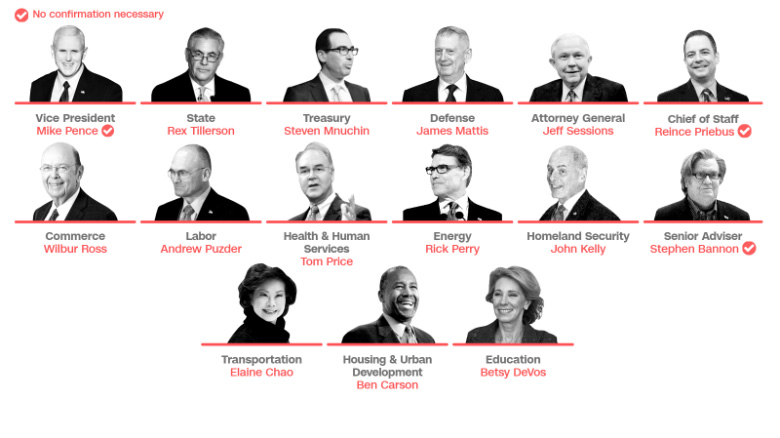
trump-team-dec-15-2016-2Will a group of ultra-wealthy people holding high offices in the Donald Trump administration be a benefit to America?

We will know the answer after January 20, 2017.

Rex Tillerson, CEO of Exxon, holds just over 2.6 million Exxon shares. But he actually only technically owns 611,087 outright, or nearly $57 Million worth. The rest are so-called restricted stock units. How rich is Rex Wayne Tillerson? Rex Wayne Tillerson net worth: $150 Million.

Steven Mnuchin is a former partner at Goldman Sachs, heads up Dune Capital. The investment firm put together a holding company in 2008 — attracting investors like J.C. Flowers, a George Soros investment fund and Paulson & Co. His net worth is around $40 million.

Senator Jeff Sessions has an average net worth of $7.52 Million as of 2014.

Wilber Ross has an estimated wealth estimated at $2.5 Billion as of December 2016 according to Forbes magazine.

Andrew Puzder, chief executive of CKE Restaurants, the parent company of Hardee’s and Carl’s Jr. is worth at least $25.6 Million.

Congressman Tom Price’ net worth is $13.0 Million.

Rick Perry, former Texas governor, total net worth is often estimated to be about $3 Million.

Steven Bannon net worth is $10 Million.

Elaine Chao, wife of Senator Mitch McConnell, net worth is at least $3 Million.

Dr. Ben Carson has a reported net worth of $10 Million.

Betsy DeVos is married to Dick DeVos and is the daughter-in-law of Richard DeVos, the founder of Amway with an estimated net worth of $5.1 Billion.

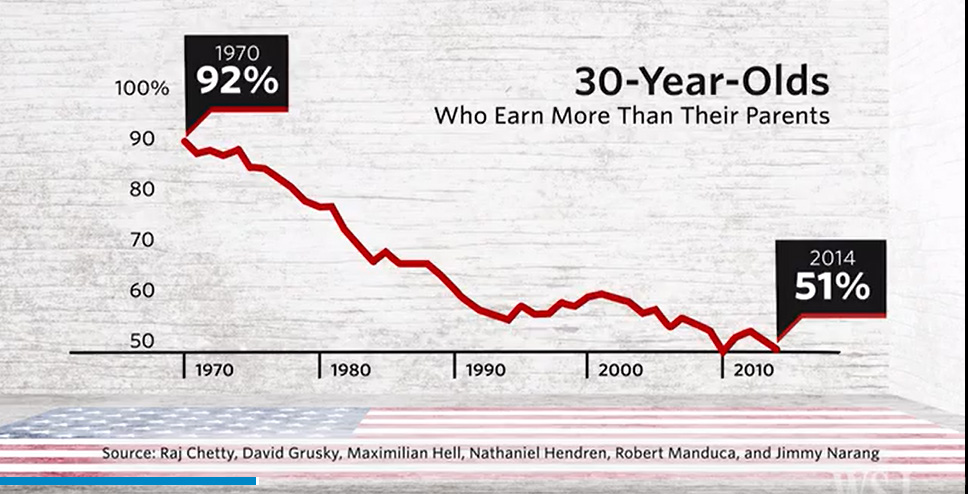
Barely Half of 30-Year-Olds Earn More Than Their Parents

Sorry, Young People: You Probably Won’t Make as Much Your Parents Did

As wages stagnate in the middle class, it becomes hard to reverse this trend

From a report in the Wall Street Journal dated December 8, 2016.   Barely half of 30-year-olds earn more than their parents did at a similar age, a research team found, an enormous decline from the early 1970s when the incomes of nearly all offspring outpaced their parents. Even rapid economic growth won’t do much to reverse the trend.

30-year-olds-earning-less-than-their-parents

Wage stagnation has taken heavy toll since 1970s

“My parents thought that one thing about America is that their kids could do better than they were able to do,” said Raj Chetty, a prominent Stanford University economist who emigrated from India at age 9 and is part of the research team. “That was important in my parents’ decision to come here.”

What’s more, even if President-elect Donald Trump fulfills his promises of rapid economic growth, the trend won’t be reversed significantly. Even if income levels grew 3.8%, the percentage of 30-year-olds who out-earn their parents would bump up to just 62%, the Wall Street Journal reports.

The study was conducted by economists and sociologists at Stanford, Harvard and the University of California. They used tax and census data to compare the earnings of 30-year-olds starting in 1970 to that of their parents.

What the report does not do is explain why wages are stagnant. I will give you my take on this horrible reality. I did earn more than my parents but only because of inflation.

When I married in 1969 my salary was $10,000 per year. According to the United States bureau of Labor Statistics your income today, based upon the CPI Inflation Calculator, that salary equates to $65,866.  My father never earned that inflation adjusted salary.

There have been many reasons for the stagnant salaries.  Three come to mind almost immediately. 

First management earned ten to twenty times the average income of most employees in the earlier parts of the 20th century.  Today management earns 200 to 300 times the average income of most employees.

Second many jobs have been outsourced other countries.  That has resulted in more potential employees seeking the remaining jobs.  Thus with more people looking for work employers can push down the pay they have to offer.

Third, many jobs have been automated thanks to artificial intelligence (AI), and computerization.   Have you seen the inside of an auto manufacturing facility?  Automation has eliminated many jobs from welding to painting.  Warehouses are now so automated that less material handlers are needed.  Office workers, I am one of them, now have computers that perform many of the manually performed functions that were done using typewriters and spreadsheets. That too reduced manpower needs. Less manpower translates to an oversupply of workers and that translates to lower pay. It is all about supply and demand.

It is unlikely that any government of any political party will change this trend.  I hope I am wrong.

How Rich do you have to be?

Wells Fargo CEO Stumpf retires but won’t receive severance pay. That headline reads nicely but it does not reveal all the facts. He will receive more than $100 Million in vested stock and a 401(k) exceeding $24 Million. Forbes magazine reports that “Even though he left on a low, John Stumpf, former CEO of Wells Fargo, will take about $133.1 million into retirement. ’’

What does a man do with $100 Million? I understand that as CEO of Wells Fargo he headed the second largest banking company in the United States but does that entitle him to earn so much money that his family will live in luxury for generations?

Take a look at the board of Directors of Wells Fargo or any other giant corporation and you will see that those directors are almost always part of a very wealthy economic club that sustains their way of life and works to keep their average employees at the same low pay that is 1/20 to 1/30 of theirs.

Stock holders don’t care as long as their shares continue to appreciate and they receive their dividend checks.

Our free enterprise society was built on the right to earn as much money as you can regardless of who remains in poverty and who does not have the money to provide their children with a good college education.

 Forbes Billionaires: Full List Of The 500 Richest People In The World 2016 tells me that we have a world where the rich get richer and the poor get poorer. Neither Donald Trump nor Hillary Clinton will change that reality.

You Don’t Have to Be Rich to Obtain Tax Breaks

Do you own a home and have a mortgage? All the interest you paid on that mortgage this year is an itemizable deduction on next year’s income tax report you will file in 2017. That one single item is usually the primary basis for having a total of deductions that will exceed the standard deduction. Without that interest deduction your total itemizable list will probably fall short of the amount needed to itemize all your expenses.

Are you going to say to yourself “I feel an obligation to pay more to help support the government.” Or are you going to itemize your deductions to lower your income tax liability? I am guessing you will itemize and pay the lower amount of taxes.

If you buy municipal bonds in your state issued by any municipality or your state government the interest you earn on those bonds is not subject to any federal income tax. Will you list the interest as coming from municipal bonds or will you list the interest as not coming from those sources and pay the taxes that would apply? I am guessing you will claim their tax free status.

The maximum rate of tax on qualified dividends is 0% on any amount that otherwise would be taxed at a 10% or 15% rate. Will you also not take advantage of that benefit?

Why is it inappropriate for Donald Trump to take all the deductions available to him?

Of course $916 Million is a big right-off. Did Donald Trump do something illegal? No. I have never heard anyone say they have a moral responsibility to pay more taxes than they are legally required to pay.

Peter Schiff and other Doomsday Stock Market Predictors

Peter SchiffThis advertisement has been appearing on many of the web sites I visit. Included is my daily visit to undergroundweather.com where it prominently appeared in two locations of the site’s main page.

There is a flourishing industry of financial doomsday predictors who make their living preying on the fears of smaller investors who fear losing their hard earned estate that provided them (or will provide them) a retirement nest egg.

Before you respond to the doomsayers it would be worth your time to investigate their backgrounds. Thus I researched and found the following about Peter Schiff simply by entering his name in a Google search. The first option that appeared was “peter schiff track record on predictions”

The first item:
http://globaleconomicanalysis.blogspot.com/2009/01/peter-schiff-was-wrong.html
in part the web site reads as follows:

Schiff’s Overall Thesis
• US Equity Markets Will Crash.
• US Dollar Will Go To Zero (Hyperinflation).
• Decoupling (The rest of the world would be immune to a US slowdown.
• Buy foreign equities and commodities and hold them with no exit strategy.

Schiff was correct about point number 1 above. The US equity markets crashed. That was a very good call. Unfortunately, his investment thesis centered on shorting the dollar in a hyperinflation bet, and buying foreign equities rather than shorting US equities.

Furthermore, Schiff made no allowances for being wrong and had no exit strategy whatsoever.

What happened in 2008 was that foreign equities sold off much harder than US equities, and a strengthening US dollar compounded the situation.

In other words, Schiff failed where it matters most: Peter Schiff did not protect his client’s assets. Let’s take a look how, and more importantly why, starting with charts
Read more at http://globaleconomicanalysis.blogspot.com/2009/01/peter-schiff-was-wrong.html#TVr1LG1LChQ9gxfc.99

The second item:

This youtube video is a compilation of Peter Schiff predictions. As you watch look at the dates that appear on screen.
Published on Nov 10, 2014

In 2009, Peter Schiff started predicting gold would go up to $5000 an ounce. At the same time, he predicted gold & the Dow Jones would soon be at the same level (eg, gold $5000, the Dow 5000.) Gold hit a record high of $1900 in August 2011. A year later, gold prices started plummeting. Schiff completely failed to foresee gold prices would eventually drop by over 35%.

For some context, on June 9, 2010 gold was $1257 an ounce. More than 4 years later, on November 10, 2014, gold was $1151 an ounce. During that same period, Dow Futures went from 10,674 to 17,613. Yet, all throughout, Schiff continued telling investors to buy gold & was very critical of any investment adviser who didn’t questioned his track record on gold prices.

During his TV appearances Schiff often tells people to go to YouTube to check his record. So here’s a compilation of Schiff’s various predictions over the past 5 years as gold prices were rising & falling & stock market prices fell, then soared to record highs.

The third item:

http://www.bloombergview.com/articles/2015-01-05/market-forecasts-to-ignore-in-2015
Market Forecasts to Ignore in 2015
in part reads:
Stock-Market Crash: There have been so many erroneous calls for a stock-market crash that it’s hard to choose which deserves special mention. But I am going to give you two that merit attention: The first comes from Chapman University professor Terry Burnham, who predicted Dow 5,000 before Dow 20,000. He technically hasn’t been proven wrong yet, but during the years he has repeated this forecast, the market has gained about 40 percent. That makes him wrong enough in my book. The second was this article in Fortune, “Why the bull market could end tomorrow.” It was filled with forecasts explaining why “smart prognosticators” and “market timing precisionists” believed the top was just about in. That was some 2,000 points ago for the Dow Jones Industrial Average and 200 points for the Standard & Poor’s 500 Index.

Gold: I almost feel bad pointing out how awful the gold forecasts have been. But special mention must go to the loudest and highest forecast, and that means Peter Schiff of EuroPacific Capital. Last April, Schiff made the bold prediction that the “Federal Reserve’s quantitative-easing program will push gold to $5,000 an ounce.” How did he do? The shiny yellow metal began the year in the low $1,200s, rallied to $1,400, before plunging to $1,150. It closed 2014 just under $1,200 as the Fed’s program of QE was ending. Gold remains 80 percent or so lower than Schiff’s target.
Recalling the George W. Bush Presidency

Remembering one of America’s worst presidents!

It appears that the folks in South Carolina have forgotten some major events that occurred when George W. Bush was president. Not all were his direct fault but he and his administration, in my opinion, did not take sufficient precautions.  I did not have to refer to any publication or website for these occurrences. They are all clearly in my mind.  They should be in yours too. 

  1. September 11, 2001 attack on the World Trade Center in New York City did occur eight months after he was inaugurated into office. The prior administration had warned of a possible terrorist attack.
  2.   Hurricane Katrina occurred on the morning on August 29, 2005. When the storm made landfall, it had a Category 3 rating on the Saffir-Simpson Hurricane Scale–it brought sustained winds of 100–140 miles per hour–and stretched some 400 miles across the Gulf coast. The History Channel says “Officials, even including President George W. Bush, seemed unaware of just how bad things were in New Orleans and elsewhere: how many people were stranded or missing; how many homes and businesses had been damaged; how much food, water and aid was needed. Katrina had left in her wake what one reporter called a “total disaster zone” where people were “getting absolutely desperate.” The Bush administration was widely criticized for its slow response to the disaster.
  3. The invasion of Iraq occurred in the spring of 2003, the United States invaded Iraq in order to overthrow leader Sadaam Hussein (1937-2006), whose regime was accused of supporting international terrorist groups and possessing large caches of weapons of mass destruction (WMD). No WMD were found. 4,486 U.S. soldiers died in Iraq.
  4. He began his presidency with a federal budget surplus; however, factors such as the enormous cost of fighting two wars (Afghanistan and Iraq) and the broad tax cuts led to annual budget deficits starting in 2002.
  5. The 2008 financial crisis was the worst economic disaster since the Great Depression. The president was mostly absent from the efforts to save the economy. Instead it was his Treasury Secretary, Henry Paulson, who made requests to congress for funds to support the banking industry.

Perhaps the above listing of George W. Bush’s major administration failures would be a reason to suspect another Bush would not be welcomed to the White House.

Goodbye to America’s Middle Class

Forget about the poor and the rich for just a few minutes. Think about the middle class. The range of the middle class varies by state. According to Pew Research Center in the middle class shrunk in every state between 2000 and 2013. The highest median income for that group was $72,483 in Maryland and at the low end in Mississippi it was $37,963.

Here is the real shocker. Household median income reached $48,474 in 2012 but in adjusted for inflation dollars Americans reached an income of $48,655 in 1978. The median income in 1978 was $13,234.

Pew Research writes: “The hollowing of the American middle class has proceeded steadily for more than four decades. Since 1971, each decade has ended with a smaller share of adults living in middle-income households than at the beginning of the decade, and no single decade stands out as having triggered or hastened the decline in the middle.

Based on the definition used in their report, the share of American adults living in middle-income households has fallen from 61% in 1971 to 50% in 2015.”

Which presidential candidate is likely to change this situation? The answer is no one. While Bernie Sanders rails against big business he has not offered any solutions.

America’s 20 richest people have more money than these 152 million people

This article appeared on End Of The American Dream and MarketWatch.

“America’s 20 wealthiest people — a group that could fit in one Gulfstream G650 jet — are now worth $732 billion, which means they have more wealth than the 152 million people who make up the least wealthy 50% of U.S. households, according to a report released Wednesday by the Institute for Policy Studies. What’s more, the “Forbes 400” wealthiest individuals in the U.S. now have a net worth of $2.34 trillion.”

So when Bernie Sanders says almost the very same thing you think “Well he is running for president and this is his hook.”

I ask you now what do you think?

Just yesterday the Los Angeles Times posted the following:

“The nation’s income gap increased 10% over the past 20 years, and roughly twice that rate for people in their prime earning years, according to a new study.

The income gap swelled 21% for those between the ages of 35 to 44, and 17.6% for people aged 45 to 54, according to the analysis by financial website Bankrate.com. The study analyzed the period from 1992 to 2012.

The study is the latest to highlight rising income inequality, and is troubling because it shows the dichotomy worsening for people in their key earnings years.

“The prime earning years for most people — when they’re in their 30s and 40s — are also the most important when it comes to setting up a future position on the wealth spectrum,” according to the study. “While some are quickly advancing toward becoming rich, others are just as quickly falling behind.”

According to the study, the income gap is widest among people 65 and older, although it grew only 3%, the slowest rate for any age group over the last 20 years.

Citing data from the Census Bureau, the bottom fifth of U.S. households earn an annual average of $11,490, the study said.

The next fifth take in $29,696. The middle tier earns $51,179 and the next group takes home $82,098. The top fifth earns $181,905, and the top 5% earns $318,052.”

The problem is that neither Hillary Clinton nor any of the GOP presidential candidates have even opened a dialog on this issue.

Thus even though there is more than enough data, none of the leading candidates want to face the unpleasant reality that the average American family is growing poorer.

Why should you vote in a presidential race when your needs are not even part of the discussion? Wait, there is one candidate who has brought this topic to the forefront.

The Countries with the Most Millionaires

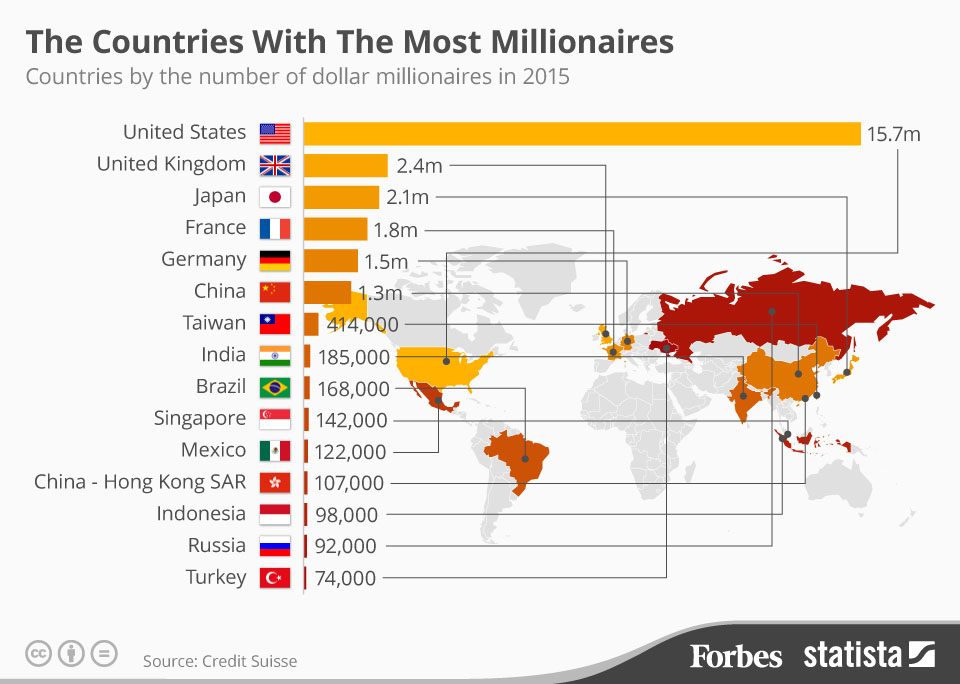
Senator Bernie Sanders is correct when he says that 1% of our citizens control more wealth than the bottom 90%. A new report posted on cnn.com references an English company named Oxfam estimates that the richest 1% will have as much wealth as the other 99% combined by next year. Just Google these words: “does 1% of Americans own 90% of the wealth” and you will find numerous web sites that confirm the Sanders contention. The United States is the overwhelming home of millionaires.

From Forbes Magazine date October 15, 2015

“The United States has the world’s biggest millionaires club by a huge distance. No other country comes even close to matching it. According to Credit Suisse Global Wealth Report, the U.S. was home was home to 41% of the world’s millionaires in 2014, and its share grew by 46% in 2015.”

“Wealth has risen has risen in the U.S. for the seventh year in succession and the U.S. millionaire population now stands at 15/7 million, according to the report. The United Kingdom comes a distant second at 2.4 million, while Japan rounds of top three countries with a population of 2.1 million.”

Countries with the most millionaires

This situation probably explains the ever higher costs of living in NYC, San Francisco, and Los Angeles.

So should we vote for Mr. Sanders based upon these facts? My response: 1) what would he do to change this reality? 2) Is this situation a bad thing?

GE says it may move up to 500 jobs overseas

When Donald Trump said “we-are-led-by-veryverystupidpeople” you probably thought he was exaggerating.  The GOP lead congress refused to re-authorize the U.S. Export Import Bank on the grounds that it was helping companies that don’t need any help.  This is the consequence of that very stupid decision.

By ASSOCIATED PRESS

General Electric LogoGeneral Electric Co. may move about 500 American jobs overseas because Congress did not renew a government program that allows foreign companies to borrow money to buy U.S. products, the industrial conglomerate said Tuesday.

Authorization for the U.S. Export Import Bank was not approved by Congress, forcing it to stop lending July 1. Foreign companies use the agency to buy expensive U.S. products when bank loans are not possible.

As a result, GE says 100 jobs from a Houston plant that makes gas turbines will move to Hungary and China in 2016. The Fairfield, Connecticut, company says those countries have lending options in place for customers.

“We do not make today’s announcements lightly and in fact, have done everything in our power to avoid making these moves at all, but Congress left us no choice when it failed to reauthorize the Ex-Im Bank this summer,” said John Rice, GE’s vice chairman.

Another 400 jobs could be created in France instead of factories in South Carolina, Maine and New York if the company wins projects it is bidding on. The projects require financing, and the export credit agency in France has agreed to provide it.

GE said it’s bidding on projects valued at $11 billion that require export financing. It said it has reached agreement with the French export credit agency to provide a line of credit for global power projects. GE said the line of credit will initially support potential orders in international markets that include Indonesia.

To access the required export credit for its customers of its aeroderivatives turbines, GE will move its final assembly from the U.S. to Hungary and China. As related projects are bid and won in these two product lines, GE said it will move approximately 500 jobs from Texas, South Carolina, Maine and New York to France, Hungary and China.

The embattled and little-known banking agency has been at the center of a fight between tea party Republicans who say it’s not needed and Democrats and some Republicans — backed by manufacturers and large businesses — who say it promotes trade and helps create jobs.

The Ex-Im Bank’s principal role is to guarantee commercial bank loans to foreign businesses and governments to buy U.S. products. U.S. taxpayers would be responsible for a loan if a company operating overseas defaults on a bank loan used to buy a product made by a U.S. company.

Copyright © 2015, Los Angeles Times