Bernie Sanders’ Labor Day Index

This is an OP-ED article in today’s Los Angeles Times. It is posted under Senator Bernie Sanders name. The data is not news to me but might be news to you.

Bernie Sanders


Amount a full-time worker must earn per hour to afford the average two-bedroom apartment in Los Angeles:

$27.38

Factor by which this exceeds the city’s current $9-an-hour minimum wage

3.04

______


Number of manufacturing jobs in the United States on Jan. 1, 2000

17.3 million


Number last year:

12.1 million

______


Percentage change in annual worker compensation from 1978 to 2013:

+10.2

Percentage change in annual CEO compensation from 1978 to 2013:

+937

______


Average CEO pay in the S&P 500:

$13.8 million

Amount of the top-compensated CEO,

David Zaslav of Discovery Communications,

was paid in 2014:

$156 million

Median salary at Discovery Communications in 2014:

$80,000

______


Median weekly earnings for full-time workers in 2015:

$801

For female full-time workers:

$726

______


Real national unemployment rate:

10.3%

(This is from the BLS Table A15, U6 data, 8-31-15)


For young White high school graduates:

33.8%


For young African American high school graduates:

51.3%

______


Percentage of the entire wealth of the United States owned by the top 1%

41


Percentage owned by the bottom 60%:

2

______


Percentage of Americans without health insurance for at least part of the year 2013:

11.7

Percentage of Canadians:

0

Percentage of Israelis:

0

______


Number of countries in the Organization for Economic Cooperation and Development (OECD) that mandate some form of paid family leave:

33

Number of OECD countries that do not:

1


Percentage of U.S. workers without access to paid family leave:

87

______


Number of American children living below the poverty line is 2012:

24.2 million

______


Percentage of Americans who still believe in the American dream:

64

When Everything Was So Great!! ??

From Dutchman a HuffPost community moderator on 7-29-2015                                   

This is for the “everything was great when Republicans were president” crowd.

Here is my updated (as of market close last Friday) analysis of the inflation-adjusted S&P 500 returns.

Source data is available from Standard and Poors (www.standardandpoors.com) and the Bureau of Labor Statistics ( href=”http://www.bea.gov“>www.bea.gov)

Peak to Valley loss for the S&P 500 from October, 2007 through January, 2009: -50.9%. Who was president then?

Cumulative return to the S&P 500 since February, 2009: +111%
And then there’s this: Rank of the best performing presidenti­­al administra­­tion for the annualized return of the S&P 500 “under their watch”:

Clinton: 14.26%

Eisenhower : 13.38%

Obama: 13.15%

Kennedy: 11.10%

Bush I: 11.01%

Truman: 9.99%

Reagan: 9.51%

Roosevelt: 8.67%

Johnson: 7.16%

Carter: 1.20%

Nixon/Ford : −2.16%

Bush II: −5.18%

Hoover: −17.33%

Amazing! The president with the 3rd best annualized real return of the S&P 500 “under his watch” since the CRSP records begin in 1926 is OBAMA!!!!!  And he did much better than the GOP hero, Mr. Reagan did.

More importantly, in aggregate and individual­­ly, Republican presidents are TERRIBLE for the S&P 500.

Annualized, real return of the S&P 500 since 1926 under Democratic presidenci­­es: 9.57%

Annualized, real return of the S&P 500 since 1926 under Republican presidenci­­es: 3.85%

Moreover, 8 of the 10 WORST YEARS for the S&P 500 occurred under Republican Presidents .

The worst years are:

1931: -43.35% (Hoover)
2008: -37.00% (Bush II)
1937: -35.02% (Roosevelt )
1974: -26.45% (Nixon)
1930: -24.0% (Hoover)
2002: -22.1% (Bush II)
1973: -14.67% (Nixon)
2001: -11.87% (Bush II)
1941: -11.58% (Roosevelt )
1957: -10.79% (Eisenhowe­­r).

And then there’s this:  the ONLY presidents to ever see the S&P 500 lower after they left office than when they came in were Republicans.

Facts. You gotta love them. Unless you’re a conservative.

Technology is Impacting our Buying Habits

Say Goodbye to Shopping Malls

America, no the entire world, is experiencing a dramatic change in the retail industry. It is very apparent in the United States. Americans are not shopping at malls as much as they have in past years. Macy’s department stores is planning to close 14 of their 800 locations in 2015. That is a company that has been a success. JC Penney plans another 40 closings in 2015. Wet Seal has announced it is closing 2/3 of their stores in 2015.

BloombergBusinessweek says “While malls stumble, mobile shopping is expected to grow 800% through 2015.”

In 2014 a long list of stores were closed. That includes 339 Sears, 170 Staples, 150 Office Depot, and 33 JC Penney. Not the only reason but a major cause has been on line sales. Many of the stores themselves have opened sales web sites.

Amazon has played a prominent role in the structural shift away from brick-and-mortar retail, and it may lay waste to several other retailers in the years to come. Without the cost burden of physical stores, Amazon can price below traditional rivals and drive recurring traffic online. But it is not the only on line business that has changed the retail climate. eBay, Etsy, are just the two other on-line businesses that I know. Want to buy anything from Hewlett Packard? They sell all of their computers, printers, and supplies on line. Meanwhile Alibaba (the Amazon knockoff) is booming in China.

While I still shop at Costco and they have seen their sales increase, they too sell many of their products on line.

Sorry old timers, this is all part of the 21st century.

The United States is Home to Millionaires

This is one topic that will not be discussed in the campaign for president in 2016. The U.S.A. is a home for millionaires. There are more in this country than any other nation in the world. The opportunity to become a millionaire is the reason so many people look for every way to enter this nation.

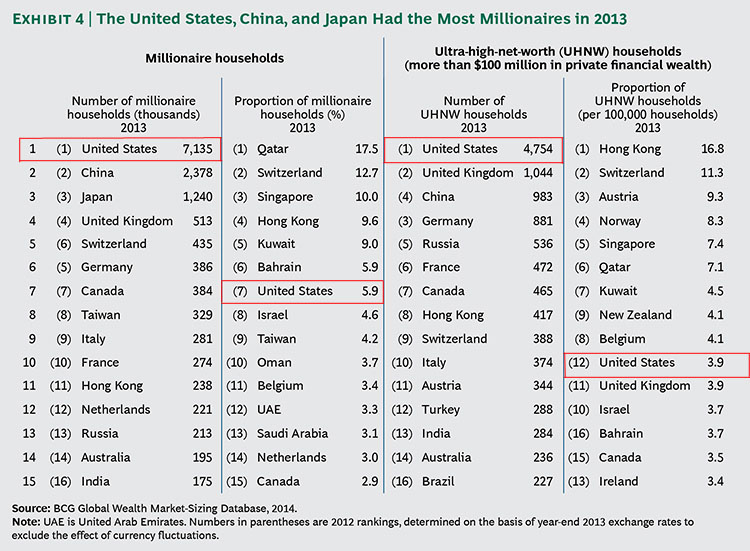
The Boston Consulting Group (BCG) posted this interesting article about wealth in the world this past June titled “Global Wealth 2014: Riding a Wave of Growth.”

Even as the income discrepancy between the average American and the top income earners has become more extreme the number of millionaires around the world has risen to new heights the numbers of millionaires in the United States has grown even more. BCG states: “As the debate over the global polarization of wealth rages on, one thing is certain: more people are becoming wealthy. The total number of millionaire households (in U.S. dollar terms) reached 16.3 million in 2013, up strongly from 13.7 million in 2012 and representing 1.1 percent of all households globally.”

MIllionaires Chart

The number of millionaires in the United States exceeds the total of the next 13 nations combined with 7,135. Among the ultra-rich (families with $100 million in wealth) shown in the third column above, once again the United States has more than four times as many as the next nation (United Kingdom).

The inflow of immigrants to the United States isn’t just the poor. The wealthy are doing their very best to grab a piece of the American pie. Businessweek had an article in the October 20-26 issue about Arcadia, California – a suburban community of Los Angeles that has been inundated with wealthy Chinese buying homes and building mansions there.

Arcadia CA

There is a possibility that you can be a millionaire in the United States. It’s easier than almost any other country in the world. So that’s why we won’t be changing the laws pertaining to millionaires. We won’t penalize you for becoming one too! It is what makes America great. It’s everyone’s goal. You don’t have to know anyone to make it happen. Anyone can be the next Steve Jobs, Bill Gates, or Sara Blakley.

The Richest and Poorest Members of Congress

Are there any poor members of congress?  How do you define rich?

The Washington Post listed the top 50 members.  The poorest in the group has assets totaling over $6 million.

This data was complied by Roll Call (http://www.rollcall.com) based on reports that members must file.

The ten richest:

  1. Rep. Darrell Issa. The California Republican tops the list for the second year in a row, with a net worth of $357 million. Source of his wealth is not disclosed.
  2. Rep. Michael McCaul. The Texas Republican is worth $118 million, according to his financial disclosure. Roll Call says his wealth is connected to his wife, Linda, the daughter of the founder of broadcast giant Clear Channel Communications.
  3. Rep. John Delaney. The Maryland Democrat’s net worth soared 64 percent from 2012 to 2013, to nearly $112 million, financial disclosure forms show. He made his fortune as chief executive of two publicly traded finance companies.
  4. Sen. John D. Rockefeller IV. The West Virginia Democrat — and heir of oil scion John D. Rockefeller — had a reported net worth of $108 million at the end of 2013.
  5. Sen. Mark R. Warner. The Virginia Democrat made his pile in telecommunications. His reported worth was $95 million.
  6. Rep. Jared Polis. The Colorado Democrat, with a listed worth of $74 million, has a blind trust and investments in senior housing in Japan and the world’s only aquaculture venture capital firm.
  7. Sen. Richard Blumenthal. The Connecticut Democrat reported a net worth of $62 million, which includes real estate holdings in New York and in Brazil.
  8. Rep. Scott Peters. The California Democrat made his cash representing businesses and government agencies as an environmental attorney. His wife made hers at a private equity firm established by her father. Their net worth: $45 million.
  9. Sen. Dianne Feinstein. The California Democrat and her husband, a private equity magnate, had a listed net worth of $44 million.
  10. Rep. Suzan DelBene. 2013 was a good year for the Washington Democrat, whose net worth rose more than 50 percent, to $38 million, primarily through the rise of Microsoft stock.

The ten poorest:

  1. David Valadao. -$4.10 million. Valadao, a California Republican who bears the dubious distinction of being poorest this year, actually lists more than $1 million in assets. The dairy farmer reports only three assets: his two family farms with a combined worth of at least $1.25 million and a bank account worth more than $1,000. His $5.35 million in liabilities are all farm-related, including a $1 million mortgage and multimillion-dollar lines of credit on the farm, its operating herd and animal feed.
  2. Alcee L. Hastings. -$2.23 million. A lawyer and former federal judge, Hastings is still paying off legal fees of more than $2 million that he incurred in a trial on charges of bribery while he was serving on a U.S. district court. The Florida Democrat was acquitted of the charges in 1983, but a federal panel later concluded he had lied and fabricated evidence. By 1989, he was removed from the court after votes by the House and Senate. He holds one other liability, a mortgage of more than $100,000 on his personal home that is comparable to the median home value for his district — $106,000.
  3.  Debbie Wasserman Schultz. -$1.04 million. The chairwoman of the Democratic National Committee, Wasserman Schultz has spent most of her career in political office, starting as a state legislator in her home state of Florida. She has two mortgages with a combined worth of at least $750,000, plus $350,000 in home equity and personal loans. She also carried more than $50,000 in credit card debt in 2012. Her assets include a spouse-held $100,000 stock in the community bank where her husband works and several small bank accounts including college savings plans for her children.
  4. Howard “Buck” McKeon. -$943,000. Before Congress, McKeon helped operate his family’s now-closed chain of Western-style clothing stores. The California Republican owes more than $1 million combined on two mortgages for homes in his district and Alexandria, Va., and has only $67,000 in assets composed of bank and life insurance accounts.
  5. Rubén Hinojosa. -$808,000. A family business in food-processing that filed for bankruptcy because of the recent economic recession, according to the Texas Democrat, has left him with an arbitration award of at least $1 million owed to a creditor, an additional $250,000 in business debt, and $35,000 in city and county property taxes overdue from 2010.
  6. Steve Israel. -$795,000. Israel has a mixture of mortgages, credit card debt and assumed student loans from his children that make up more than $800,000 in liabilities. The New York Democrat also has a small bank account worth less than $1,000 and a retirement account worth more than $15,000.
  7. Mike Quigley. -$765,000. The Illinois Democrat has a mix of mortgages and credit card debt totaling more than $800,000. But he also has a college savings plan for his children and a pension left over from his service on the Cook County Board of Commissioners.
  8. Joseph Crowley. -$762,000. Democratic House Caucus Vice Chairman Crowley has $850,000 in liabilities from two mortgages and a home equity line of credit. The New York Democrat counts a small retirement plan and some college savings plans for his children under his assets.
  9. Pedro R. Pierluisi. -$674,000. The resident commissioner for Puerto Rico’s wife’s consulting firm is listed as an asset worth at least $1 million, but some multimillion-dollar mortgages on his San Juan homes drops Pierluisi’s net worth into negative territory.
  10. Chaka Fattah. -$650,000. The Pennsylvania Democrat has $800,000 in mortgages and home equity loans for three properties in the greater Philadelphia area. But he also has a state retirement account worth at least $50,000 and GE common stock worth at least $100,000.

While these members appear to be in the most dire straits on paper, an alternative calculation would peg the seven members who report having no assets as the poorest. These seven members are: Democrats Kyrsten Sinema of Arizona, Gwen Moore of Wisconsin, John Conyers Jr. of Michigan and Gregory W. Meeks of New York, and Republicans Rick Crawford of Arkansas, Duncan Hunter of California and Louie Gohmert of Texas. These members do not have enough liabilities to drop into the 10 poorest, but their net worths range from -$15,000 (Sinema) to -$610,000 (Gohmert).

Democrat Debbie Stabenow of Michigan is the poorest member of the Senate, with a net worth of -$585,000. Fellow Democrat Mark Pryor of Arkansas is the senator with the smallest amount of assets; he has a bank account worth $1,000 to $15,000 and one for his children worth less than $1,000.

A Progressive Estate Tax in the United States

This idea won’t become law but it should.

By:  Sen. Bernie Sanders (I-Vt.)

Huffington Post

Monday, September 8, 2014

The founders of our country declared their independence from what they viewed as a tyrannical aristocracy in England. More than two centuries later, today’s tyrannical aristocracy is no longer a foreign power. It’s an American billionaire class which has unprecedented economic and political influence over all of our lives.

Unless we reduce skyrocketing wealth and income inequality, unless we end the ability of the super-rich to buy elections, the United States will be well on its way toward becoming an oligarchic form of society where almost all power rests with the billionaire class.

In the year 2014, the U.S. has by far the most unequal distribution of wealth and income of any major country on earth. This inequality is worse than at any time in our country’s history since 1928. Today, the top 1 percent owns about 37 percent of the total wealth in this country. The bottom 60 percent owns only 1.7 percent of our nation’s wealth.

At a time median family income is $5,000 less than it was in 1999, the net worth of the top 400 billionaires in this country has doubled over the past decade. The top 1 percent now owns more wealth than the bottom 90 percent of Americans and one family, the Walton family of Wal-Mart, owns more wealth than the bottom 40 percent of Americans. 

In terms of income, the top 1 percent earns more than the bottom 50 percent. Since the Great Recession of 2008, 95 percent of all income gains in the U.S. have gone to the top 1 percent. While the rich have become even richer, more Americans are living in poverty than at any time in our nation’s history. Today, half of Americans have less than $10,000 in savings. We have the highest rate of childhood poverty – 22 percent – than any major country on earth.

More than a century ago, President Theodore Roosevelt recognized the danger of massive wealth and income inequality and what it meant to the economic and political well-being of the country. In addition to busting up the big trusts of his time, he fought for the creation of a progressive estate tax to reduce the enormous concentration of wealth that existed during the Gilded Age.

“The absence of effective state, and, especially, national, restraint upon unfair money-getting has tended to create a small class of enormously wealthy and economically powerful men, whose chief object is to hold and increase their power,” the Republican president said. “The really big fortune, the swollen fortune, by the mere fact of its size acquires qualities which differentiate it in kind as well as in degree from what is passed by men of relatively small means. Therefore, I believe in … a graduated inheritance tax on big fortunes, properly safeguarded against evasion and increasing rapidly in amount with the size of the estate.”

Roosevelt spoke those words on Aug. 31, 1910. They are even more relevant today.

A progressive estate tax on multi-millionaires and billionaires is the fairest way to reduce wealth inequality, lower our $17 trillion national debt and raise the resources we need for investments in infrastructure, education and other neglected national priorities.

I will shortly introduce legislation that will:

• Call for a progressive estate tax rate structure so that the super wealthy pay their fair share of taxes. The tax rate for the value of an estate above $3.5 million and below $10 million would be 40 percent. The tax rate on the value of estates above $10 million and below $50 million would be 50 percent, and the tax rate on the value of estates above $50 million would be 55 percent.

• Include a billionaire’s surtax of 10 percent. This surtax on the value of estates worth more than $1 billion would currently apply to fewer than 500 of the wealthiest families in America worth more than $2 trillion.

• Close estate tax loopholes that have allowed the wealthy to avoid billions in estate taxes. Some of the wealthiest Americans in this country have exploited loopholes in the tax code to avoid paying an estimated $100 billion in estate taxes since 2000. My bill would close those loopholes.

• Exempt the first $3.5 million of an estate from federal taxation ($7 million for couples), the same exemption that existed in 2009. Under this legislation, 99.75 percent of Americans would not pay a penny in estate taxes. 

This legislation would exempt more than 99.7 percent of Americans from paying any estate tax while ensuring that the wealthiest Americans in our country pay their fair share.

I agree with former Labor Secretary Robert Reich who wrote, in support of this legislation, that America “is creating an aristocracy of wealth populated by heirs who don’t have to work for a living yet have great influence over how the nation’s productive assets are deployed.” He is right in calling the proposal that I’ve laid out “a welcome step toward reversing this trend.” Let’s fight together to see that it is implemented.

Income inequality: Nothing New!

Lifestyles_of_the_Rich_&_FamousThe following article was in The Week magazine dated February 7, 2014.  Their title was Income inequality: Why does the gap keep widening?  Then the article proceeds to tell readers that it hasn’t widened.  It’s just great political rhetoric that might help win elections.

 Perhaps it’s the strong rhetoric of Pope Francis and President Obama, or the growing sense that the economic recovery is leaving the poor and the middle class behind. But income inequality-an issue that once preoccupied liberal policy wonks and scruffy Occupy Wall Street activists-has suddenly become “part of the mainstream kitchentable debate” in America, said Michael Hiltzik in LATimes.com.

 A startling new Gallup poll finds fully two thirds of adults either somewhat or very dissatisfied with the distribution of wealth in this country-and that includes 54 percent of Republicans. The rich just keep getting richer, said Harry Bruinius in CSMonitor.com, and “the public has been taking notice.” Since 2009, 95 percent of U.S. economic gains have gone to the wealthiest 1 percent of the population. Wall Street stocks and corporate profits are soaring to all-time highs, yet on Main Street, salaries have been stagnant, and millions can’t find jobs that pay middle-class salaries. Americans who once believed that anyone could climb the ladder with hard work and talent now suspect that the system is “stacked against them.”

The rich may be getting richer, said Nick Gillespie in TheDailyBeast.com, but that doesn’t mean it’s getting harder to join their ranks. A study released last week by Harvard economists shows that a child born into the poorest fifth of U.S. households has the same 7.8 percent chance of climbing the ladder into the richest fifth as he or she did 50 years ago. That figure is “unacceptably low,” but “upward mobility” is still happening. To address income inequality with effective policies, said David Brooks in The New York Times, we have to understand its real roots. The “growing affluence of the rich” isn’t causing the problems of the poor. Those problems are the result of globalization’s impact on “low-skill jobs,” and even more importantly, of social and cultural factors. America’s underclass lives in a world of broken homes, crime-filled communities, dysfunctional schools, and personal chaos. That’s what is keeping people stuck at the bottom, not the growing wealth of the top 1 percent.

Now there’s a convenient rationalization, said Matthew O’Brien in TheAtlantic.com. The reality is that as the rich award themselves with all the gains created by technology and cheap labor, they’ve come to inhabit “a different world.” Their kids grow up with $40,000-a-year preschools, tutors, private lessons, special college prep, and on and on. On this unlevel playing field, how do kids from the bottom 90 percent compete? Those at the top of the social ladder have one overriding goal, said David Horsey in the Los Angeles Times: “to protect what they have and get even more.” That’s why wealthy individuals and corporations flood Washington and state capitols with political contributions. It’s no accident that people who make $20 million on investments pay lower tax rates than struggling plumbers and teachers. Unless the rich suddenly get a conscience, the U.S. will soon be “the world’s biggest banana republic,” with the ruling plutocrats living behind gilded gates.

So what’s the answer? said Mickey Kaus in The Wall Street Journal. Democrats may moan about inequality, but when it comes to policies that might reverse the trends, “they got nothin’, as comedians say.” Raising the minimum wage? Hiking the top tax rates? Please. Small tweaks to the status quo will not “stop the top 10 percent from taking home 50 percent of the nation’s income.” Let’s face it: Everyone may be talking about income inequality, but thus far, it’s a problem without a solution.

Spend Today – Let Tomorrow be Someone Else’s Problem

I am exhausted by government mismanagement.  It’s not about Obamacare.  It’s about foolish spending at the state and local levels.

Here in California the EDD (Employment Development Department),  that is the department that pays unemployment insurance, they decided to implement a new computerized check paying system.  California paid Deloitte Consulting $62 million to develop EDD’s new computer system.  An estimated 148,000 people have experienced delays of up to four weeks in receiving their payments due to computer glitches.

The Los Angeles DWP implemented a new billing system in October of this year.  Thousands of people received bills that were double their normal charges.  Some received bills one half their normal charges.  When those receiving incorrect overcharges refused to pay they were threatened with shutoff notices.

A retired DWP construction worker volunteered his retirement benefit to me, $6,000 per month.  Stunned, I said nothing.  The DWP has a powerful union.

Meanwhile Chicago officials, as they often do, turned to borrowing to relieve the financial pressure. This time they used taxable bonds with high interest rates, making the ultimate price tag even bigger.  A $12 million bill related to disabled parking will be paid off in 2039 for at least $30 million.  The Chicago Tribune found that the mayor’s boasting of tough choices amounts to selling taxable bonds to cover day-to-day expenses.  Long after he is gone the bill for retirement benefits will come due.  With a declining population (in the 1950s it was 3.5 million people, today the population is 2.5 million) this city may be the next Detroit.

Saving for Retirement

Living in one of the highest cost of living cities in the nation made saving for retirement a very difficult task.  Los Angeles-Long Beach California had a composite index of 136.4% on 2010.  The issue is the cost of housing.  That is 207.1% or more than twice the national average.  Costs for other things like food, utilities, and transportation are just slightly over the national average.  A middle class income left little for savings.

Even if you don’t live on the Pacific coast or in Manhattan you are probably unprepared to meet retirement expenses.  That is the results according to a survey by Fidelity Investments.

The problem with this survey is the sponsor.  Fidelity Investments wants to encourage you to increase your savings rate because managing savings investments is their business.

We live in a consumption economy.  The stores keep trying to sell you the latest, greatest whatever.  There is hardly a day that does not have a Macy’s ad in the newspaper.  Internet web sites all have links to the things you probably didn’t know you needed.  The credit card only helps you to buy the stuff you really do not need.

Ban credit cards in your house. Shop at Sears and Penney’s.  Stay out of Macy’s, Lord and Taylor’s, and Nordstrom’s.

Before you pay a single bill each month pay yourself in the form of a fixed amount of savings.

Enjoying the Stock Market Rise? Now might be the Time to Sell!

Revised December 2, 2013

The marvelous thing about the stock market is you can find someone, an expert, who will say the words you want to hear.  Thus if you believe the stock market will continue to go up there are plenty of stock market advisers who will tell you that the end of the rise is no where in sight.  However, if you are skeptical about the continued rise in stock market shares then you will listen to those who say now is the time to sell.

After all, buy low sell high demands you get out now!  Frankly it looks like a bubble to me.

Economist Caution: Prepare For ‘Massive Wealth Destruction’

Starts with these two paragraphs.

Take immediate steps to protect your wealth . . . NOW!

That’s exactly what many well-respected economists, billionaires, and noted authors are telling you to do — experts such as Marc Faber, Peter Schiff, Donald Trump, and Robert Wiedemer. According to them, we are on the verge of another recession, and this one will be far worse than what we experienced during the last financial crisis.

Most of the above group are known bear market advisers.  How about Oaktree Chairman, Howard Marks?  He has a bundle of funds to manage.  He posted this article on Morningstar.  Not a bear market web site.

The Race is On

. . . there’s a race
to the bottom going on, reflecting a widespread reduction in the level of
prudence on the part of investors and capital providers.  No one can prove at
this point that those who participate will be punished, or that their long-run
performance won’t exceed that of the naysayers.  But that is the usual
pattern.

I know, you want to squeeze every last drop out of the unbelievable rise in the stock market.  After all the S&P 500 is up over 25% this year alone.  The problem is that when it drops, the falls seem to come fast and furious.  Just remember, mutual fund trades occur at the end of the day.  In just one day the market lost 777.68 or 6.98%. That was not in 1929.  That was September 29, 2008.

Oh well that was 2008 you are saying.  That was the start of the Great Recession.  What about the 15% drop in August 2011?  That occurred between August 4 and August 10.

Don’t be greedy!