Economic Facts

I have waited to write about this until this weekend hoping that economists and responsible government officials could offer reasonable explanations.  They have not!

The United States economy is in trouble and no one wants to talk about it!

The U.S. economy shrank by .1% in the last quarter of 2012.  That number would not be too bad if it weren’t for the fact that the economy grew by 3.1% in the third quarter of the year.  That is a change in direction of 3.2%.  No one wants to admit the economy is in trouble. Instead all the talking heads and all the government leaders are talking up positive data.  The reasoning appears to be “if we ignore the situation maybe it will go away. Let’s be positive.”

Some worthwhile points:

  • Every wage earner saw his take home pay decrease by 2% thanks to the expired payroll tax holiday.
  • Companies don’t expand and don’t hire when there is no demand for their products.
  • The real unemployment rate is not publicized because it is too frightening for most people (especially those in government) to confront.  It is the “Total unemployed…” from a monthly labor report in Table A-15 called U-6.  The rate was 14.4% for January.  The number has been unchanged for the past three months.  This real unemployment rate peaked at 17.1% in October 2009.  The historical typical rate has been between 7% and 8.5%.
  • The United States must add more than 200,000 jobs a month to reduce the unemployment rate.  150,000 new jobs simply meets the requirements of the growing work force.  This fact has been repeated on newscast after newscast.  Thus 157,000 new jobs in January are not satisfactory.
  • Housing prices may have leveled off but they are far from those that existed in 2007.
  • Corporate profits are for the most part up and that has been great for those who have significant stock ownership.  Most Americans consider themselves well off if they have a $200,000 in retirement savings.  Government statistics indicate most families have $50,000 in savings.  Most people are not major beneficiaries of the past year’s increased S&P 500.
  • The coming sequestration or budget cuts will result in contractor and federal government employee layoffs.  Both political parties seem to have settled on this event starting March 2013.  There will be a cut of $85.4 billion of both defense and non-defense spending.  That is the law that congress passed.

Our Congress needs to start developing solutions rather than arguing.  Politics are destroying this nation.
Credit Cards Can Be Better Than Cash

I bought a new bed using a credit card.  I could have written a check for the full amount but the bed store offered a one year no interest payment plan.  Why not? I thought.  So the bed was to be delivered three days later.

Oh, there is one thing I neglected to tell you.  The old bed had a foam topper that was purchased separately and has been on top for about seven or eight years.  My beautiful wife said it’s not the topper that is sagging it’s the bed.  OK, I agreed without challenging her wisdom.  However, the next day, after I had ordered the new bed, she decides to remove the topper and check the mattress.  “Look at this” she says, “the mattress without the topper seems quite comfortable.”  I lay down on the bed and surprise.  It feels identical to the new bed.  I called and cancelled the bed order!  Did I yell at my wife?  No!  Was I happy the bed was bought using a credit card? Yes!

Thus you have learned one of the benefits of credit card purchases.  If you have a problem with a product you’ve purchased – it’s damaged or defective, or is never delivered ­you have extra legal protection if you bought the item with a credit card. Federal law gives consumers the right to withhold payment on credit card purchases in certain situations.

Try to resolve the dispute directly with the seller. If you call the seller or visit in person and don’t get a resolution, send a letter so that the issue is documented. In the meantime, don’t pay the amount that is in dispute, the California Department of Con­sumer Affairs says.

If the problem remains unresolved, call your credit card company and tell it you want to withhold payment for the disputed transaction. Follow up with a letter to the card company, and send a copy to the seller. This will “demonstrate to the seller that you intend to follow through with your complaint, and that will increase the chance that the seller will resolve the problem voluntarily,” the consumer agency said.

The credit card company will contact the seller and try to resolve the dispute. While the item is under investigation, your card issuer may not report you as “delinquent” for withholding payment, provided that you follow the steps above. But the card company can describe the amount as “disputed.” “Since the dispute probably will end up on your credit record, the right to withhold should never be used frivolously,” the consumer agency said.

Your right to withhold payments does not apply if the transaction was for less than $50, or if it took place more than 100 miles from your home and in a state other than your own. But those restrictions are waived if the credit card was issued by the seller – a department store credit card, for example.

You can withhold payment only if you use your card as a credit card. Using it as a debit card is like paying cash.

Some Investments are Appropriate

Why are you relying in savings account interest?  Some banks are paying .05% APY on certificates of deposit.  I saw an ad this morning trumpeting 0.9% APY.  That is an unacceptable rate of return.

As we start the new year we are all looking at our savings and the earnings those savings provided.  Commentaries on financial networks like CNBC and in the financial sections of newspapers all say that most of us have put our money in low interest earning savings accounts at banks.  The reason is obvious.  We fear losing those hard gained savings.

Businessweek December 24-Janauary 6 edition cover story Titled “Get Rich Slow” points out that at today’s bank interest rates it would take 1,387 years to double your money.  Yes, the Federal Reserve is trying to encourage you to invest elsewhere.  Honestly there are many investments that pay more than FDIC insured savings accounts.  Some are just as safe as a savings account.  My favorite is Ginnie Mae Bonds that are “providing a guaranty backed by the full faith and credit of the United States” These bonds currently pay an interest rate of 2.68%.  They have earned higher interest rates in past years.  According to Morningstar, if you had invested $10,000 in January 2003 and had all interest re-invested in GNMA bonds, the current value would be $16,398.

There are other somewhat more risky investments but those risks are minimal.  Consider Procter and Gamble the world’s largest consumer goods company, whose products like Tide detergent and Gillette razors are in 98 percent of U.S. households.  Other products of theirs are Crest Toothpaste, Pantene Shampoo, Duracell, and Prilosec OTC.  That is not the complete list that encompasses at least 32 items.  The share price has varied over the decade but it has been a reliable dividend payer that now yields 3.19%.  As one lady told me, “I do not care what the share price is as long as I receive my dividends”.  She lives in an expensive independent living facility and draws her income to pay the bill from the dividends.

http://finance.yahoo.com/echarts?s=%5Egspc#symbol=^gspc;range=3m;compare=;indicator=volume;charttype=area;crosshair=on;ohlcvalues=0;logscale=off;source=undefined;

The S&P 500 was at 1257.60 on January 1, 2012.  Today the value is 1502.96.  That is a 19.5% increase in value.  There is no guarantee this growth will continue.  Is this a bubble?  Perhaps! 

Can you afford to be a non-participant?  If the market drops 10% just sell and you just might have more money than you do today.

Cash is Still King in Emergencies

Do you have some cash stashed away for an emergency?

The widespread and ongoing power outages caused by Hurricane Sandy not only left millions of people in the dark but reminded many of us of how useful it can be to have some good, old-fashioned cash on hand for an emergency.

For a few days after the Northridge Earthquake (1994) the power was out.  The local market was open but to purchase anything required cash in small denominations.  ATMs were not operating.  Happily we had some money.

It’s all part of planning for the next emergency.  Every part of the nation is subject to weather or other physical disaster occurrence.

So, before the next big storm, it may make sense to round up a little extra cash. Some advice from money experts:

  • If you want to conceal cash in a safe place at      home, it’s easy enough to make one. For example, put a roll of bills into an empty food can and stow it deep in your pantry or hollow out that copy of “Moby Dick” you know you’ll never read anyhow. Burglars have  seen it all, of course, but they’re usually in too big a hurry to check  every book or canned good you own. If you’re not the do-it-yourself type,  you can buy similar items, such as wall clocks with secret compartments and Pringles tubes with fake bottoms.
  • Consider a home safe. Safes are designed to protect their contents from fire, burglary, water, or some combination of      those perils. So your first step is to decide what risks you’re most concerned about. You can find safes at retailers such as Costco, Home Depot, Lowe’s, Sears, and Target, as well at specialty stores and online. Expect to pay $50 for a small chest suitable for stowing cash or $100 and  up for a safe large enough to accommodate other valuables and important  documents.

What’s your plan?

35 Days to Fiscal Cliff Hell

Some of this posting is based upon an article titled, “Fiscal Cliff Could Cost America 277K Jobs in January” posted on this website.

While addressing the House Financial Services Committee in February of this year, Federal Reserve Chairman Ben Bernanke coined the term “fiscal cliff,” describing, “a massive fiscal cliff of large spending cuts and tax increases” scheduled to occur on January 1, 2013.

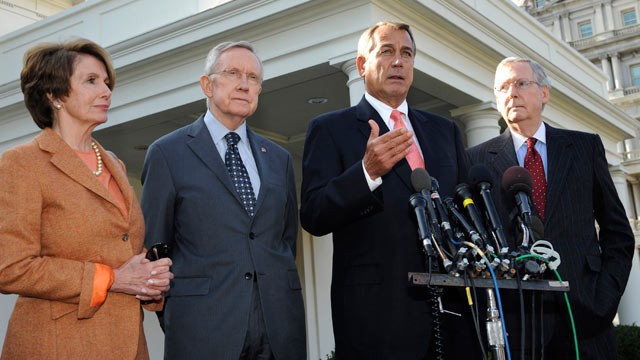
Just a few days ago President Barack Obama, House Speaker John Boehner, and Senate Majority Leader Harry Reid and minority leaders were all talking as if an agreement to avoid the fiscal cliff was a realistic possibility.

Today’s news reports are that little progress has been made.

Should Congress fail to act, allowing the tax cuts to expire and budget cuts to take effect, the results could be drastic, increasing the annual federal tax burden on the average family of four by about $2,200, according to the Congressional Budget Office.

The major components of the fiscal cliff are the expiration of the Bush Tax Cuts, federal unemployment benefits, and social security payroll tax cuts, on top of automatically triggered spending cuts associated with the Budget Control Act of 2011.

Cuts associated with the Budget Control Act could result in the loss of 277,000 federal jobs, according to a report from the George Mason  University Center for Regional Analysis. The report assesses the impact the Budget Control Act would have on all agencies subject to cutbacks including Agriculture, Commerce, Education, EPA, Energy, Health and Human Services, Homeland Security, Housing and Urban Development, State, NASA, Transportation and Interior. While the cuts would only reduce federal spending from 22.9% of GDP to 22.4% of GDP, according to the CBO, they would cause significant job losses for federal health inspectors, Federal Aviation Administration workers, and FBI agents.

The president does not appear to be willing to write a piece of proposed legislation to avert going over the fiscal cliff.  This was my complaint about his management style throughout his first term.  It was no Barack Obama who wrote the Affordable Care Act.  It was members of the Democratic Party leadership in the houses of Congress.

If the sequestration occurs both political parties deserve blame.  The president should not be campaigning as he did during much of his first term.  He should be negotiating with congress.  His failure to bring this self inflicted event to a satisfactory conclusion will dog his next four year term.

Special Income Tax Rates for the Very Wealthy

Everyone should be taxed at the same rate. There should be no deductions or allowances for any thing!

Steve Rattner, President Barack Obama’s former car czar, appeared on Fareed Zakaria’s GPS a few week ago. (Steven Rattner is Chairman of Willett Advisors LLC, the investment arm for New York Mayor Michael R. Bloomberg’s personal and philanthropic assets.) Mr. Rattner said that one of the reasons Mitt Romney won’t release his income tax returns is his legal but highly unusual asset protection.

Romney has a $100 million IRA and off shore accounts that avoid US income tax. Rattner pointed out that many rich people pay income tax at the 35% rate while there is a group that pay at the much lower rates. Rattner said he didn’t think the American people would be too happy with this situation. I certainly am not happy!

There is always going to be a very rich part of this society. I don’t know the reason but it was confirmed by Vilfredo Pareto (15 July 1848 – 19 August 1923). He made several important contributions to economics, particularly in the study of income distribution and in the analysis of individuals’ choices. The Pareto principle was named after him and built on observations of his such as that 80% of the land in Italy was owned by 20% of the population. Today in the USA 85% of America’s wealth is owned by 20% of the population (quite close to Pareto’s 80-20 theory).

What I do not accept is the idea that the wealthiest among us pay 15% in income taxes.

This is nothing about Jealously.  This is about fairness.

There is no question that rich people spend more money on stuff. The question is: Should rich people whose earnings are the result of investments be taxed on their income at 15% (or less if Paul Ryan has his way) than people whose earnings are based upon a salary?

Personally I believe everyone should pay income taxes at the same graduated rate no matter what the source of the income. No one should be given any allowances or deductions for ANYTHING. You want a wife, more kids – go for it – just don’t expect any help from the government.

Investment Scandal is Standard Operating Procedure

You Can’t Trust Banks or Brokers

The Madoff scandal seems like many years ago but it was December 2008.  Then there was the Allen Stanford February 2009 scandal that the SEC called a “massive ongoing fraud” involving $7 billion.  We had to wait to December 2011 for the MF Global bankruptcy.  Jamie Dimon of JP Morgan Chase announced in May of this year that the bank lost $2 Billion but as things turned out the amount may be closer to $7.5 Billion.  A mere $15 Million is missing in the accounts of an Iowa futures brokerage named Peregrine – the 64 year old founder is suspected of falsifying customer accounts for at least two years (sounds like the Madoff affair).  He tried to commit suicide – we should have let him – It would have saved the government the cost of his imprisonment.

Not to be outdone, the banks that set the Libor (London Interbank Offered Rate) has been rigging the rates and Barclays has been fined $450 Million.  Some American banks may be involved.  Many American consumer and home mortgage loans are based upon this rate.

Mere mortals, such as myself, are at the mercy of the wheeler dealers.

If there was another failure of any of our large banks the United States would come to their rescue even though politicians say they won’t. Why?  Because just four of the conglomerates have assets totaling 51% of our annual national economy.

The list:

  • Bank of America
  • JP   Morgan Chase
  • Citi  Group
  • Wells Fargo

Their assets total $7.7 Trillion.  The national GDP $15.1 Trillion.

Do You Own an Offshore Bank Account?

I know that few of you do.  One person that does is the Republican candidate for president, Mitt Romney.  Just Google the above question and you will obtain quite a few responses.  Google, “Romney’s secret offshore bank accounts.”  You will see articles posted by Vanity Fair, Huffington Post, and the NY Daily News.  I know what you are thinking.  Those are all Liberal news companies.  You would be wrong.  The NY Daily News is owned by one wealthy businessman, Mort Zuckerman.  The same Mort Zuckerman who also owns U.S. News & World Report.  The same Mort Zuckerman who has been appearing as a guest on many political talk shows and slamming Barack Obama.

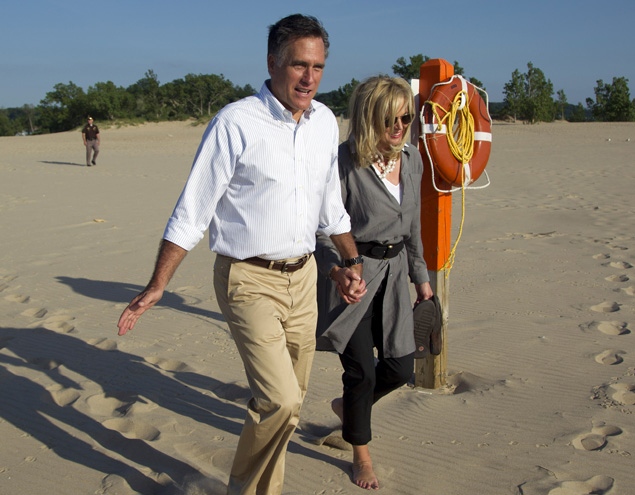
Mitt and Ann Romney
Mitt and Ann Romney

This is the New York Daily News report.

Mitt Romney’s massive fortune – estimated to be as high as $250 million – is held in a complex and opaque network of offshore havens that are impossible to penetrate, according to a report in Vanity Fair.

By / NEW YORK DAILY NEWS

Mitt Romney’s massive fortune – estimated to be as high as $250 million – is held in a complex and opaque network of offshore havens that are impossible to penetrate, according to a report in Vanity Fair.

Romney had a Swiss bank account and has interests in tax havens like Bermuda and the Cayman Islands. The Romney campaign has insisted he does not use the havens to avoid paying U.S. taxes, but Vanity Fair wrote it is impossible to confirm that he is not seeing a savings.

The Republican candidate paid a 14 percent tax rate on $21.7 million in income in 2010 – far lower than the rate paid by many Americans because his earnings comes from investments rather than wages.

Vanity Fair noted that Romney has continued to receive large payments from Bain Capital since leaving the private equity firm in 1999.

Romney has personal interests in at least a dozen of the 138 or more funds organized by Bain in the Cayman Islands. Vanity Fair said the Romney-related funds are worth as much as $30 million and hidden behind confidentiality disclaimers.

READ MORE: MITT ROMNEY HOLDS MILLIONS IN CAYMAN ISLES TAX HAVEN, BUT SAYS ‘I’M NO TAX DODGER’

The report also raised questions about Romney’s blind trusts, which are used by politicians to remove conflicts of interests by turning investment control over to an independent trustee.

Romney’s financial disclosure form lists 25 such investments in an open-ended category labeled “over $1 million,” Vanity Fair reported. Many of them are set up in tax havens like the Cayman Islands.

Meanwhile, the Romney campaign is distancing itself from the CEO of Barclays, who stepped down from the British bank Tuesday amid an interest-rate fixing scandal.

Robert Diamond will no longer co-host a London fundraiser scheduled for July 27 when Romney will be in town for the Olympics.

“Mr. Diamond decided to step aside as a co-host for the upcoming London reception to focus all his attention on Barclays,” Romney spokeswoman Andrea Saul told The Financial Times. “We respect his decision.” The fundraiser will go on without the former CEO.

Barclays was fined $453 million last week by U.S. and British regulators for submitting false reports on interbank borrowing rates between 2005 and 2009.

Banks are Too Big To Fail! Is it true?

“SAN FRANCISCO(MarketWatch) — Moody’s Investors Service downgraded the ratings late Thursday of 15 financial firms with global capital-markets operations from one to three notches.”  The list included Bank of America Corp. BAC, Citigroup Inc. C, HSBC Holdings PLC.  These three are on the list of America’s largest banks.

Largest banks and thrifts in US by total deposits

Company                       City, State            Deposits in Billions of Dollars

JPMorgan Chase & Co.                            New York, NY            1,127.8

Bank of America Corp.                            Charlotte, NC              1,033.0

Citigroup Inc.                                          New York, NY                 865.9

Wells Fargo & Co.                                  San Francisco, CA           920.1

U.S. Bancorp                                          Minneapolis, MN             230.9

Capital One Financial Corp.                 McLean, VA                     211.2

Bank of New York Mellon Corp.         New York, NY                    219.1

PNC Financial Services Group Inc.     Pittsburgh, PA                    209.2

HSBC North America Holdings Inc.      New York, NY                   122.6

State Street Corp.                                Boston, MA                        157.3

This identical data was printed in Forbes and The WSJ.

Yes, you read it correctly, JPMorgan Chase & Co. has deposits of One Trillion, onehundred twenty eight Billion point eight dollars.

Moody’s says “All the banks affected by these rating actions have significant exposure to the volatility and risks inherent in the capital markets business, which have led many to fail or avoid it only through the receipt of support from a third party.”  We can all conclude that the third party is a government or government sponsored entity.

Banks receive aid but the aid to small business and home owners is minimal.  If it isn’t called welfare, what do you call government support for banks?

Facebook Folly

How many website do you subscribe to?

The say 800 million people have Facebook accounts. Those accounts are free. I am one of those subscribers and most likely so are you. I have never purchased anything as a result of having that account. I only go onto the account when I am bombarded by e-mail messages telling me that I have messages that require my response. Usually the messages are from people I do not know but want to be my friend. These are people who “maybe” did meet me somewhere but I can’t remember where and their faces are not familiar to me.

 I must agree with Betty White when she presented her monologue on SNL. “I really have to thank Facebook … I didn’t know what Facebook was, and now that I do know what it is, I have to say, it sounds like a huge waste of time. I would never say the people on it are losers, but that’s only because I’m polite. People say ‘But Betty, Facebook is a great way to connect with old friends.’ Well at my age, if I wanna connect with old friends, I need a Ouija Board. Needless to say, we didn’t have Facebook when I was growing up. We had phonebook, but you wouldn’t waste an afternoon with it.”

Betty White Monologue

Apparently Mark Zuckerberg convinced himself and millions of others that his free social media site could be a marketing tool. Betty White is correct. He is trying to sell access to the telephone book.

Buy a share of Facebook? Why? How many people will reach their purchasing decision based upon the things they see on that site. Facebook’s number three advertiser, General Motors, has discontinued their advertising on the site.