Don’t Hold Your Breath Waiting for Muni Armageddon

From MorningstarAdvisor

by Russel Kinnel | 07-18-11

What happened to the muni catastrophe? Meredith Whitney ended 2010 scaring the daylights out of municipal-bond investors by predicting “hundreds of billions” in municipal-bond defaults in the coming year. No doubt her prediction on “60 Minutes” played a part in the net redemptions seen in municipal-bond funds for most of this year.

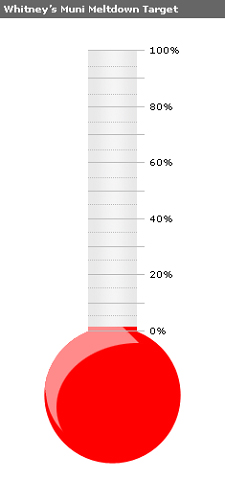
Yet here we are at the halfway point, and defaults are running at a trickle. Rather than the $200 billion or more of defaults Whitney predicted, we’ve had $746 million according to Income Securities Advisor. DWS estimates that, at that rate, we’ll have about $1.7 billion in defaults for the year. In fact, DWS and Income Securities Advisor’s Distressed Debt Securities newsletter say defaults have dropped significantly from the prior three years. The market peaked at about $8 billion in defaults in 2008, so this year could be one fourth of that or less.

For those scoring at home, that means we’ve only reached 1% of Whitney’s predicted default level.

You’ve no doubt read about the problems in Illinois, Florida, and California, where deficits have grown and governments have been forced to make cuts. But there are good reasons why the system is strained but not breaking. Governments can raise taxes and cut spending to get themselves out of their messes, and that’s what they are doing. Moreover, they need to come back to municipal markets to continue to borrow so they have strong incentives to treat bondholders well.

In addition, an improving economy has meant rising tax revenues. Municipalities’ tax revenues started rising in late 2010 and have continued to do so. Income tax and sales-tax revenues naturally rise as the economy improves.

This means that, if you own a well-run muni-bond fund, you’re in pretty good shape. These funds usually have bonds from a hundred or more issuers, so one default won’t have much impact. And, of course, they do thorough credit research to steer clear of most, though not all, defaults. With some munis paying better tax-free yields than many high-quality taxable bonds, this isn’t a bad time to get in. In fact, some taxable-bond managers are even buying munis because they look attractive even without the tax break factored in. That said, fewer new munis have been issued so far in 2011, so additional waves of new debt could drive prices lower in the short term.
Investors may have noticed the divergence between dire predictions and reality as muni-fund flows turned positive in June after fairly steady redemptions. The $980 million flowing into munis isn’t a huge amount but it does indicate that the fear level is dropping. I don’t expect this to turn into really big inflows soon, but it may mean a market headwind is going away.

Cause of the 2008 Economic Meltdown

I respect New York Times commentator David Brooks for his well thought out columns.  His appearances on Sunday talk shows always provide calm clear analysis.  This is what he said about the 2008 economic meltdown.

It all started with Fannie Mae, the government-backed mortgage giant, and its former chief executive James Johnson. In a well ­reported new book, Reckless Endangerment, Gretchen Morgenson and Joshua Rosner reveal how Johnson, a “Democratic sage with a raft of prestigious connections,” enriched his friends and made $100 million for himself by flooding the market with risky subprime mortgages. Dispensing with the usual criteria for making loans, Fannie handed out billions in federally guaranteed dollars like candy, and “helped spread risky behavior and low standards across the housing industry.” Johnson and his cronies paid themselves lavishly, and used Fannie funding to lobby congressmen, falsify academic research, and suck in “reputable figures” such as Bill Daley, Ken Starr, and Larry Summers to defend Fannie’s scam. In the end it all crashed-bringing big banks, Wall Street, and the entire economy down with it. Yet Johnson and the other power players skated away, blameless. “This is how Washington works.” Is it any wonder there’s such a growth market for angry populism?

$ Ayn Rand, Goddess of the Market $

I just finished reading Jennifer Burns’ biography of Ayn Rand.   The exact title is “Goddess of the Market Ayn Rand and the American Right”The author is an Assistant Professor of History at the University of Virginia.  The 286 page book was printed in 2009 and its Epilogue includes opinion of our 2008 – 2011 Great Recession and how it relates to Rand.  Each chapter of the book starts with a dollar sign.

Ayn Rand was clearly irrevocably impacted by her childhood in Czarist and Communist Russia.  Her undying allegiance to a form of society that does not exist, except in theory, is the absolute opposite of some kind of free society that Karl Marx had envisioned.  Watch Youtube videos of Mike Wallace interviews of Ayn Rand and you will understand that she was unmovable by his reasonable questions about her allegiance to a theory.

The last sentence in the book tells it all. “…Rand lay facing the world in an open casket.  Next to her coffin was an enormous topiary, shaped into the sign of the dollar.”

Unfortunately too many American conservatives think such a society can exist.

American Recessions are Nothing New

When Barack Obama was inaugurated president the unemployment rate was 7.8%.  That was January 20th, 2009.  Subsequently the unemployment rate rose to 10.1% in October 2009.  Since then it dropped to 8.8% in March of this year but has now risen to 9.1%.  That was a bit of a roller coaster.

Despite the federal government’s best efforts the unemployment rate rose from 3.2% in 1929 to 23.6% in 1932. It never dropped below 14% until 1942 when WWII was in process.  The massive expenditures of the war proved that Keynesian theory does work but the cost is astronomical.

On “John King, USA” on Thursday, Richard Quest said he was looking for a low increase in jobs of 90,000 to 120,000.  That number is twice the BLS reported increase of 54,000 new jobs.

Friday evening: “CBS Evening News,” Harry Smith (lead story): “Tonight, too much firing, not enough hiring: The economic recovery hits a detour. But the president says it would have been a lot worse without the auto bailout” … “NBC Nightly News,” Brian Williams (second story after John Edwards): “Hitting home: Americans are feeling it every day. And tonight, new evidence is out on the economy stalling out” …ABC’s “World News,” George Stephanopoulos, filling in for Diane Sawyer, (second story after Edwards): “Surprisingly bad unemployment numbers fuel new worries about the economy: Is the recovery in reverse?” “John King, USA” started with an interview of Chrystia Freeland, of Reuters and Dr. Peter Morici, Professor at the R.H. Smith School of Business at the University of Maryland, with both of them agreeing that the focus in Washington should be on jobs but it’s on debt reduction.

While Mitt Romney is correct in saying, “He can’t keep blaming George Bush”, neither he nor any other politician has offered a coherent plan to revise the economy and bring back jobs.

The history of recessions and panics in this country goes back to 1797.  That first panic is listed as one of the 13 worst in America’s history.

Our economic system appears to have an inherent flaw.  Despite Ben Bernanke’s study of the Great Depression,   he does not know how to avoid recessions and does not know how to speed a recovery any more than anyone else.  No doubt, eventually this recession will end.  We just don’t know when.

Stock Rally Will End In Tears

In January 2010 we all saw the stock market dip, rise and dive.  At the end of the month there was no appreciable change from January 1.  I offered the historic fact that January’s are a worthwhile bell weather forecaster of the entire year.  I was wrong and the market grew dramatically month after month.  I threw in the towel in December 2010 and joined the obvious surge in stock market values.  The decision was reinforced this past January.  However, I have continued to be sceptical because I see no reason for optimism in the United States.  Brazil, China, and India are growing because the West has outsourced its manufacturing.

David Rosenberg of the Financial Times supports my view with some valuable observations.

There’s no denying we’re in the midst of an “incredible” stock-market rally, said David Rosenberg. But that doesn’t mean we’re in a bull  market. Genuine bull markets are preceded by demographic shifts or technological advances that promote rapid, sustained growth in productivity and capital assets. The 1949-66 bull market was spurred by “a baby boom that would unleash years of tremendously strong demand growth.” The 1982-2000 bull run was powered by “a wave of innovation” that brought us the mainframe, the personal computer, the Internet, and the smartphone. By contrast, the “bear-market rally” of 2003-07 was fueled by “phony wealth generated by a nonproductive asset called housing,” with a dubious assist from “widespread financial engineering.” Likewise, the current rally doesn’t owe its existence to the iPad or Facebook. They’re “fun,” but they haven’t revolutionized productivity. What has fueled the rally is “unprecedented monetary and fiscal stimulus.” Granted, it’s tough to sit out a rally that has seen “the market surge more than 90 percent.” But “it is much, much tougher to actually experience a correction in the other direction.”

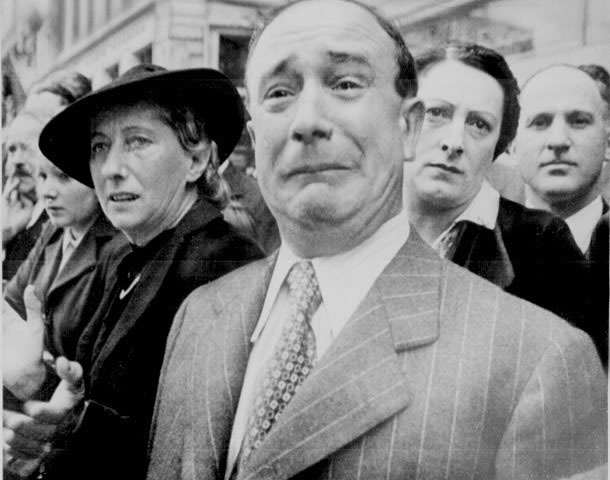
Photo credit: http://photobucket.com/images/crying/?sortby=sevendaysview#!cpZZ2QQtppZZ16

“America’s best days lie ahead”

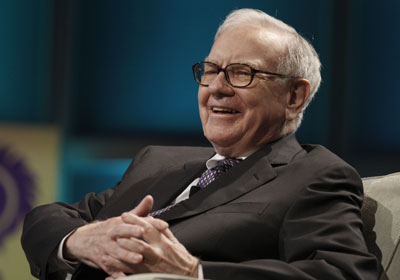
Warren Buffett is Investing in America

Warren Buffett’s annual letter to his company’s (Berkshire Hathaway)  shareholders.

“…for the purpose of estimating our current earning power, we are envisioning a year free of a mega-catastrophe in insurance and possessing a general business climate somewhat better than that of 2010 but weaker than that of 2005 or 2006…

Last year – in the face of widespread pessimism about our economy – we demonstrated our enthusiasm for capital investment at Berkshire by spending $6 billion on property and equipment. Of this amount, $5.4 billion – or 90% of the total – was spent in the United States. Certainly our businesses will expand abroad in the future, but an overwhelming part of their future investments will be at home. In 2011, we will set a new record for capital spending – $8 billion – and spend all of the $2 billion increase in the United States.

Money will always flow toward opportunity, and there is an abundance of that in America. Commentators today often talk of “great uncertainty.” But think back, for example, to December 6, 1941, October 18, 1987 and September 10, 2001. No matter how serene today may be, tomorrow is always uncertain.

Don’t let that reality spook you. Throughout my lifetime, politicians and pundits have constantly moaned about terrifying problems facing America. Yet our citizens now live an astonishing six times better than when I was born. The prophets of doom have overlooked the all-important factor that is certain: Human potential is far from exhausted, and the American system for unleashing that potential – a system that has worked wonders for over two centuries despite frequent interruptions for recessions and even a Civil War – remains alive and effective.

We are not natively smarter than we were when our country was founded nor do we work harder. But look around you and see a world beyond the dreams of any colonial citizen. Now, as in 1776, 1861, 1932 and 1941, America’s best days lie ahead.”

Unrealistic Inflation

In 1971 I bought my first home for $28,000.  My annual income was $10,000.  I was buying a home within the usual guideline parameters for buying at home 2 ½ to 3 times my annual income.  Excluded was my wife’s income because I knew she would stop working once we had children.  I sold that house in 1979 for $88,000.  I could not afford to buy the house for that price because my salary had tracked the median household income and was $17,000.  I was fortunate and my income did exceed the annual average in the following years. However, it certainly did not rise sufficiently to enable me to afford buying my second home at its market price in 2000 and beyond.   

The U.S. Census Bureau currently publishes median household income data from 1975 until present day.

Year No. of Households Nominal $ Inflation Adjusted $
2009 117,538,000 $49,777 $49,777
2008 117,181,000 $50,112 $50,112
2007 116,783,000 $50,233 $52,163
2006 116,011,000 $48,201 $51,473
2005 114,384,000 $46,326 $51,093
2004 113,343,000 $44,334 $50,535
2003 112,000,000 $43,318 $50,711
2002 111,278,000 $42,409 $50,756
2001 109,297,000 $42,228 $51,356
2000 108,209,000 $41,990 $52,500
1999 106,434,000 $40,696 $52,587
1998 103,874,000 $38,885 $51,295
1997 102,528,000 $37,005 $49,497
1996 101,018,000 $35,492 $48,499
1995 99,627,000 $34,076 $47,803
1994 98,990,000 $32,264 $46,351
1993 97,107,000 $31,241 $45,839
1992 96,426,000 $30,636 $46,063
1991 95,669,000 $30,126 $46,445
1990 94,312,000 $29,943 $47,818
1989 93,347,000 $28,906 $48,463
1988 92,830,000 $27,225 $47,614
1987 91,124,000 $26,061 $47,251
1986 89,479,000 $24,897 $46,665
1985 88,458,000 $23,618 $45,069
1984 86,789,000 $22,415 $44,242
1983 85,407,000 $20,885 $42,910
1982 83,918,000 $20,171 $43,212
1981 83,527,000 $19,074 $43,328
1980 82,368,000 $17,710 $44,059
1979 80,776,000 $16,461 $45,498
1978 77,330,000 $15,064 $45,625
1977 76,030,000 $13,572 $43,925
1976 74,142,000 $12,686 $43,649
1975 72,867,000 $11,800 $42,936

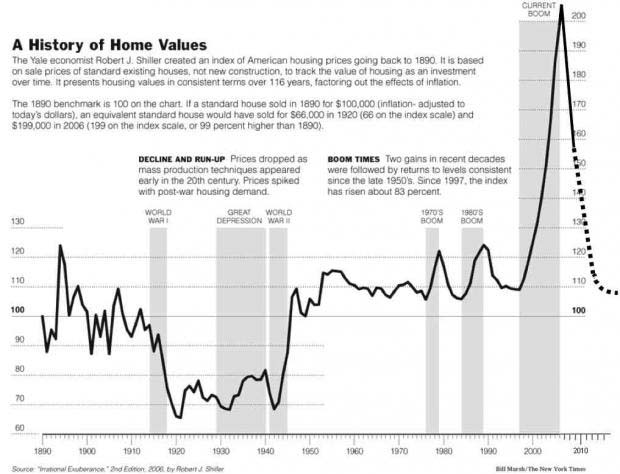
Home prices have not kept pace with median family income for most people.  We saw an unrealistic acceleration that was boosted by the government and home loan companies.  From the Business Insider comes this graph created by economist Robert Shiller that supports my contention that the housing bubble will not be inflating any time soon.

Click on graph to enlarge

Senator Alan Simpson Calls Seniors ‘Greediest Generation’…

This person is PISSED!!!!  Wish I were the one that sent this to the beloved Senator!!!!  There isn’t a word that is false and I am believing that many Americans are beginning to think along these same lines……

This article was just posted by the Associated Press today. Baby boomers near 65 with retirements in jeopardy.

 
From a man in Montana….who – like the rest of us – has just about had enough!

Hey Alan,

   Let’s get a few things straight!

   1.      As a career politician, you have been on the public dole for FIFTY YEARS.

   2.      I have been paying Social Security taxes for 48 YEARS (since I was 15 years old. I am now 63).

   3.      My Social Security payments, and those of millions of other Americans, were safely tucked away in an interest bearing account for decades until you political pukes decided to raid the account and give OUR money to a bunch of zero ambition losers in return for votes, thus bankrupting the system and turning Social Security into a Ponzi scheme that would have made Bernie Madoff proud.

   4.      Recently, just like Lucy & Charlie Brown, you and your ilk pulled the proverbial football away from millions of American seniors nearing retirement and moved the goalposts for full retirement from age 65 to age 67. NOW, you and your shill commission is proposing to move the goalposts YET AGAIN!

   5.      I, and millions of other Americans, have been paying into Medicare from Day One, and now you morons propose to change the rules of the game. Why? Because you idiots mismanaged other parts of the economy to such an extent that you need to steal money from Medicare to pay the bills.

   6.      I, and millions of other Americans, have been paying income taxes our entire lives, and now you propose to increase our taxes yet again. Why? Because you incompetent bastards spent our money so profligately that you just kept on spending even after you ran out of money. Now, you come to the American taxpayers and say you need more to pay of YOUR debt!

   To add insult to injury, you label us “greedy” for calling bullshit on your incompetence. Well, Captain Bullshit, I have a few questions for YOU!

   1.      How much money have you earned from the American taxpayers during your pathetic 50-year political career?

   2.      At what age did you retire from your pathetic political career, and how much are you receiving in annual retirement benefits from the American taxpayers?

   3.      How much do you pay for YOUR government provided health insurance?

   4.      What cuts in YOUR retirement and health care benefits are you proposing in your disgusting deficit reduction proposal, or, as usual, have you exempted yourself and your political cronies?

It is you, Captain Bullshit, and your political co-conspirators who are greedy.  It is you and they who have bankrupted America and stolen the American dream from millions of loyal, patriotic taxpayers. And for what? Votes. That’s right, sir.  You and yours have bankrupted America for the sole purpose of advancing your pathetic political careers. You know it, we know it, and you know that we know it.

And you can take that to the bank, you miserable son of a bitch.

The Republicans Win Again!

The 277-148 vote came less than 24 hours after the Senate cleared the bill, 81-19.  Congress has extended Bush tax cuts and gave Republicans more than they could have possibly hoped to win.

This legislation was negotiated behind closed doors between Senate Minority Leader Mitch McConnell and the President.  Along with all the other deals Obama has made behind closed doors, he has proven himself not to be the transformative president he campaigned to be.  Barack Obama has proven himself to do whatever is politically expedient. 

Now that this horrible piece of legislation has been approved by both houses of Congress, what to you imagine the Republicans will demand next?  What ever it is, you can be certain that Mr. Obama will concede to the demand. 

The worst part of this legislation is the reduction in Social Security taxes.  They go down by 2% of almost everyone’s pay check (a deduction that applies to salaries up to $106,800).  In one year they will have to be raised.  What is the chance that the increase will occur?  Republicans will fight that increase.

When I heard that FICA (Social Security) taxes would be lowered for one year with passage of the new tax bill I was excited about the positive impact on lower income families.  Then, I thought , won’t that have an impact on the Social Security Trust  Fund? I heard nothing about this on any of the cable news stations.  Perhaps I am worrying unnecessarily.  I only listened half heartedly to Bernie Sanders during his 8 1/2 hour rage.

Today I finally find that there are others who are questioning this short term stimulus that will hasten the destruction of Social Security.

Click these links to read the opinion of others. 

Social Security Payroll Tax “Holiday” is No Gift to Americans

Social Security payroll tax cut is no way to give workers a break

Obama’s “Tax Holiday”: A Poison Pill for Social Security

Other Views of Social Security

Black Friday and the Culture of Spending

I remember when my mother came home with a “charga-plate” from the May Company department store.  That was back in the 1950s and really was the beginning of the charge card era.  Charge cards and easy credit has been a big boon for retailers of all sorts.  From cars to clothes to food, we can now buy everything using that plastic card.  

Newsweek’s December 6, 2010 cover is titled Money to Burn – Why Americans Can’t Stop Spending.  The article contends that our spending habit and instant gratification culture will dominate our knowledge that the bill for all that spending will arrive at the end of the month. 

Despite the persuasiveness of that argument there is definitely a rising tide of those who have learned that you can’t have everything you want.  The Dave Ramsey radio program contends that “Cash is King and the Paid off Mortgage has replaced the BMW” as the new American idea of success. His three hour program seems to be in every part of the country from Portland, Oregon to Los Angeles, California to Nashville, Tennessee totaling over 350 outlets.

Now the “Great Recession” seems to have brought us to our senses.  Most of us have lost a job or know someone who has.  All of us have been alerted and frightened by that growing credit card debt.  The recession now denies us, what seemed the never ending offers to apply for more credit cards and easy credit terms.  Most of that has stopped.  According to a Businessweek October 2008 article credit card debt had reached $950 Billion.

From Creditcards.com

  • Total U.S. revolving debt (98 percent of which is made up of credit card debt): $852.6 Billion, as of March 2010 (Source: Federal Reserve’s G.19 report on consumer credit, March 2010).  That is a reduction of $50 Billion a year for the past two years.
  •  

  • Total U.S. consumer debt: $2.42 Trillion, as of June 2010 (Source: Federal Reserve’s G.19 report on consumer credit, August 2010)
  •  

Despite the reports of improved sales in the malls since Black Friday, I believe that our big spending days are behind us.