Killing the Iran deal could backfire

If Israeli Prime Minister Benjamin Netanyahu succeeds in getting Congress to kill President Obama’s deal with Iran, “it may be a Pyrrhic victory, said Ben-Dror Yemini in Yedioth Ahronoth (a national daily newspaper published in Tel Aviv, Israel). Of course the agreement to limit Iran’s nuclear programs in exchange for lifting of sanctions is terrible. The draft deal is full of loopholes and will lend legitimacy to the Islamic Republic’s repressive and dangerous theocracy. Most Arab countries are against the deal and privately support Netanyahu’s position rather than Obama’s. But America is still our most important ally and an even more open rift with the Obama administration could hurt. “Humiliating the president of the United States could evoke anti-Semitic blast waves” by seeming to give evidence to those who argue that rich Jews manipulate world events.

Even in the U.S., there is “an anti-Zionist coalition radical left and radical right” that would ramp up its anti-Semitic propaganda to frightening heights.” Instead of publicly defeating Obama by lobbying Congress, Netanyahu do far better to persuade the president to “climb down,” perhaps by pointing out that Iran’s Ayatollah Ali Khomeini is already backtracking from the deal as framed. Netanyahu needs to remember that while “Obama is wrong, he isn’t an enemy.”

Genocide

Genocide is the deliberate and systematic destruction, in whole or in part, of an ethnic, racial, religious or national group.

Just yesterday a former SS sergeant, Oskar Groening, described in chilling detail Wednesday how cattle cars full of Jews were brought to the Auschwitz death camp, the people stripped of their belongings and then most led directly into gas chambers. Groening is being tried on 300,000 counts of accessory to murder, related to a period between May and July 1944 when around 425,000 Jews from Hungary were brought to the Auschwitz-Birkenau complex in Nazi-occupied Poland and most immediately gassed to death.  The Holocaust was the largest killing of any group in the world.  This man should be put to death in a gas chamber.

The Hamidian massacres also referred to as the Armenian Massacres of 1894–1896 occurred in the Ottoman Empire. The genocide began on April 24, 1915, when Ottoman authorities arrested some 250 Armenian intellectuals and community leaders in Constantinople. Thereafter, the Ottoman military uprooted Armenians from their homes and forced them to march for hundreds of miles, without food and water, to the desert of what is now Syria. Massacres ignored age and gender, with rape and other acts of sexual abuse being commonplace. The majority of Armenian diaspora communities were founded as a result of these events. Mass killings continued under the Republic of Turkey during the Turkish–Armenian War phase of Turkish War of Independence.

Turkey, the successor state of the Ottoman Empire, denies the word genocide is an accurate term for the mass killings of Armenians that began under Ottoman rule in 1915. It has in recent years been faced with repeated calls to recognize them as genocide. To date, twenty-three countries have officially recognized the mass killings as genocide,[19] a view which is shared by most genocide scholars and historians.

President Barack Obama promised he would declare the killing of Armenians a genocide in 2008. His refusal to do so now is another blunder that continues to make the United States appear weak. Turkey has not been a friend of the United States. The loss of their cooperation with America in the Middle East has already occurred. America gains nothing by refusing to define a crime against humanity.

Remarkable Similarities 2015 to 1938

September 30, 1938
The British Prime Minister has been hailed as bringing “peace to Europe” after signing a non-aggression pact with Germany.

PM Neville Chamberlain arrived back in the UK today, holding an agreement signed by Adolf Hitler which stated the German leader’s desire never to go to war with Britain again.

The two men met at the Munich conference between Britain, Germany, Italy and France yesterday, convened to decide the future of Czechoslovakia’s Sudetenland.

Winston Churchill, who declared, “You were given the choice between war and dishonour. You chose dishonour and you will have war.”

April 2, 2015
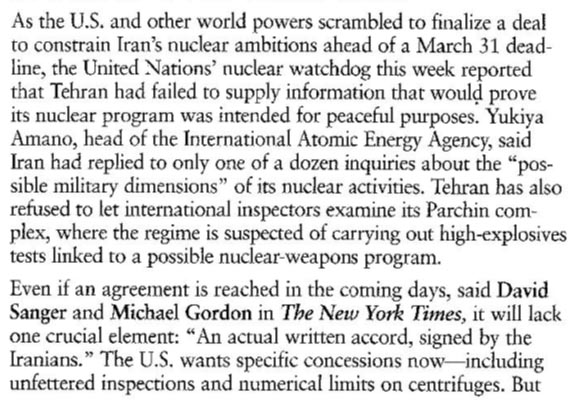
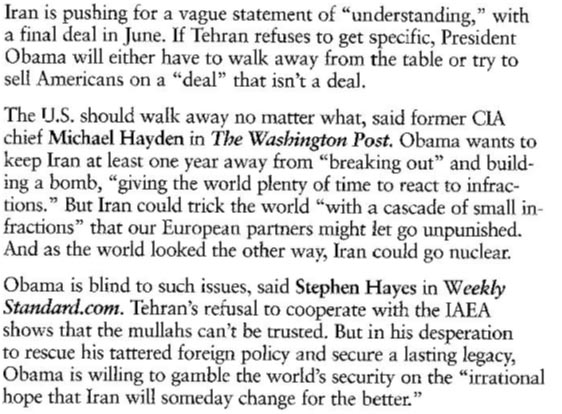
Pres­id­ent Obama said Thursday that a ma­jor break­through in the in­ter­na­tion­al talks con­cern­ing Ir­an’s nuc­le­ar pro­gram will bring about a deal that will make the world safer.

Iran is known to have about 19,000 IR-1 centrifuges, often referred to as first-generation machines because they are less sophisticated than newer models. They are installed at two uranium-enrichment facilities at Natanz and Fordow. Under the tentative deal, Iran has agreed to reduce by about two-thirds its installed centrifuges to 6,104, with 5,060 of these enriching uranium for 10 years.

Last summer, Iran’s supreme leader, Ayatollah Ali Khamenei, said the country ultimately needed the enrichment capacity of 190,000 first-generation centrifuges to fuel a domestic nuclear-power industry.

Israeli Prime Minister Benjamin Netanyahu has long demanded that Iran’s enrichment facilities be entirely dismantled, although last month, he signaled for the first time that he could accept Tehran being allowed a very limited enrichment capacity.

Iran is not to be allowed to deploy newer centrifuges that can enrich uranium more quickly.

For those of you too young to remember: Fifty-two American diplomats and citizens were held hostage for 444 days (November 4, 1979, to January 20, 1981) by Iran. The story was replicated in the movie Argo.

Chants of “Death to America” are a recent fact. In 2013, a new Iranian president, Hassan Rouhani, was sworn into office. While more soft-spoken than his predecessor – and widely described as a “moderate” – Rouhani has nonetheless referred to “the Zionist regime” as an enemy nation and pledged to find a way to achieve Khomeini’s long-term goal of ensuring that Israel ceases to exist.

Obama versus Netanyahu

Obama versus Netanyahu

“If there is one lesson American Jews will learn from Israel’s election, it’s this:  they’re not us.

Israel is not New York. Or LA. Or Chicago or Boston or Miami or Philadelphia. It is a Jewish “community” unlike any in America.”

Those are the opening words by Rob Eshman in today’s Jewish Journal.

We just don’t appreciate the perceptions of Israelis. They live under the constant threat of war with their neighbors. They live in fear of their lives. No one in the United States lives with those kinds of fears. Many American Zionists will evolve in their view of Israel. The reason is that Americans favor the idea of a two state solution to the Israel-Palestinian problem.

I suspect that the ongoing enmity between President Obama and Prime Minister Netanyahu is the result of the prime minister’s refusal to negotiate a two state solution. In other words Netanyahu told Obama his one state position years ago. He only just told the world two days ago.

Netanyahu and his American supporters may still change the course of the Iran nuclear negotiations. Those Americans who favor supporting Israel in all situations no matter what that country does will work their will through Congress. There is no doubt that Israel’s path will be unpleasant over the next two years.

Israelis are a resourceful people. They will find a way to have their way.

David Bancroft

Benjamin Netenyahu Speaks to the United States Congress

My theory is that Speaker of the House John Boehner invited Benjamin Netenyahu to speak to Congress is an effort on the part of the GOP to prove to Jewish voters that the Republican Party is the party that supports Israel.  It’s not that their votes will change an election.  The GOP would like to attract more Jewish donors.

I believe Benjamin Netenyahu really does fear for the existence of Israel.  His intention is to go where ever he must to obtain the support for what he believes are Israel’s needs.

$1.6t

How much did the United States spend on the wars, counter terrorism operations, reconstruction, diplomacy, and medical care for wounded veterans since September 11, 2001? $1.6 trillion according to a congressional authorized office. Most of that money includes $686 billion on Operation enduring Freedom (Afghanistan) and another $815 billion on Operation Iraqi Freedom (Iraq).

What do we have to show for our efforts? Iraq is in a state of collapse and Afghanistan is teetering towards collapse. ISIS (or ISIL) is on the rise having taken control of eastern Syria and Northwestern Iraq. al-Qaeda is on the rise in Yemen and Libya.

If there is a strategy to defeat al-Qaeda and ISIS it has not been revealed to the press and so the citizens of the United States have no knowledge.

The United States had provided a significant amount of military hardware to Egypt, Jordan, Saudi Arabia, and other Gulf nations but they seem to prefer keeping it all parked in their garages. Perhaps the killing of a Jordanian pilot will motivate countries in that region to step up to the plate and actively participate, but given their historical behavior this seems like an unlikely occurrence.

The Arab nations will hope that the United States will send in more troops and equipment to stop their enemies. Given America’s exhaustion over wars that did not result in defeat of Jihadi terrorist groups it is unlikely that there will be another wave of American ground troops.

The only event that is likely to cause a major re-engagement of America in the Middle East is a direct attack on the United States.

Hypocrites or Honest People?

The United States has a history of wanting to assure the world that we did something really bad and it won’t happen again. Other nations for the most part simply move on and say as little as possible about their previous misbehaviour. Turkey’s refusal to acknowledge the killing of millions of Armenians is the outstanding example. Germany is the one nation that stands out in trying to make amends for the Holocaust.

Look at the list of things we Americans champion that we once supported. In every instance America says “never again.” Today we lecture other nations about their behavior.

– Slavery: Pope Paul III forbade it in 1537. Great Britain abolished slavery in 1805.

– Massacre of indigenous people: Sand Creek Massacre in Colorado. The killing commenced on Nov. 29, 1864, when 700 members of the Colorado Territory Militia led by Col. John Chivington attacked a Native American encampment in southeastern Colorado, slaughtering between 150 and 200 Indians — mostly women, children and the elderly.

– Internment of people of Japanese descent in America during WWII.

– A Bomb use: The United States dropped it twice to end WWII. Justified or not, the United States does everything in its power to prevent other nations from obtaining the capability of building nuclear weapons.

– Torture of war prisoners: Abu Ghraib and Guantanamo and in other locations, prisons were places where there was extreme torture and mistreatment.

What all of these incidents have in common is the words “never again.” However, when the United States government believes it has “the right” to its actions all holds are bared. As a nation we panic. Ebola was not even close to becoming an epidemic in this nation. Still the public and the government behaved as if there was an issue of going shopping at your local market.

When the next event occurs, and it will, you can be sure that panic will bring out the worst in us. Since we choose to investigate and report our behavior, our enemies will use those reports to prove that the United States is a really bad country.

Russia Resuming Cold War Behavior

President Obama belittled Mitt Romney for his prediction over the course of the 2012 campaign, Romney repeatedly called Russia “our number one geopolitical foe.”  Then came this debate confrontation.


Now in response to NATO’s “anti-Russia inclinations,” the Kremlin will resume its Cold War-era practice of sending long-range bombers to patrol the western Atlantic and eastern Pacific.  The flights, which will extend to the borders of U.S. territorial waters, follow a markedly more aggressive air defense posture by Russia in the eight months since it seized and annexed Ukraine’s Crimea region in March, according to European strategic analysts.


Newsweek reports:
“Russia has announced plans to build a drone base for military reconnaissance in a town just 420 miles off mainland Alaska and just over 300 miles off the US state’s St Lawrence Island, Russia’s state news agency reported on Thursday.”

“The command of the eastern military district in charge of the military development of the Arctic zone has moved forward with plans to form an unmanned aerial vehicle division,” Alexandr Gordeev, spokesperson for the district said.”

Hungarian leadership is now saying that it feels a kinship with Russia.  Russian speaking Latvians are leaning towards Russia. Russia does not need to be communist to stand as the opposition to western style democracy.  Mikhail Gorbachev recently warned of a renewal of the Cold War.

Barack Obama as leader of a new Cold War is very frightening.  I am looking forward to a new tough American leader.

Fareed Zakaria: Obama needs to dial back his Syria strategy

Opinion writer October 16, 2014 in The Washington Post

From the start, President Obama’s Syria policy has foundered because of a gap between words and deeds. And he’s done it again. Having declared that the aim of U.S. policy is to “degrade and ultimately destroy” the Islamic State, Obama now finds himself pressured to escalate military action in Syria. This is a path destined for failure. In fact, the administration should abandon its lofty rhetoric and make clear that it is focused on a strategy against the Islamic State that is actually achievable: containment.

Escalation in Syria cannot meet American objectives and is almost certain to produce chaos and unintended consequences. The central reality is that Washington has no serious local partners on the ground. It is important to understand that the Free Syrian Army doesn’t actually exist. A Congressional Research Service report points out that the name does not refer to any “organized command and control structure with national reach.” The director of national intelligence has testified that the opposition to the Bashar al-Assad regime is composed of 1,500 separate militias. We call a bunch of these militias — which are anti-Assad and also anti-Islamist (we hope) — the Free Syrian Army.

Scholar Joshua Landis — whose blog Syria Comment is an essential source — estimates that the Assad regime controls about half of Syrian territory, though much more of the population. The Islamic State controls about one-third of the country, and the other militias control a little less than 20 percent. But the largest and most effective of these non-Islamic State groups are al-Qaeda-affiliated and also deadly enemies of the United States. The non-jihadi groups collectively control less than 5 percent of Syria. Landis writes that, according to opposition leaders, Washington is supporting about 75 of these groups.

A U.S. strategy of escalating airstrikes in Syria — even if coupled with ground forces — would wish that the weakest and most disorganized forces in the country somehow become the strongest, first defeating the Islamic State, then the Assad regime, all while fighting off Jabhat al-Nusra and Khorasan. The chance that all this will happen is remote. Far more likely, heavy bombings in Syria will produce chaos and instability on the ground, further destroying Syria and promoting the free-for-all in which jihadi groups thrive.

Critics are sure this policy would have been easy three years ago, when the opposition to Assad was more secular and democratic. This is a fantasy. It’s true that the demonstrations against the Assad regime in the initial months seemed to be carried out by more secular and liberal people. This was also true in Libya and Egypt. But over time, more organized, passionate and religious forces triumphed. This is a familiar pattern in revolutions — including the French, Russian and Iranian. They are begun by liberals and taken over by radicals.

For any strategy to work in Syria, it needs both a military and a political component. The military element is weak. The political one is nonexistent.

The crucial, underlying reason for the violence in Iraq and Syria is a Sunni revolt against governments in Baghdad and Damascus that they view as hostile, apostate regimes. That revolt, in turn, has been fueled by Saudi Arabia, the United Arab Emirates and Qatar, each supporting its own favorite Sunni groups, which has only added to the complexity. On the other side, Iran has supported the Shiite and Alawite regimes, ensuring that this sectarian struggle is also regional.

The political solution, presumably, is some kind of power-sharing arrangement in those two capitals. But this is not something that the United States can engineer in Syria. It tried in Iraq, but despite 170,000 troops, tens of billions of dollars and David Petraeus’s skillful leadership, the deals Petraeus brokered started unraveling within months of his departure, well before American troops had left. This is not a part of the world where power-sharing and pluralism have worked — with the exception of Lebanon, and that happened after a bloody 15-year civil war in which one out of every 20 people in the country was slaughtered.

The only strategy against the Islamic State that has any chance of working is containment — bolstering the neighbors (who are threatened far more than the United States) that are willing to fight militarily and politically. They include, most importantly, Iraq, Jordan, Lebanon, Turkey and the Gulf states. The greatest challenge is to get the Iraqi government to make serious concessions to Sunnis so that they are recruited into the fight, something that has not happened so far. All of this should be coupled with counterterrorism, which means strikes at key Islamic State targets, as well as measures to track foreign fighters, stop their movements, intercept their funds, and protect the neighbors and the West from a jihadi infiltration spilling over.

The Obama administration is pursuing many elements of this strategy. It should be forthright about its objectives and abandon its grander rhetoric, which is setting itself up for escalation and failure.